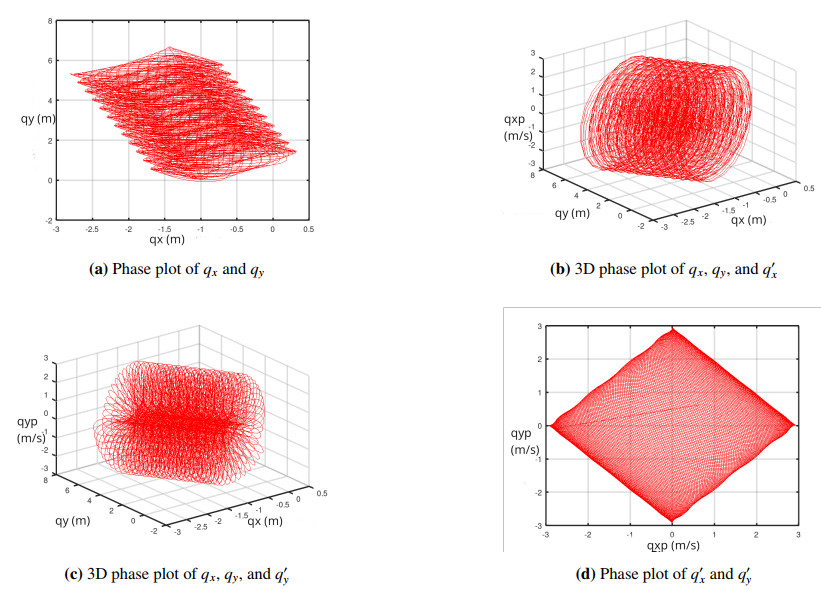
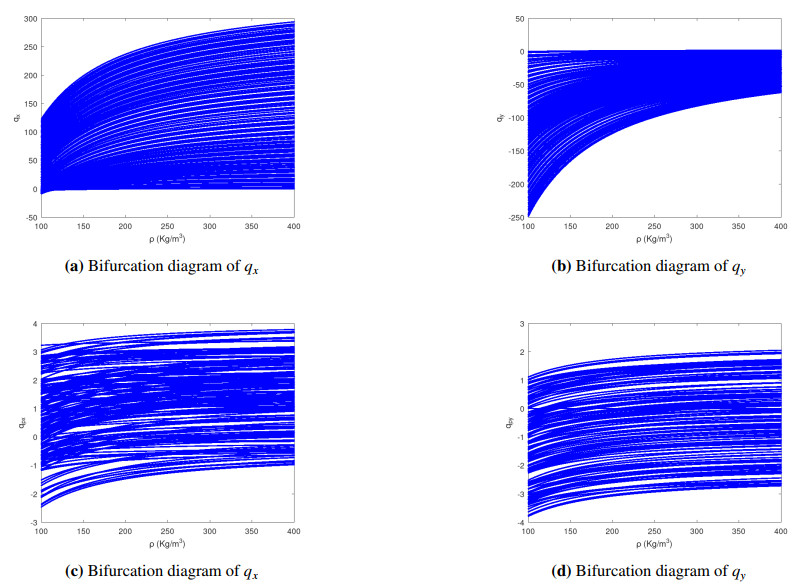
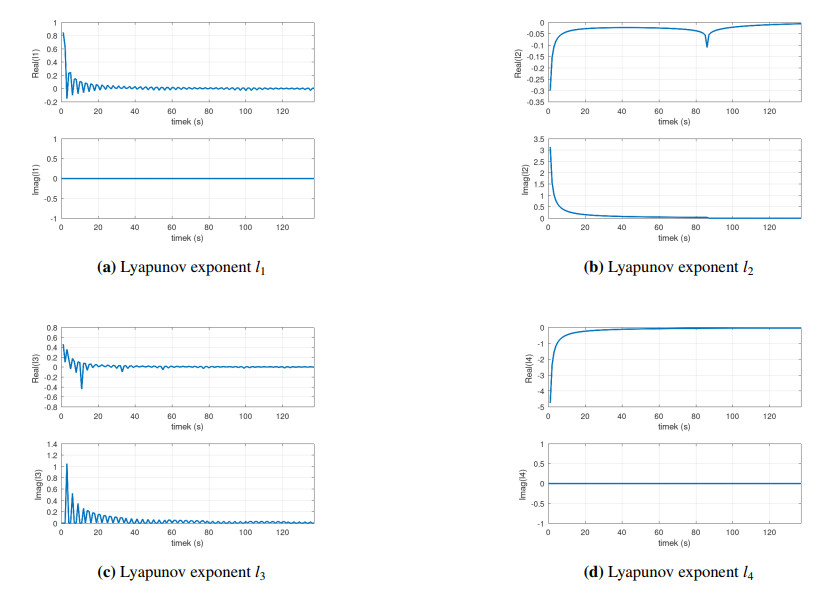
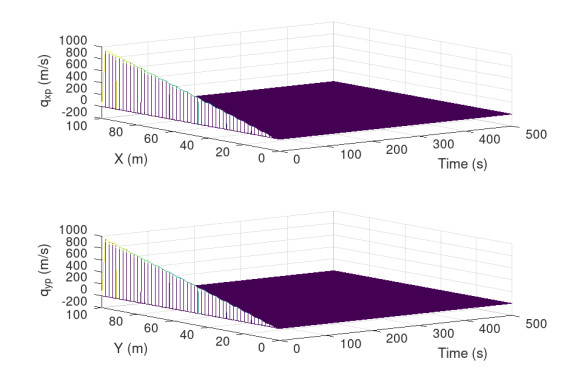
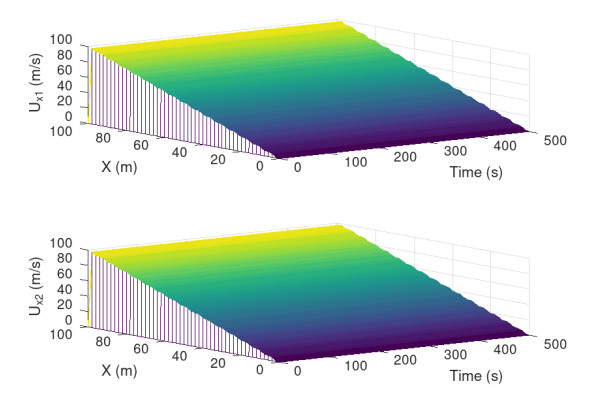
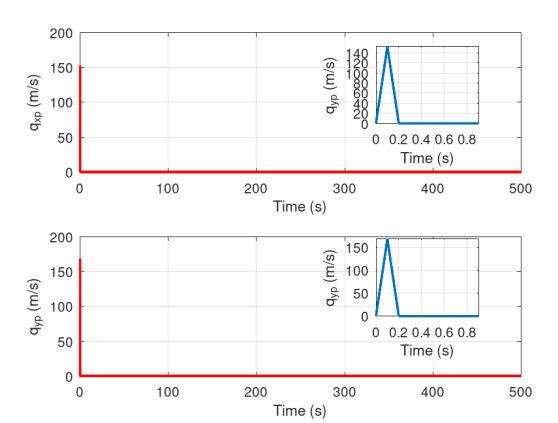
This work introduced a novel control strategy for the chaos suppression in a numerical wave tank with chaotic vortices. The control strategy is based on designing a robust passivity-based boundary control for the uncertain Navier-Stokes equation interacting with a wave energy converter. First, the dynamic analysis of the uncertain Navier-Stokes equation was presented by determining the eigenfunction and eigenvalues along with computing the phase portraits, bifurcation diagrams, and Lyapunov exponents. Additionally, the proposed boundary controller was derived by selecting an appropriate Lyapunov functional, aiming to suppress the chaotic vortices present in the uncertain Navier-Stokes equation. In addition to the theoretical and numerical results, we also numerically evaluated the interactions between an energy wave converter generator and the chaotic vortices, first as an open-loop problem, and next, the proposed boundary control strategy was tested to suppress the chaotic behavior. Finally, the discussion and conclusion of this research study were presented.
Citation: Fernando E. Serrano, Vicenc Puig Cayuela, Jesus M. Munoz-Pacheco. Robust passivity-based boundary control of the 2-D Navier-Stokes equation with chaotic vortex[J]. AIMS Mathematics, 2026, 11(1): 1777-1806. doi: 10.3934/math.2026074
This work introduced a novel control strategy for the chaos suppression in a numerical wave tank with chaotic vortices. The control strategy is based on designing a robust passivity-based boundary control for the uncertain Navier-Stokes equation interacting with a wave energy converter. First, the dynamic analysis of the uncertain Navier-Stokes equation was presented by determining the eigenfunction and eigenvalues along with computing the phase portraits, bifurcation diagrams, and Lyapunov exponents. Additionally, the proposed boundary controller was derived by selecting an appropriate Lyapunov functional, aiming to suppress the chaotic vortices present in the uncertain Navier-Stokes equation. In addition to the theoretical and numerical results, we also numerically evaluated the interactions between an energy wave converter generator and the chaotic vortices, first as an open-loop problem, and next, the proposed boundary control strategy was tested to suppress the chaotic behavior. Finally, the discussion and conclusion of this research study were presented.

| [1] |
H. B. Yu, Global strong solutions and decay to the 3D full compressible Navier–Stokes equations without heat conductivity, Discrete Cont. Dyn.-A, 45 (2025), 1911–1927. https://doi.org/10.3934/dcds.2024152 doi: 10.3934/dcds.2024152

|
| [2] |
C. Cavaterra, M. Grasselli, M. A. Mehmood, R. Voso, Analysis of a Navier–Stokes phase-field crystal system, Nonlinear Anal.-Real, 83 (2025), 104263. https://doi.org/10.1016/j.nonrwa.2024.104263 doi: 10.1016/j.nonrwa.2024.104263
|
| [3] |
I. Herbst, Mild regularity of weak solutions to the Navier–Stokes equations, Nonlinear Anal.-Theor., 254 (2025), 113744. https://doi.org/10.1016/j.na.2024.113744 doi: 10.1016/j.na.2024.113744
|
| [4] |
Z. J. Tan, Y. H. Zeng, Temporal second-order two-grid finite element method for semilinear time-fractional Rayleigh–Stokes equations, J. Comput. Appl. Math., 459 (2025), 116375. https://doi.org/10.1016/j.cam.2024.116375 doi: 10.1016/j.cam.2024.116375
|
| [5] |
M. Lukáčová-Medvid'ová, A. Schömer Conditional regularity for the compressible Navier-Stokes equations with potential temperature transport, J. Differ. Equations, 423 (2025), 1–40. https://doi.org/10.1016/j.jde.2024.12.028 doi: 10.1016/j.jde.2024.12.028
|
| [6] |
S. Gao, Z. Y. Zhang, Q. Li, S. Q. Ding, H. H.-C. Iu, Y. H. Cao, et al., Encrypt a story: A video segment encryption method based on the discrete sinusoidal memristive Rulkov neuron, IEEE T. Depend. Secure, 22 (2025), 8011–8024. https://doi.org/10.1109/TDSC.2025.3603570 doi: 10.1109/TDSC.2025.3603570
|
| [7] |
S. Gao, S. Q. Ding, H. H.-C. Iu, U. Erkan, A. Toktas, C. Simsek, et al., A three-dimensional memristor-based hyperchaotic map for pseudorandom number generation and multi-image encryption, Chaos, 35 (2025), 073105. https://doi.org/10.1063/5.0270220 doi: 10.1063/5.0270220
|
| [8] |
S. Gao, R. Wu, H. H.-C. Iu, U. Erkan, Y. H. Cao, Q. Li, et al., Chaos-based video encryption techniques: A review, Comput. Sci. Rev., 58 (2025), 100816. https://doi.org/10.1016/j.cosrev.2025.100816 doi: 10.1016/j.cosrev.2025.100816
|
| [9] |
W. G. Melo, L2 decay of weak solutions for the Navier–Stokes equations with supercritical dissipation, Nonlinear Anal.-Real, 84 (2025), 104329. https://doi.org/10.1016/j.nonrwa.2025.104329 doi: 10.1016/j.nonrwa.2025.104329
|
| [10] |
J. H. Neyra, H. López-Lázaro, O. Rubio, C. R. T. Junior, Pullback exponential attractor of dynamical systems associated with non-cylindrical problems, J. Math. Anal. Appl., 547 (2025), 129332. https://doi.org/10.1016/j.jmaa.2025.129332 doi: 10.1016/j.jmaa.2025.129332
|
| [11] |
A. Deeb, D. Dutykh, Numerical integration of Navier–Stokes equations by time series expansion and stabilized FEM, Math. Comput. Simulat., 233 (2025), 208–236. https://doi.org/10.1016/j.matcom.2025.01.023 doi: 10.1016/j.matcom.2025.01.023
|
| [12] |
D. Wang, Z. F. Hao, F. Q. Chen, Y. S. Chen, Multi-mode motion dynamics of a top tensioned riser excited by vortices and varying tension, Int. J. Bifurcat. Chaos, 32 (2022), 2250144. https://doi.org/10.1142/S0218127422501449 doi: 10.1142/S0218127422501449
|
| [13] |
B. H. Huynh, T. Tjahjowidodo, Experimental chaotic quantification in bistable vortex induced vibration systems, Mech. Syst. Signal Pr., 85 (2017), 1005–1019. https://doi.org/10.1016/j.ymssp.2016.09.025 doi: 10.1016/j.ymssp.2016.09.025
|
| [14] | H. Zhang, B. B. Mao, H. Yang, J. J. Zhang, Modeling of coherent evolution of ocean turbulence based on time-dependent intrinsic correlation, 2023 IEEE 3rd International Conference on Power, Electronics and Computer Applications (ICPECA), Shenyang, China, 2023,226–231. https://doi.org/10.1109/ICPECA56706.2023.10075883 |
| [15] | Y. N. Aye, N. Srinil, Experimental observation on chaotic vortex-induced vibration of circular cylinder in turbulent flow, 2023 42nd International Conference on Ocean, Offshore and Arctic Engineering, Melbourne, Australia, 2023, OMAE2023-101301. https://doi.org/10.1115/OMAE2023-101301 |
| [16] | V. V. Zhmur, E. A. Ryzhov, K. V. Koshel, Ellipsoidal vortex in a nonuniform flow: dynamics and chaotic advections, J. Mar. Res., 69 (2011), 435–461. |
| [17] |
E. S. Baranovskii, E. Y. Prosviryakov, S. V. Ershkov, Mathematical analysis of steady non-isothermal flows of a micropolar fluid, Nonlinear Anal.-Real, 84 (2025), 104294. https://doi.org/10.1016/j.nonrwa.2024.104294 doi: 10.1016/j.nonrwa.2024.104294
|
| [18] |
H. Kozono, S. Shimizu, Analyticity of solutions to the stationary Navier–Stokes equations via parameter trick, Nonlinear Anal.-Real, 84 (2025), 104319. https://doi.org/10.1016/j.nonrwa.2025.104319 doi: 10.1016/j.nonrwa.2025.104319
|
| [19] |
F. L. Cardoso-Ribeiro, G. Haine, Y. L. Gorrec, D. Matignon, H. Ramirez, Port-Hamiltonian formulations for the modeling, simulation and control of fluids, Comput. Fluids, 283 (2024), 106407. https://doi.org/10.1016/j.compfluid.2024.106407 doi: 10.1016/j.compfluid.2024.106407
|
| [20] | T. Reis, M. Schaller, Port-Hamiltonian formulation of Oseen flows, Systems Theory and PDEs (WOSTAP 22 2022), Cham: Birkhäuser, 2024,123–148. https://doi.org/10.1007/978-3-031-64991-2_5 |
| [21] |
M. Lohmayer, S. Leyendecker, Exergetic Port-Hamiltonian systems: Navier-Stokes-Fourier fluid, IFAC-PapersOnLine, 55 (2022), 74–80. https://doi.org/10.1016/j.ifacol.2022.08.033 doi: 10.1016/j.ifacol.2022.08.033
|
| [22] |
G. Haine, D. Matignon, Incompressible navier-stokes equation as port-Hamiltonian systems: Velocity formulation versus vorticity formulation, IFAC-PapersOnLine, 54 (2021), 161–166. https://doi.org/10.1016/j.ifacol.2021.11.072 doi: 10.1016/j.ifacol.2021.11.072
|
| [23] |
H. Fan, D. Y. Wu, Numerical investigation on vortex characteristics inside a jet pump under low entrainment ratio conditions, Flow Meas. Instrum., 102 (2025), 102800. https://doi.org/10.1016/j.flowmeasinst.2024.102800 doi: 10.1016/j.flowmeasinst.2024.102800
|
| [24] |
A. Khademi, E. Salari, S. Dufour, Simulation of 3D turbulent flows using a discretized generative model physics-informed neural networks, Int. J. Nonlin. Mech., 170 (2025), 104988. https://doi.org/10.1016/j.ijnonlinmec.2024.104988 doi: 10.1016/j.ijnonlinmec.2024.104988
|
| [25] |
S. Zhong, C. Zhang, A. W. Fan. Numerical study on heat transfer enhancement of laminar flow in fully wavy wall microchannels, Appl. Therm. Eng., 266 (2025), 125782. https://doi.org/10.1016/j.applthermaleng.2025.125782 doi: 10.1016/j.applthermaleng.2025.125782
|
| [26] |
J.-N. Zhang, S.-X. Wei, T.-L. Xie, H.-T. Tong, Q. Liu, S.-F. Yin. Hydrodynamic and mixing characteristics in oscillating feedback micromixers: influence of geometric configuration and scale, Chem. Eng. Process., 209 (2025), 110153. https://doi.org/10.1016/j.cep.2025.110153 doi: 10.1016/j.cep.2025.110153
|
| [27] |
L. Li, P. Xu, Q. H. Li, Z. C. Yin, R. Y. Zheng, J. F. Wu, et al., Multi-field coupling particle flow dynamic behaviors of the microreactor and ultrasonic control method, Powder Technol., 454 (2025), 120731. https://doi.org/10.1016/j.powtec.2025.120731 doi: 10.1016/j.powtec.2025.120731
|
| [28] |
J. Redaud, J. Auriol, Y. L. Gorrec. In domain dissipation assignment of boundary controlled Port-Hamiltonian systems using backstepping, Syst. Control Lett., 185 (2024), 105722. https://doi.org/10.1016/j.sysconle.2024.105722 doi: 10.1016/j.sysconle.2024.105722
|
| [29] | S.-A. Hauschild, N. Marheineke, Model reduction for a Port-Hamiltonian formulation of the Euler equations, Progress in Industrial Mathematics at ECMI 2021 (ECMI 2021), Cham: Springer, 2022, 1–7. https://doi.org/10.1007/978-3-031-11818-0_1 |
| [30] |
J.-P. Toledo-Zucco, D. Matignon, C. Poussot-Vassal, Y. L.Gorrec, Structure-preserving discretization and model order reduction of boundary-controlled 1D port-Hamiltonian systems, Syst. Control Lett., 194 (2024), 105947. https://doi.org/10.1016/j.sysconle.2024.105947 doi: 10.1016/j.sysconle.2024.105947
|
| [31] | A. MacChelli, Distributed-parameter Port-Hamiltonian systems in discrete-time, 2023 62nd IEEE Conference on Decision and Control (CDC), Singapore, Singapore, 2023, 2931–2936. https://doi.org/10.1109/CDC49753.2023.10383674 |
| [32] | K. Y. Tan, P. L. Li, T. Beckers, Physics-constrained learning for PDE systems with uncertainty quantified Port-Hamiltonian models, 2024 6th Annual Conference on Learning for Dynamics and Control, Oxford, UK, 2024, 1753–1764. |
| [33] |
A. Macchelli, Y. L. Gorrec, Y. Wu, H. Ramírez, Energy-based control of a wave equation with boundary anti-damping, IFAC-PapersOnLine, 53 (2020), 7740–7745. https://doi.org/10.1016/j.ifacol.2020.12.1527 doi: 10.1016/j.ifacol.2020.12.1527
|
| [34] |
C. Ponce, H. Ramirez, Y. L. Gorrec, Finite dimensional shape control design of linear port-Hamiltonian systems with in-domain pointwise inputs, IFAC-PapersOnLine, 56 (2023), 6777–6782. https://doi.org/10.1016/j.ifacol.2023.10.385 doi: 10.1016/j.ifacol.2023.10.385
|
| [35] |
N. Liu, Y. X. Wu, Y. L. Gorrec, L. Lefèvre, H. Ramirez, Reduced order in domain control of distributed parameter port-Hamiltonian systems via energy shaping, Automatica, 161 (2024), 111500. https://doi.org/10.1016/j.automatica.2023.111500 doi: 10.1016/j.automatica.2023.111500
|
| [36] |
N. M. T. Vu, V. Trenchant, H. Ramirez, L. Lefèvre, Y. L. Gorrec, Parabolic matching of hyperbolic system using control by interconnection, IFAC-PapersOnLine, 50 (2017), 5574–5579. https://doi.org/10.1016/j.ifacol.2017.08.1101 doi: 10.1016/j.ifacol.2017.08.1101
|
| [37] |
N. Boonkumkrong, S. Chinvorarat, P. Asadamongkon, Passivity-based boundary control with the backstepping observer for the vibration suppression of the flexible beam, Heliyon, 9 (2023), e12740. https://doi.org/10.1016/j.heliyon.2022.e12740 doi: 10.1016/j.heliyon.2022.e12740
|
| [38] |
M. R. J. Harandi, H. D. Taghirad, On the matching equations of kinetic energy shaping in IDA-PBC, J. Franklin I., 358 (2021), 8639–8655. https://doi.org/10.1016/j.jfranklin.2021.08.034 doi: 10.1016/j.jfranklin.2021.08.034
|
| [39] |
P. Sozhaeswari, R. Sakthivel, M. Chadli, R. Abinandhitha, Design of fault-tolerant non-fragile control for parabolic PDE systems with semi-Markov jump: the finite-time case, Int. J. Syst. Sci., 56 (2025), 2606–2623. https://doi.org/10.1080/00207721.2025.2450093 doi: 10.1080/00207721.2025.2450093
|
| [40] |
M. R. J. Harandi, S. A. Khalilpour, H. D. Taghirad, Adaptive energy shaping control of a 3-DOF underactuated cable-driven parallel robot, IEEE T. Ind. Inform., 19 (2023), 7552–7560. https://doi.org/10.1109/TII.2022.3211980 doi: 10.1109/TII.2022.3211980
|
| [41] |
R. D. Ayissi, G. Deugoué, J. N. Zangue, T. T. Medjo, On the existence of optimal and epsilon-optimal controls for the stochastic 2D nonlocal Cahn–Hilliard–Navier–Stokes system, Nonlinear Analysis, 265 (2026), 114016. https://doi.org/10.1016/j.na.2025.114016 doi: 10.1016/j.na.2025.114016
|
| [42] |
S. Manservisi, F. Menghini, Numerical simulations of optimal control problems for the Reynolds averaged Navier–Stokes system closed with a two-equation turbulence model, Comput. Fluids, 125 (2016), 130–143. https://doi.org/10.1016/j.na.2025.114016 doi: 10.1016/j.na.2025.114016
|
| [43] |
N. Smaoui, M. Zribi, Dynamics and control of the 2-d Navier–Stokes equations, Appl. Math. Comput., 237 (2014), 461–473. https://doi.org/10.1016/j.amc.2014.03.150 doi: 10.1016/j.amc.2014.03.150
|
| [44] |
Y. Zhou, L. Peng, Weak solutions of the time-fractional Navier–Stokes equations and optimal control, Comput. Math. Appl., 73 (2017), 1016–1027. https://doi.org/10.1016/j.camwa.2016.07.007 doi: 10.1016/j.camwa.2016.07.007
|
| [45] | C. Pozrikidis, Introduction to kinematics, In: Fluid dynamics, 3 Eds., New York: Springer, 2017, 1–62. https://doi.org/10.1007/978-1-4899-7991-9 |
| [46] |
A. Abbatiello, D. Basarić, N. Chaudhuri, On a blow-up criterion for the Navier–Stokes–Fourier system under general equations of state, Nonlinear Anal.-Real, 84 (2025), 104328. https://doi.org/10.1016/j.nonrwa.2025.104328 doi: 10.1016/j.nonrwa.2025.104328
|
| [47] |
Y. R. Jin, X. L. Chen, Investigation into the reduction of aerodynamic drag via external windshields on high-speed trains, J. Eng. Appl. Sci., 72 (2025), 7. https://doi.org/10.1186/s44147-025-00577-0 doi: 10.1186/s44147-025-00577-0
|
| [48] |
M. Y. Pan, C. X. Fu, L. Yang, D. D. He, A fully-decoupled, second-order accurate, positivity-preserving and energy stable scheme for a two-phase flow system with ions transport, J. Comput. Appl. Math., 465 (2025), 116573. https://doi.org/10.1016/j.cam.2025.116573 doi: 10.1016/j.cam.2025.116573
|
| [49] |
C. Huang, H. X. Chen, Q. Cheng, L. J. Chen, Efficient positivity preserving schemes for stochastic complex systems, J. Comput. Appl. Math., 462 (2025), 116464. https://doi.org/10.1016/j.cam.2024.116464 doi: 10.1016/j.cam.2024.116464
|
| [50] |
R. Rashad, S. Stramigioli, The Port-Hamiltonian structure of continuum mechanics, J. Nonlinear Sci., 35 (2025), 35. https://doi.org/10.1007/s00332-025-10130-1 doi: 10.1007/s00332-025-10130-1
|
| [51] |
F. Califano, R. Rashad, F. P. Schuller, S. Stramigioli, Geometric and energy-aware decomposition of the Navier-Stokes equations: A port-Hamiltonian approach, Phys. Fluids, 33 (2021), 047114. https://doi.org/10.1063/5.0048359 doi: 10.1063/5.0048359
|
| [52] |
N. Duan, Strong solution of 3D generalized Navier–Stokes equations with damping, Bound. Value Probl., 2025 (2025), 40. https://doi.org/10.1186/s13661-025-01998-9 doi: 10.1186/s13661-025-01998-9
|
| [53] |
A. Novruzi, F. Mezatio, Existence and uniqueness of a time-periodic strong solution to incompressible Navier-Stokes equations in a time-periodic moving domain, describing the blood flow in an artificial heart, J. Math. Anal. Appl., 548 (2025), 129410. https://doi.org/10.1016/j.jmaa.2025.129410 doi: 10.1016/j.jmaa.2025.129410
|
| [54] |
A. D. Polyanin, N. A. Kudryashov, Exact solutions and reductions of nonlinear Schrödinger equations with delay, J. Comput. Appl. Math., 462 (2025), 116477. https://doi.org/10.1016/j.cam.2024.116477 doi: 10.1016/j.cam.2024.116477
|
| [55] |
S. Gao, Z. Y. Zhang, H. H.-C. Iu, S. Q. Ding, J. Mou, U. Erkan, et al., A parallel color image encryption algorithm based on a 2-D Logistic-Rulkov neuron map, IEEE Internet Things, 12 (2025), 18115–18124. https://doi.org/10.1109/JIOT.2025.3540097 doi: 10.1109/JIOT.2025.3540097
|
| [56] |
S. Gao, H. H.-C. Iu, U. Erkan, C. Simsek, A. Toktas, Y. H. Cao, et al., A 3D memristive cubic map with dual discrete memristors: Design, implementation, and application in image encryption, IEEE T. Circ. Syst. Vid., 35 (2025), 7706–7718. https://doi.org/10.1109/TCSVT.2025.3545868 doi: 10.1109/TCSVT.2025.3545868
|
| [57] |
Z. F. Ma, D. B. Tong, Q. Y. Chen, W. N. Zhou, Fixed/prescribed-time synchronization and energy consumption for Kuramoto-Oscillator networks, IEEE T. Cybernetics, 55 (2025), 3379–3389. https://doi.org/10.1109/TCYB.2025.3556103 doi: 10.1109/TCYB.2025.3556103
|
| [58] |
M. Shi, D. B. Tong, Q. Y. Chen, W. N. Zhou, Pth moment exponential synchronization for delayed multi-agent systems with Lévy noise and Markov switching, IEEE T. Circuits-II, 71 (2024), 697–701. https://doi.org/10.1109/TCSII.2023.3304635 doi: 10.1109/TCSII.2023.3304635
|
| [59] |
D. Gutiérrez-Oribio, I, Stefanou, F. Plestan, Passivity-based control of underactuated mechanical systems with Coulomb friction: Application to earthquake prevention, Automatica, 165 (2024), 111661. https://doi.org/10.1016/j.automatica.2024.111661 doi: 10.1016/j.automatica.2024.111661
|
| [60] | R. A. Freeman, P. V. Kokotovic, Robust nonlinear control design: state-space and Lyapunov techniques, Boston: Birkhäuser, 1996. https://doi.org/10.1007/978-0-8176-4759-9 |
| [61] |
A. Mironchenko, Lyapunov criteria for robust forward completeness of distributed parameter systems, Syst. Control Lett., 180 (2023), 105618. https://doi.org/10.1016/j.sysconle.2023.105618 doi: 10.1016/j.sysconle.2023.105618
|
| [62] |
D. Gutiérrez-Oribio, Y. Orlov, I. Stefanou, F. Plestan, Robust boundary tracking control of wave PDE: Insight on forcing slow-aseismic response, Syst. Control Lett., 178 (2023), 105571. https://doi.org/10.1016/j.sysconle.2023.105571 doi: 10.1016/j.sysconle.2023.105571
|
| [63] |
J. Auriol, F. Bribiesca-Argomedo, D. B. Saba, M. D. Loreto, F. D. Meglio, Delay-robust stabilization of a hyperbolic PDE–ODE system, Automatica, 95 (2018), 494–502. https://doi.org/10.1016/j.automatica.2018.06.033 doi: 10.1016/j.automatica.2018.06.033
|
| [64] |
A. Smyshlyaev, M. Krstic, Adaptive boundary control for unstable parabolic PDEs–Part Ⅱ: estimation-based designs, Automatica, 43 (2007), 1543–1556. https://doi.org/10.1016/j.automatica.2007.02.014 doi: 10.1016/j.automatica.2007.02.014
|
| [65] |
B. Fenu, J. C. C. Henriques, M. Glorioso, L. M. C. Gato, M. Bonfanti, Real-time Wells turbine simulation on an oscillating-water-column wave energy converter physical model, Appl. Energy, 376 (2024), 124121. https://doi.org/10.1016/j.apenergy.2024.124121 doi: 10.1016/j.apenergy.2024.124121
|
| [66] |
S. Capasso, B. Tagliafierro, I. Martínez-Estévez, C. Altomare, M. Gómez-Gesteira, M. Göteman, et al., Development of an SPH-based numerical wave-current tank and application to wave energy converters, Appl. Energy, 377 (2025), 124508. https://doi.org/10.1016/j.apenergy.2024.124508 doi: 10.1016/j.apenergy.2024.124508
|
| [67] |
N. Jiang, H. H. Yang, A second order ensemble algorithm for computing the Navier-Stokes equations, J. Math. Anal. Appl., 530 (2024), 127674. https://doi.org/10.1016/j.jmaa.2023.127674 doi: 10.1016/j.jmaa.2023.127674
|
| [68] |
M. Elghandouri, K. Ezzinbi, L. Saidi, Exploring well-posedness and asymptotic behavior in an Advection-Diffusion-Reaction (ADR) model, J. Comput. Appl. Math., 462 (2025), 116465. https://doi.org/10.1016/j.cam.2024.116465 doi: 10.1016/j.cam.2024.116465
|
| [69] |
D. Černá, Orthogonal wavelet method for multi-stage expansion and contraction options under stochastic volatility, Appl. Numer. Math., 212 (2025), 155–175. https://doi.org/10.1016/j.apnum.2025.02.001 doi: 10.1016/j.apnum.2025.02.001
|
Figures(16) / Tables(4)

Fernando E. Serrano, Vicenc Puig Cayuela, Jesus M. Munoz-Pacheco. Robust passivity-based boundary control of the 2-D Navier-Stokes equation with chaotic vortex[J]. AIMS Mathematics, 2026, 11(1): 1777-1806. doi: 10.3934/math.2026074





 DownLoad: