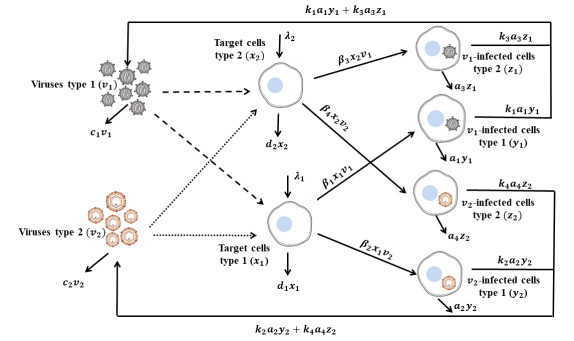
Since some viruses share transmission routes, coinfection can occur. While most models assume one target cell, many viruses infect and replicate in multiple cell types. The purpose of this study is to develop and analyze a model describing coinfection by two viruses that grow and compete within two distinct target-cell populations. We prove that the proposed model is mathematically well-defined and admits unique, biologically meaningful solutions. Using the next-generation matrix method, we derive expressions for the basic reproduction numbers corresponding to virus type 1 single infection ($ R_{1} $), virus type 2 single infection ($ R_{2} $), and two-virus coinfection ($ R_{0} $). The model usually admits an infection-free equilibrium. The existence conditions for the virus type 1 single-infection, virus type 2 single-infection, and two-virus coexistence equilibria are also established. Applying the Lyapunov direct method, we demonstrate the global stability of all steady states. The obtained results reveal new insights into the factors that allow two viruses to coexist in a stable state, thereby enabling the possibility of chronic coinfections. The model is further extended to examine the influence of two reverse transcriptase (RT) inhibitors and to explore the role of a second target-cell population in two-virus codynamics. We find that neglecting the second target-cell population leads to underestimation of $ R_{1} $ and $ R_{2} $; consequently, drug levels determined from a one-target-cell model may be insufficient to clear the viruses. The model is extended to incorporate antiviral drug therapy and to determine the minimum drug efficacies required to eliminate viral coinfection. The results provide deeper insight into the dynamics of dual infections involving viruses that compete for distinct target-cell populations.
Citation: N. H. AlShamrani, A. M. Elaiw. Modeling within-host dynamics of two competing viruses with distinct target-cell populations[J]. AIMS Mathematics, 2026, 11(1): 1489-1526. doi: 10.3934/math.2026063
Since some viruses share transmission routes, coinfection can occur. While most models assume one target cell, many viruses infect and replicate in multiple cell types. The purpose of this study is to develop and analyze a model describing coinfection by two viruses that grow and compete within two distinct target-cell populations. We prove that the proposed model is mathematically well-defined and admits unique, biologically meaningful solutions. Using the next-generation matrix method, we derive expressions for the basic reproduction numbers corresponding to virus type 1 single infection ($ R_{1} $), virus type 2 single infection ($ R_{2} $), and two-virus coinfection ($ R_{0} $). The model usually admits an infection-free equilibrium. The existence conditions for the virus type 1 single-infection, virus type 2 single-infection, and two-virus coexistence equilibria are also established. Applying the Lyapunov direct method, we demonstrate the global stability of all steady states. The obtained results reveal new insights into the factors that allow two viruses to coexist in a stable state, thereby enabling the possibility of chronic coinfections. The model is further extended to examine the influence of two reverse transcriptase (RT) inhibitors and to explore the role of a second target-cell population in two-virus codynamics. We find that neglecting the second target-cell population leads to underestimation of $ R_{1} $ and $ R_{2} $; consequently, drug levels determined from a one-target-cell model may be insufficient to clear the viruses. The model is extended to incorporate antiviral drug therapy and to determine the minimum drug efficacies required to eliminate viral coinfection. The results provide deeper insight into the dynamics of dual infections involving viruses that compete for distinct target-cell populations.

| [1] |
R. J. Rockett, J. Draper, M. Gall, E. M. Sim, A. Arnott, J. E. Agius, et al., Co-infection with SARS-CoV-2 Omicron and Delta variants revealed by genomic surveillance, Nat. Commun., 13 (2022), 2745. https://doi.org/10.1038/s41467-022-30518-x doi: 10.1038/s41467-022-30518-x

|
| [2] |
S. Bonhoeffer, R. M. May, G. M. Shaw, M. A. Nowak, Virus dynamics and drug therapy, PNAS, 94 (1997), 6971–6976. https://doi.org/10.1073/pnas.94.13.6971 doi: 10.1073/pnas.94.13.6971
|
| [3] |
S. B. Halstead, Pathogenesis of dengue: challenges to molecular biology, Science, 239 (1988), 476–481. https://doi.org/10.1126/science.3277268 doi: 10.1126/science.3277268
|
| [4] |
E. Pilotti, M. V. Bianchi, A. De Maria, F. Bozzano, M. G. Romanelli, U. Bertazzoni, et al., HTLV-1/-2 and HIV-1 co-infections: retroviral interference on host immune status, Front. Microbiol., 4 (2013), 372. https://doi.org/10.3389/fmicb.2013.00372 doi: 10.3389/fmicb.2013.00372
|
| [5] |
Q. Maqsood, A. Sumrin, M. Iqbal, S. Younas, N. Hussain, M. Mahnoor, et al., Hepatitis C virus/Hepatitis B virus coinfection: current prospectives, Antivir. Ther., 28 (2023), 1–18. https://doi.org/10.1177/13596535231189643 doi: 10.1177/13596535231189643
|
| [6] |
E. Zappulo, A. Giaccone, N. Schiano Moriello, I. Gentile, Pharmacological approaches to prevent vertical transmission of HIV and HBV, Expert Rev. Clin. Phar., 15 (2022), 863–876. https://doi.org/10.1080/17512433.2022.2105202 doi: 10.1080/17512433.2022.2105202
|
| [7] |
A. Omame, M. E. Isah, M. Abbas, An optimal control model for COVID-19, zika, dengue, and chikungunya co-dynamics with reinfection, Optim. Contr. Appl. Meth., 44 (2023), 170–204. https://doi.org/10.1002/oca.2936 doi: 10.1002/oca.2936
|
| [8] |
K. Murphy, SARS CoV-2 detection from upper and lower respiratory tract specimens: diagnostic and infection control implications, Chest, 158 (2020), 1804–1805. https://doi.org/10.1016/j.chest.2020.07.061 doi: 10.1016/j.chest.2020.07.061
|
| [9] |
M. A. Nowak, C. R. M. Bangham, Population dynamics of immune responses to persistent viruses, Science, 272 (1996), 74–79. https://doi.org/10.1126/science.272.5258.74 doi: 10.1126/science.272.5258.74
|
| [10] |
X. Lai, X. Zou, Modeling HIV-1 virus dynamics with both virus-to-cell infection and cell-to-cell transmission, SIAM J. Appl. Math., 74 (2014), 898–917. https://doi.org/10.1137/130930145 doi: 10.1137/130930145
|
| [11] |
Y. Yang, L. Zou, S. Ruan, Global dynamics of a delayed within-host viral infection model with both virus-to-cell and cell-to-cell transmissions, Math. Biosci., 270 (2015), 183–191. https://doi.org/10.1016/j.mbs.2015.05.001 doi: 10.1016/j.mbs.2015.05.001
|
| [12] |
D. Hu, Y. Yuan, Threshold dynamics of an age-structured HIV model with virus-to-cell, cell-to-cell transmissions, and CTL immune response, J. Math. Biol., 92 (2026), 13. https://doi.org/10.1007/s00285-025-02328-4 doi: 10.1007/s00285-025-02328-4
|
| [13] |
G. Doitsh, N. Galloway, X. Geng, Z. Yang, K. Monroe, O. Zepeda, et al., Cell death by pyroptosis drives CD4 T-cell depletion in HIV-1 infection, Nature, 505 (2014), 509–514. https://doi.org/10.1038/nature12940 doi: 10.1038/nature12940
|
| [14] |
Y. Jiang, T. Zhang, Global stability of a cytokine-enhanced viral infection model with nonlinear incidence rate and time delays, Appl. Math. Lett., 132 (2022), 108110. https://doi.org/10.1016/j.aml.2022.108110 doi: 10.1016/j.aml.2022.108110
|
| [15] |
W. Wang, G. Wu, X. Fan, Global dynamics of a novel viral infection model mediated by pattern recognition receptors, Appl. Math. Lett., 173 (2026), 109757. https://doi.org/10.1016/j.aml.2025.109757 doi: 10.1016/j.aml.2025.109757
|
| [16] |
P. A. Naik, B. M. Yeolekar, S. Qureshi, N. Manhas, M. Ghoreishi, M. Yeolekar et al., Global analysis of a fractional-order hepatitis B virus model under immune response in the presence of cytokines, Adv. Theor. Simul., 7 (2024), 2400726. https://doi.org/10.1002/adts.202400726 doi: 10.1002/adts.202400726
|
| [17] |
W. Wang, X. Wang, X. Fan, On the global attractivity of a diffusive viral infection model with spatial heterogeneity, Math. Method. Appl. Sci., 48 (2025), 15656–15660. https://doi.org/10.1002/mma.70040 doi: 10.1002/mma.70040
|
| [18] |
G. Huang, Y. Takeuchi, W. Ma, Lyapunov functionals for delay differential equations model of viral infections, SIAM J. Appl. Math., 70 (2010), 2693–2708. https://doi.org/10.1137/090780821 doi: 10.1137/090780821
|
| [19] |
L. Hong, J. Li, L. Rong, X. Wang, Global dynamics of a delayed model with cytokine-enhanced viral infection and cell-to-cell transmission, AIMS Mathematics, 9 (2024), 16280–16296. https://doi.org/10.3934/math.2024788 doi: 10.3934/math.2024788
|
| [20] |
P. De Leenheer, S. S. Pilyugin, Multistrain virus dynamics with mutations: a global analysis, Math. Med. Biol., 25 (2008), 285–322. https://doi.org/10.1093/imammb/dqn023 doi: 10.1093/imammb/dqn023
|
| [21] |
L. Pinky, H. M. Dobrovolny, SARS-CoV-2 coinfections: could influenza and the common cold be beneficial? J. Med. Virol., 92 (2020), 2623–2630. https://doi.org/10.1002/jmv.26098 doi: 10.1002/jmv.26098
|
| [22] |
L. Pinky, G. Gonzalez-Parra, H. M. Dobrovolny, Superinfection and cell regeneration can lead to chronic viral coinfections, J. Theor. Biol., 466 (2019), 24–38. https://doi.org/10.1016/j.jtbi.2019.01.011 doi: 10.1016/j.jtbi.2019.01.011
|
| [23] |
A. M. Elaiw, N. H. AlShamrani, Analysis of a within-host HIV/HTLV-I co-infection model with immunity, Virus Res., 295 (2021), 198204. https://doi.org/10.1016/j.virusres.2020.198204 doi: 10.1016/j.virusres.2020.198204
|
| [24] |
R. Shi, Y. Zhang, Dynamic analysis and optimal control of a fractional order HIV/HTLV co-infection model with HIV-specific CTL immune response, AIMS Mathematics, 9 (2024), 9455–9493. https://doi.org/10.3934/math.2024462 doi: 10.3934/math.2024462
|
| [25] |
A. M. Elaiw, A. D. Al Agha, G. Alsaadi, A. D. Hobiny, Global analysis of HCV/HBV codynamics model with antibody immunity, Eur. Phys. J. Plus, 139 (2024), 850. https://doi.org/10.1140/epjp/s13360-024-05604-2 doi: 10.1140/epjp/s13360-024-05604-2
|
| [26] |
A. M. Elaiw, G. Alsaadi, A. A. Raezah, A. D. Hobiny, Co-dynamics of hepatitis B and C viruses under the influence of CTL immunity, Alex. Eng. J., 119 (2025), 285–325. https://doi.org/10.1016/j.aej.2025.01.029 doi: 10.1016/j.aej.2025.01.029
|
| [27] |
H. Nampala, L. S. Luboobi, J. Y. Mugisha, C. Obua, M. Jablonska-Sabuka, Modelling hepatotoxicity and antiretroviral therapeutic effect in HIV/HBV co-infection, Math. Biosci., 302 (2018), 67–79. https://doi.org/10.1016/j.mbs.2018.05.012 doi: 10.1016/j.mbs.2018.05.012
|
| [28] |
R. Shi, T. Lu, C. Wang, Dynamic analysis of a fractional-order model for HIV with drug-resistance and CTL immune response, Math. Comput. Simulat., 188 (2021), 509–536. https://doi.org/10.1016/j.matcom.2021.04.022 doi: 10.1016/j.matcom.2021.04.022
|
| [29] |
A. M. Elaiw, R. S. Alsulami, A. D. Hobiny, Global properties of SARS-CoV-2 and IAV coinfection model with distributed-time delays and humoral immunity, Math. Method. Appl. Sci., 47 (2024), 9340–9384. https://doi.org/10.1002/mma.10074 doi: 10.1002/mma.10074
|
| [30] |
M. S. Khumaeroh, N. Nuwari, E. S. Erianto, N. Rizka, Mathematical model of SAR-CoV-2 and influenza a virus coinfection within host with CTL-mediated immunity, JJBM, 5 (2024), 95–108. https://doi.org/10.37905/jjbm.v5i2.27782 doi: 10.37905/jjbm.v5i2.27782
|
| [31] |
A. M. Elaiw, N. H. AlShamrani, A. D. Hobiny, Mathematical modeling of HIV/HTLV co-infection with CTL-mediated immunity, AIMS Mathematics, 6 (2020), 1634–1676. https://doi.org/10.3934/math.2021098 doi: 10.3934/math.2021098
|
| [32] |
H. Yang, X. Li, W. Zhang, A stochastic HIV/HTLV-I co-infection model incorporating the AIDS-related cancer cells, Discrete Cont. Dyn.-B, 29 (2024), 702–730. https://doi.org/10.3934/dcdsb.2023110 doi: 10.3934/dcdsb.2023110
|
| [33] |
S. Chowdhury, J. K. Ghosh, U. Ghosh, Co-infection dynamics between HIV-HTLV-I disease with the effects of cytotoxic T-lymphocytes, saturated incidence rate and study of optimal control, Math. Comput. Simulat., 223 (2024), 195–218. https://doi.org/10.1016/j.matcom.2024.04.015 doi: 10.1016/j.matcom.2024.04.015
|
| [34] |
A. Nurtay, M. G. Hennessy, J. Sardanyés, L. Alsedà, S. F. Elena, Theoretical conditions for the coexistence of viral strains with differences in phenotypic traits: a bifurcation analysis, R. Soc. Open Sci., 6 (2019), 181179. https://doi.org/10.1098/rsos.181179 doi: 10.1098/rsos.181179
|
| [35] |
Y. He, W. Ma, S. Dang, L. Chen, R. Zhang, S. Mei, et al., Possible recombination between two variants of concern in a COVID-19 patient, Emerg. Microbes Infec., 11 (2022), 552–555. https://doi.org/10.1080/22221751.2022.2032375 doi: 10.1080/22221751.2022.2032375
|
| [36] |
L. B. Rong, R. Ribeiro, A. Perelson, Modeling quasispecies and drug resistance in hepatitis C patients treated with a protease inhibitor, Bull. Math. Biol., 74 (2012), 1789–1817. https://doi.org/10.1007/s11538-012-9736-y doi: 10.1007/s11538-012-9736-y
|
| [37] |
L. Rong, Z. Feng, A. S. Perelson, Emergence of HIV-1 drug resistance during antiretroviral treatment, Bull. Math. Biol., 69 (2007), 2027–2060. https://doi.org/10.1007/s11538-007-9203-3 doi: 10.1007/s11538-007-9203-3
|
| [38] |
P. Wu, H. Zhao, Dynamics of an HIV infection model with two infection routes and evolutionary competition between two viral strains, Appl. Math. Model., 84 (2020), 240–264. https://doi.org/10.1016/j.apm.2020.03.040 doi: 10.1016/j.apm.2020.03.040
|
| [39] |
W. Chen, L. Zhang, N. Wang, Z. Teng, Bifurcation analysis and chaos for a double-strains HIV coinfection model with intracellular delays, saturated incidence and logistic growth, Math. Comput. Simulat., 223 (2024), 617–641. https://doi.org/10.1016/j.matcom.2024.04.025 doi: 10.1016/j.matcom.2024.04.025
|
| [40] | D. Wodarz, Killer cell dynamics: mathematical and computational approaches to immunology, New York: Springer, 2007. https://doi.org/10.1007/978-0-387-68733-9 |
| [41] |
S. K. Masenga, B. C. Mweene, E. Luwaya, L. Muchaili, M. Chona, A. Kirabo, HIV-host cell interactions, Cells, 12 (2023), 1351. https://doi.org/10.3390/cells12101351 doi: 10.3390/cells12101351
|
| [42] |
C. Gross, A. K. Thoma-Kress, Molecular mechanisms of HTLV-1 cell-to-cell transmission, Viruses, 8 (2016), 74. https://doi.org/10.3390/v8030074 doi: 10.3390/v8030074
|
| [43] |
S. K. Sasmal, Y. Takeuchi, S. Nakaoka, T-cell mediated adaptive immunity and antibody-dependent enhancement in secondary dengue infection, J. Theor. Biol., 470 (2019), 50–63. https://doi.org/10.1016/j.jtbi.2019.03.010 doi: 10.1016/j.jtbi.2019.03.010
|
| [44] |
S. Jindadamrongwech, C. Thepparit, D. R. Smith, Identification of GRP78 (BiP) as a liver cell-expressed receptor element for dengue virus serotype 2, Arch. Virol., 149 (2004), 915–927. https://doi.org/10.1007/s00705-003-0263-x doi: 10.1007/s00705-003-0263-x
|
| [45] | J. M. Willey, L. M. Sherwood, C. J. Woolverton, Microbiology, New York: McGraw-Hill, 2008. |
| [46] |
F. M. Lum, L. F. P. Ng, Cellular and molecular mechanisms of chikungunya pathogenesis, Antivir. Res., 120 (2015), 165–174. https://doi.org/10.1016/j.antiviral.2015.06.009 doi: 10.1016/j.antiviral.2015.06.009
|
| [47] |
Z. Her, B. Malleret, M. Chan, E. K. Ong, S. C. Wong, D. J. Kwek, et al., Active infection of human blood monocytes by Chikungunya virus triggers an innate immune response, J. Immunol., 184 (2010), 5903–5913. https://doi.org/10.4049/jimmunol.0904181 doi: 10.4049/jimmunol.0904181
|
| [48] |
J. Eder, E. Zijlstra-Willems, G. Koen, N. A. Kootstra, K. C. Wolthers, T. B. Geijtenbeek, Transmission of Zika virus by dendritic cell subsets in skin and vaginal mucosa, Front. Immunol., 14 (2023), 1125565. https://doi.org/10.3389/fimmu.2023.1125565 doi: 10.3389/fimmu.2023.1125565
|
| [49] |
R. Qesmi, J. Wu, J. Wu, J. M. Heffernan, Influence of backward bifurcation in a model of hepatitis B and C viruses, Math. Biosci., 224 (2010), 118–125. https://doi.org/10.1016/j.mbs.2010.01.002 doi: 10.1016/j.mbs.2010.01.002
|
| [50] |
R. Qesmi, S. ElSaadany, J. M. Heffernan, J. Wu, A hepatitis B and C virus model with age since infection that exhibits backward bifurcation, SIAM J. Appl. Math., 71 (2011), 1509–1530. https://doi.org/10.1137/10079690X doi: 10.1137/10079690X
|
| [51] |
B. Song, Y. Zhang, Y. Sang, L. Zhang, Stability and Hopf bifurcation on an immunity delayed HBV/HCV model with intra- and extra-hepatic coinfection and saturation incidence, Nonlinear Dyn., 111 (2023), 14485–14511. https://doi.org/10.1007/s11071-023-08580-x doi: 10.1007/s11071-023-08580-x
|
| [52] | H. L. Smith, P. Waltman, The theory of the chemostat: dynamics of microbial competition, Cambridge: Cambridge University Press, 1995. https://doi.org/10.1017/CBO9780511530043 |
| [53] |
A. Korobeinikov, Global properties of basic virus dynamics models, Bull. Math. Biol., 66 (2004), 879–883. https://doi.org/10.1016/j.bulm.2004.02.001 doi: 10.1016/j.bulm.2004.02.001
|
| [54] | J. K. Hale, S. M. Verduyn Lunel, Introduction to functional differential equations, New York: Springer, 1993. https://doi.org/10.1007/978-1-4612-4342-7 |
| [55] | H. K. Khalil, Nonlinear systems, Upper Saddle River: Prentice Hall, 2002. |
| [56] |
J. Danane, K. Allali, Z. Hammouch, Mathematical analysis of a fractional differential model of HBV infection with antibody immune response, Chaos Soliton. Fract., 136 (2020), 109787. https://doi.org/10.1016/j.chaos.2020.109787 doi: 10.1016/j.chaos.2020.109787
|
| [57] |
Z. Yaagoub, M. Sadki, K. Allali, A generalized fractional hepatitis B virus infection model with both cell-to-cell and virus-to-cell transmissions, Nonlinear Dyn., 112 (2024), 16559–16585. https://doi.org/10.1007/s11071-024-09867-3 doi: 10.1007/s11071-024-09867-3
|
| [58] |
P. A. Naik, M. Farman, S. Jamil, M. U. Saleem, K. S. Nisar, Z. Huang, Modeling and computational study of cancer treatment with radiotherapy using real data, PLoS One, 20 (2025), e0320906. https://doi.org/10.1371/journal.pone.0320906 doi: 10.1371/journal.pone.0320906
|
| [59] |
E. F. Obiajulu, N. O. Iheonu, N. N. Araka, A. Omame, Stability and bifurcation analysis in a co-dynamical model for mpox and syphilis incorporating intervention measures using real data from USA, Model. Earth Syst. Environ., 12 (2026), 59. https://doi.org/10.1007/s40808-025-02666-8 doi: 10.1007/s40808-025-02666-8
|
| [60] |
P. A. Naik, B. M. Yeolekar, S. Qureshi, M. Yeolekar, A. Madzvamuse, Modeling and analysis of the fractional-order epidemic model to investigate mutual influence in HIV/HCV co-infection, Nonlinear Dyn., 112 (2024), 11679–11710. https://doi.org/10.1007/s11071-024-09653-1 doi: 10.1007/s11071-024-09653-1
|
| [61] |
A. Ahmad, M. Farman, P. A. Naik, E. Hincal, F. Iqbal, Z. Huang, Bifurcation and theoretical analysis of a fractional-order Hepatitis B epidemic model incorporating different chronic stages of infection, J. Appl. Math. Comput., 71 (2025), 1543–1564. https://doi.org/10.1007/s12190-024-02301-2 doi: 10.1007/s12190-024-02301-2
|
| [62] |
D. S. Callaway, A. S. Perelson, HIV-1 infection and low steady state viral loads, Bull. Math. Biol., 64 (2002), 29–64. https://doi.org/10.1006/bulm.2001.0266 doi: 10.1006/bulm.2001.0266
|
| [63] |
S. Khajanchi, S. Bera, T. K. Kar, An optimal control problem for HTLV-I infection model, Optim. Contr. Appl. Met., 46 (2025), 798–810. https://doi.org/10.1002/oca.3232 doi: 10.1002/oca.3232
|
| [64] |
S. W. Teklu, T. T. Guya, B. S. Kotola, T. S. Lachamo, Analyses of an age structure HIV/AIDS compartmental model with optimal control theory, Sci. Rep., 15 (2025), 5491. https://doi.org/10.1038/s41598-024-82467-8 doi: 10.1038/s41598-024-82467-8
|
| [65] |
L. Yu, S. Gao, X. Z. Li, M. Martcheva, Optimal control of HIV/AIDS-TB co-infection model with health education and treatment, J. Biol. Syst., 33 (2025), 729–779. https://doi.org/10.1142/S0218339025500202 doi: 10.1142/S0218339025500202
|
| [66] |
A. S. Devi, P. A. Naik, S. Boulaaras, N. Sene, Z. Huang, Understanding the transmission mechanism of HIV/TB co-infection using fractional framework with optimal control, Int. J. Numer. Model. Electron., 38 (2025), e70097. https://doi.org/10.1002/jnm.70097 doi: 10.1002/jnm.70097
|
| [67] |
P. van den Driessche, J. Watmough, Reproduction numbers and sub-threshold endemic equilibria for compartmental models of disease transmission, Math. Biosci., 180 (2002), 29–48. https://doi.org/10.1016/S0025-5564(02)00108-6 doi: 10.1016/S0025-5564(02)00108-6
|
Figures(9) / Tables(6)

N. H. AlShamrani, A. M. Elaiw. Modeling within-host dynamics of two competing viruses with distinct target-cell populations[J]. AIMS Mathematics, 2026, 11(1): 1489-1526. doi: 10.3934/math.2026063





 DownLoad: