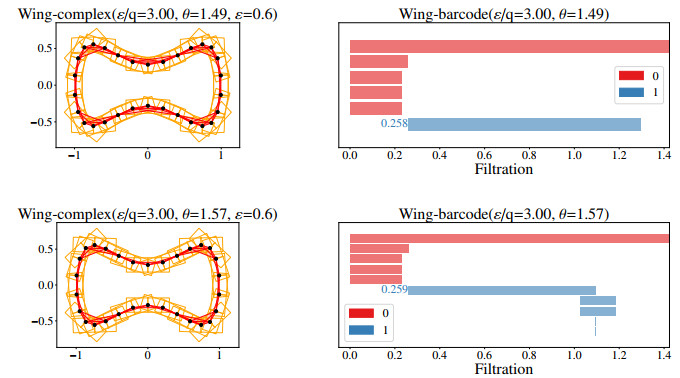
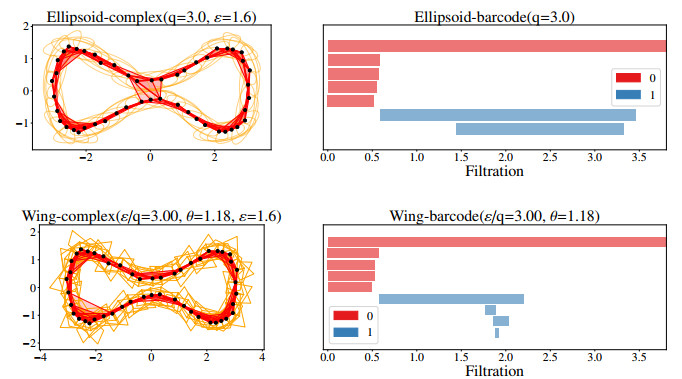
Persistent homology is a key tool in topological data analysis, used to capture the topological features of data across multiple scales. To accurately capture the topology of data with varying geometric structures, one should construct suitable simplicial complexes. In this paper, we propose wing complexes as a novel method for finite sets of points sampled from a smooth plane curve. The key innovation of the wing complex lies in its ability to stretch and shrink along the tangent and normal directions based on a specific parameter, allowing it to adapt to the local curvature variations of the data. We theoretically derive the topological properties of wing complexes and conduct related experiments. The results demonstrate that, compared to traditional methods, wing complexes provide more persistent and accurate topological features, particularly in regions with rapid local curvature variations, whereas traditional methods often fail to capture the correct topological features.
Citation: Zishan Weng, Minghui Zhao. Persistent homology via curvature-adaptive wing complexes[J]. AIMS Mathematics, 2026, 11(1): 785-809. doi: 10.3934/math.2026034
Persistent homology is a key tool in topological data analysis, used to capture the topological features of data across multiple scales. To accurately capture the topology of data with varying geometric structures, one should construct suitable simplicial complexes. In this paper, we propose wing complexes as a novel method for finite sets of points sampled from a smooth plane curve. The key innovation of the wing complex lies in its ability to stretch and shrink along the tangent and normal directions based on a specific parameter, allowing it to adapt to the local curvature variations of the data. We theoretically derive the topological properties of wing complexes and conduct related experiments. The results demonstrate that, compared to traditional methods, wing complexes provide more persistent and accurate topological features, particularly in regions with rapid local curvature variations, whereas traditional methods often fail to capture the correct topological features.

| [1] |
H. Edelsbrunner, D. Letscher, A. Zomorodian, Topological persistence and simplification, Discrete Comput. Geom., 28 (2002), 511–533. https://doi.org/10.1007/s00454-002-2885-2 doi: 10.1007/s00454-002-2885-2

|
| [2] |
A. Zomorodian, G. Carlsson, Computing persistent homology, Discrete Comput. Geom., 33 (2005), 249–274. https://doi.org/10.1007/s00454-004-1146-y doi: 10.1007/s00454-004-1146-y
|
| [3] | G. Carlsson, Topology and data, Bull. Amer. Math. Soc., 46 (2009), 255–308. https://doi.org/10.1090/S0273-0979-09-01249-X |
| [4] |
G. Carlsson, Topological pattern recognition for point cloud data, Acta Numer., 23 (2014), 289–368. https://doi.org/10.1017/S0962492914000051 doi: 10.1017/S0962492914000051
|
| [5] |
F. Chazal, V. de Silva, S. Oudot, Persistence stability for geometric complexes, Geom. Dedicata, 173 (2014), 193–214. https://doi.org/10.1007/s10711-013-9937-z doi: 10.1007/s10711-013-9937-z
|
| [6] | F. Chazal, V. de Silva, M. Glisse, S. Oudot, The structure and stability of persistence modules, Cham: Springer, 2016. https://doi.org/10.1007/978-3-319-42545-0 |
| [7] |
Y. Lee, S. D. Barthel, P. Dłotko, S. M. Moosavi, K. Hess, B. Smit, Quantifying similarity of pore-geometry in nanoporous materials, Nat. Commun., 8 (2017), 15396. https://doi.org/10.1038/ncomms15396 doi: 10.1038/ncomms15396
|
| [8] | M. Dindin, Y. Umeda, F. Chazal, Topological data analysis for arrhythmia detection through modular neural networks, In: Advances in artificial intelligence, Cham: Springer, 2020,177–188. https://doi.org/10.1007/978-3-030-47358-7_17 |
| [9] | M. Carrière, R. Rabadán, Topological data analysis of single-cell hi-c contact maps, In: Topological data analysis, Cham: Springer, 2020,147–162. https://doi.org/10.1007/978-3-030-43408-3_6 |
| [10] | W. Liu, H. Guo, W. Zhang, Y. Zang, C. Wang, J. Li, Toposeg: topology-aware segmentation for point clouds, In: Proceedings of the thirty-first international joint conference on artificial intelligence, 2022, 1201–1208. https://doi.org/10.24963/ijcai.2022/168 |
| [11] |
K. He, J. Shi, H. Fang, Bifurcation and chaos analysis of a fractional-order delay financial risk system using dynamic system approach and persistent homology, Math. Comput. Simulat., 223 (2024), 253–274. https://doi.org/10.1016/j.matcom.2024.04.013 doi: 10.1016/j.matcom.2024.04.013
|
| [12] | R. Brüel-Gabrielsson, B. J. Nelson, A. Dwaraknath, P. Skraba, L. J. Guibas, G. Carlsson, A topology layer for machine learning, arXiv: 1905.12200. https://doi.org/10.48550/arXiv.1905.12200 |
| [13] |
M. Ferri, I. Stanganelli, Size functions for the morphological analysis of melanocytic lesions, Int. J. Biomed. Imaging, 2010 (2010), 621357. https://doi.org/10.1155/2010/621357 doi: 10.1155/2010/621357
|
| [14] | S. Y. Oudot, Persistence theory: from quiver representations to data analysis, American Mathematical Society, 2015. http://doi.org/10.1090/surv/209 |
| [15] |
F. Chazal, B. Michel, An introduction to topological data analysis: fundamental and practical aspects for data scientists, Front. Artif. Intell., 4 (2021), 667963. https://doi.org/10.3389/frai.2021.667963 doi: 10.3389/frai.2021.667963
|
| [16] |
S. Dantchev, I. Ivrissimtzis, Efficient construction of the Čech complex, Comput. Graph., 36 (2012), 708–713. https://doi.org/10.1016/j.cag.2012.02.016 doi: 10.1016/j.cag.2012.02.016
|
| [17] |
A. Zomorodian, Fast construction of the Vietoris-Rips complex, Comput. Graph., 34 (2010), 263–271. https://doi.org/10.1016/j.cag.2010.03.007 doi: 10.1016/j.cag.2010.03.007
|
| [18] | C. Maria, J.-D. Boissonnat, M. Glisse, M. Yvinec, The gudhi library: simplicial complexes and persistent homology, In: Mathematical software–-ICMS 2014, Berlin, Heidelberg: Springer, 2014,167–174. https://doi.org/10.1007/978-3-662-44199-2_28 |
| [19] | G. Tauzin, U. Lupo, L. Tunstall, J. B. Pérez, M. Caorsi, A. M. Medina-Mardones, et al., giotto-tda: A topological data analysis toolkit for machine learning and data exploration, J. Mach. Learn. Res., 22 (2021), 1–6. |
| [20] |
H. Edelsbrunner, E. P. Mücke, Three-dimensional alpha shapes, ACM Transactions On Graphics (TOG), 13 (1994), 43–72. https://doi.org/10.1145/174462.156635 doi: 10.1145/174462.156635
|
| [21] | V. de Silva, G. E. Carlsson, Topological estimation using witness complexes, In: Eurographics Symposium on Point-Based Graphics, 2004,157–166. https://doi.org/10.2312/SPBG/SPBG04/157-166 |
| [22] |
P. Breiding, S. Kališnik, B. Sturmfels, M. Weinstein, Learning algebraic varieties from samples, Rev. Mat. Complut., 31 (2018), 545–593. https://doi.org/10.1007/s13163-018-0273-6 doi: 10.1007/s13163-018-0273-6
|
| [23] |
S. Kališnik, D. Lešnik, Finding the homology of manifolds using ellipsoids, Journal of Applied and Computational Topology, 8 (2024), 193–238. https://doi.org/10.1007/s41468-023-00145-6 doi: 10.1007/s41468-023-00145-6
|
| [24] | N. Canova, S. Kališnik, A. Moser, B. Rieck, A. Žegarac, Persistent homology via ellipsoids, arXiv: 2408.11450. https://doi.org/10.48550/arXiv.2408.11450 |
| [25] | A. Hatcher, Algebraic topology, Cambridge University Press, 2002. |
| [26] | M. B. Botnan, Topological data analysis, 2024. Available from: https://www.few.vu.nl/botnan/lecture_notes.pdf. |
| [27] |
U. Bauer, M. Kerber, F. Roll, A. Rolle, A unified view on the functorial nerve theorem and its variations, Expo. Math., 41 (2023), 125503. https://doi.org/10.1016/j.exmath.2023.04.005 doi: 10.1016/j.exmath.2023.04.005
|

Figures(32)

Zishan Weng, Minghui Zhao. Persistent homology via curvature-adaptive wing complexes[J]. AIMS Mathematics, 2026, 11(1): 785-809. doi: 10.3934/math.2026034





 DownLoad: