This paper investigates a chemotaxis model described by the following system of partial differential equations:
$ \begin{eqnarray*} \left\{ \begin{array}{llll} u_{t} = \Delta u - \nabla \cdot (u \mathbf{w}) + \gamma(u - u^{\alpha}), & x \in \Omega, \, t > 0, \\ v_{t} = \Delta v - v + u, & x \in \Omega, \, t > 0, \\ \mathbf{w}_{t} = \Delta \mathbf{w} - \mathbf{w} + \chi \nabla v, & x \in \Omega, \, t > 0, \\ \partial_{\mathbf{n}} u = \partial_{\mathbf{n}} v = 0, \quad \mathbf{w} = 0, & x \in \partial \Omega, \end{array} \right. \end{eqnarray*} $
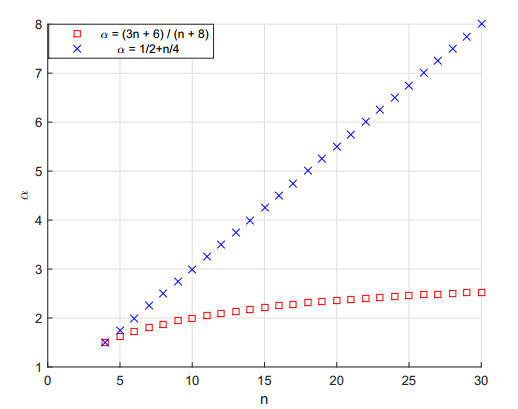
posed on a smooth, bounded domain $ \Omega \subset \mathbb{R}^n $, where $ \chi > 0 $, $ \gamma \geq 0 $, and $ \alpha > 1 $ are parameters. By employing $ L^p $-estimates and a carefully constructed bootstrap iteration method, we analyze the intricate mathematical relationships governing the system. Our findings demonstrate the existence of globally bounded solutions for $ n \geq 4 $, contingent upon the conditions that $ \gamma > 0 $ and $ \alpha > \frac{3n + 6}{n + 8} $. These findings significantly refine the known parameter constraints for global solution existence. In particular, our work improves upon previous studies—such as those by Zhang et al. (2019), Dong and Peng (2021), and Mu and Tao (2022)—which typically imposed the stricter condition $ \alpha > \frac{1}{2} + \frac{n}{4} $. Our analysis thus provides sharper criteria for $ \alpha $, broadening the understanding of solution behavior in chemotaxis systems.
Citation: Jiashan Zheng, Liqiong Pu. Sufficient conditions for global boundedness in inertial chemotaxis systems with logistic growth[J]. AIMS Mathematics, 2025, 10(9): 20626-20641. doi: 10.3934/math.2025921
This paper investigates a chemotaxis model described by the following system of partial differential equations:
$ \begin{eqnarray*} \left\{ \begin{array}{llll} u_{t} = \Delta u - \nabla \cdot (u \mathbf{w}) + \gamma(u - u^{\alpha}), & x \in \Omega, \, t > 0, \\ v_{t} = \Delta v - v + u, & x \in \Omega, \, t > 0, \\ \mathbf{w}_{t} = \Delta \mathbf{w} - \mathbf{w} + \chi \nabla v, & x \in \Omega, \, t > 0, \\ \partial_{\mathbf{n}} u = \partial_{\mathbf{n}} v = 0, \quad \mathbf{w} = 0, & x \in \partial \Omega, \end{array} \right. \end{eqnarray*} $
posed on a smooth, bounded domain $ \Omega \subset \mathbb{R}^n $, where $ \chi > 0 $, $ \gamma \geq 0 $, and $ \alpha > 1 $ are parameters. By employing $ L^p $-estimates and a carefully constructed bootstrap iteration method, we analyze the intricate mathematical relationships governing the system. Our findings demonstrate the existence of globally bounded solutions for $ n \geq 4 $, contingent upon the conditions that $ \gamma > 0 $ and $ \alpha > \frac{3n + 6}{n + 8} $. These findings significantly refine the known parameter constraints for global solution existence. In particular, our work improves upon previous studies—such as those by Zhang et al. (2019), Dong and Peng (2021), and Mu and Tao (2022)—which typically imposed the stricter condition $ \alpha > \frac{1}{2} + \frac{n}{4} $. Our analysis thus provides sharper criteria for $ \alpha $, broadening the understanding of solution behavior in chemotaxis systems.

| [1] |
X. Cao, Fluid interaction does not affect the critical exponent in a three-dimensional Keller-Segel-Stokes model, Z. Angew. Math. Phys., 61 (2020), 1–21. https://doi.org/10.1007/s00033-020-1285-x doi: 10.1007/s00033-020-1285-x

|
| [2] |
X. Cao, Y. Tao, Boundedness and stabilization enforced by mild saturationof taxis inaproducer scrounger model, Nonlinear Anal.-Real, 57 (2021), 103189. https://doi.org/10.1016/j.nonrwa.2020.103189 doi: 10.1016/j.nonrwa.2020.103189
|
| [3] | R. S. Cantrell, C. Cosner, Spatial ecology via reaction-diffusion equations, John Wiley & Sons, 2003. http://doi.org/10.1002/0470871296 |
| [4] |
M. A. J. Chaplain, Reaction-diffusion prepatterning and its potential role in tumour invasion, J. Biol. Syst., 3 (1995), 929–936. https://doi.org/10.1142/S0218339095000824 doi: 10.1142/S0218339095000824
|
| [5] |
Y. Dong, Y. Peng, Global boundedness in the higher-dimensional chemotaxis system with indirect signal production and rotational flux, Appl. Math. Lett., 112 (2021), 106700. https://doi.org/10.1016/j.aml.2020.106700 doi: 10.1016/j.aml.2020.106700
|
| [6] |
M. Ding, W. Wang, Global boundedness in a quasilinear fully parabolic chemotaxis system with indirect signal production, Discrete Cont. Dyn.-B, 24 (2019), 4665–4684. http://dx.doi.org/10.3934/dcdsb.2018328 doi: 10.3934/dcdsb.2018328
|
| [7] |
R. A. Fisher, The wave of advance of advantageous genes, Ann. Eugen., 7 (1937), 355–369. https://doi.org/10.1111/j.1469-1809.1937.tb02153.x doi: 10.1111/j.1469-1809.1937.tb02153.x
|
| [8] |
G. R. Flierl, D. Grünbaum, S. A. Levins, D. B. Olson, From individuals to aggregations: the interplay between behavior and physics, J. Theor. Biol., 196 (1999), 397–454. https://doi.org/10.1006/jtbi.1998.0842 doi: 10.1006/jtbi.1998.0842
|
| [9] |
K. Fujie, T. Senba, Application of an Adams type inequality to a two-chemical substances chemotaxis system, J. Differ. Equations, 263 (2017), 88–148. https://doi.org/10.1016/j.jde.2017.02.031 doi: 10.1016/j.jde.2017.02.031
|
| [10] |
Y. Giga, H. Sohr, Abstract $L^p$ estimates for the Cauchy problem with applications to the Navier-Stokes equations in exterior domains, J. Funct. Anal., 102 (1991), 72–94. https://doi.org/10.1016/0022-1236(91)90136-S doi: 10.1016/0022-1236(91)90136-S
|
| [11] |
Z. Hassan, W. Shen, Y. Zhang, Global existence of classical solutions of chemotaxis systems with logistic source and consumption or linear signal production on $R_n$, J. Differ. Equations, 413 (2024), 497–556. http://doi.org/10.1016/j.jde.2024.08.064 doi: 10.1016/j.jde.2024.08.064
|
| [12] |
D. Horstmann, M. Winkler, Boundedness vs. blow-up in a chemotaxis system, J. Differ. Equations, 215 (2005), 52–107. https://doi.org/10.1016/j.jde.2004.10.022 doi: 10.1016/j.jde.2004.10.022
|
| [13] |
H. Jin, Z. Wang, Global stability of prey-taxis systems, J. Differ. Equations, 262 (2017), 1257–1290. https://doi.org/10.1016/j.jde.2016.10.010 doi: 10.1016/j.jde.2016.10.010
|
| [14] |
P. Kareiva, G. Odell, Swarms of predators exhibit "preytaxis" if individual predators use area-restricted search, Am. Naturalist, 130 (1987), 233–270. https://doi.org/10.1086/284707 doi: 10.1086/284707
|
| [15] |
P. Kareiva, Experimental and mathematical analyses of herbivore movement: Quantifying the influence of plant spacing and quality on foraging discrimination, Ecol. Monogr., 52 (1982), 261–282. https://doi.org/10.2307/2937331 doi: 10.2307/2937331
|
| [16] |
E. F. Keller, L. A. Segel, Initiation of slime mold aggregation is viewed as an instability, J. Theor. Biol., 26 (1970), 399–415. https://doi.org/10.1016/0022-5193(70)90092-5 doi: 10.1016/0022-5193(70)90092-5
|
| [17] |
W. B. Lv, Q. Wang, A chemotaxis system with signal-dependent motility, indirect signal production and generalized logistic source: Global existence and asymptotic stabilization, J. Math. Anal. Appl., 488 (2020), 124108. https://doi.org/10.1016/j.jmaa.2020.124108 doi: 10.1016/j.jmaa.2020.124108
|
| [18] |
C. Mu, W. Tao, Stabilization and pattern formation in chemotaxis models with acceleration and logistic source, Math. Biosci. Eng., 20 (2022), 2011–2038. http://doi.org/10.3934/mbe.2023093 doi: 10.3934/mbe.2023093
|
| [19] |
C. Mu, W. Tao, Z. Wang, Global dynamics and spatiotemporal heterogeneity of a preytaxis model with prey-induced acceleration, Eur. J. Appl. Math., 35 (2024), 1–33. http://doi.org/10.1017/S0956792523000347 doi: 10.1017/S0956792523000347
|
| [20] |
A. Okubo, H. C. Chiang, C. C. Ebbesmeyer, Acceleration field of individual midges, anarete pritchardi (diptera: Cecidomyiidae), within a swarm, Can. Entomol., 109 (1977), 149–156. https://doi.org/10.4039/Ent109149-1 doi: 10.4039/Ent109149-1
|
| [21] | J. K. Parrish, P. Turchin, Individual decisions, traffic rules, and emergent pattern in schooling fish, In: Parrish JK, Hamner WM, Eds., Animal Groups in Three Dimensions: How Species Aggregate, Cambridge University Press, 1997,126–142. https://doi.org/10.1017/CBO9780511601156.009 |
| [22] | P. Quittner, P. Souplet, Superlinear parabolic problems, Blow-up, global existence and steady states, Basel: Birkhäuser, 2019. http://doi.org/10.1007/978-3-7643-8442-5 |
| [23] |
G. Ren, B. Liu, Global dynamics for an attraction-repulsion chemotaxis model with logistic source, J. Differ. Equations, 268 (2020), 4320–4373. https://doi.org/10.1016/j.jde.2019.10.027 doi: 10.1016/j.jde.2019.10.027
|
| [24] |
J. A. Sherratt, J. D. Murray, Models of epidermal wound healing, Proc. Roy. Soc. Lond. B, 241 (1990), 29–36. http://doi.org/10.1098/rspb.1990.0061 doi: 10.1098/rspb.1990.0061
|
| [25] |
W. Tao, Z. Wang, On a new type of chemotaxis model with acceleration, Commun. Math. Anal. Appl., 1 (2022), 319–344. http://doi.org/10.4208/cmaa.2022-0003 doi: 10.4208/cmaa.2022-0003
|
| [26] |
M. Winkler, Aggregation vs. global diffusive behavior in the higher-dimensional Keller-Segel model, J. Differ. Equations, 248 (2010), 2889–2905. https://doi.org/10.1016/j.jde.2010.02.008 doi: 10.1016/j.jde.2010.02.008
|
| [27] |
Y. Xiao, J. Jiang, Global existence and uniform boundedness in a fully parabolic Keller-Segel system with non-monotonic signal-dependent motility, J. Differ. Equations, 354 (2023), 403–429. https://doi.org/10.1016/j.jde.2023.02.028 doi: 10.1016/j.jde.2023.02.028
|
| [28] |
W. Zhang, P. Niu, S. Liu, Large time behavior in a chemotaxis model with logistic growth and indirect signal production, Nonlinear Anal.-Real, 50 (2019), 484–497. http://doi.org/10.1016/j.nonrwa.2019.05.002 doi: 10.1016/j.nonrwa.2019.05.002
|
Figures(1)

Jiashan Zheng, Liqiong Pu. Sufficient conditions for global boundedness in inertial chemotaxis systems with logistic growth[J]. AIMS Mathematics, 2025, 10(9): 20626-20641. doi: 10.3934/math.2025921





 DownLoad: