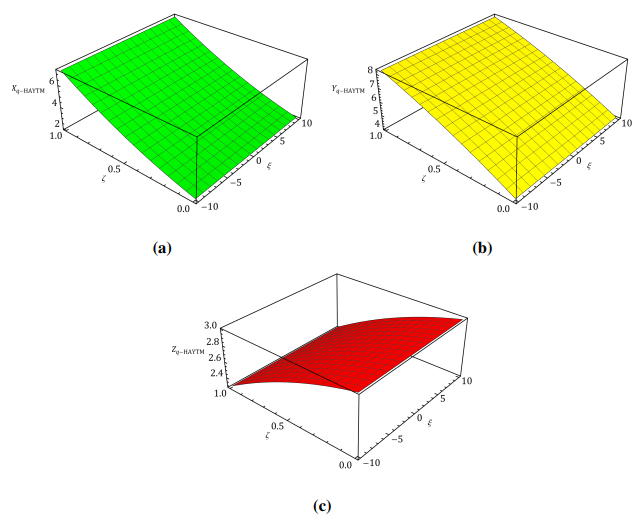
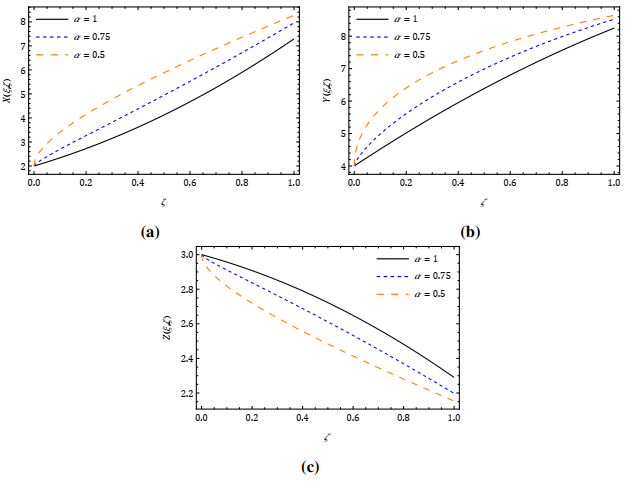
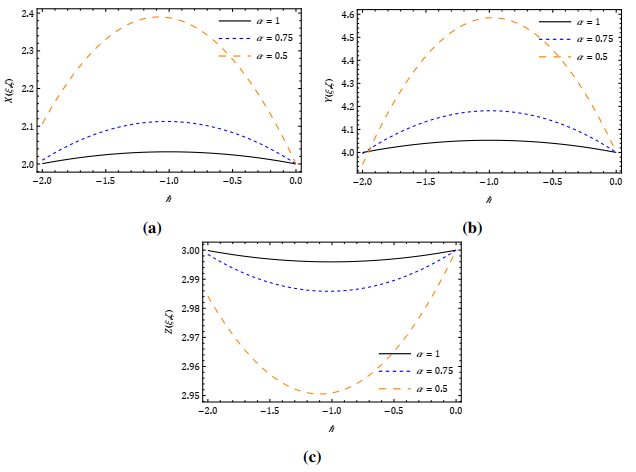
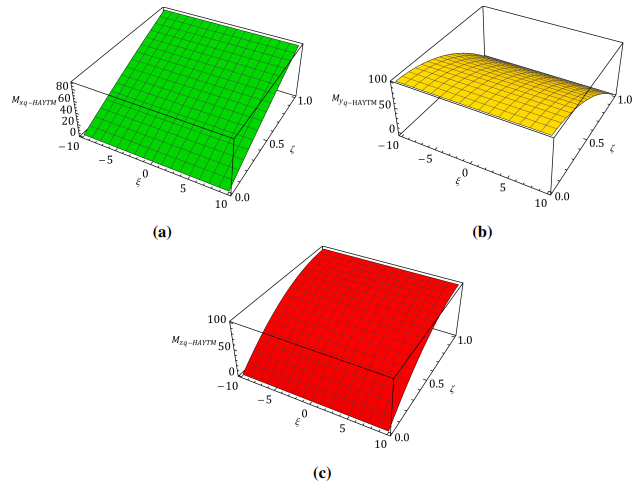
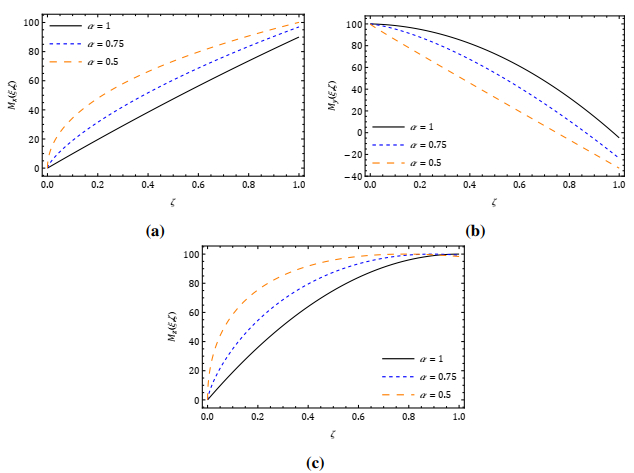
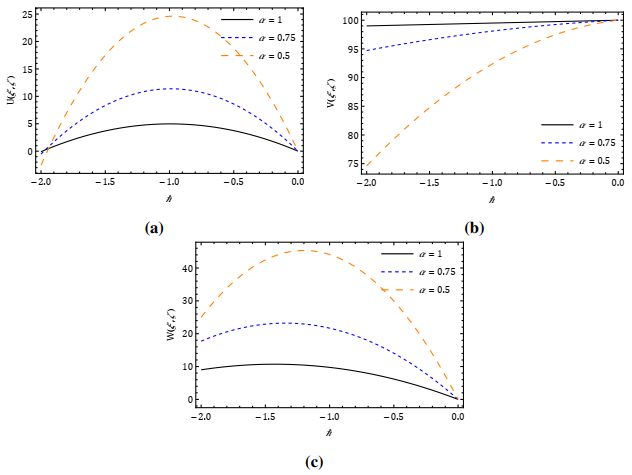
The objective of the present study is to illustrate the significance and applicability of fractional-order derivatives in resolving mathematical models. In this study, we investigated two mathematical models, including the nonlinear time-fractional water pollution model and the time-fractional Bloch model, which arises in bioengineering. These models were successfully solved by using a unique technique known as the $ q $-homotopy analysis Yang transform method, and approximate solutions were obtained. Using the Caputo operator, which accounts for memory effects, the model was examined in fractional order. The results clearly indicate that fractional-order derivatives give a better match for the behavior of the systems under consideration. This method not only allows for improved comprehension of complex phenomena but also provides an opportunity for further research in diverse areas, such as environmental science and bio engineering. The results obtained by the considered method are in the form of a series that converges swiftly and also we proposed convergence analysis for the considered method. This technique helps us modify the convergence area of the series solution by utilizing an auxiliary parameter called $ \hbar $, also referred to as the convergence control parameter. The outcomes were analyzed using 3D plots and graphs, and also we conducted numerical simulations. The obtained results demonstrate that the proposed method is highly accurate and successful in examining nonlinear issues that arise in various scientific and technological domains.
Citation: Naveed Iqbal, Halaiah Basavarajaiah Chethan, Doddabhadrappla Gowda Prakasha, Meraj Ali Khan. A new transform technique for the analysis of the time-fractional water pollution model and Bloch equation[J]. AIMS Mathematics, 2025, 10(9): 20606-20625. doi: 10.3934/math.2025920
The objective of the present study is to illustrate the significance and applicability of fractional-order derivatives in resolving mathematical models. In this study, we investigated two mathematical models, including the nonlinear time-fractional water pollution model and the time-fractional Bloch model, which arises in bioengineering. These models were successfully solved by using a unique technique known as the $ q $-homotopy analysis Yang transform method, and approximate solutions were obtained. Using the Caputo operator, which accounts for memory effects, the model was examined in fractional order. The results clearly indicate that fractional-order derivatives give a better match for the behavior of the systems under consideration. This method not only allows for improved comprehension of complex phenomena but also provides an opportunity for further research in diverse areas, such as environmental science and bio engineering. The results obtained by the considered method are in the form of a series that converges swiftly and also we proposed convergence analysis for the considered method. This technique helps us modify the convergence area of the series solution by utilizing an auxiliary parameter called $ \hbar $, also referred to as the convergence control parameter. The outcomes were analyzed using 3D plots and graphs, and also we conducted numerical simulations. The obtained results demonstrate that the proposed method is highly accurate and successful in examining nonlinear issues that arise in various scientific and technological domains.

| [1] |
Z. Sabir, R. Sadat, M. R. Ali, S. B. Said, M. Azhar, A numerical performance of the novel fractional water pollution model through the Levenberg-Marquardt backpropagation method, Arab. J. Chem., 16 (2023), 104493. https://doi.org/10.1016/j.arabjc.2022.104493 doi: 10.1016/j.arabjc.2022.104493

|
| [2] |
A. Ebrahimzadeh, A. Jajarmi, D. Baleanu, Enhancing water pollution management through a comprehensive fractional modeling framework and optimal control techniques, J. Nonlinear Math. Phys., 31 (2024), 48. https://doi.org/10.1007/s44198-024-00215-y doi: 10.1007/s44198-024-00215-y
|
| [3] |
S. H. Mousavi, M. R. Kavianpour, J. L. G. Alcaraz, O. A. Yamini, System dynamics modeling for effective strategies in water pollution control: Insights and applications, Appl. Sci., 13 (2023), 9024. https://doi.org/10.3390/app13159024 doi: 10.3390/app13159024
|
| [4] |
Y. N. Anjam, M. Yavuz, M. ur Rahman, A. Batool, Analysis of a fractional pollution model in a system of three interconnecting lakes, AIMS Biophys., 10 (2023), 220–240. https://doi.org/10.3934/biophy.2023014 doi: 10.3934/biophy.2023014
|
| [5] |
A. Batabyal, H. Beladi, Decentralized vs. centralized water pollution cleanup in the Ganges in a model with three cities, Netw. Spat. Econ., 24 (2024), 383–394. https://doi.org/10.1007/s11067-024-09620-8 doi: 10.1007/s11067-024-09620-8
|
| [6] |
J. Yang, L. Jia, Z. Guo, Y. Shen, X. Li, Z. Mou, et al., Prediction and control of water quality in Recirculating Aquaculture System based on hybrid neural network, Eng. Appl. Artif. Intell., 121 (2023), 106002. https://doi.org/10.1016/j.engappai.2023.106002 doi: 10.1016/j.engappai.2023.106002
|
| [7] |
F. Bloch, The nuclear induction experiment, Phys. Rev., 70 (1946), 474–485. https://doi.org/10.1103/PhysRev.70.474 doi: 10.1103/PhysRev.70.474
|
| [8] |
S. Kumar, N. Faraz, K. A. Sayevand, Fractional model of Bloch equation in nuclear magnetic resonance and its analytic approximate solution, Walailak J. Sci. Tech., 11 (2014), 273–285. https://doi.org/10.2004/wjst.v11i4.519 doi: 10.2004/wjst.v11i4.519
|
| [9] |
I. Petras, Modeling and numerical analysis of fractional-order Bloch equations, Comput. Math. Appl., 61 (2011), 341–356. https://doi.org/10.1016/j.camwa.2010.11.009 doi: 10.1016/j.camwa.2010.11.009
|
| [10] | S. Bhalekar, V. Daftardar-Gejji, D. Baleanu, R. Magin, Fractional Bloch equation with delay, Comput. Math. Appl., 61 (2011), 1355–1365. Available from: http://hdl.handle.net/20.500.12416/1262. |
| [11] |
A. D. Bain, C. K. Anand, Z. Nie, Exact solution to the Bloch equations and application to the Hahn echo, J. Magn. Reson., 206 (2010), 227–240. https://doi.org/10.1016/j.jmr.2010.07.012 doi: 10.1016/j.jmr.2010.07.012
|
| [12] |
K. Murase, N. Tanki, Numerical solutions to the time-dependent Bloch equations revisited, J. Magn. Reson. Imaging, 29 (2011), 126–131. https://doi.org/10.1016/j.mri.2010.07.003 doi: 10.1016/j.mri.2010.07.003
|
| [13] |
J. Singh, J. Kumar, D. Baleanu, Numerical computation of fractional Bloch equation by using Jacobi operational matrix, J. King Saud. Univ. Sci., 36 (2024), 103263. https://doi.org/10.1016/j.jksus.2024.103263 doi: 10.1016/j.jksus.2024.103263
|
| [14] |
Akshey, T. R. Singh, Approximate-analytical iterative approach to time-fractional Bloch equation with Mittag-Leffler type kernel, Math. Method. Appl. Sci., 47 (2024), 7028–7045. https://doi.org/10.1002/mma.9955 doi: 10.1002/mma.9955
|
| [15] | A. A. Kilbas, H. M. Srivastava, J. J. Nieto, Theory and applicational differential equations, Elsevier Science B.V., Amsterdam, The Netherlands, 2006, 69–71. https://doi.org/10.1016/S0304-0208(06)80001-0 |
| [16] | K. S. Miller, B. Ross, An introduction to fractional calculus and fractional differential equations, John Wiley and Sons, 1993. |
| [17] |
V. E. Tarasov, General non-local electrodynamics: Equations and non-local effects, Ann. Phys., 445 (2022), 169082. https://doi.org/10.1016/j.aop.2022.169082 doi: 10.1016/j.aop.2022.169082
|
| [18] |
W. Waheed, G. Deng, B. Liu, Discrete Laplacian operator and its applications in signal processing, IEEE Access, 8 (2020), 89692–89707. https://doi.org/10.1109/ACCESS.2020.2993577 doi: 10.1109/ACCESS.2020.2993577
|
| [19] |
W. U. Hassan, K. Shabbir, A. Zeeshan, R. Ellahi, Regression analysis for thermal transport of fractional-order magnetohydrodynamic Maxwell fluid flow under the influence of chemical reaction using integrated machine learning approach, Chaos Soliton. Fract., 191 (2025), 115927. https://doi.org/10.1016/j.chaos.2024.115927 doi: 10.1016/j.chaos.2024.115927
|
| [20] |
G. Monzon, Fractional variational iteration method for higher-order fractional differential equations, J. Fract. Calc. Appl., 15 (2024), 1–15. https://doi.org/10.21608/jfca.2023.229366.1027 doi: 10.21608/jfca.2023.229366.1027
|
| [21] |
A. H. Ganie, M. M. AlBaidani, A. A. Khan, Comparative study of the fractional partial differential equations via novel transform, Symmetry, 15 (2023), 1101. https://doi.org/10.3390/sym15051 doi: 10.3390/sym15051
|
| [22] |
R. M. Jena, S. Chakraverty, Residual power series method for solving time-fractional model of vibration equation of large membranes, J. Appl. Comput. Mech., 5 (2019), 603–615. https://doi.org/10.22055/jacm.2018.26668.1347 doi: 10.22055/jacm.2018.26668.1347
|
| [23] |
M. Qayyum, E. Ahmad, S. T. Saeed, H. Ahmad, S. Askar, Homotopy perturbation method-based soliton solutions of the time-fractional (2+1)-dimensional Wu-Zhang system describing long dispersive gravity water waves in the ocean, Front. Phys., 11 (2023), 1178154. https://doi.org/10.3389/fphy.2023.1178154 doi: 10.3389/fphy.2023.1178154
|
| [24] |
M. M. Adel, E. Ramadan, H. Ahmad, T. Botmart, Sobolev-type nonlinear Hilfer fractional stochastic differential equations with noninstantaneous impulsive, AIMS Math., 7 (2022), 20105–20125. https://doi.org/10.3934/math.20221100 doi: 10.3934/math.20221100
|
| [25] |
A. F. S. Aboubakr, G. M. Ismail, M. M. Khader, M. A. E. Abdelrahman, A. M. T. AbdEl-Bar, M. Adel, Derivation of an approximate formula of the Rabotnov fractional-exponential kernel fractional derivative and applied for numerically solving the blood ethanol concentration system, AIMS Math., 8 (2023), 30704–30716. https://doi.org/10.3934/math.20231569 doi: 10.3934/math.20231569
|
| [26] |
M. Adel, M. M. Khader, S. Algelany, High-dimensional chaotic Lorenz system: Numerical treatment using Changhee polynomials of the Appell type, Fractal Fract., 7 (2023), 398. https://doi.org/10.3390/fractalfract7050398 doi: 10.3390/fractalfract7050398
|
| [27] |
Q. M. Tawhari, Advanced analytical techniques for fractional Schrödinger and Korteweg-de Vries equations, AIMS Math., 10 (2025), 11708–11731. https://doi.org/10.3934/math.2025530 doi: 10.3934/math.2025530
|
| [28] |
Y. F. Ibrahim, S. E. A. El-Bar, M. M. Khader, M. Adel, Studying and simulating the fractional COVID-19 model using an efficient spectral collocation approach, Fractal Fract., 7 (2023), 307. https://doi.org/10.3390/fractalfract7040307 doi: 10.3390/fractalfract7040307
|
| [29] |
M. Adel, M. M. Khader, H. Ahmad, T. A. Assiri, Approximate analytical solutions for the blood ethanol concentration system and predator-prey equations by using variational iteration method, AIMS Math., 8 (2023), 19083–19096. https://doi.org/10.3934/math.2023974 doi: 10.3934/math.2023974
|
| [30] |
K. Naveen, D. G. Prakasha, F. Mofarreh, A. Haseeb, A study on solutions of fractional order equal-width equation using novel approach, Mod. Phys. Lett. B, 39 (2025), 2550058. https://doi.org/10.1142/S0217984925500587 doi: 10.1142/S0217984925500587
|
| [31] |
S. Aihui, X. Hui, Decay estimate and blow-up for fractional Kirchhoff wave equations involving a logarithmic source, AIMS Math., 10 (2025), 14032–14054. https://doi.org/10.3934/math.2025631 doi: 10.3934/math.2025631
|
| [32] |
C. V. D. Kumar, D. G. Prakasha, N. B. Turki, Exploring the dynamics of fractional-order nonlinear dispersive wave system through homotopy technique, Open Phys., 23 (2025), 20250128. https://doi.org/10.1515/phys-2025-0128 doi: 10.1515/phys-2025-0128
|
| [33] |
H. B. Chethan, R. Saadeh, D. G. Prakasha, A. Qazza, N. S. Malagi, M. Nagaraja, et al., An efficient approximate analytical technique for the fractional model describing the solid tumor invasion, Front. Phys., 12 (2024), 1294506. https://doi.org/10.3389/fphy.2024.1294506 doi: 10.3389/fphy.2024.1294506
|
| [34] | S. Liao, Homotopy analysis method: A new analytical technique for nonlinear problems, Commun. Nonlinear Sci. Numer., 2 (1997), 95–100. |
| [35] |
A. Ullah, K. J. Ansari, A. Ullah, Advancing non-linear PDE's solutions: Modified Yang transform method with Caputo-Fabrizio fractional operator, Phys. Scr., 99 (2024), 125291. https://doi.org/10.1088/1402-4896/ad921d doi: 10.1088/1402-4896/ad921d
|
| [36] |
M. Naeem, H. Yasmin, R. Shah, N. A. Shah, J. D. Chung, A comparative study of fractional partial differential equations with the help of yang transform, Symmetry, 15 (2023), 146. https://doi.org/10.3390/sym15010146 doi: 10.3390/sym15010146
|
| [37] |
P. Sunthrayuth, H. A. Alyousef, S. A. El-Tantawy, A. Khan, N. Wyal, Solving fractional-order diffusion equations in a plasma and fluids via a novel transform, J. Funct. Space., 2022 (2022), 1899130. https://doi.org/10.1155/2022/1899130 doi: 10.1155/2022/1899130
|
| [38] |
A. S. Bekela, A. T. Deresse, A hybrid yang transform adomian decomposition method for solving time-fractional nonlinear partial differential equation, BMC Res. Notes, 17 (2024), 226. https://doi.org/10.1186/s13104-024-06877-7 doi: 10.1186/s13104-024-06877-7
|
Figures(6) / Tables(6)

Naveed Iqbal, Halaiah Basavarajaiah Chethan, Doddabhadrappla Gowda Prakasha, Meraj Ali Khan. A new transform technique for the analysis of the time-fractional water pollution model and Bloch equation[J]. AIMS Mathematics, 2025, 10(9): 20606-20625. doi: 10.3934/math.2025920





 DownLoad: