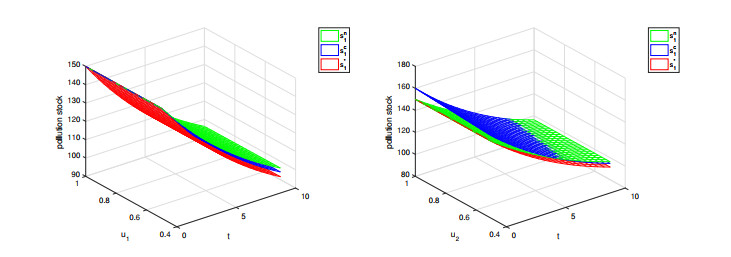
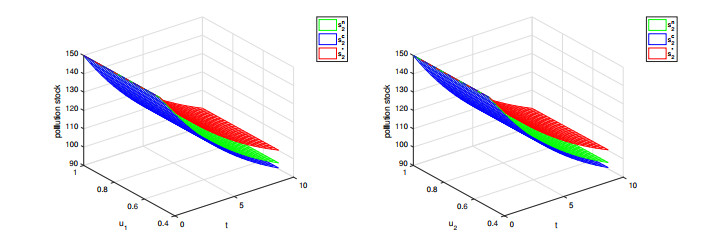
This paper investigates a differential game modeling transboundary pollution management in the Upper Yangtze River Basin under noncooperative and cooperative scenarios, incorporating emissions trading, learning-by-doing effects, and abatement investment costs. The maximum principle of optimal control theory was employed to derive equilibrium solutions for both models. Numerical simulations identified optimal emission levels and abatement investments for the Chongqing Municipality and Sichuan Province under each scenario, with the pollution stock trajectories computed using the fourth-order Runge-Kutta method. Numerical validation demonstrated that ecological compensation mechanisms enhance mitigation effectiveness. Furthermore, the study revealed that learning-by-doing efficiency gains and reductions in regional abatement investment costs synergistically enhance both pollution mitigation and economic returns within this framework.
Citation: Zuliang Lu, Mingsong Li, Longzhou Cao, Junman Li, Zhihui Cao, Zhuran Xiang. A differential game of transboundary pollution in the upper Yangtze river: Ecological compensation and learning-by-doing in the Chongqing-Sichuan region[J]. AIMS Mathematics, 2025, 10(10): 24329-24351. doi: 10.3934/math.20251079
This paper investigates a differential game modeling transboundary pollution management in the Upper Yangtze River Basin under noncooperative and cooperative scenarios, incorporating emissions trading, learning-by-doing effects, and abatement investment costs. The maximum principle of optimal control theory was employed to derive equilibrium solutions for both models. Numerical simulations identified optimal emission levels and abatement investments for the Chongqing Municipality and Sichuan Province under each scenario, with the pollution stock trajectories computed using the fourth-order Runge-Kutta method. Numerical validation demonstrated that ecological compensation mechanisms enhance mitigation effectiveness. Furthermore, the study revealed that learning-by-doing efficiency gains and reductions in regional abatement investment costs synergistically enhance both pollution mitigation and economic returns within this framework.

| [1] |
U. Moslener, T. Requate, The dynamics of optimal abatement strategies for multiple pollutants–An illustration in the Greenhouse, Ecol. Econ., 68 (2009), 1521–1534. https://doi.org/10.1016/j.ecolecon.2008.10.010 doi: 10.1016/j.ecolecon.2008.10.010

|
| [2] |
S. Li, X. Pan, A dynamic general equilibrium model of pollution abatement under learning by doing, Econ. Lett., 122 (2014), 285–288. https://doi.org/10.1016/j.econlet.2013.12.002 doi: 10.1016/j.econlet.2013.12.002
|
| [3] |
L. Bertinelli, C. Camacho, B. Zou, Carbon capture and storage and transboundary pollution: A differential game approach, Eur. J. Oper. Res., 237 (2014), 721–728. https://doi.org/10.1016/j.ejor.2014.02.025 doi: 10.1016/j.ejor.2014.02.025
|
| [4] |
H. Benchekroun, G. Martin-Herran, The impact of foresight in a transboundary pollution game, Eur. J. Oper. Res., 251 (2016), 300–309. https://doi.org/10.1016/j.ejor.2015.11.014 doi: 10.1016/j.ejor.2015.11.014
|
| [5] |
X. Huang, P. He, W. Zhang, A cooperative differential game of transboundary industrial pollution between two regions, J. Clean. Prod., 120 (2016), 43–52. https://doi.org/10.1016/j.jclepro.2015.10.095 doi: 10.1016/j.jclepro.2015.10.095
|
| [6] |
D. W. K. Yeung, L. A. Petrosyan, A cooperative stochastic differential game of transboundary industrial pollution, Automatica, 44 (2008), 1532–1544. https://doi.org/10.1016/j.automatica.2008.03.005 doi: 10.1016/j.automatica.2008.03.005
|
| [7] |
K. Jiang, R. Merrill, D. You, P. Pan, Z. Li, Optimal control for transboundary pollution under ecological compensation: A stochastic differential game approach, J. Clean. Prod., 241 (2019), 118391. https://doi.org/10.1016/j.jclepro.2019.118391 doi: 10.1016/j.jclepro.2019.118391
|
| [8] |
U. Moslener, T. Requate, Optimal abatement in dynamic multi-pollutant problems when pollutants can be complements or substitutes, J. Econ. Dyn. Control, 31 (2007), 2293–2316. https://doi.org/10.1016/j.jedc.2006.03.009 doi: 10.1016/j.jedc.2006.03.009
|
| [9] |
J. A. List, C. F. Mason, Optimal institutional arrangements for transboundary pollutants in a second-best world: evidence from a differential game with asymmetric players, J. Environ. Econ. Manage., 42 (2001), 277–296. https://doi.org/10.1006/jeem.2000.1163 doi: 10.1006/jeem.2000.1163
|
| [10] |
K. Jiang, D. You, Z. Li, S. Shi, A differential game approach to dynamic optimal control strategies for watershed pollution across regional boundaries under eco-compensation criterion, Ecol. Indic., 105 (2019), 229–241. https://doi.org/10.1016/j.ecolind.2019.05.065 doi: 10.1016/j.ecolind.2019.05.065
|
| [11] |
Y. Yi, Z. Wei, C. Fu, A differential game of transboundary pollution control and ecological compensation in a river basin, Complexity, 2020 (2020), 6750805. https://doi.org/10.1155/2020/6750805 doi: 10.1155/2020/6750805
|
| [12] |
C. Wei, C. Luo, A differential game design of watershed pollution management under ecological compensation criterion, J. Clean. Prod., 274 (2020), 122320. https://doi.org/10.1016/j.jclepro.2020.122320 doi: 10.1016/j.jclepro.2020.122320
|
| [13] |
X. Gao, J. Shen, W. He, F. Sun, Z. Zhang, X. Zhang, et al., Multilevel governments' decision-making process and its influencing factors in watershed ecological compensation, Sustainability, 11 (2019), 1990. https://doi.org/10.3390/su11071990 doi: 10.3390/su11071990
|
| [14] |
N. Anjum, A. Paulraj, C. Blome, C. Rajkumar, Environmental process design and performance: Understanding the key role of learning by doing and employee empowerment, Int. J. Prod. Econ., 282 (2025), 109563. https://doi.org/10.1016/j.ijpe.2025.109563 doi: 10.1016/j.ijpe.2025.109563
|
| [15] |
S. Chang, W. Qin, X. Wang, Dynamic optimal strategies in transboundary pollution game under learning by doing, Phys. A, 490 (2018), 139–147. https://doi.org/10.1016/j.physa.2017.08.010 doi: 10.1016/j.physa.2017.08.010
|
| [16] |
Z. Chen, R. Xu, Y. Yi, Dynamic optimal control of transboundary pollution abatement under learning-by-doing depreciation, Complexity, 2020 (2020), 3763684. https://doi.org/10.1155/2020/3763684 doi: 10.1155/2020/3763684
|
| [17] |
Z. Wei, Y. Yi, C. Fu, Cournot competition and "green" innovation under efficiency-improving learning by doing, Phys. A, 531 (2019), 121762. https://doi.org/10.1016/j.physa.2019.121762 doi: 10.1016/j.physa.2019.121762
|
| [18] |
H. Li, G. Guo, A differential game analysis of multipollutant transboundary pollution in river basin, Phys. A, 535 (2019), 122484. https://doi.org/10.1016/j.physa.2019.122484 doi: 10.1016/j.physa.2019.122484
|
| [19] |
Z. Lu, F. Huang, Y. Zhao, L. Li, C. Hou, Y. Yang, Multi-area transboundary pollution problems under learning by doing in Yangtze River Delta Region, China, Math. Methods Appl. Sci., 44 (2021), 1029–1051. https://doi.org/10.1002/mma.6810 doi: 10.1002/mma.6810
|
| [20] |
C. Zhu, X. Xi, M. Goh, Differential game analysis of joint emission reduction decisions under mixed carbon policies and CEA, J. Environ. Manage., 358 (2024), 120913. https://doi.org/10.1016/j.jenvman.2024.120913 doi: 10.1016/j.jenvman.2024.120913
|
| [21] |
C. Zhu, J. Ma, J. Li, M. Goh, Grandfathering or benchmarking? The impact of carbon quota allocation rule on the joint emission reduction supply chain, Int. J. Prod. Res., 63 (2025), 3608–3629. https://doi.org/10.1080/00207543.2024.2425777 doi: 10.1080/00207543.2024.2425777
|
| [22] |
L. Lambertini, J. Poyago-Theotoky, A. Tampieri, Cournot competition and "green" innovation: An inverted-U relationship, Energy Econ., 68 (2017), 116–123. https://doi.org/10.1016/j.eneco.2017.09.022 doi: 10.1016/j.eneco.2017.09.022
|
| [23] |
Y. Yi, R. Xu, S. Zhang, A cooperative stochastic differential game of transboundary industrial pollution between two asymmetric nations, Math. Probl. Eng., 2017 (2017), 9492582. https://doi.org/10.1155/2017/9492582 doi: 10.1155/2017/9492582
|
Figures(10) / Tables(4)

Zuliang Lu, Mingsong Li, Longzhou Cao, Junman Li, Zhihui Cao, Zhuran Xiang. A differential game of transboundary pollution in the upper Yangtze river: Ecological compensation and learning-by-doing in the Chongqing-Sichuan region[J]. AIMS Mathematics, 2025, 10(10): 24329-24351. doi: 10.3934/math.20251079





 DownLoad: