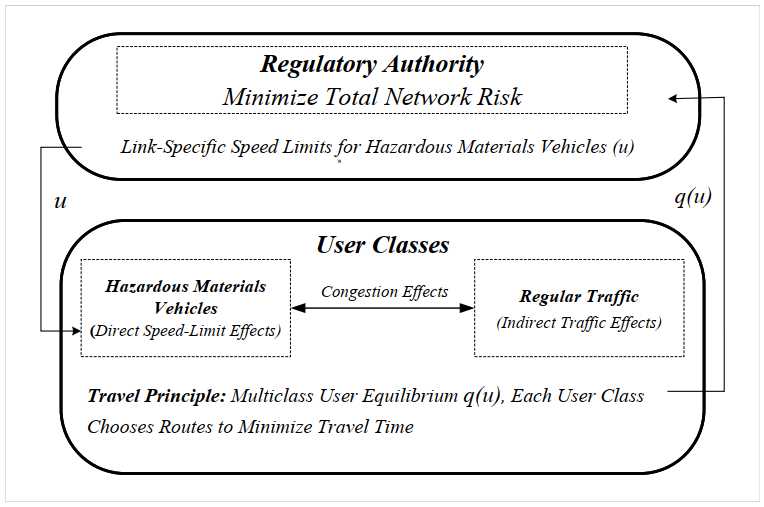
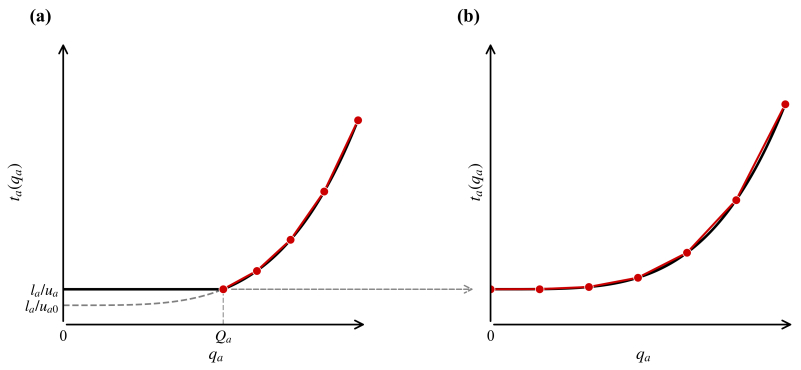
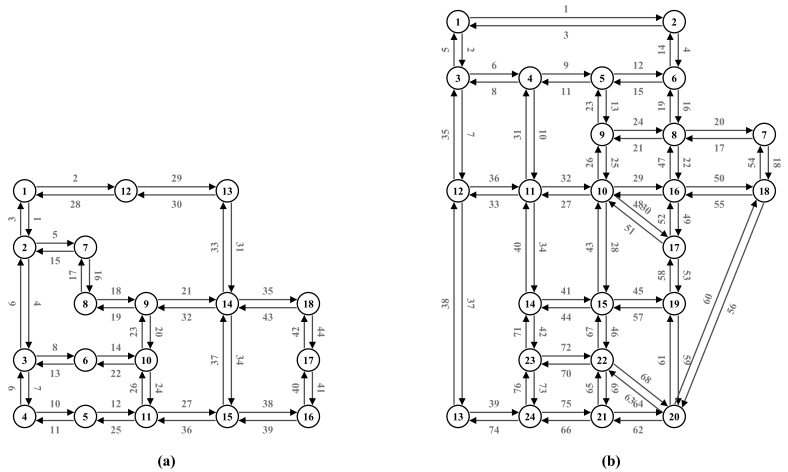
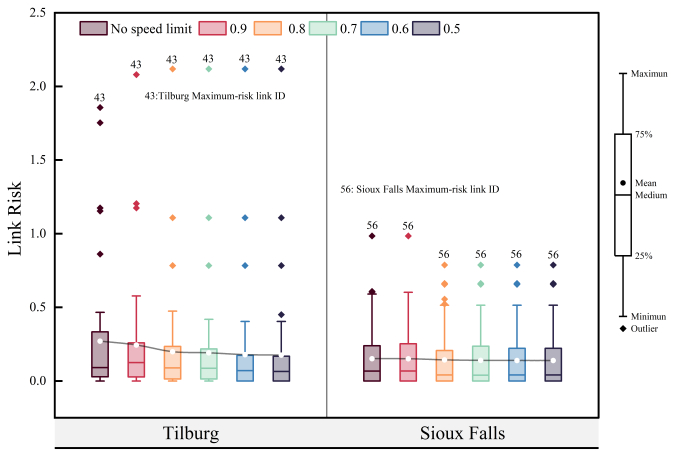
Hazardous materials (hazmat) transportation accidents may cause severe casualties and environmental damage, highlighting the need for effective risk-mitigation strategies. In mixed traffic environments, hazmat vehicles share road resources with regular traffic, and the resulting congestion effects may further affect travel costs, traffic flow distribution, and transportation risk. This study proposes a speed-limit strategy for hazmat vehicles to reduce network transportation risk. A government–carrier bilevel optimization model was developed to characterize the decision-making relationship between regulatory authorities and transportation users. In the upper-level model, the regulatory authority determines the speed limits for hazmat vehicles on each link to minimize population-exposure-based network transportation risk. In the lower-level model, hazmat and regular traffic are incorporated into a multiclass user equilibrium framework, where the effects of hazmat speed limits on their travel costs and the congestion effects of aggregate traffic flow in the mixed traffic environment are incorporated into link travel costs. To address the computational challenges arising from complementarity constraints and nonlinear travel time functions, the bilevel model was reformulated as a mixed-integer linear programming model and solved using binary-variable linearization and special ordered sets of type 2 (SOS2)-based piecewise linearization. Numerical experiments on the Tilburg and Sioux Falls networks showed that reducing speed limits generally decreases the modeled network transportation risk, with maximum reductions of 35.12% and 7.91%, respectively, while the travel delay of hazmat vehicles correspondingly increases, with maximum increases of 19.71% and 11.15%, respectively. The proposed framework provides decision support for transportation authorities in designing network-level speed-limit strategies while accounting for congestion effects in mixed traffic environments and their implications for hazmat transportation risk.
Citation: Guanxiang Zhang, Haidong Huang. Risk optimization of hazardous materials transportation through differentiated speed limit strategies in mixed traffic networks[J]. Journal of Industrial and Management Optimization, 2026, 22(11): 5625-5650. doi: 10.3934/jimo.2026191
Hazardous materials (hazmat) transportation accidents may cause severe casualties and environmental damage, highlighting the need for effective risk-mitigation strategies. In mixed traffic environments, hazmat vehicles share road resources with regular traffic, and the resulting congestion effects may further affect travel costs, traffic flow distribution, and transportation risk. This study proposes a speed-limit strategy for hazmat vehicles to reduce network transportation risk. A government–carrier bilevel optimization model was developed to characterize the decision-making relationship between regulatory authorities and transportation users. In the upper-level model, the regulatory authority determines the speed limits for hazmat vehicles on each link to minimize population-exposure-based network transportation risk. In the lower-level model, hazmat and regular traffic are incorporated into a multiclass user equilibrium framework, where the effects of hazmat speed limits on their travel costs and the congestion effects of aggregate traffic flow in the mixed traffic environment are incorporated into link travel costs. To address the computational challenges arising from complementarity constraints and nonlinear travel time functions, the bilevel model was reformulated as a mixed-integer linear programming model and solved using binary-variable linearization and special ordered sets of type 2 (SOS2)-based piecewise linearization. Numerical experiments on the Tilburg and Sioux Falls networks showed that reducing speed limits generally decreases the modeled network transportation risk, with maximum reductions of 35.12% and 7.91%, respectively, while the travel delay of hazmat vehicles correspondingly increases, with maximum increases of 19.71% and 11.15%, respectively. The proposed framework provides decision support for transportation authorities in designing network-level speed-limit strategies while accounting for congestion effects in mixed traffic environments and their implications for hazmat transportation risk.

| [1] |
A. De Maio, G. Laporte, R. Musumanno, F. Vocaturo, Sustainable risk mitigation in hazardous material transportation, Comput. Oper. Res., 184 (2025), 107228. http://dx.doi.org/10.1016/j.cor.2025.107228 doi: 10.1016/j.cor.2025.107228

|
| [2] | Bureau of Transportation Statistics, Hazardous materials fatalities, injuries, accidents, and property damage data, Bureau of Transportation Statistics, Available from: https://www.bts.gov/content/hazardous-materials-fatalities-injuries-accidents-and-property-damage-data. |
| [3] |
N. Holeczek, Hazardous materials truck transportation problems: A classification and state of the art literature review, Transp. Res. Part D, 69 (2019), 305–328. http://dx.doi.org/10.1016/j.trd.2019.02.010 doi: 10.1016/j.trd.2019.02.010
|
| [4] |
V. Verter, B. Y. Kara, A path-based approach for hazmat transport network design, Manage. Sci., 54 (2008), 29–40. http://dx.doi.org/10.1287/mnsc.1070.0763 doi: 10.1287/mnsc.1070.0763
|
| [5] |
H. Yang, X. L. Wang, Y. F. Yin, The impact of speed limits on traffic equilibrium and system performance in networks, Transp. Res. Part B, 46 (2012), 1295–1307. http://dx.doi.org/10.1016/j.trb.2012.08.002 doi: 10.1016/j.trb.2012.08.002
|
| [6] |
X. Lin, L. Leclercq, L. Tavasszy, Optimal speed limit under multiclass user equilibrium: A prescriptive approach using mathematical programming, Commun. Transp. Res., 5 (2025), 100221. http://dx.doi.org/10.1016/j.commtr.2025.100221 doi: 10.1016/j.commtr.2025.100221
|
| [7] |
S. A. Wang, Efficiency and equity of speed limits in transportation networks, Transp. Res. Part C, 32 (2013), 61–75. http://dx.doi.org/10.1016/j.trc.2013.04.003 doi: 10.1016/j.trc.2013.04.003
|
| [8] |
X. L. Yan, Z. L. Wu, Z. P. Wu, H. B. Wang, Study on the network acoustics environment effects of traffic management measures by a bilevel programming model, Sustainable Cities Soc., 101 (2024), 105203. http://dx.doi.org/10.1016/j.scs.2024.105203 doi: 10.1016/j.scs.2024.105203
|
| [9] |
X. L. Yan, Z. P. Wu, H. B. Wang, Network noise control under speed limit strategies using an improved bilevel programming model, Transp. Res. Part D, 121 (2023), 103805. http://dx.doi.org/10.1016/j.trd.2023.103805 doi: 10.1016/j.trd.2023.103805
|
| [10] |
M. Borowska-Stefańska, J. Felcyn, M. Gałuszka, M. Kowalski, A. Majchrowska, S. Wiśniewski, Effects of speed limits introduced to curb road noise on the performance of the urban transport system, J. Transp. Health, 30 (2023), 101592. http://dx.doi.org/10.1016/j.jth.2023.101592 doi: 10.1016/j.jth.2023.101592
|
| [11] | W. Wang, H. G. Zhang, L. L. Ding, W. S. Zhang, G. Gao, H. Zhang, Transportation network optimization of the hazardous materials considering vehicle speed limit interval, Oper. Res. Manage. Sci., 30 (2021), 128–134. |
| [12] |
S. W. Chiou, A learning optimization for resilience enhancement of risk-informed traffic control system with hazardous materials transportation under uncertainty, Reliab. Eng. Syst. Saf., 252 (2024), 110425. http://dx.doi.org/10.1016/j.ress.2024.110425 doi: 10.1016/j.ress.2024.110425
|
| [13] |
B. Y. Kara, V. Verter, Designing a road network for hazardous materials transportation, Transp. Sci., 38 (2004), 188–196. http://dx.doi.org/10.1287/trsc.1030.0065 doi: 10.1287/trsc.1030.0065
|
| [14] |
L. Bianco, M. Caramia, S. Giordani, A bilevel flow model for hazmat transportation network design, Transp. Res. Part C, 17 (2009), 175–196. http://dx.doi.org/10.1016/j.trc.2008.10.001 doi: 10.1016/j.trc.2008.10.001
|
| [15] |
Y. Dadkar, L. Nozick, D. Jones, Optimizing facility use restrictions for the movement of hazardous materials, Transp. Res. Part B, 44 (2010), 267–281. http://dx.doi.org/10.1016/j.trb.2009.07.006 doi: 10.1016/j.trb.2009.07.006
|
| [16] |
J. P. Xu, J. Gang, X. Lei, Hazmats transportation network design model with emergency response under complex fuzzy environment, Math. Probl. Eng., 2013 (2013), 517372. http://dx.doi.org/10.1155/2013/517372 doi: 10.1155/2013/517372
|
| [17] |
T. Esfandeh, R. Batta, C. Kwon, Time-dependent hazardous-materials network design problem, Transp. Sci., 52 (2018), 454–473. http://dx.doi.org/10.1287/trsc.2016.0698 doi: 10.1287/trsc.2016.0698
|
| [18] |
S. Masoud, S. Kim, Y. J. Son, Mitigating the risk of hazardous materials transportation: A hierarchical approach, Comput. Ind. Eng., 148 (2020), 106735. http://dx.doi.org/10.1016/j.cie.2020.106735 doi: 10.1016/j.cie.2020.106735
|
| [19] |
P. Marcotte, A. Mercier, G. Savard, V. Verter, Toll policies for mitigating hazardous materials transport risk, Transp. Sci., 43 (2009), 228–243. http://dx.doi.org/10.1287/trsc.1080.0236 doi: 10.1287/trsc.1080.0236
|
| [20] |
L. Bianco, M. Caramia, S. Giordani, V. Piccialli, A game-theoretic approach for regulating hazmat transportation, Transp. Sci., 50 (2016), 424–438. http://dx.doi.org/10.1287/trsc.2015.0592 doi: 10.1287/trsc.2015.0592
|
| [21] |
J. S. Wang, Y. Y. Kang, C. Kwon, R. Batta, Dual toll pricing for hazardous materials transport with linear delay, Netw. Spat. Econ., 12 (2012), 147–165. http://dx.doi.org/10.1007/s11067-011-9156-9 doi: 10.1007/s11067-011-9156-9
|
| [22] |
T. Esfandeh, C. Kwon, R. Batta, Regulating hazardous materials transportation by dual toll pricing, Transp. Res. Part B, 83 (2016), 20–35. http://dx.doi.org/10.1016/j.trb.2015.10.009 doi: 10.1016/j.trb.2015.10.009
|
| [23] |
Z. Zhou, F. Chu, A. Che, M. C. Zhou, $\varepsilon$-Constraint and fuzzy logic-based optimization of hazardous material transportation via lane reservation, IEEE Trans. Intell. Transp. Syst., 14 (2013), 847–857. http://dx.doi.org/10.1109/TITS.2013.2243836 doi: 10.1109/TITS.2013.2243836
|
| [24] |
S. W. Chiou, A bi-objective bi-level signal control policy for transport of hazardous materials in urban road networks, Transp. Res. Part D, 42 (2016), 16–44. http://dx.doi.org/10.1016/j.trd.2015.09.003 doi: 10.1016/j.trd.2015.09.003
|
| [25] |
R. C. Carlson, I. Papamichail, M. Papageorgiou, A. Messmer, Optimal mainstream traffic flow control of large-scale motorway networks, Transp. Res. Part C, 18 (2010), 193–212. http://dx.doi.org/10.1016/j.trc.2009.05.014 doi: 10.1016/j.trc.2009.05.014
|
| [26] | B. Khondaker, Variable speed limit: A microscopic analysis in a connected vehicle environment, University of Calgary, 2016. http://dx.doi.org/10.1016/j.trc.2015.07.014 |
| [27] |
M. B. A. Dijkema, S. C. V. D. Zee, B. Brunekreef, R. T. V. Strien, Air quality effects of an urban highway speed limit reduction, Atmos. Environ., 42 (2008), 9098–9105. http://dx.doi.org/10.1016/j.atmosenv.2008.09.039 doi: 10.1016/j.atmosenv.2008.09.039
|
| [28] |
M. Madireddy, B. D. Coensel, A. Can, B. Degraeuwe, B. Beusen, I. D. Vlieger, et al., Assessment of the impact of speed limit reduction and traffic signal coordination on vehicle emissions using an integrated approach, Transp. Res. Part D, 16 (2011), 504–508. http://dx.doi.org/10.1016/j.trd.2011.06.001 doi: 10.1016/j.trd.2011.06.001
|
| [29] |
X. Pei, S. C. Wong, N. N. Sze, The roles of exposure and speed in road safety analysis, Accid. Anal. Prev., 48 (2012), 464–471. http://dx.doi.org/10.1016/j.aap.2012.03.005 doi: 10.1016/j.aap.2012.03.005
|
| [30] |
Z. Y. Pu, Z. B. Li, Y. Jiang, Y. H. Wang, Full Bayesian before-after analysis of safety effects of variable speed limit system, IEEE Trans. Intell. Transp. Syst., 22 (2021), 964–976. http://dx.doi.org/10.1109/TITS.2019.2961699 doi: 10.1109/TITS.2019.2961699
|
| [31] |
Y. N. Yang, H. P. Lu, Y. F. Yin, H. Yang, Optimization of variable speed limits for efficient, safe, and sustainable mobility, Transp. Res. Rec., 2333 (2013), 37–45. http://dx.doi.org/10.3141/2333-05 doi: 10.3141/2333-05
|
| [32] |
H. Yang, H. B. Ye, X. W. Li, B. Q. Zhao, Speed limits, speed selection and network equilibrium, Transp. Res. Part C, 51 (2015), 260–273. http://dx.doi.org/10.1016/j.trc.2014.12.002 doi: 10.1016/j.trc.2014.12.002
|
| [33] |
J. G. Wardrop, Some theoretical aspects of road traffic research, Proc. Inst. Civ. Eng., 1 (1952), 325–362. http://dx.doi.org/10.1680/ipeds.1952.11259 doi: 10.1680/ipeds.1952.11259
|
| [34] |
R. Y. Guo, H. J. Huang, A discrete dynamical system of formulating traffic assignment: Revisiting Smith's model, Transp. Res. Part C, 71 (2016), 122–142. http://dx.doi.org/10.1016/j.trc.2016.07.005 doi: 10.1016/j.trc.2016.07.005
|
| [35] |
M. Taslimi, R. Batta, C. Kwon, A comprehensive modeling framework for hazmat network design, hazmat response team location, and equity of risk, Comput. Oper. Res., 79 (2017), 119–130. http://dx.doi.org/10.1016/j.cor.2016.10.005 doi: 10.1016/j.cor.2016.10.005
|
| [36] |
R. Gopalan, K. S. Kolluri, R. Batta, M. H. Karwan, Modeling equity of risk in the transportation of hazardous materials, Oper. Res., 38 (1990), 961–973. http://dx.doi.org/10.1287/opre.38.6.961 doi: 10.1287/opre.38.6.961
|
| [37] |
D. W. Harwood, J. G. Viner, E. R. Russell, Procedure for developing truck accident and release rates for hazmat routing, J. Transp. Eng., 119 (1993), 189–199. http://dx.doi.org/10.1061/(ASCE)0733-947X(1993)119:2(189) doi: 10.1061/(ASCE)0733-947X(1993)119:2(189)
|
| [38] |
L. Aarts, I. van Schagen, Driving speed and the risk of road crashes: A review, Accid. Anal. Prev., 38 (2006), 215–224. http://dx.doi.org/10.1016/j.aap.2005.07.004 doi: 10.1016/j.aap.2005.07.004
|
| [39] | R. Elvik, P. Christensen, A. H. Amundsen, Speed and road accidents: An evaluation of the Power Model, Institute of Transport Economics, Oslo, 2004. |
| [40] |
M. Tanishita, B. van Wee, Impact of vehicle speeds and changes in mean speeds on per vehicle-kilometer traffic accident rates in Japan, IATSS Res., 41 (2017), 107–112. http://dx.doi.org/10.1016/j.iatssr.2016.09.003 doi: 10.1016/j.iatssr.2016.09.003
|
| [41] |
K. M. Kockelman, J. Ma, Freeway speeds and speed variations preceding crashes, within and across lanes, J. Transp. Res. Forum, 46 (2007), 43–61. http://dx.doi.org/10.22004/ag.econ.206875 doi: 10.22004/ag.econ.206875
|
| [42] | M. C. Taylor, D. A. Lynam, A. Baruya, The effects of drivers' speed on the frequency of road accidents, Transport Research Laboratory, Crowthorne, 2000. |
| [43] |
X. Lin, L. Leclercq, L. Tavasszy, H. van Lint, Formulating multiclass user equilibrium using mixed-integer linear programming, EURO J. Transp. Logist., 11 (2022), 100097. http://dx.doi.org/10.1016/j.ejtl.2022.100097 doi: 10.1016/j.ejtl.2022.100097
|
| [44] |
S. Siddiqui, S. A. Gabriel, An SOS1-based approach for solving MPECs with a natural gas market application, Netw. Spat. Econ., 13 (2013), 205–227. http://dx.doi.org/10.1007/s11067-012-9178-y doi: 10.1007/s11067-012-9178-y
|
| [45] | Rijkswaterstaat, Data Rijkswaterstaat, Rijkswaterstaat, Available from: https://rijkswaterstaatdata.nl/data-gebruiken/. |
| [46] | Transportation Networks for Research Core Team, Transportation networks for research, Available from: https://github.com/bstabler/TransportationNetworks. |
| [47] | Statistics Netherlands, Population dynamics; birth, death and migration per region, Statistics Netherlands, Available from: https://www.cbs.nl/en-gb/figures/detail/37259eng. |
| [48] | U.S. Census Bureau, TIGER/Line Shapefiles, U.S. Census Bureau, Available from: https://www.census.gov/geographies/mapping-files/time-series/geo/tiger-line-file.html. |
| [49] |
K. Zhang, Y. Nie, Mitigating the impact of selfish routing: An optimal-ratio control scheme (ORCS) inspired by autonomous driving, Transp. Res. Part C Emerg. Technol., 87 (2018), 75–90. http://dx.doi.org/10.1016/j.trc.2017.12.011 doi: 10.1016/j.trc.2017.12.011
|
 jimo-22-11-191-s001.pdf |
 |
Figures(6) / Tables(5)
Guanxiang Zhang, Haidong Huang. Risk optimization of hazardous materials transportation through differentiated speed limit strategies in mixed traffic networks[J]. Journal of Industrial and Management Optimization, 2026, 22(11): 5625-5650. doi: 10.3934/jimo.2026191




 DownLoad: