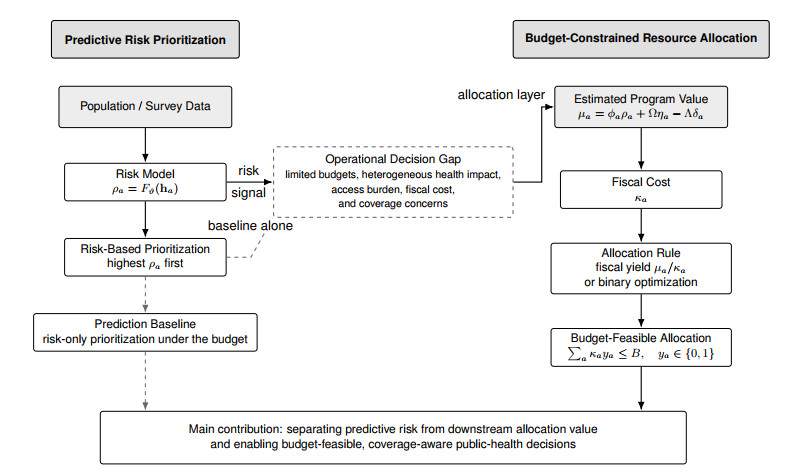
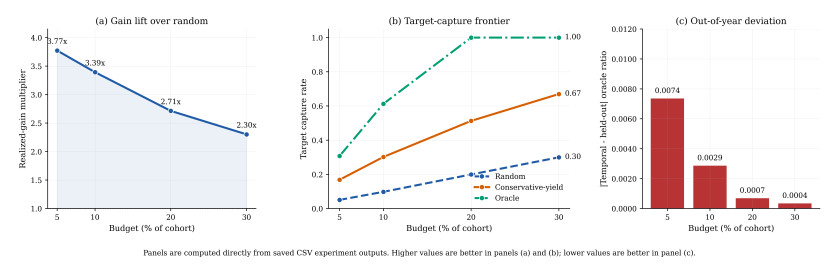
Health artificial intelligence (AI) risk models can rank individuals by predicted need, but a risk score alone does not determine a budget-feasible allocation when programs' value, fiscal cost, and access conditions differ. We study how AI risk scores can be translated into public health resource allocation decisions under a common budget. Using 2024 Behavioral Risk Factor Surveillance System (BRFSS) public use data, we estimate a 29-variable risk model for a retrospective self-reported diabetes/prediabetes-related target (area under the receiver operating characteristic curve (AUC) 0.8002; average precision 0.4331). A transparent five-variable comparator yields an AUC of 0.7781 and average precision of 0.3848. Relative to the full risk ranking, fiscal yield allocation improves the held-out retrospective value by 1.30%, 0.90%, 0.53%, and 0.42% across 5%, 10%, 20%, and 30% budgets, respectively, while closely matching the prospective binary benchmark. The direction is stable across 30 repeated model refits, although the bootstrap intervals do not exclude zero at every budget. Cost–stress and survey-weighted analyses further show that allocation value depends on cost heterogeneity and coverage objectives. Prediction therefore provides most first-order prioritization value, while downstream allocation offers smaller, context-dependent refinements. The analysis is retrospective and does not estimate causal intervention effects or identify previously undiagnosed disease.
Citation: Jinho Cha, Eun-Young Kwon. From health AI risk scores to budget-feasible decisions: Predictive optimization for public health resource allocation[J]. Journal of Industrial and Management Optimization, 2026, 22(11): 5651-5691. doi: 10.3934/jimo.2026192
Health artificial intelligence (AI) risk models can rank individuals by predicted need, but a risk score alone does not determine a budget-feasible allocation when programs' value, fiscal cost, and access conditions differ. We study how AI risk scores can be translated into public health resource allocation decisions under a common budget. Using 2024 Behavioral Risk Factor Surveillance System (BRFSS) public use data, we estimate a 29-variable risk model for a retrospective self-reported diabetes/prediabetes-related target (area under the receiver operating characteristic curve (AUC) 0.8002; average precision 0.4331). A transparent five-variable comparator yields an AUC of 0.7781 and average precision of 0.3848. Relative to the full risk ranking, fiscal yield allocation improves the held-out retrospective value by 1.30%, 0.90%, 0.53%, and 0.42% across 5%, 10%, 20%, and 30% budgets, respectively, while closely matching the prospective binary benchmark. The direction is stable across 30 repeated model refits, although the bootstrap intervals do not exclude zero at every budget. Cost–stress and survey-weighted analyses further show that allocation value depends on cost heterogeneity and coverage objectives. Prediction therefore provides most first-order prioritization value, while downstream allocation offers smaller, context-dependent refinements. The analysis is retrospective and does not estimate causal intervention effects or identify previously undiagnosed disease.

| [1] |
J. Kleinberg, H. Lakkaraju, J. Leskovec, J. Ludwig, S. Mullainathan, Human decisions and machine predictions, Q. J. Econ., 133 (2018), 237–293. https://doi.org/10.1093/qje/qjx032 doi: 10.1093/qje/qjx032

|
| [2] |
A. N. Elmachtoub, P. Grigas, Smart "predict, then optimize", Manag. Sci., 68 (2022), 9–26. https://doi.org/10.1287/mnsc.2020.3922 doi: 10.1287/mnsc.2020.3922
|
| [3] |
D. Bertsimas, N. Kallus, From predictive to prescriptive analytics, Manag. Sci., 66 (2020), 1025–1044. https://doi.org/10.1287/mnsc.2018.3253 doi: 10.1287/mnsc.2018.3253
|
| [4] | B. Wilder, B. Dilkina, M. Tambe, Melding the data-decisions pipeline: Decision-focused learning for combinatorial optimization, In: Proceedings of the AAAI Conference on Artificial Intelligence, 33 (2019), 1658–1665. https://doi.org/10.1609/aaai.v33i01.33011658 |
| [5] | P. L. Donti, B. Amos, J. Z. Kolter, Task-based end-to-end model learning in stochastic optimization, In: Advances in Neural Information Processing Systems, 30 (2017), 5484–5494. Available from: https://papers.neurips.cc/paper/7132-task-based-end-to-end-model-learning-in-stochastic-optimization. |
| [6] | T. Tulabandhula, C. Rudin, Machine learning with operational costs, J. Mach. Learn. Res., 14 (2013), 1989–2028. Available from: https://jmlr.org/papers/v14/tulabandhula13a.html. |
| [7] |
Y. Deng, T. C. Y. Chan, E. Delage, L. Yin, Robust and data-driven optimization in healthcare operations, INFORMS J. Comput., 30 (2018), 373–394. https://doi.org/10.1287/ijoc.2017.0778 doi: 10.1287/ijoc.2017.0778
|
| [8] | S. Martello, P. Toth, Knapsack Problems: Algorithms and Computer Implementations, John Wiley & Sons, Chichester, UK, 1990. |
| [9] | H. Kellerer, U. Pferschy, D. Pisinger, Knapsack Problems, Springer, Berlin, Heidelberg, 2004. https://doi.org/10.1007/978-3-540-24777-7 |
| [10] | D. Pisinger, P. Toth, Knapsack problems, In: Handbook of Combinatorial Optimization, Kluwer Academic Publishers, Boston, MA, 1998,299–428. https://doi.org/10.1007/978-1-4613-0303-9_5 |
| [11] | Ding-Zhu Du, Panos M. Pardalos, Handbook of Combinatorial Optimization, Kluwer Academic Publishers, Boston, MA, 1998. https://doi.org/10.1007/978-1-4613-0303-9 |
| [12] | G. L. Nemhauser, L. A. Wolsey, Integer and Combinatorial Optimization, John Wiley & Sons, New York, 1988. https://doi.org/10.1002/9781118627372 |
| [13] | L. A. Wolsey, Integer Programming, John Wiley & Sons, New York, 1998. |
| [14] | A. Schrijver, Combinatorial Optimization: Polyhedra and Efficiency, Springer, Berlin, Heidelberg, 2003. |
| [15] | R. M. Karp, Reducibility among combinatorial problems, In: Complexity of Computer Computations, Springer, Boston, MA, 1972, 85–103. https://doi.org/10.1007/978-1-4684-2001-2_9 |
| [16] | V. V. Vazirani, Approximation Algorithms, Springer, Berlin, Heidelberg, 2001. https://doi.org/10.1007/978-3-662-04565-7 |
| [17] | A. H. Mokdad, D. F. Stroup, W. H. Giles, Public health surveillance for behavioral risk factors in a changing environment: Recommendations from the behavioral risk factor surveillance team, MMWR Recomm. Rep., 52 (2003), 1–12. Available from: https://www.cdc.gov/mmwr/preview/mmwrhtml/rr5209a1.htm. |
| [18] | Centers for Disease Control and Prevention, Behavioral risk factor surveillance system: 2023 survey data and documentation, Public-use data and documentation, 2024. Available from: https://www.cdc.gov/brfss/annual_data/annual_2023.html. |
| [19] | Centers for Disease Control and Prevention, Behavioral risk factor surveillance system: 2024 survey data and documentation, Public-use data and documentation, 2025. Available from: https://www.cdc.gov/brfss/annual_data/annual_2024.html |
| [20] |
H. Wang, Z. Cui, Y. Chen, M. Avidan, A. B. Abdallah, A. Kronzer, Predicting hospital readmission via cost-sensitive deep learning, IEEE/ACM Trans. Comput. Biol. Bioinform., 15 (2018), 1968–1978. https://doi.org/10.1109/TCBB.2018.2827029 doi: 10.1109/TCBB.2018.2827029
|
| [21] | J. R. Birge, F. Louveaux, Introduction to Stochastic Programming, Springer, New York, 2011. https://doi.org/10.1007/978-1-4614-0237-4 |
| [22] |
A. Shapiro, Monte carlo sampling methods, Handbooks Oper. Res. Manag. Sci., 10 (2003), 353–425. https://doi.org/10.1016/S0927-0507(03)10006-0 doi: 10.1016/S0927-0507(03)10006-0
|
| [23] |
A. J. Kleywegt, A. Shapiro, T. Homem-de Mello, The sample average approximation method for stochastic discrete optimization, SIAM J. Optim., 12 (2002), 479–502. https://doi.org/10.1137/S1052623499363220 doi: 10.1137/S1052623499363220
|
| [24] | S. Asur, B. A. Huberman, Predicting the future with social media, In: Proceedings of the 2010 IEEE/WIC/ACM International Conference on Web Intelligence and Intelligent Agent Technology, 2010,492–499. https://doi.org/10.1109/WI-IAT.2010.63 |
| [25] |
H. Choi, H. Varian, Predicting the present with google trends, Econ. Rec., 88 (2012), 2–9. https://doi.org/10.1111/j.1475-4932.2012.00809.x doi: 10.1111/j.1475-4932.2012.00809.x
|
| [26] | D. Gruhl, R. Guha, R. Kumar, J. Novak, A. Tomkins, The predictive power of online chatter, In: Proceedings of the Eleventh ACM SIGKDD International Conference on Knowledge Discovery in Data Mining, 2005, 78–87. https://doi.org/10.1145/1081870.1081883 |
| [27] |
S. Goel, J. M. Hofman, S. Lahaie, D. M. Pennock, D. J. Watts, Predicting consumer behavior with web search, Proc. Natl. Acad. Sci. U.S.A., 107 (2010), 17486–17490. https://doi.org/10.1073/pnas.1005962107 doi: 10.1073/pnas.1005962107
|
| [28] |
Z. Da, J. Engelberg, P. Gao, In search of attention, J. Finance, 66 (2011), 1461–1499. https://doi.org/10.1111/j.1540-6261.2011.01679.x doi: 10.1111/j.1540-6261.2011.01679.x
|
| [29] |
A. Rajkomar, E. Oren, K. Chen, A. M. Dai, N. Hajaj, M. Hardt, P. J. Liu, et al., Scalable and accurate deep learning with electronic health records, npj Digit. Med., 1 (2018), 18. https://doi.org/10.1038/s41746-018-0029-1 doi: 10.1038/s41746-018-0029-1
|
| [30] |
A. L. Beam, I. S. Kohane, Big data and machine learning in health care, JAMA, 319 (2018), 1317–1318. https://doi.org/10.1001/jama.2017.18391 doi: 10.1001/jama.2017.18391
|
| [31] |
E. J. Topol, High-performance medicine: The convergence of human and artificial intelligence, Nat. Med., 25 (2019), 44–56. https://doi.org/10.1038/s41591-018-0300-7 doi: 10.1038/s41591-018-0300-7
|
| [32] |
Z. Obermeyer, E. J. Emanuel, Predicting the future: Big data, machine learning, and clinical medicine, N. Engl. J. Med., 375 (2016), 1216–1219. https://doi.org/10.1056/NEJMp1606181 doi: 10.1056/NEJMp1606181
|
| [33] |
J. H. Chen, S. M. Asch, Machine learning and prediction in medicine: Beyond the peak of inflated expectations, N. Engl. J. Med., 376 (2017), 2507–2509. https://doi.org/10.1056/NEJMp1702071 doi: 10.1056/NEJMp1702071
|
| [34] |
D. C. Angus, R. Khera, T. Lieu et al., AI, health, and health care today and tomorrow: The JAMA summit report on artificial intelligence, JAMA, 334 (2025), 1650–1664. https://doi.org/10.1001/jama.2025.18490 doi: 10.1001/jama.2025.18490
|
| [35] |
J. Wiens, S. Saria, M. Sendak, M. Ghassemi, V. X. Liu, F. Doshi-Velez, et al., Do no harm: A roadmap for responsible machine learning for health care, Nat. Med., 25 (2019), 1337–1340. https://doi.org/10.1038/s41591-019-0548-6 doi: 10.1038/s41591-019-0548-6
|
| [36] |
C. J. Kelly, A. Karthikesalingam, M. Suleyman, G. Corrado, D. King, Key challenges for delivering clinical impact with artificial intelligence, BMC Med., 17 (2019), 195. https://doi.org/10.1186/s12916-019-1426-2 doi: 10.1186/s12916-019-1426-2
|
| [37] |
E. H. Weissler, T. Naumann, T. Andersson et al., The role of machine learning in clinical research: Transforming the future of evidence generation, Trials, 22 (2021), 537. https://doi.org/10.1186/s13063-021-05489-x doi: 10.1186/s13063-021-05489-x
|
| [38] |
L. Clifton, J. Powell, D. A. Clifton, A. Sheikh, When to and when not to use machine learning in risk prediction models, Lancet Digit. Health, 8 (2026), 100954. https://doi.org/10.1016/j.landig.2025.100954 doi: 10.1016/j.landig.2025.100954
|
| [39] |
MARS-ED Investigators, Machine learning for risk stratification in the emergency department (MARS-ED): A randomized controlled trial, Nat. Commun., 17 (2026), 242. https://doi.org/10.1038/s41467-025-66947-7 doi: 10.1038/s41467-025-66947-7
|
| [40] |
M. Khan, M. Rashid, U. Ghani, M. Saleem, M. Faheem, M. A. Khan, Access and privacy control for healthcare decision support system: A smart medical data exchange engine (SMDEE), CAAI Trans. Intell. Technol., 10 (2025), 1616–1632. https://doi.org/10.1049/cit2.70077 doi: 10.1049/cit2.70077
|
| [41] |
Z. Obermeyer, B. Powers, C. Vogeli, S. Mullainathan, Dissecting racial bias in an algorithm used to manage the health of populations, Science, 366 (2019), 447–453. https://doi.org/10.1126/science.aax2342 doi: 10.1126/science.aax2342
|
| [42] |
K. Ladin, J. Cuddeback, O. K. Duru, S. Goel, W. Harvey, J. G. Park, et al., Guidance for unbiased predictive information for healthcare decision-making and equity (GUIDE): Considerations when race may be a prognostic factor, npj Digit. Med., 7 (2024), 290. https://doi.org/10.1038/s41746-024-01245-y doi: 10.1038/s41746-024-01245-y
|
| [43] |
A. Rajkomar, M. Hardt, M. D. Howell, G. Corrado, M. H. Chin, Ensuring fairness in machine learning to advance health equity, Ann. Intern. Med., 169 (2018), 866–872. https://doi.org/10.7326/M18-1990 doi: 10.7326/M18-1990
|
| [44] |
Y. Yang, H. Zhang, J. W. Gichoya, D. Katabi, M. Ghassemi, The limits of fair medical imaging AI in real-world generalization, Nat. Med., 30 (2024), 2838–2848. https://doi.org/10.1038/s41591-024-03113-4 doi: 10.1038/s41591-024-03113-4
|
| [45] | J. Grand-Clément, Y. H. Goh, C. Chan, V. Goyal, E. Chuang, Interpretable machine learning for resource allocation with application to ventilator triage, 2021. https://arXiv.org/abs/2110.10994 |
| [46] |
S. Deo, K. Rajaram, S. Rath, U. S. Karmarkar, M. B. Goetz, Planning for HIV screening, testing, and care at the veterans health administration, Oper. Res., 63 (2015), 287–304. https://doi.org/10.1287/opre.2015.1353 doi: 10.1287/opre.2015.1353
|
| [47] |
C. W. Chan, V. F. Farias, N. Bambos, G. J. Escobar, Optimizing intensive care unit discharge decisions with patient readmissions, Oper. Res., 60 (2012), 1323–1341. https://doi.org/10.1287/opre.1120.1105 doi: 10.1287/opre.1120.1105
|
| [48] |
D. W. Bates, S. Saria, L. Ohno-Machado, A. Shah, G. Escobar, Big data in health care: Using analytics to identify and manage high-risk and high-cost patients, Health Aff., 33 (2014), 1123–1131. https://doi.org/10.1377/hlthaff.2014.0041 doi: 10.1377/hlthaff.2014.0041
|
| [49] |
P. W. F. Wilson, J. B. Meigs, L. Sullivan, C. S. Fox, D. M. Nathan, R. B. D'Agostino, Prediction of incident diabetes mellitus in middle-aged adults: The framingham offspring study, Arch. Intern. Med., 167 (2007), 1068–1074. https://doi.org/10.1001/archinte.167.10.1068 doi: 10.1001/archinte.167.10.1068
|
| [50] |
J. Lindström, J. Tuomilehto, The diabetes risk score: A practical tool to predict type 2 diabetes risk, Diabetes Care, 26 (2003), 725–731. https://doi.org/10.2337/diacare.26.3.725 doi: 10.2337/diacare.26.3.725
|
| [51] |
H. Bang, A. M. Edwards, A. S. Bomback, C. M. Ballantyne, D. Brillon, M. A. Callahan, et al., Development and validation of a patient self-assessment score for diabetes risk, Ann. Intern. Med., 151 (2009), 775–783. https://doi.org/10.7326/0003-4819-151-11-200912010-00005 doi: 10.7326/0003-4819-151-11-200912010-00005
|
| [52] |
R. Kahn, P. Alperin, D. Eddy, K. Borch-Johnsen, J. Buse, J. Feigelman, et al., Age at initiation and frequency of screening to detect type 2 diabetes: A cost-effectiveness analysis, Lancet, 375 (2010), 1365–1374. https://doi.org/10.1016/S0140-6736(09)62162-0 doi: 10.1016/S0140-6736(09)62162-0
|
| [53] |
E. W. Gregg, X. Zhuo, Y. J. Cheng, A. L. Albright, K. M. V. Narayan, T. J. Thompson, Trends in lifetime risk and years of life lost due to diabetes in the USA, 1985–2011: A modelling study, Lancet Diabetes Endocrinol., 2 (2014), 867–874. https://doi.org/10.1016/S2213-8587(14)70161-5 doi: 10.1016/S2213-8587(14)70161-5
|
| [54] |
A. L. Soyster, Convex programming with set-inclusive constraints and applications to inexact linear programming, Oper. Res., 21 (1973), 1154–1157. https://doi.org/10.1287/opre.21.5.1154 doi: 10.1287/opre.21.5.1154
|
| [55] |
A. Ben-Tal, A. Nemirovski, Robust convex optimization, Math. Oper. Res., 23 (1998), 769–805. https://doi.org/10.1287/moor.23.4.769 doi: 10.1287/moor.23.4.769
|
| [56] |
D. Bertsimas, M. Sim, The price of robustness, Oper. Res., 52 (2004), 35–53. https://doi.org/10.1287/opre.1030.0065 doi: 10.1287/opre.1030.0065
|
| [57] | A. Ben-Tal, L. El Ghaoui, A. Nemirovski, Robust Optimization, Princeton University Press, Princeton, NJ, 2009. https://doi.org/10.1515/9781400831050 |
| [58] |
W. Wiesemann, D. Kuhn, M. Sim, Distributionally robust convex optimization, Oper. Res., 62 (2014), 1358–1376. https://doi.org/10.1287/opre.2014.1314 doi: 10.1287/opre.2014.1314
|
| [59] |
E. Delage, Y. Ye, Distributionally robust optimization under moment uncertainty with application to data-driven problems, Oper. Res., 58 (2010), 595–612. https://doi.org/10.1287/opre.1090.0741 doi: 10.1287/opre.1090.0741
|
| [60] |
P. Mohajerin Esfahani, D. Kuhn, Data-driven distributionally robust optimization using the wasserstein metric: Performance guarantees and tractable reformulations, Math. Program., 171 (2018), 115–166. https://doi.org/10.1007/s10107-017-1172-1 doi: 10.1007/s10107-017-1172-1
|
| [61] |
R. T. Rockafellar, S. Uryasev, Optimization of conditional value-at-risk, J. Risk, 2 (2000), 21–41. https://doi.org/10.21314/JOR.2000.038 doi: 10.21314/JOR.2000.038
|
| [62] |
G. S. Collins, J. B. Reitsma, D. G. Altman, K. G. M. Moons, Transparent reporting of a multivariable prediction model for individual prognosis or diagnosis (TRIPOD): The TRIPOD statement, Ann. Intern. Med., 162 (2015), 55–63. https://doi.org/10.7326/M14-0697 doi: 10.7326/M14-0697
|
| [63] |
K. G. M. Moons, D. G. Altman, J. B. Reitsma, J. P. A. Ioannidis, P. Macaskill, E. W. Steyerberg, et al., Transparent reporting of a multivariable prediction model for individual prognosis or diagnosis (TRIPOD): Explanation and elaboration, Ann. Intern. Med., 162 (2015), W1–W73. https://doi.org/10.7326/M14-0698 doi: 10.7326/M14-0698
|
| [64] |
A. J. Vickers, E. B. Elkin, Decision curve analysis: A novel method for evaluating prediction models, Med. Decis. Making, 26 (2006), 565–574. https://doi.org/10.1177/0272989X06295361 doi: 10.1177/0272989X06295361
|
| [65] |
D. Pisinger, An exact algorithm for large multiple knapsack problems, Eur. J. Oper. Res., 114 (1999), 528–541. https://doi.org/10.1016/S0377-2217(98)00120-9 doi: 10.1016/S0377-2217(98)00120-9
|
| [66] |
H. Rahimian, S. Mehrotra, Frameworks and results in distributionally robust optimization, Open J. Math. Optim., 3 (2022), 1–85. https://doi.org/10.5802/ojmo.15 doi: 10.5802/ojmo.15
|
Figures(6) / Tables(12)
Jinho Cha, Eun-Young Kwon. From health AI risk scores to budget-feasible decisions: Predictive optimization for public health resource allocation[J]. Journal of Industrial and Management Optimization, 2026, 22(11): 5651-5691. doi: 10.3934/jimo.2026192




 DownLoad: