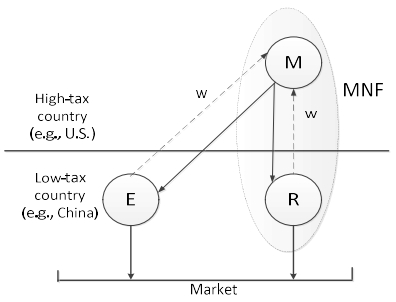
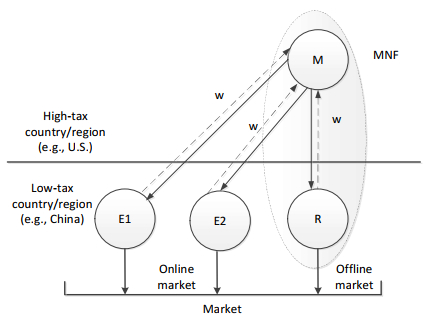
The e-tailers selling global brands' products on cross-border e-commerce platforms have been suffering from low-quality image. To solve this problem, some platforms (e.g., JD.com, eBay and Tmall Global) have utilized blockchain for quality verification. However, there is scant literature investigating the decision on blockchain adoption of the multinational firms on cross-border e-commerce platforms and its impact on the firms' production decisions. To address this gap, we developed a game-theoretic model to examine the supply chain parties' intention to participate in blockchain in a setting with one multinational firm (MNF) owning retail divisions, which competes with the e-tailers who sell the MNF's brand products in a low tax country. Considering the number of the e-tailers on the cross-border e-commerce platforms selling global brands' products is in a monopoly or in a duopoly, we investigated the blockchain adoption by multinational firms under different market structures. We found that, first, different blockchain adoption patterns will shape distinct channel competition structures, thereby directly affecting the MNF's pricing strategy and responsiveness to tax disparity by altering the degree of competitive equilibrium and channel symmetry. Second, blockchain is a double-edged sword for the MNF, which increases the MNF's wholesaling profit, but reduces the MNF's retailing and tax-planning profits. Consequently, when the e-tailer monopolizes the cross-border e-commerce market, the MNF tends to refuse to participate in blockchain. However, under a duopoly cross-border e-commerce market, the MNF prefers joint blockchain participation with both e-tailers when the stronger e-tailer has a high-quality image, particularly when the fixed cost of blockchain adoption and tax disparity are low. Third, the MNF's blockchain adoption incentive increases with e-tailers' quality image but decreases with cross-border tax disparity. In this study, we clarify that the MNF and regulators should take downstream market structure and international tax disparity into consideration when promoting blockchain-enabled product quality-verification infrastructure.
Citation: Fei Yan, Xiao-ping Wang, Zhi-chao Zhang. Should multinational firms participate in blockchain to provide quality verification under different market structures?[J]. Journal of Industrial and Management Optimization, 2026, 22(11): 5588-5624. doi: 10.3934/jimo.2026190
The e-tailers selling global brands' products on cross-border e-commerce platforms have been suffering from low-quality image. To solve this problem, some platforms (e.g., JD.com, eBay and Tmall Global) have utilized blockchain for quality verification. However, there is scant literature investigating the decision on blockchain adoption of the multinational firms on cross-border e-commerce platforms and its impact on the firms' production decisions. To address this gap, we developed a game-theoretic model to examine the supply chain parties' intention to participate in blockchain in a setting with one multinational firm (MNF) owning retail divisions, which competes with the e-tailers who sell the MNF's brand products in a low tax country. Considering the number of the e-tailers on the cross-border e-commerce platforms selling global brands' products is in a monopoly or in a duopoly, we investigated the blockchain adoption by multinational firms under different market structures. We found that, first, different blockchain adoption patterns will shape distinct channel competition structures, thereby directly affecting the MNF's pricing strategy and responsiveness to tax disparity by altering the degree of competitive equilibrium and channel symmetry. Second, blockchain is a double-edged sword for the MNF, which increases the MNF's wholesaling profit, but reduces the MNF's retailing and tax-planning profits. Consequently, when the e-tailer monopolizes the cross-border e-commerce market, the MNF tends to refuse to participate in blockchain. However, under a duopoly cross-border e-commerce market, the MNF prefers joint blockchain participation with both e-tailers when the stronger e-tailer has a high-quality image, particularly when the fixed cost of blockchain adoption and tax disparity are low. Third, the MNF's blockchain adoption incentive increases with e-tailers' quality image but decreases with cross-border tax disparity. In this study, we clarify that the MNF and regulators should take downstream market structure and international tax disparity into consideration when promoting blockchain-enabled product quality-verification infrastructure.

| [1] |
S. P. Parvasi, A. A. Taleizadeh, L. E. Cárdenas-Barrón, Retail price competition of domestic and international companies: A bi-level game theoretical optimization approach, RAIRO Oper. Res., 57 (2023), 291–323. https://doi.org/10.1051/ro/2023007 doi: 10.1051/ro/2023007

|
| [2] |
B. Niu, Z. Mu, B. Cao, J. Gao, Should multinational firms implement blockchain to provide quality verification? Transp. Res. E, 145 (2021), 102121. https://doi.org/10.1016/j.tre.2020.102121 doi: 10.1016/j.tre.2020.102121
|
| [3] |
X. Zhang, X. Zha, B. Dan, Y. Liu, R. Sui, Logistics mode selection and information sharing in a cross-border e-commerce supply chain with competition, Eur. J. Oper. Res., 314 (2024), 136–151. https://doi.org/10.1016/j.ejor.2023.08.058 doi: 10.1016/j.ejor.2023.08.058
|
| [4] | X. Liu, Y. He, P. G. Hooshmand, S. Li, Dynamic optimization of e-commerce supply chains for fresh products with blockchain and reference effect, Technol. Forecast. Soc. Change., 2025. https://doi.org/10.1016/j.techfore.2025.124040 |
| [5] |
E. H. Caoui, C. Farronato, J. J. Horton, R. Schultz, Consumer demand with social influences: evidence from an E-Commerce platform, Manag. Sci., 72 (2025), 3550–3570. https://doi.org/10.1287/mnsc.2024.04995 doi: 10.1287/mnsc.2024.04995
|
| [6] |
Z. Zhang, H. Xu, K. Chen, Y. Zhao, Z. Liu, Channel mode selection for an E-platform supply chain in the presence of a secondary marketplace, Eur. J. Oper. Res., 305 (2023), 1215–1235. https://doi.org/10.1016/j.ejor.2022.06.064 doi: 10.1016/j.ejor.2022.06.064
|
| [7] |
A. E. Roth, What have we learned from market design? Econ. J., 118 (2008), 285–310. https://doi.org/10.1111/j.1468-0297.2007.02121.x doi: 10.1111/j.1468-0297.2007.02121.x
|
| [8] | X. Xu, R. Fan, D. Wang, Y. Wang, Y. Wang, The role of consumer reviews in e-commerce platform credit supervision: A signaling game model based on complex network, Electron. Commer. Res. Appl., 2024. https://doi.org/10.1016/j.elerap.2023.101347 |
| [9] |
C. Troncoso-Valverde, F. Chávez-Bustamante, Do you want to know a secret? Strategic alliances and competition in product markets, Eur. J. Oper. Res., 313 (2024), 1180–1190. https://doi.org/ 10.1016/j.ejor.2023.10.004 doi: 10.1016/j.ejor.2023.10.004
|
| [10] | L. Li, X. Fang, Y. F. Lim, Asymmetric information of product authenticity on C2C e-commerce platforms: How can inspection services help? Manuf. Serv. Oper. Manag., 25 (2023), 631–647. https://doi.org/10.1287/msom.2023.1186 |
| [11] | P. Suryawanshi, P. Dutta, Optimization models for supply chains under risk, uncertainty, and resilience: A state-of-the-art review and future research directions, Transp. Res. E., 2022. https://doi.org/10.1016/j.tre.2021.102553 |
| [12] |
O. I. Oriekhoe, B. I. Ashiwaju, K. C. Ihemereze, U. Ikwue, C. A. Udeh, Blockchain technology in supply chain management: A comprehensive review, Int. J. Manag. Entrep. Res., 6 (2024), 150–166. https://doi.org/10.51594/ijmer.v6i1.714 doi: 10.51594/ijmer.v6i1.714
|
| [13] | F. J. M. Carrascosa, S. G. Galán, M. V. Ibáñez, M. Szczerska, T. Marciniak, N. R. Reyes, Fuzzy game-theoretic optimization for sustainable cloud computing, Eng. Appl. Artif. Intell., 2025. https://doi.org/10.1016/j.engappai.2025.112725 |
| [14] | M. N. Agi, A. K. Jha, Blockchain technology in the supply chain: An integrated theoretical perspective of organizational adoption, Int. J. Prod. Econ., 2022. https://doi.org/10.1016/j.ijpe.2022.108458 |
| [15] | A. Babaei, E. B. Tirkolaee, S. S. Ali, Innovative supply chain network design with two-step authentication and environmentally-friendly blockchain technology, Ann. Oper. Res., 2024. https://doi.org/10.1007/s10479-024-05950-5 |
| [16] |
M. Quayson, C. Bai, J. Sarkis, M. A. Hossin, Evaluating barriers to blockchain technology for sustainable agricultural supply chain: A fuzzy hierarchical group DEMATEL approach, Oper. Manag. Res., 17 (2024), 728–753. https://doi.org/10.1007/s12063-024-00443-x doi: 10.1007/s12063-024-00443-x
|
| [17] | D. Ivanov, Conceptual and formal models for design, adaptation, and control of digital twins in supply chain ecosystems, Omega, 2025. https://doi.org/10.1016/j.omega.2025.103356 |
| [18] | B. Niu, Y. Ruan, H. Xu, Turn a blind eye? E-tailer's blockchain participation considering upstream competition between copycats and brands, Int. J. Prod. Econ., 2023. https://doi.org/10.1016/j.ijpe.2023.109009 |
| [19] |
N. Kshetri, Blockchain's roles in meeting key supply chain management objectives, Int. J. Inf. Manag., 39 (2018), 80-89. https://doi.org/10.1016/j.ijinfomgt.2017.12.005 doi: 10.1016/j.ijinfomgt.2017.12.005
|
| [20] |
N. Gaur, Blockchain challenges in adoption, Manag. Finance, 46 (2019), 849–858. https://doi.org/10.1108/mf-07-2019-0328 doi: 10.1108/mf-07-2019-0328
|
| [21] |
T. M. Choi, Blockchain technology supported platforms for diamond authentication and certification in luxury supply chains, Transp. Res. E, 128 (2019), 17–29. https://doi.org/10.1016/j.tre.2019.05.011 doi: 10.1016/j.tre.2019.05.011
|
| [22] | D. Ivanov, Intelligent digital twin (iDT) for supply chain stress-testing, resilience, and viability, Int. J. Prod. Econ., 2023. https://doi.org/10.1016/j.ijpe.2023.108938 |
| [23] | T. M. Choi, S. Guo, S. Luo, When blockchain meets social-media: Will the result benefit social media analytics for supply chain operations management? Transp. Res. E., 2020. https://doi.org/10.1016/j.tre.2020.101860 |
| [24] | N. Kshetri, Blockchain and sustainable supply chain management in developing countries, Int. J. Inf. Manag., 2021. https://doi.org/10.1016/j.ijinfomgt.2021.102376 |
| [25] |
B. Niu, N. Zhang, Z. Mu, Overseas production or domestic production? Impacts of tax disparity and market difference, Eur. J. Oper. Res., 320 (2025), 670–681. https://doi.org/10.1016/j.ejor.2024.09.012 doi: 10.1016/j.ejor.2024.09.012
|
| [26] | L. S. Shapley, A value for n-person games, in: H. Kuhn, A. Tucker (Eds.), Contributions to the theory of games II, Princeton University Press, Princeton, 1953,307–317. https://doi.org/10.1515/9781400881970-018 |
| [27] |
S. Ergün, P. Usta, S. Z. Alparslan Gök, G. W. Weber, A game theoretical approach to emergency logistics planning in natural disasters, Ann. Oper. Res., 324 (2023), 855–868. https://doi.org/10.1007/s10479-021-04099-9 doi: 10.1007/s10479-021-04099-9
|
| [28] |
İ. Özcan, J. D. Śledziński, S. Z. Alparslan Gök, M. Butlewski, G. W. Weber, Mathematical encouragement of companies to cooperate by using cooperative games with fuzzy approach, J. Ind. Manag. Optim., 19 (2023), 7180–7195. https://doi.org/10.3934/jimo.2022258 doi: 10.3934/jimo.2022258
|
| [29] |
B. Kim, K. S. Park, S. Y. Jung, S. H. Park, Offshoring and outsourcing in a global supply chain: Impact of the arm's length regulation on transfer pricing, Eur. J. Oper. Res., 266 (2018), 88–98. https://doi.org/10.1016/j.ejor.2017.09.004 doi: 10.1016/j.ejor.2017.09.004
|
| [30] |
B. Niu, Y. Liu, F. Liu, C. K. M. Lee, Transfer pricing and channel structure of a multinational firm under overseas retail disruption risk, Int. J. Prod. Res., 57 (2019), 2901–2925. https://doi.org/10.1080/00207543.2018.1516902 doi: 10.1080/00207543.2018.1516902
|
| [31] |
B. Niu, J. Xu, C. K. M. Lee, L. Chen, Order timing and tax planning when selling to a rival in a low-tax emerging market, Transp. Res. E, 123 (2019), 165–179. https://doi.org/10.1016/j.tre.2019.01.014 doi: 10.1016/j.tre.2019.01.014
|
| [32] |
G. Lai, Y. Liu, W. Xiao, International taxation and production outsourcing, Prod. Oper. Manag., 30 (2021), 402–418. https://doi.org/10.1111/poms.13260 doi: 10.1111/poms.13260
|
| [33] |
J. Yoon, S. Talluri, H. Yildiz, C. Sheu, The value of blockchain technology implementation in international trades under demand volatility risk, Int. J. Prod. Res., 58 (2020), 2163–2183. https://doi.org/10.1080/00207543.2019.1693651 doi: 10.1080/00207543.2019.1693651
|
| [34] | B. Mishra, R. K. Singh, R. Mishra, D. Demirkol, T. Daim, Blockchain adoption in automotive supply chain: A systematic literature review amalgamated with bibliometric analysis technique and future research directions, Technol. Soc., 2025. https://doi.org/10.1016/j.techsoc.2024.102775 |
| [35] |
V. Babich, G. Hilary, Distributed ledgers and operations: What operations management researchers should know about blockchain technology, Manuf. Serv. Oper. Manag., 22 (2020), 223–240. https://doi.org/10.1287/msom.2018.0752 doi: 10.1287/msom.2018.0752
|
| [36] | C. Cao, Y. He, Y. Liu, H. Huang, F. Zhang, Blockchain technology adoption mechanism for semiconductor chip supply chains considering information disclosure under cost-sharing contract, Int. J. Prod. Econ., 2025. https://doi.org/10.1016/j.ijpe.2024.109496 |
| [37] | N. Kumar, K. Kumar, A. Aeron, F. Verre, Blockchain technology in supply chain management: Innovations, applications, and challenges, Telemat. Inform. Rep., 2025. https://doi.org/10.1016/j.teler.2025.100204 |
| [38] |
S. Z. Alparslan Gök, İ. Özcan, On big boss fuzzy interval games, Eur. J. Oper. Res., 306 (2023), 1040–1046. https://doi.org/10.1016/j.ejor.2022.03.026 doi: 10.1016/j.ejor.2022.03.026
|
| [39] |
İ. Özcan, J. D. Śledziński, S. Z. Alparslan Gök, A. Meca, G. W. Weber, M. Butlewski, A game theory perspective on strategic profit distribution in complex IT projects, J. Ind. Manag. Optim., 21 (2025), 1503–1517. https://doi.org/10.3934/jimo.2024135 doi: 10.3934/jimo.2024135
|
| [40] | I. P. Kabanov, Models of tax and other payments collection in cross-border electronic commerce, Russ. Foreign Econ. J., 10 (2017), 56–68. |
| [41] |
H. Li, Q. Qing, J. Wang, X. Hong, An analysis of technology licensing and parallel importation under different market structures, Eur. J. Oper. Res., 289 (2021), 132–143. https://doi.org/10.1016/j.ejor.2020.07.008 doi: 10.1016/j.ejor.2020.07.008
|
| [42] |
M. S. Altug, O. Sahin, Impact of parallel imports on pricing and product launch decisions in pharmaceutical industry, Prod. Oper. Manag., 28 (2019), 258–275. https://doi.org/10.1111/poms.12908 doi: 10.1111/poms.12908
|
| [43] |
S. C. Bulmus, S. X. Zhu, R. Teunter, Competition for cores in remanufacturing, Eur. J. Oper. Res., 233 (2014), 105–113. https://doi.org/10.1016/j.ejor.2013.08.025 doi: 10.1016/j.ejor.2013.08.025
|
| [44] | D. Xue, R. Teunter, S. X. Zhu, W. Zhou, Entering the high-end market by collecting and remanufacturing a competitor's high-end cores, Omega, 2021. https://doi.org/10.1016/j.omega.2019.102168 |
| [45] | A. Goli, Efficient optimization of robust project scheduling for industry 4.0: A hybrid approach based on machine learning and meta-heuristic algorithms, Int. J. Prod. Econ., 2024. https://doi.org/10.1016/j.ijpe.2024.109427 |
| [46] | A. Ala, A. Goli, Incorporating machine learning and optimization techniques for assigning patients to operating rooms by considering fairness policies, Eng. Appl. Artif. Intell., 2024. https://doi.org/10.1016/j.engappai.2024.108980 |
| [47] |
S. Rahmani, A. Goli, Robust sustainable canola oil-based biodiesel supply chain network design under supply and demand uncertainty, Environ. Sci. Pollut. Res., 30 (2023), 86268–86299. https://doi.org/10.1007/s11356-023-28044-4 doi: 10.1007/s11356-023-28044-4
|
| [48] |
I. Shahsavani, A. Goli, A systematic literature review of circular supply chain network design: Application of optimization models, Environ. Dev. Sustain., 27 (2025), 23483–23514. https://doi.org/10.1007/s10668-023-03362-2 doi: 10.1007/s10668-023-03362-2
|
| [49] |
C. S. Tang, L. P. Veelenturf, The strategic role of logistics in the industry 4.0 era, Transp. Res. E, 129 (2019), 1–11. https://doi.org/10.1016/j.tre.2019.06.004 doi: 10.1016/j.tre.2019.06.004
|
| [50] |
E. Savku, A stochastic control approach for constrained stochastic differential games with jumps and regimes, Mathematics, 11 (2023), 30–43. https://doi.org/10.3390/math11143043 doi: 10.3390/math11143043
|
| [51] | A. Hosseini, A. Goli, Energy-aware dual-channel agricultural supply chain network design under uncertainty, Comput. Ind. Eng., 2025. https://doi.org/10.1016/j.cie.2025.111294 |
| [52] |
J. Chod, N. Trichakis, G. Tsoukalas, H. Aspegren, M. Weber, On the financing benefits of supply chain transparency and blockchain adoption, Manag. Sci., 66 (2020), 4378–4396. https://doi.org/10.1287/mnsc.2019.3434 doi: 10.1287/mnsc.2019.3434
|
| [53] | A. Goli, Optimization of renewable energy project portfolio selection using hybrid AIS-AFS algorithm in an international case study, Sci. Rep., 2024. https://doi.org/10.1038/s41598-024-68449-w |
| [54] |
M. Shunko, L. Debo, S. Gavirneni, Transfer pricing and sourcing strategies for multinational firms, Prod. Oper. Manag., 23 (2014), 2043–2057. https://doi.org/10.1111/poms.12175 doi: 10.1111/poms.12175
|
 jimo-22-11-190-s001.pdf |
 |


Figures(12) / Tables(1)
Fei Yan, Xiao-ping Wang, Zhi-chao Zhang. Should multinational firms participate in blockchain to provide quality verification under different market structures?[J]. Journal of Industrial and Management Optimization, 2026, 22(11): 5588-5624. doi: 10.3934/jimo.2026190




 DownLoad: