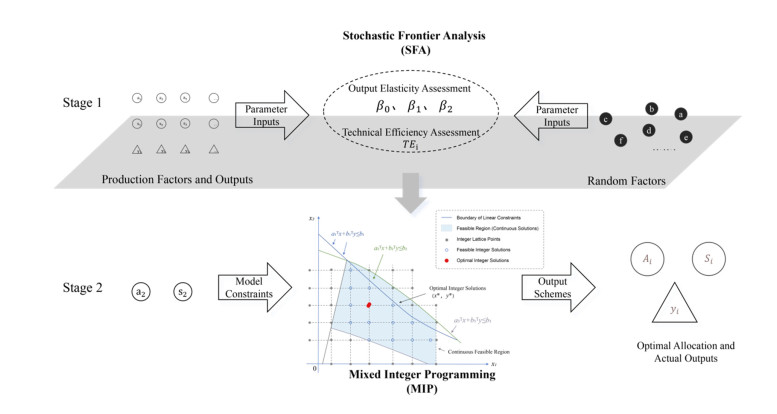
As e-commerce fulfillment complexity increases, intelligent warehouse systems centered on automated guided vehicles (AGVs) face increasingly stringent demands for resource allocation efficiency. The coordinated configuration of AGVs and workstations directly determines system productivity and operational costs. However, existing research often relies on deterministic assumptions or single optimization methods, which struggle to capture the impact of random factors—such as order arrivals and processing times—on system performance, and lack comprehensive analysis of resource coordination and optimal investment. To address this gap, this study proposes a joint optimization approach integrating stochastic frontier analysis (SFA) with mixed-integer nonlinear programming (MINLP), establishing an intelligent warehouse resource allocation model focused on the integrated optimization of AGVs and workstations. First, SFA is employed to separate environmental randomness from technical inefficiency, identifying the efficiency frontier under random disturbances and delineating the effective boundary of resource allocation. Second, an MINLP model is constructed under the constraint of this efficiency frontier to jointly optimize discrete investments and matching relationships between AGVs and workstations. By coupling efficiency evaluation with combinatorial optimization, this method overcomes the limitations of single approaches in handling uncertainty and achieving global optimization. Third, a case study at a large e-commerce company in China demonstrates that the model effectively identifies resource redundancy and imbalance: after optimization, the number of workstations and AGVs decreased by approximately 48% and 11%, respectively, achieving a reduction of resource inputs and a decline in weighted objective-function value, together with efficiency improvement. By introducing SFA into discrete resource optimization and deeply integrating it with MINLP, this research establishes a unified framework of efficiency frontier identification and resource optimization allocation, offering a novel methodology for designing intelligent warehouse systems under uncertain conditions.
Citation: Guanghui Fan, Weihua Liu, Chao Fan, Guodong Li, Hongxiao Zhang. A collaborative optimization model of efficiency frontier and resource in smart warehouses with stochastic disturbance[J]. Journal of Industrial and Management Optimization, 2026, 22(11): 5557-5587. doi: 10.3934/jimo.2026189
As e-commerce fulfillment complexity increases, intelligent warehouse systems centered on automated guided vehicles (AGVs) face increasingly stringent demands for resource allocation efficiency. The coordinated configuration of AGVs and workstations directly determines system productivity and operational costs. However, existing research often relies on deterministic assumptions or single optimization methods, which struggle to capture the impact of random factors—such as order arrivals and processing times—on system performance, and lack comprehensive analysis of resource coordination and optimal investment. To address this gap, this study proposes a joint optimization approach integrating stochastic frontier analysis (SFA) with mixed-integer nonlinear programming (MINLP), establishing an intelligent warehouse resource allocation model focused on the integrated optimization of AGVs and workstations. First, SFA is employed to separate environmental randomness from technical inefficiency, identifying the efficiency frontier under random disturbances and delineating the effective boundary of resource allocation. Second, an MINLP model is constructed under the constraint of this efficiency frontier to jointly optimize discrete investments and matching relationships between AGVs and workstations. By coupling efficiency evaluation with combinatorial optimization, this method overcomes the limitations of single approaches in handling uncertainty and achieving global optimization. Third, a case study at a large e-commerce company in China demonstrates that the model effectively identifies resource redundancy and imbalance: after optimization, the number of workstations and AGVs decreased by approximately 48% and 11%, respectively, achieving a reduction of resource inputs and a decline in weighted objective-function value, together with efficiency improvement. By introducing SFA into discrete resource optimization and deeply integrating it with MINLP, this research establishes a unified framework of efficiency frontier identification and resource optimization allocation, offering a novel methodology for designing intelligent warehouse systems under uncertain conditions.

| [1] |
S. Qu, X. Li, M. K. Lim, W. Liu, Z. Li, Y. Wang, Smart supply chain management: A systematic literature review and future research agenda, Int. J. Logist. Res. Appl., (2025), 1–29. https://doi.org/10.1080/13675567.2025.2569701 doi: 10.1080/13675567.2025.2569701

|
| [2] |
K. J. Roodbergen, I. F. A. Vis, A survey of literature on automated storage and retrieval systems, Eur. J. Oper. Res., 194 (2009), 343–362. https://doi.org/10.1016/j.ejor.2008.01.038 doi: 10.1016/j.ejor.2008.01.038
|
| [3] |
T. Lamballais, D. Roy, M. B. M. De Koster, Estimating performance in a robotic mobile fulfillment system, Eur. J. Oper. Res., 256 (2017), 976–990. https://doi.org/10.1016/j.ejor.2016.06.063 doi: 10.1016/j.ejor.2016.06.063
|
| [4] |
D. Aigner, C. A. K. Lovell, P. Schmidt, Reprint of: Formulation and estimation of stochastic frontier production function models, J. Econom., 234 (2023), 15–24. https://doi.org/10.1016/j.jeconom.2023.01.023 doi: 10.1016/j.jeconom.2023.01.023
|
| [5] |
F. Weidinger, N. Boysen, D. Briskorn, Storage assignment with rack-moving mobile robots in KIVA warehouses, Transp. Sci., 52 (2018), 1479–1495. https://doi.org/10.1287/trsc.2018.0826 doi: 10.1287/trsc.2018.0826
|
| [6] |
B. Nicoletti, A. Appolloni, Warehouse 5.0 framework for a warehouse compatible with Industry 5.0, Int. J. Logist. Res. Appl., 28 (2025), 1–25. https://doi.org/10.1080/13675567.2025.2565224 doi: 10.1080/13675567.2025.2565224
|
| [7] |
E. Guerrazzi, V. Mininno, D. Aloini, Balancing picking and outbound loading efficiency in an SBS/RS through a digital twin, Flex. Serv. Manuf. J., (2024), 640–668. https://doi.org/10.1007/s10696-024-09554-w doi: 10.1007/s10696-024-09554-w
|
| [8] |
B. Zhang, X. Liang, W. Song, Y. Chen, Multidimensional AGV path planning in 3D warehouses using ant colony optimization and advanced neural networks, Commun. Comput. Inf. Sci., (2025), 180–191. https://doi.org/10.1007/978-981-96-9946-9_16 doi: 10.1007/978-981-96-9946-9_16
|
| [9] |
J. Zhao, C. Zhang, Order allocation strategy optimization in a goods-to-person robotic mobile fulfillment system with multiple picking stations, Appl. Sci., 15 (2025), 9173. https://doi.org/10.3390/app15169173 doi: 10.3390/app15169173
|
| [10] |
S. Mahmoudinazlou, A. Sobhanan, H. Charkhgard, A. Eshragh, G. Dunn, Deep reinforcement learning for dynamic order picking in warehouse operations, Comput. Oper. Res., 182 (2025), 107112. https://doi.org/10.1016/j.cor.2025.107112 doi: 10.1016/j.cor.2025.107112
|
| [11] |
C. K. M. Lee, Y. Lv, K. K. H. Ng, W. Ho, K. L. Choy, Design and application of Internet of Things-based warehouse management system for smart logistics, Int. J. Prod. Res., 56 (2018), 2753–2768. https://doi.org/10.1080/00207543.2017.1394592 doi: 10.1080/00207543.2017.1394592
|
| [12] |
Í. R. da C. Barros, T. P. Nascimento, Robotic mobile fulfillment systems: A survey on recent developments and research opportunities, Rob. Auton. Syst., 137 (2021), 103729. https://doi.org/10.1016/j.robot.2021.103729 doi: 10.1016/j.robot.2021.103729
|
| [13] |
R. de Koster, T. Le-Duc, K. J. Roodbergen, Design and control of warehouse order picking: A literature review, Eur. J. Oper. Res., 182 (2007), 481–501. https://doi.org/10.1016/j.ejor.2006.07.009 doi: 10.1016/j.ejor.2006.07.009
|
| [14] |
G. Fragapane, R. de Koster, F. Sgarbossa, J. O. Strandhagen, Planning and control of autonomous mobile robots for intralogistics: Literature review and research agenda, Eur. J. Oper. Res., 294 (2021), 405–426. https://doi.org/10.1016/j.ejor.2021.01.019 doi: 10.1016/j.ejor.2021.01.019
|
| [15] |
D. Roy, A. Krishnamurthy, S. S. Heragu, C. J. Malmborg, Performance analysis and design trade-offs in warehouses with autonomous vehicle technology, IIE Trans., 44 (2012), 1045–1060. https://doi.org/10.1080/0740817X.2012.665201 doi: 10.1080/0740817X.2012.665201
|
| [16] |
C. A. Valle, J. E. Beasley, A two stage approach for order and rack allocation with order backlog in a mobile rack environment, Ann. Oper. Res., 351 (2025), 167–201. https://doi.org/10.1007/s10479-024-06058-6 doi: 10.1007/s10479-024-06058-6
|
| [17] |
G. Li, J. Shao, D. Xu, W. Xu, The warehouse-retailer network design game, J. Ind. Manag. Optim., 11 (2015), 291–305. https://doi.org/10.3934/jimo.2015.11.291 doi: 10.3934/jimo.2015.11.291
|
| [18] |
S. Benzidia, B. Ageron, O. Bentahar, J. Husson, Investigating automation and AGV in healthcare logistics: A case study based approach, Int. J. Logist. Res. Appl., 22 (2019), 273–293. https://doi.org/10.1080/13675567.2018.1518414 doi: 10.1080/13675567.2018.1518414
|
| [19] |
M. Brunetti, M. Mes, E. Lalla-Ruiz, Smart logistics nodes: Concept and classification, Int. J. Logist. Res. Appl., 27 (2024), 1984–2020. https://doi.org/10.1080/13675567.2024.2327394 doi: 10.1080/13675567.2024.2327394
|
| [20] |
P. Han, Y. Huo, W. Liu, E. Qi, H. Cai. The Development Strategy of Supply Chain Intelligent Technology Considering Technology Development Uncertainty. Eur. J. Oper. Res., 328 (2026): 496–510. https://doi.org/10.1016/j.ejor.2025.07.026 doi: 10.1016/j.ejor.2025.07.026
|
| [21] |
J. Gu, M. Goetschalckx, L. F. McGinnis, Research on warehouse design and performance evaluation: A comprehensive review, Eur. J. Oper. Res., 203 (2010), 539–549. https://doi.org/10.1016/j.ejor.2009.07.031 doi: 10.1016/j.ejor.2009.07.031
|
| [22] |
N. Boysen, R. de Koster, F. Weidinger, Warehousing in the e-commerce era: A survey, Eur. J. Oper. Res., 277 (2019), 396–411. https://doi.org/10.1016/j.ejor.2018.08.023 doi: 10.1016/j.ejor.2018.08.023
|
| [23] |
K. Azadeh, R. de Koster, D. Roy, Robotized and automated warehouse systems: Review and recent developments, Transp. Sci., 53 (2019), 917–945. https://doi.org/10.1287/trsc.2018.0873 doi: 10.1287/trsc.2018.0873
|
| [24] |
N. Boysen, D. Briskorn, S. Emde, Parts-to-picker based order processing in a rack-moving mobile robots environment, Eur. J. Oper. Res., 262 (2017), 550–562. https://doi.org/10.1016/j.ejor.2017.03.053 doi: 10.1016/j.ejor.2017.03.053
|
| [25] |
W. N. A. W. A. Fatthi, A. Shuib, R. M. Dom, A mixed integer programming model for solving real-time truck-to-door assignment and scheduling problem at cross docking warehouse, J. Ind. Manag. Optim., 12 (2016), 431–447. https://doi.org/10.3934/jimo.2016.12.431 doi: 10.3934/jimo.2016.12.431
|
| [26] |
K. Sakouvogui, A comparative approach of stochastic frontier analysis and data envelopment analysis estimators: evidence from banking system, J. Econ. Stud., 47 (2020), 1787–1810. https://doi.org/10.1108/JES-01-2019-0051 doi: 10.1108/JES-01-2019-0051
|
| [27] |
J. Sun, A. B. Rosli, A. Daud, Efficiency analysis of listed pharmaceutical companies in China: A method combining three-stage DEA with undesirable output, PCA, and tobit regression, PLoS ONE, 20 (2025). https://doi.org/10.1371/journal.pone.0329767 doi: 10.1371/journal.pone.0329767
|
| [28] |
K. L. Rødseth, R. B. Holmen, T. Kuosmanen, H. Schøyen, Nonparametric estimation of allocative efficiency using indirect production theory: Application to container ports in Norway, J. Prod. Anal., 62 (2024), 365–377. https://doi.org/10.1007/s11123-024-00719-1 doi: 10.1007/s11123-024-00719-1
|
Figures(5) / Tables(11)
Guanghui Fan, Weihua Liu, Chao Fan, Guodong Li, Hongxiao Zhang. A collaborative optimization model of efficiency frontier and resource in smart warehouses with stochastic disturbance[J]. Journal of Industrial and Management Optimization, 2026, 22(11): 5557-5587. doi: 10.3934/jimo.2026189




 DownLoad: