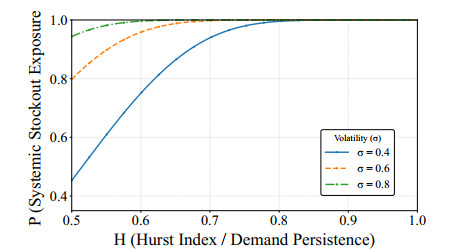
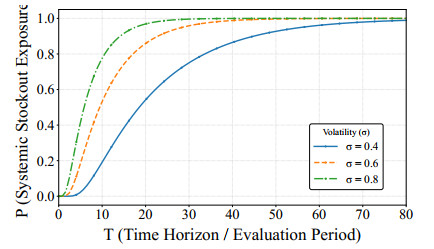
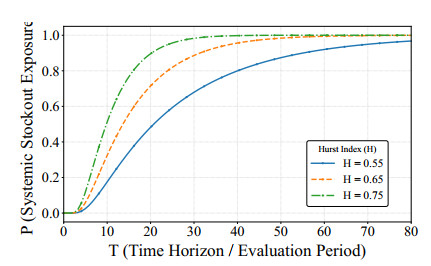
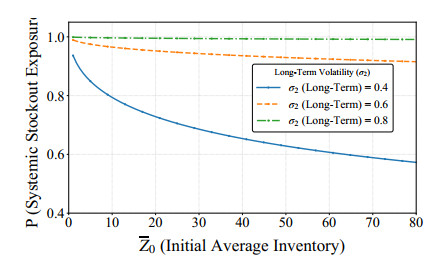
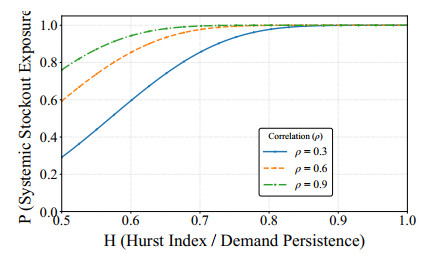
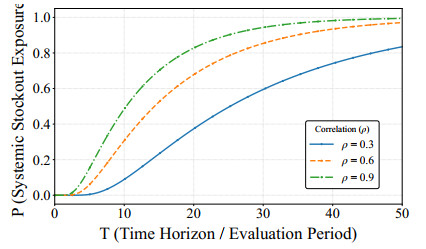
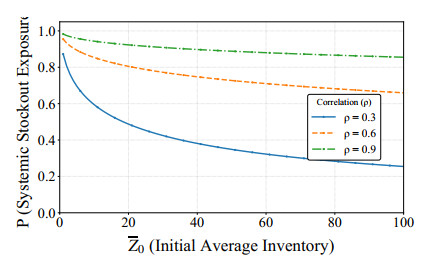
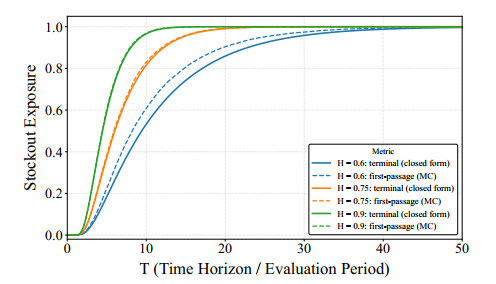
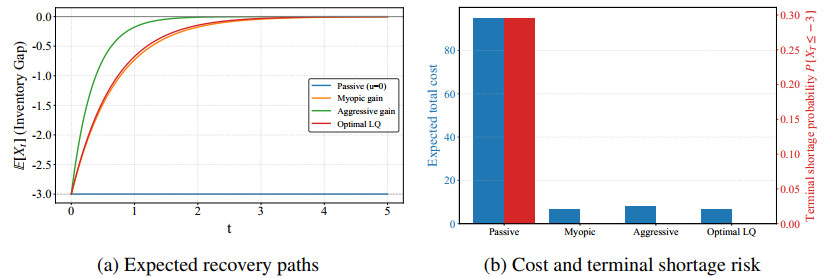
E-commerce platforms increasingly rely on multi-warehouse fulfillment networks, which speed delivery but also expose them to systemic stockout risk, the network-wide loss of fulfillment capability caused by persistent demand shocks. Such persistence is common in digital commerce, where viral promotions and platform-wide campaigns produce demand surges with long memory that Markovian models cannot capture. We embedded long-memory demand pressure, modeled by fractional Brownian motion, in a continuous-time inventory network and obtained four results. First, we derived a closed-form expression for the systemic stockout risk of a benchmark network, defined as the probability that its average inventory of a critical item ends the period below its safety threshold, and identified the exact conditions under which this risk rises with demand persistence, the time horizon, and volatility. Its validity was proven rather than assumed; the result is exact under a common shock, asymptotically exact under correlated shocks, and with a quantified error under independent shocks. Companion measures capture the expected shortfall and the risk of breaching the threshold at any time, not only at the period's end. Second, the internal work of keeping the network balanced can be split into two quantities that should not be confused: a pressure index measuring how unevenly stock is spread and the actual volume of goods moved between warehouses. This distinction separates stock health from the logistics cost of maintaining it. Third, within a class of feedback policies based on the observed inventory gap, we obtained the optimal emergency-replenishment rule, which acts earlier and harder when demand is more persistent and is proved optimal by an elementary argument that sidesteps the difficulties associated with fractional noise. Fourth, when demand shocks are shared across warehouses, the network's overall risk does not fall to zero as it grows but settles at a strictly positive floor, so adding or diversifying warehouses removes location-specific risk but not the risk shared across all locations. Overall, the paper provides e-commerce platforms with a practical framework for quantifying systemic stockout risk under long-memory demand, calibrating that memory from data, and dynamically deploying emergency fulfillment capacity through a computable optimal feedback rule.
Citation: Hui Sun. Systemic stockout risk in e-commerce fulfillment networks: A fractional stochastic control approach[J]. Journal of Industrial and Management Optimization, 2026, 22(9): 4387-4421. doi: 10.3934/jimo.2026153
E-commerce platforms increasingly rely on multi-warehouse fulfillment networks, which speed delivery but also expose them to systemic stockout risk, the network-wide loss of fulfillment capability caused by persistent demand shocks. Such persistence is common in digital commerce, where viral promotions and platform-wide campaigns produce demand surges with long memory that Markovian models cannot capture. We embedded long-memory demand pressure, modeled by fractional Brownian motion, in a continuous-time inventory network and obtained four results. First, we derived a closed-form expression for the systemic stockout risk of a benchmark network, defined as the probability that its average inventory of a critical item ends the period below its safety threshold, and identified the exact conditions under which this risk rises with demand persistence, the time horizon, and volatility. Its validity was proven rather than assumed; the result is exact under a common shock, asymptotically exact under correlated shocks, and with a quantified error under independent shocks. Companion measures capture the expected shortfall and the risk of breaching the threshold at any time, not only at the period's end. Second, the internal work of keeping the network balanced can be split into two quantities that should not be confused: a pressure index measuring how unevenly stock is spread and the actual volume of goods moved between warehouses. This distinction separates stock health from the logistics cost of maintaining it. Third, within a class of feedback policies based on the observed inventory gap, we obtained the optimal emergency-replenishment rule, which acts earlier and harder when demand is more persistent and is proved optimal by an elementary argument that sidesteps the difficulties associated with fractional noise. Fourth, when demand shocks are shared across warehouses, the network's overall risk does not fall to zero as it grows but settles at a strictly positive floor, so adding or diversifying warehouses removes location-specific risk but not the risk shared across all locations. Overall, the paper provides e-commerce platforms with a practical framework for quantifying systemic stockout risk under long-memory demand, calibrating that memory from data, and dynamically deploying emergency fulfillment capacity through a computable optimal feedback rule.

| [1] | J. Miglani, Global retail e-commerce sales will reach $6.8 trillion by 2028, Forrester, 2024. Available from: https://www.forrester.com/blogs/global-retail-e-commerce-sales-will-reach-6-8-trillion-by-2028/. |
| [2] |
N. Kim, B. Montreuil, W. Klibi, M. Z. Babai, Network inventory deployment for responsive fulfillment, Int. J. Prod. Econ., 255 (2023), 108664. https://doi.org/10.1016/j.ijpe.2022.108664 doi: 10.1016/j.ijpe.2022.108664

|
| [3] |
M. Rodríguez-García, I. González-Romero, Á. Ortiz-Bas, J. C. Prado-Prado, E-fulfillment cost management in omnichannel retailing: An exploratory study, Comput. Ind., 159 (2024), 104094. https://doi.org/10.1016/j.compind.2024.104094 doi: 10.1016/j.compind.2024.104094
|
| [4] | Amazon Staff, Amazon Prime members enjoyed fastest-ever delivery speeds in 2024, and US members saved on average over $500 on delivery fees, Amazon News, 2025. Available from: https://www.aboutamazon.com/news/retail/prime-members-us-savings-fastest-delivery-2024. |
| [5] | Capital One Shopping, Amazon logistics statistics, Capital One Shopping Research, 2026. Available from: https://capitaloneshopping.com/research/amazon-logistics-statistics/. |
| [6] | D. Y. Kim, B. S. Knight, D. Mitrofanov, How online retailers can avoid costly out-of-stock issues, Harvard business review, Harvard Business Review, 2024. Available from: https://hbr.org/2024/10/how-online-retailers-can-avoid-costly-out-of-stock-issues. |
| [7] | H. Ruben, 27% of shoppers will switch retailers, abandon purchase if they come across locked-up products: Report, Retail Dive, 2024. Available from: https://www.retaildive.com/news/locked-up-merchandise-shrink-consumer-behavior-numerator/732111/. |
| [8] |
X. Jing, M. Lewis, Stockouts in online retailing, J. Mark. Res., 48 (2011), 342–354. https://doi.org/10.1509/jmkr.48.2.342 doi: 10.1509/jmkr.48.2.342
|
| [9] | TikTok, TikTok Shop is where shoppers come to discover, TikTok Newsroom, 2025. Available from: https://newsroom.tiktok.com/en-us/tiktok-shop-is-where-shoppers-come-to-discover. |
| [10] | Z. Yang, TikTok Shop is now the size of eBay, Wired, 2025. Available from: https://www.wired.com/story/tiktok-shop-sales-global-ecommerce/. |
| [11] |
X. Chen, Y. Wang, S. Wei, J. Shen, The effect of herd behavior on consumer intention in live streaming e-commerce: The moderating role of interaction, Int. J. Hum. Comput. Interact., 41 (2025), 1674–1687. https://doi.org/10.1080/10447318.2024.2364464 doi: 10.1080/10447318.2024.2364464
|
| [12] |
E. Yazdani, S. Gopinath, S. J. Carson, The role of reviewer badges in the dynamics of online reviews, Int. J. Res. Mark., 41 (2024), 547–566. https://doi.org/10.1016/j.ijresmar.2024.01.003 doi: 10.1016/j.ijresmar.2024.01.003
|
| [13] |
S. Hosseini, D. Ivanov, A. Dolgui, Review of quantitative methods for supply chain resilience analysis, Transp. Res. Part E Logist. Transp. Rev., 125 (2019), 285–307. https://doi.org/10.1016/j.tre.2019.03.001 doi: 10.1016/j.tre.2019.03.001
|
| [14] |
R. C. Basole, M. A. Bellamy, Supply network structure, visibility, and risk diffusion: A computational approach, Decis. Sci., 45 (2014), 753–789. https://doi.org/10.1111/deci.12099 doi: 10.1111/deci.12099
|
| [15] | P. H. Zipkin, Foundations of inventory management, McGraw-Hill, Boston, Springer, 2000. |
| [16] |
M. Z. Babai, H. Chen, A. A. Syntetos, D. Lengu, A compound-Poisson Bayesian approach for spare parts inventory forecasting, Int. J. Prod. Econ., 232 (2021), 107954. https://doi.org/10.1016/j.ijpe.2020.107954 doi: 10.1016/j.ijpe.2020.107954
|
| [17] |
R. Qin, D. A. Nembhard, Demand modeling of stochastic product diffusion over the life cycle, Int. J. Prod. Econ., 137 (2012), 201–210. https://doi.org/10.1016/j.ijpe.2012.01.027 doi: 10.1016/j.ijpe.2012.01.027
|
| [18] |
Y.-F. Chen, Herd behavior in purchasing books online, Comput. Hum. Behav., 24 (2008), 1977–1992. https://doi.org/10.1016/j.chb.2007.08.004 doi: 10.1016/j.chb.2007.08.004
|
| [19] |
X. L. Shen, K. Z. K. Zhang, S. J. Zhao, Herd behavior in consumers' adoption of online reviews, J. Assoc. Inf. Sci. Technol., 67 (2016), 2754–2765. https://doi.org/10.1002/asi.23602 doi: 10.1002/asi.23602
|
| [20] |
L. A. Gil-Alana, C. Poza, Seasonal long memory in retail sales in the G7 countries, Fractal Fract., 8 (2024), 650. https://doi.org/10.3390/fractalfract8110650 doi: 10.3390/fractalfract8110650
|
| [21] | M. L. Puterman, Markov decision processes: Discrete stochastic dynamic programming, John Wiley & Sons, New York, Springer, 1994. https://doi.org/10.1002/9780470316887 |
| [22] |
C. Guo, S. Fang, Y. He, Y. Zhang, Some empirical studies for the applications of fractional G-Brownian motion in finance, Quant. Finance Econ., 9 (2025), 1–39. https://doi.org/10.3934/qfe.2025001 doi: 10.3934/qfe.2025001
|
| [23] |
R. Cont, D.-A. Fournié, Functional Itô calculus and stochastic integral representation of martingales, Ann. Probab., 41 (2013), 109–148. https://doi.org/10.1214/11-AOP721 doi: 10.1214/11-AOP721
|
| [24] |
T. E. Duncan, Y. Hu, B. Pasik-Duncan, Stochastic calculus for fractional Brownian motion I. Theory, SIAM J. Control Optim., 38 (2000), 582–612. https://doi.org/10.1137/S036301299834171X doi: 10.1137/S036301299834171X
|
| [25] | F. Biagini, Y. Hu, B. Øksendal, T. Zhang, Stochastic calculus for fractional brownian motion and applications, Springer, London, 2008. https://doi.org/10.1007/978-1-84628-797-8 |
| [26] |
Y. Hu, B. Øksendal, Fractional white noise calculus and applications to finance, Infin. Dimens. Anal. Quantum Probab. Relat. Top., 6 (2003), 1–32. https://doi.org/10.1142/S0219025703001110 doi: 10.1142/S0219025703001110
|
| [27] |
N. Boysen, R. de Koster, F. Weidinger, Warehousing in the e-commerce era: A survey, Eur. J. Oper. Res., 277 (2019), 396–411. https://doi.org/10.1016/j.ejor.2018.08.023 doi: 10.1016/j.ejor.2018.08.023
|
| [28] |
A. Risberg, A systematic literature review on e-commerce logistics: towards an e-commerce and omni-channel decision framework, Int. Rev. Retail Distrib. Consum. Res., 33 (2023), 67–91. https://doi.org/10.1080/09593969.2022.2089903 doi: 10.1080/09593969.2022.2089903
|
| [29] |
X. Yang, M. Ostermeier, A. Hübner, Winning the race to customers with micro-fulfillment centers: an approach for network planning in quick commerce, Cent. Eur. J. Oper. Res., 32 (2024), 295–334. https://doi.org/10.1007/s10100-023-00893-x doi: 10.1007/s10100-023-00893-x
|
| [30] |
Y. Wang, S. Minner, Data-driven multi-location inventory placement in digital commerce, Comput. Ind. Eng., 200 (2025), 110842. https://doi.org/10.1016/j.cie.2024.110842 doi: 10.1016/j.cie.2024.110842
|
| [31] |
M. Melacini, S. Perotti, M. Rasini, E. Tappia, E-fulfilment and distribution in omni-channel retailing: a systematic literature review, Int. J. Phys. Distrib. Logist. Manag., 48 (2018), 391–414. https://doi.org/10.1108/IJPDLM-02-2017-0101 doi: 10.1108/IJPDLM-02-2017-0101
|
| [32] |
C. Paterson, G. Kiesmüller, R. Teunter, K. Glazebrook, Inventory models with lateral transshipments: A review, Eur. J. Oper. Res., 210 (2011), 125–136. https://doi.org/10.1016/j.ejor.2010.05.048 doi: 10.1016/j.ejor.2010.05.048
|
| [33] |
B. Y. Ekren, S. K. Mangla, E. E. Turhanlar, Y. Kazancoglu, G. Li, Lateral inventory share-based models for IoT-enabled E-commerce sustainable food supply networks, Comput. Oper. Res., 130 (2021), 105237. https://doi.org/10.1016/j.cor.2021.105237 doi: 10.1016/j.cor.2021.105237
|
| [34] |
Y. Li, C. W. Zobel, Exploring supply chain network resilience in the presence of the ripple effect, Int. J. Prod. Econ., 228 (2020), 107693. https://doi.org/10.1016/j.ijpe.2020.107693 doi: 10.1016/j.ijpe.2020.107693
|
| [35] |
C. Colon, S. Hochrainer-Stigler, Systemic risks in supply chains: a need for system-level governance, Supply Chain Manag., 28 (2023), 682–694. https://doi.org/10.1108/SCM-03-2022-0101 doi: 10.1108/SCM-03-2022-0101
|
| [36] |
F. Habibi, R. K. Chakrabortty, A. Abbasi, Evaluating supply chain network resilience considering disruption propagation, Comput. Ind. Eng., 183 (2023), 109531. https://doi.org/10.1016/j.cie.2023.109531 doi: 10.1016/j.cie.2023.109531
|
| [37] |
F. Habibi, R. K. Chakrabortty, A. Abbasi, W. Ho, Investigating disruption propagation and resilience of supply chain networks: interplay of tiers and connections, Int. J. Prod. Res., 63 (2025), 6229–6251. https://doi.org/10.1080/00207543.2025.2470348 doi: 10.1080/00207543.2025.2470348
|
| [38] |
C. Ma, L. Zhang, L. You, W. Tian, A review of supply chain resilience: A network modeling perspective, Appl. Sci., 15 (2025), 265. https://doi.org/10.3390/app15010265 doi: 10.3390/app15010265
|
| [39] |
Y. Kim, Y.-S. Chen, K. Linderman, Supply network disruption and resilience: A network structural perspective, J. Oper. Manag., 33–34 (2015), 43–59. https://doi.org/10.1016/j.jom.2014.10.006 doi: 10.1016/j.jom.2014.10.006
|
| [40] |
A. Hosseini, A. Goli, Energy-aware dual-channel agricultural supply chain network design under uncertainty, Comput. Ind. Eng., 207 (2025), 111294. https://doi.org/10.1016/j.cie.2025.111294 doi: 10.1016/j.cie.2025.111294
|
| [41] |
S. Rahmani, A. Goli, Robust sustainable canola oil-based biodiesel supply chain network design under supply and demand uncertainty, Environ. Sci. Pollut. Res., 30 (2023), 86268–86299. https://doi.org/10.1007/s11356-023-28044-4 doi: 10.1007/s11356-023-28044-4
|
| [42] |
I. Shahsavani, A. Goli, A systematic literature review of circular supply chain network design: application of optimization models, Environ. Dev. Sustain., 27 (2025), 23483–23514. https://doi.org/10.1007/s10668-023-03362-2 doi: 10.1007/s10668-023-03362-2
|
| [43] |
K. Ma, T. Chen, C. Zheng, Influence of thinking style and attribution on consumer response to online stockouts, J. Retail. Consum. Serv., 43 (2018), 218–225. https://doi.org/10.1016/j.jretconser.2018.03.014 doi: 10.1016/j.jretconser.2018.03.014
|
| [44] |
A. Gunness, H. Oppewal, How mindset and store familiarity impact online stockout responses, Int. J. Retail Distrib. Manag., 48 (2020), 326–347. https://doi.org/10.1108/IJRDM-02-2018-0034 doi: 10.1108/IJRDM-02-2018-0034
|
| [45] |
M. E. Kumar, D. P. Sharma, A. V. Tapar, Out-of-stock justifications and consumers' behavioral outcomes–exploring the role of product type and sales level information in out-of-stock situations, J. Retail. Consum. Serv., 60 (2021), 102458. https://doi.org/10.1016/j.jretconser.2021.102458 doi: 10.1016/j.jretconser.2021.102458
|
| [46] |
D. M. Piehlmaier, U. Dávila Gamiño, Fear and loathing in the supermarket: the effect of incidental stockouts on consumer anxiety, J. Mark. Anal., (2025), 1–10. https://doi.org/10.1057/s41270-025-00418-2 doi: 10.1057/s41270-025-00418-2
|
| [47] |
V. V. Acharya, L. H. Pedersen, T. Philippon, M. Richardson, Measuring systemic risk, Rev. Financ. Stud., 30 (2017), 2–47. https://doi.org/10.1093/rfs/hhw088 doi: 10.1093/rfs/hhw088
|
| [48] |
T. Adrian, M. K. Brunnermeier, CoVaR, Am. Econ. Rev., 106 (2016), 1705–1741. https://doi.org/10.1257/aer.20120555 doi: 10.1257/aer.20120555
|
| [49] |
S. Kharvi, T. P. M. Pakkala, An optimal inventory policy when purchase price follows geometric Brownian motion process, OPSEARCH, 58 (2021), 835–851. https://doi.org/10.1007/s12597-020-00500-6 doi: 10.1007/s12597-020-00500-6
|
| [50] |
D. C. Heath, P. L. Jackson, Modeling the evolution of demand forecasts with application to safety stock analysis in production/distribution systems, IIE Trans., 26 (1994), 17–30. https://doi.org/10.1080/07408179408966604 doi: 10.1080/07408179408966604
|
| [51] |
L. Xin, D. A. Goldberg, Distributionally robust inventory control when demand is a martingale, Math. Oper. Res., 47 (2022), 2387–2414. https://doi.org/10.1287/moor.2021.1213 doi: 10.1287/moor.2021.1213
|
| [52] |
K. Yamazaki, Inventory control for spectrally positive Lévy demand processes, Math. Oper. Res., 42 (2017), 212–237. https://doi.org/10.1287/moor.2016.0801 doi: 10.1287/moor.2016.0801
|
| [53] |
R. T. Baillie, Long memory processes and fractional integration in econometrics, J. Econom., 73 (1996), 5–59. https://doi.org/10.1016/0304-4076(95)01732-1 doi: 10.1016/0304-4076(95)01732-1
|
| [54] |
J. E. Vera-Valdés, Nonfractional long-range dependence: Long memory, antipersistence, and aggregation, Econometrics, 9 (2021), 39. https://doi.org/10.3390/econometrics9040039 doi: 10.3390/econometrics9040039
|
| [55] |
N. Zeinali, A. Pourdarvish, An entropy-based estimator of the Hurst exponent in fractional Brownian motion, Physica A, 591 (2022), 126690. https://doi.org/10.1016/j.physa.2021.126690 doi: 10.1016/j.physa.2021.126690
|
| [56] |
C. Bender, L. Viitasaari, Fractional brownian motion in financial modeling, Wiley StatsRef: Statistics Reference Online, (2016), 1–5. https://doi.org/10.1002/9781118445112.stat07865 doi: 10.1002/9781118445112.stat07865
|
| [57] |
P. Guasoni, Z. Nika, M. Rásonyi, Trading fractional Brownian motion, SIAM J. Financial Math., 10 (2019), 769–789. https://doi.org/10.1137/17M113592X doi: 10.1137/17M113592X
|
| [58] |
B. B. Mandelbrot, J. W. V. Ness, Fractional Brownian motions, fractional noises and applications, SIAM Rev., 10 (1968), 422–437. https://doi.org/10.1137/1010093 doi: 10.1137/1010093
|
| [59] |
G. Bhardwaj, N. R. Swanson, An empirical investigation of the usefulness of ARFIMA models for predicting macroeconomic and financial time series, J. Econom., 131 (2006), 539–578. https://doi.org/10.1016/j.jeconom.2005.01.016 doi: 10.1016/j.jeconom.2005.01.016
|
| [60] |
F. Yerlikaya-Özkurt, C. Vardar-Acar, Y. Yolcu-Okur, G. W. Weber, Estimation of the Hurst parameter for fractional Brownian motion using the CMARS method, J. Comput. Appl. Math., 259 (2014), 843–850. https://doi.org/10.1016/j.cam.2013.08.001 doi: 10.1016/j.cam.2013.08.001
|
| [61] | J. Beran, Statistics for long-memory processes, Chapman & Hall, New York, 1994. https://doi.org/10.1201/9780203738481 |
| [62] |
A. W. Lo, Long-term memory in stock market prices, Econometrica, 59 (1991), 1279–1313. https://doi.org/10.2307/2938368 doi: 10.2307/2938368
|
| [63] |
M. S. Taqqu, V. Teverovsky, W. Willinger, Estimators for long-range dependence: An empirical study, Fractals, 3 (1995), 785–798. https://doi.org/10.1142/S0218348X95000692 doi: 10.1142/S0218348X95000692
|
| [64] |
Z. Y. Chen, Z. P. Fan, M. Sun, Machine learning methods for data-driven demand estimation and assortment planning considering cross-selling and substitutions, INFORMS J. Comput., 35 (2023), 158–177. https://doi.org/10.1287/ijoc.2022.1251 doi: 10.1287/ijoc.2022.1251
|
| [65] |
I. Vallés-Pérez, E. Soria-Olivas, M. Martínez-Sober, A. J. Serrano-López, J. Gómez-Sanchís, F. Mateo, Approaching sales forecasting using recurrent neural networks and transformers, Expert Syst. Appl., 201 (2022), 116993. https://doi.org/10.1016/j.eswa.2022.116993 doi: 10.1016/j.eswa.2022.116993
|
| [66] |
J. A. O. Torres, A. M. Santiago, J. R. García-Martínez, B. Y. López-Zapata, J. A. M. López, O. J. R. Zapata, et al., A data-driven approach using recurrent neural networks for material demand forecasting in manufacturing, Logistics, 9 (2025), 130. https://doi.org/10.3390/logistics9030130 doi: 10.3390/logistics9030130
|
| [67] |
Y. Yu, B. Wang, S. Zheng, Data-driven product design and assortment optimization, Transp. Res. Part E Logist. Transp. Rev., 182 (2024), 103413. https://doi.org/10.1016/j.tre.2024.103413 doi: 10.1016/j.tre.2024.103413
|
| [68] |
A. Goli, Efficient optimization of robust project scheduling for industry 4.0: A hybrid approach based on machine learning and meta-heuristic algorithms, Int. J. Prod. Econ., 278 (2024), 109427. https://doi.org/10.1016/j.ijpe.2024.109427 doi: 10.1016/j.ijpe.2024.109427
|
| [69] |
A. Ala, A. Goli, Incorporating machine learning and optimization techniques for assigning patients to operating rooms by considering fairness policies, Eng. Appl. Artif. Intell., 136 (2024), 108980. https://doi.org/10.1016/j.engappai.2024.108980 doi: 10.1016/j.engappai.2024.108980
|
| [70] |
A. Goli, Optimization of renewable energy project portfolio selection using hybrid AIS-AFS algorithm in an international case study, Sci. Rep., 14 (2024), 17388. https://doi.org/10.1038/s41598-024-68449-w doi: 10.1038/s41598-024-68449-w
|
| [71] |
T. T. Dufera, Fractional Brownian motion in option pricing and dynamic delta hedging: Experimental simulations, N. Am. J. Econ. Finance, 69 (2024), 102017. https://doi.org/10.1016/j.najef.2023.102017 doi: 10.1016/j.najef.2023.102017
|
| [72] |
X. Wang, J. Yu, C. Zhang, On the optimal forecast with the fractional Brownian motion, Quant. Finance, 24 (2024), 337–346. https://doi.org/10.1080/14697688.2023.2297730 doi: 10.1080/14697688.2023.2297730
|
| [73] |
E. A. G. D. Souza, T. Mlinar, M. V. D. Broeke, S. Creemers, Dynamic programming in inventory management: A review, Comput. Oper. Res., 183 (2025), 107164. https://doi.org/10.1016/j.cor.2025.107164 doi: 10.1016/j.cor.2025.107164
|
| [74] |
Y. Zhang, A. R. Richter, J. G. Shanthikumar, Z. J. M. Shen, Dynamic inventory relocation in disaster relief, Prod. Oper. Manag., 31 (2022), 1052–1070. https://doi.org/10.1111/poms.13594 doi: 10.1111/poms.13594
|
| [75] |
J. Wu, X. Chao, Optimal control of a Brownian production/inventory system with average cost criterion, Math. Oper. Res., 39 (2014), 163–189. https://doi.org/10.1287/moor.2013.0603 doi: 10.1287/moor.2013.0603
|
| [76] |
X. Luo, Z. Liu, J. Wu, Dynamic pricing and optimal control for a stochastic inventory system with non-instantaneous deteriorating items and partial backlogging, Mathematics, 8 (2020), 906. https://doi.org/10.3390/math8060906 doi: 10.3390/math8060906
|
| [77] |
J. Ma, S. Yang, High-dimensional stochastic control models for newsvendor problems and deep learning resolution, Ann. Oper. Res., 339 (2024), 789–811. https://doi.org/10.1007/s10479-024-05872-2 doi: 10.1007/s10479-024-05872-2
|
| [78] |
K. Sazvari, A. Mahmoodi, H. Sadeghi, Joint dynamic pricing and inventory decisions for duopoly retailers with deterioration items and reference price effect, J. Ind. Prod. Eng., 43 (2026), 456–480. https://doi.org/10.1080/21681015.2025.2580972 doi: 10.1080/21681015.2025.2580972
|
| [79] |
X. Wang, Q. Chen, Stochastic optimal control for dynamic pricing and production in fashion retailing: An economic sustainability approach, Discrete Dyn. Nat. Soc., 2024 (2024), 4854557. https://doi.org/10.1155/ddns/4854557 doi: 10.1155/ddns/4854557
|
| [80] |
W. Lu, L. Yan, Dynamic pricing and inventory strategies for fashion products using stochastic fashion level function, Axioms, 13 (2024), 453. https://doi.org/10.3390/axioms13070453 doi: 10.3390/axioms13070453
|
| [81] |
A. Shapiro, Y. Li, Distributionally robust stochastic optimal control, Oper. Res. Lett., 60 (2025), 107234. https://doi.org/10.1016/j.orl.2024.107234 doi: 10.1016/j.orl.2024.107234
|
| [82] |
T. Başar, J. Moon, J. Yong, H. Zhang, Nonstandard linear-quadratic decision making, Proc. 62nd IEEE Conf. Decis. Control, 2023, 8901–8920. https://doi.org/10.1109/CDC49753.2023.10384310 doi: 10.1109/CDC49753.2023.10384310
|
| [83] |
B. Taskesen, D. Iancu, Ç. Koçyigit, D. Kuhn, Distributionally robust linear quadratic control, Adv. Neural Inf. Process. Syst., 36 (2023), 18613–18632. https://doi.org/10.52202/075280-0817 doi: 10.52202/075280-0817
|
| [84] |
E. A. Jaber, E. Miller, H. Pham, Linear-quadratic control for a class of stochastic Volterra equations: Solvability and approximation, Ann. Appl. Probab., 31 (2021), 2244–2274. https://doi.org/10.1214/20-AAP1645 doi: 10.1214/20-AAP1645
|
| [85] |
A. A. Zimbidis, Pricing in a competitive insurance market driven by fractional noise, Variance, 5 (2011), 55–67. https://doi.org/10.66573/001c.84251 doi: 10.66573/001c.84251
|
| [86] |
M. L. Kleptsyna, A. L. Breton, M. Viot, About the linear-quadratic regulator problem under a fractional Brownian perturbation, ESAIM Probab. Stat., 7 (2003), 161–170. https://doi.org/10.1051/ps:2003007 doi: 10.1051/ps:2003007
|
| [87] |
T. E. Duncan, B. Maslowski, B. Pasik-Duncan, Linear-quadratic control for stochastic equations in a Hilbert space with fractional Brownian motions, SIAM J. Control Optim., 50 (2012), 507–531. https://doi.org/10.1137/110831416 doi: 10.1137/110831416
|
| [88] |
Y. Han, Y. Sun, Stochastic linear quadratic optimal control problem for systems driven by fractional Brownian motions, Optim. Control Appl. Methods, 40 (2019), 900–913. https://doi.org/10.1002/oca.2523 doi: 10.1002/oca.2523
|
| [89] | C. Liu, H. Fan, Y. Li, Two-person zero-sum stochastic linear quadratic control problems with Markov chains and fractional Brownian motion in infinite horizon, preprint, arXiv preprint, arXiv: 2412.16538, 2024. https://doi.org/10.48550/arXiv.2412.16538 |
| [90] |
E. Savku, A stochastic control approach for constrained stochastic differential games with jumps and regimes, Mathematics, 11 (2023), 3043. https://doi.org/10.3390/math11143043 doi: 10.3390/math11143043
|
| [91] |
E. Savku, Memory and anticipation: Two main theorems for Markov regime-switching stochastic processes, Stochastics, 97 (2025), 1079–1096. https://doi.org/10.1080/17442508.2024.2427733 doi: 10.1080/17442508.2024.2427733
|
| [92] |
R. Pakhira, S. Sarkar, U. Ghosh, Study of memory effect in an inventory model for deteriorating items with partial backlogging, Comput. Ind. Eng., 148 (2020), 106705. https://doi.org/10.1016/j.cie.2020.106705 doi: 10.1016/j.cie.2020.106705
|
| [93] |
P. K. Santra, G. S. Mahapatra, A. Kumar, Effect of reliability and memory on fractional inventory model incorporating promotional effort on demand, RAIRO Oper. Res., 57 (2023), 1767–1784. https://doi.org/10.1051/ro/2023095 doi: 10.1051/ro/2023095
|
| [94] |
A. Dasgupta, A. S. Mahapatra, P. K. Santra, G. S. Mahapatra, A. K. Shaw, B. Sarkar, Learning and memory effect in a fractional order quantity model incorporating promotion-assisted demand under uncertainty, J. Ind. Manag. Optim., 20 (2024), 3514–3551. https://doi.org/10.3934/jimo.2024063 doi: 10.3934/jimo.2024063
|
| [95] |
M. Jain, H. Indoria, A. Chaudhary, P. Singh, Effects of memory on inventory control and pricing policy for imperfect production with rework process, RAIRO Oper. Res., 59 (2025), 77–99. https://doi.org/10.1051/ro/2024215 doi: 10.1051/ro/2024215
|
| [96] |
A. F. Momena, R. Pakhira, R. Haque, A. Sobczak, S. P. Mondal, A memory-dependent inventory model with fuzzy price-dependent demand under backlogged shortages, J. Uncertain Syst., 18 (2025), 2550003. https://doi.org/10.1142/S1752890925500035 doi: 10.1142/S1752890925500035
|
| [97] |
R. B. Davies, D. S. Harte, Tests for Hurst effect, Biometrika, 74 (1987), 95–101. https://doi.org/10.1093/biomet/74.1.95 doi: 10.1093/biomet/74.1.95
|
| [98] |
J. Geweke, S. Porter-Hudak, The estimation and application of long memory time series models, J. Time Ser. Anal., 4 (1983), 221–238. https://doi.org/10.1111/j.1467-9892.1983.tb00371.x doi: 10.1111/j.1467-9892.1983.tb00371.x
|
| [99] |
P. M. Robinson, Gaussian semiparametric estimation of long range dependence, Ann. Stat., 23 (1995), 1630–1661. https://doi.org/10.1214/aos/1176324317 doi: 10.1214/aos/1176324317
|
| [100] |
E. Savku, G. W. Weber, A stochastic maximum principle for a Markov regime-switching jump-diffusion model with delay and an application to finance, J. Optim. Theory Appl., 179 (2018), 696–721. https://doi.org/10.1007/s10957-017-1159-3 doi: 10.1007/s10957-017-1159-3
|
| [101] |
R. Korn, H. Kraft, A stochastic control approach to portfolio problems with stochastic interest rates, SIAM J. Control Optim., 40 (2002), 1250–1269. https://doi.org/10.1137/S0363012900377791 doi: 10.1137/S0363012900377791
|
| [102] |
B. Z. Temoçin, R. Korn, A. S. Selcuk-Kestel, Constant proportion portfolio insurance in defined contribution pension plan management, Ann. Oper. Res., 266 (2018), 329–348. https://doi.org/10.1007/s10479-017-2449-8 doi: 10.1007/s10479-017-2449-8
|
| [103] |
B. Z. Temoçin, G. W. Weber, Optimal control of stochastic hybrid system with jumps: A numerical approximation, J. Comput. Appl. Math., 259 (2014), 443–451. https://doi.org/10.1016/j.cam.2013.10.021 doi: 10.1016/j.cam.2013.10.021
|
| [104] |
H. Ö. Bakan, F. Yılmaz, G. W. Weber, Minimal truncation error constants for Runge–Kutta method for stochastic optimal control problems, J. Comput. Appl. Math., 331 (2018), 196–207. https://doi.org/10.1016/j.cam.2017.10.011 doi: 10.1016/j.cam.2017.10.011
|
| [105] |
G. Kara, A. Özmen, G. W. Weber, Stability advances in robust portfolio optimization under parallelepiped uncertainty, Cent. Eur. J. Oper. Res., 27 (2019), 241–261. https://doi.org/10.1007/s10100-017-0508-5 doi: 10.1007/s10100-017-0508-5
|
| [106] |
A. Özmen, G. W. Weber, İ. Batmaz, E. Kropat, RCMARS: Robustification of CMARS with different scenarios under polyhedral uncertainty set, Commun. Nonlinear Sci. Numer. Simul., 16 (2011), 4780–4787. https://doi.org/10.1016/j.cnsns.2011.04.001 doi: 10.1016/j.cnsns.2011.04.001
|
 jimo-22-09-153-s001.pdf |
 |
Figures(11) / Tables(3)
Hui Sun. Systemic stockout risk in e-commerce fulfillment networks: A fractional stochastic control approach[J]. Journal of Industrial and Management Optimization, 2026, 22(9): 4387-4421. doi: 10.3934/jimo.2026153




 DownLoad: