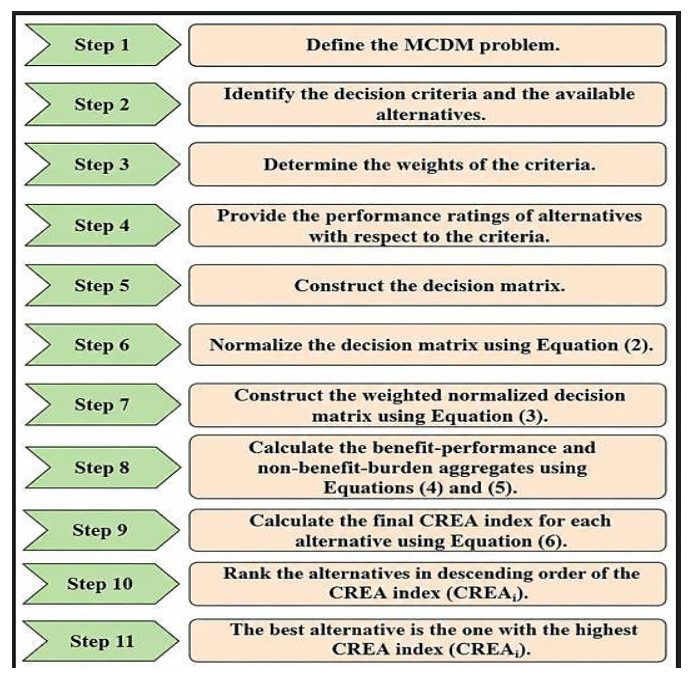
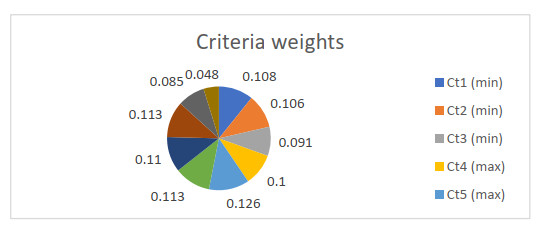
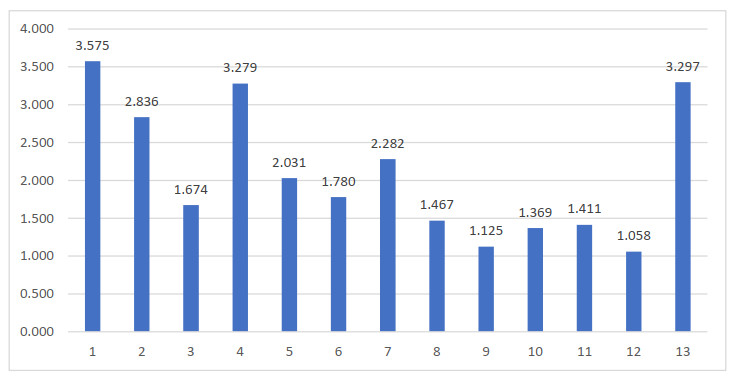
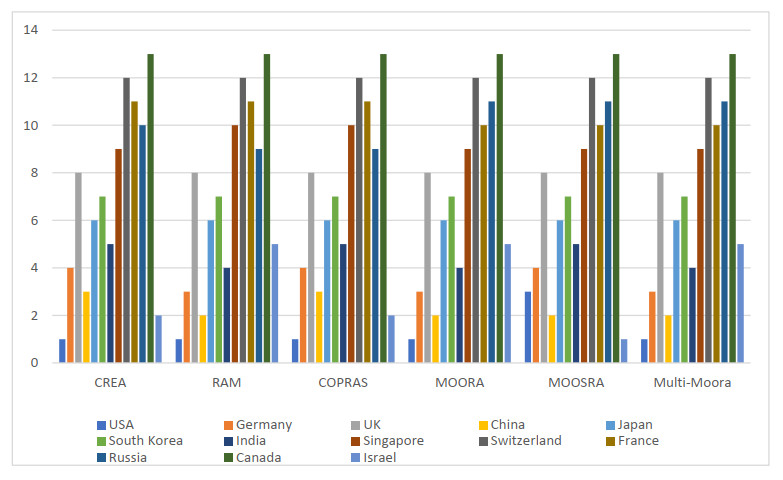
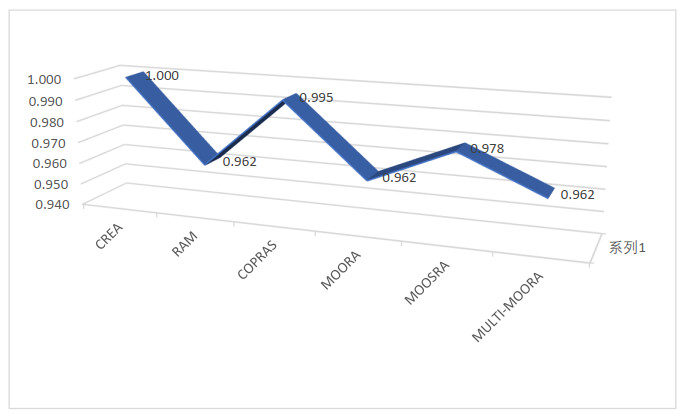
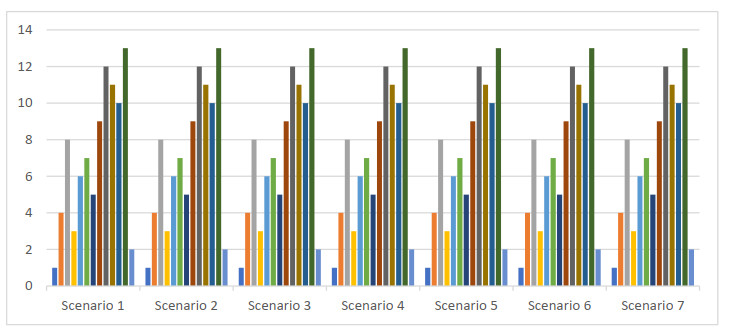
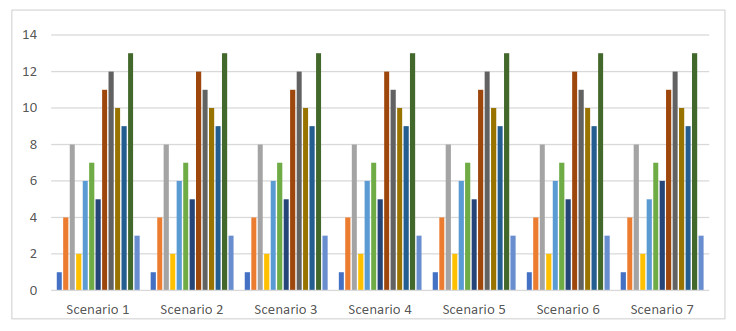
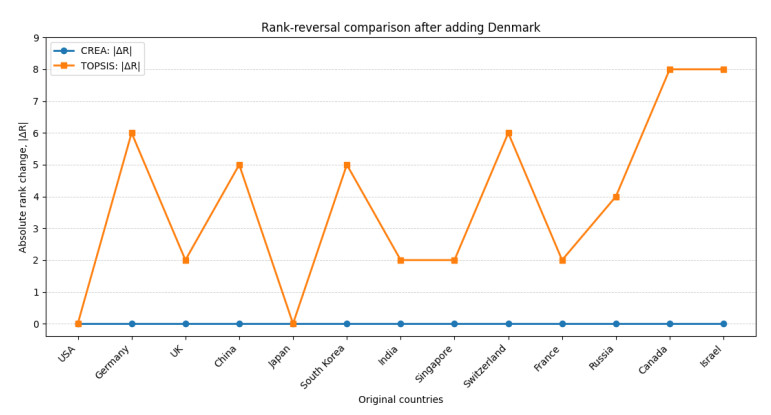
This paper proposes the composite ratio and Euclidean aggregation (CREA) method, a new multi-criteria decision-making approach for biotechnology country evaluation. CREA assesses national biotechnology performance by integrating heterogeneous criteria related to regulation, innovation, research productivity, market size, clinical-trial activity, human capital, and intellectual-property protection. The method applies a common fixed-reference normalization expression to both criterion types while preserving their different preference directions. The benefit-performance and non-benefit-burden components are then aggregated separately and integrated through a hybrid Euclidean–ratio index. Objective criterion weights were determined using the SITDE method. Biotech patents received the highest weight of 0.126, while the IP protection index received the lowest weight of 0.048. The empirical application evaluated 13 countries using 10 criteria. The United States ranked first with a CREA score of 3.575, followed by Israel with 3.297 and China with 3.279, whereas Canada ranked last with a score of 1.058. Comparative analysis with RAM, COPRAS, MOORA, MOOSRA, and MULTI-MOORA produced Spearman correlations ranging from 0.962 to 0.995. Under the tested Ct5 weight-perturbation scenarios, the maximum absolute changes in CREA scores ranged from 0.17% to 4.45%, while the ranking positions of all 13 countries remained unchanged. In one rank-reversal experiment involving the addition of Denmark, the rankings of the original countries remained unchanged under CREA, whereas TOPSIS produced rank changes for 11 countries. These findings provide preliminary evidence of ranking stability and practical usefulness in the present biotechnology benchmarking application. Broader validation using larger samples, multiple datasets, and additional rank-reversal scenarios is required before general conclusions regarding the stability of CREA can be drawn.
Citation: Yalamanda Babu Gopisetty, E. Hymavathi, Vijaya Ramu Dirisala, Ravitez Dondeti. A novel composite ratio and Euclidean aggregation (CREA) multi-criteria decision-making method for decision support in cross-country biomedical and biotechnology research system evaluation[J]. Journal of Industrial and Management Optimization, 2026, 22(9): 4339-4386. doi: 10.3934/jimo.2026152
This paper proposes the composite ratio and Euclidean aggregation (CREA) method, a new multi-criteria decision-making approach for biotechnology country evaluation. CREA assesses national biotechnology performance by integrating heterogeneous criteria related to regulation, innovation, research productivity, market size, clinical-trial activity, human capital, and intellectual-property protection. The method applies a common fixed-reference normalization expression to both criterion types while preserving their different preference directions. The benefit-performance and non-benefit-burden components are then aggregated separately and integrated through a hybrid Euclidean–ratio index. Objective criterion weights were determined using the SITDE method. Biotech patents received the highest weight of 0.126, while the IP protection index received the lowest weight of 0.048. The empirical application evaluated 13 countries using 10 criteria. The United States ranked first with a CREA score of 3.575, followed by Israel with 3.297 and China with 3.279, whereas Canada ranked last with a score of 1.058. Comparative analysis with RAM, COPRAS, MOORA, MOOSRA, and MULTI-MOORA produced Spearman correlations ranging from 0.962 to 0.995. Under the tested Ct5 weight-perturbation scenarios, the maximum absolute changes in CREA scores ranged from 0.17% to 4.45%, while the ranking positions of all 13 countries remained unchanged. In one rank-reversal experiment involving the addition of Denmark, the rankings of the original countries remained unchanged under CREA, whereas TOPSIS produced rank changes for 11 countries. These findings provide preliminary evidence of ranking stability and practical usefulness in the present biotechnology benchmarking application. Broader validation using larger samples, multiple datasets, and additional rank-reversal scenarios is required before general conclusions regarding the stability of CREA can be drawn.

| [1] |
A. Tyczewska, T. Twardowski, E. Woźniak-Gientka, Agricultural biotechnology for sustainable food security, Trends Biotechnol. , 41 (2023), 331–341. https://doi.org/10.1016/j.tibtech.2022.12.013 doi: 10.1016/j.tibtech.2022.12.013

|
| [2] |
X. Wei, J. Luo, A. Pu, Q. Liu, L. Zhang, S. Wu, et al., From biotechnology to bioeconomy: A review of development dynamics and pathways, Sustainability, 14 (2022), 10413. https://doi.org/10.3390/su141610413 doi: 10.3390/su141610413
|
| [3] |
S. Losacker, S. Heiden, I. Liefner, H. Lucas, Rethinking bioeconomy innovation in sustainability transitions, Technol. Soc., 74 (2023), 102291. https://doi.org/10.1016/j.techsoc.2023.102291 doi: 10.1016/j.techsoc.2023.102291
|
| [4] |
A. Bettanti, A. Lanati, A. Missoni, Biopharmaceutical innovation ecosystems: A stakeholder model and the case of lombardy, J. Technol. Transf., 47 (2022), 1948–1973. https://doi.org/10.21203/rs.3.rs-350375/v1 doi: 10.21203/rs.3.rs-350375/v1
|
| [5] |
S. K. Aghmiuni, S. Siyal, Q. Wang, Y. Duan, Assessment of factors affecting innovation policy in biotechnology, J. Innov. Knowl., 5 (2020), 180–190. https://doi.org/10.1016/j.jik.2019.10.002 doi: 10.1016/j.jik.2019.10.002
|
| [6] |
Y. Han, L. L. Fan, Y. Xue, A sustainable balance between innovation and risk: How the "right to science" affects china's medical biotechnology regulatory policy, Comput. Struct. Biotechnol. J., 24 (2024), 306–313. https://doi.org/10.1016/j.csbj.2024.04.027 doi: 10.1016/j.csbj.2024.04.027
|
| [7] |
J. L. Furman, M. E. Porter, S. Stern, The determinants of national innovative capacity, Res. Policy, 31 (2002), 899–933. https://doi.org/10.1016/s0048-7333(01)00152-4 doi: 10.1016/s0048-7333(01)00152-4
|
| [8] |
V. Raghupathi, W. Raghupathi, Exploring science-and-technology-led innovation: A cross-country study, J. Innov. Entrep., 8 (2019), 5. https://doi.org/10.1186/s13731-018-0097-0 doi: 10.1186/s13731-018-0097-0
|
| [9] | V. Belton, T. J. Stewart, Multiple criteria decision analysis: An integrated approach, Springer, 2002. https://doi.org/10.1007/978-1-4615-1495-4 |
| [10] |
A. Mardani, A. Jusoh, K. Nor, Z. Khalifah, N. Zakwan, A. Valipour, Multiple criteria decision-making techniques and their applications–a review of the literature from 2000 to 2014, Ekon. Istraž., 28 (2015), 516–571. https://doi.org/10.1080/1331677x.2015.1075139 doi: 10.1080/1331677x.2015.1075139
|
| [11] |
P. Thokala, N. Devlin, K. Marsh, R. Baltussen, M. Boysen, Z. Kalo, et al., Multiple criteria decision analysis for health care decision making—an introduction: Report 1 of the ispor mcda emerging good practices task force, Value Health, 19 (2016), 1–13. https://doi.org/10.1016/j.jval.2015.12.003 doi: 10.1016/j.jval.2015.12.003
|
| [12] |
A. Angelis, P. Kanavos, Multiple criteria decision analysis (mcda) for evaluating new medicines in health technology assessment and beyond: The advance value framework, Soc. Sci. Med., 188 (2017), 137–156. https://doi.org/10.1016/j.socscimed.2017.06.024 doi: 10.1016/j.socscimed.2017.06.024
|
| [13] | M. Nardo, M. Saisana, A. Saltelli, S. Tarantola, Tools for composite indicators building, European Comission, 15 (2005), 19–20. https://doi.org/10.1787/533411815016 |
| [14] |
A. Kelemen, Z. K. Szabó, S. Bozóki, Z. Szádoczki, Á. D. Hartvig, A sensitivity analysis of composite indicators: Min/max thresholds, Environ. Sustain. Indic., 23 (2024), 100453. https://doi.org/10.1016/j.indic.2024.100453 doi: 10.1016/j.indic.2024.100453
|
| [15] |
S. Greco, A. Ishizaka, M. Tasiou, G. Torrisi, On the methodological framework of composite indices: A review of the issues of weighting, aggregation, and robustness, Soc. Indic. Res., 141 (2019), 61–94. https://doi.org/10.1007/s11205-017-1832-9 doi: 10.1007/s11205-017-1832-9
|
| [16] | J. R. Centre, Handbook on constructing composite indicators: Methodology and user guide, Springer, 2008. |
| [17] |
C. Liu, K. Li, P. Jiang, D. Li, L. Su, S. Lu, et al., A hybrid multiple criteria decision-making technique to evaluate regional intellectual capital: Evidence from china, Mathematics, 9 (2021), 1676. https://doi.org/10.3390/math9141676 doi: 10.3390/math9141676
|
| [18] |
M. Žižović, D. Pamučar, M. Albijanić, P. Chatterjee, I. Pribićević, Eliminating rank reversal problem using a new multi-attribute model—the rafsi method, Mathematics, 8 (2020), 1015. https://doi.org/10.3390/math8061015 doi: 10.3390/math8061015
|
| [19] |
B. Paradowski, J. Wątróbski, W. Sałabun, Novel coefficients for improved robustness in multi-criteria decision analysis, Artif. Intell. Rev., 58 (2025), 298. https://doi.org/10.1007/s10462-025-11307-6 doi: 10.1007/s10462-025-11307-6
|
| [20] |
J. Więckowski, W. Sałabun, Sensitivity analysis approaches in multi-criteria decision analysis: A systematic review, Appl. Soft Comput., 148 (2023), 110915. https://doi.org/10.1016/j.asoc.2023.110915 doi: 10.1016/j.asoc.2023.110915
|
| [21] |
A. Sotoudeh-Anvari, Root assessment method (ram): A novel multi-criteria decision making method and its applications in sustainability challenges, J. Clean. Prod., 423 (2023), 138695. https://doi.org/10.1016/j.jclepro.2023.138695 doi: 10.1016/j.jclepro.2023.138695
|
| [22] |
D. Dagostino, F. D. Falco, F. Minelli, F. Minichiello, New robust multi-criteria decision-making framework for thermal insulation of buildings under conflicting stakeholder interests, Appl. Energy, 376 (2024), 124262. https://doi.org/10.1016/j.apenergy.2024.124262 doi: 10.1016/j.apenergy.2024.124262
|
| [23] |
L. Jiang, H. Liao, B. D. Baets, A simulation study on the probabilities of rank reversal, tie making, and tie breaking for multiple criteria decision making methods, Omega, 125 (2024), 103033. https://doi.org/10.1016/j.omega.2023.103033 doi: 10.1016/j.omega.2023.103033
|
| [24] |
R. Kaiser, H. Prange, The reconfiguration of national innovation systems—the example of german biotechnology, Res. Policy, 33 (2004), 395–408. https://doi.org/10.1016/j.respol.2003.09.001 doi: 10.1016/j.respol.2003.09.001
|
| [25] |
N. Thumm, Management of intellectual property rights in european biotechnology firms, Technol. Forecast. Soc. Change, 67 (2001), 259–272. https://doi.org/10.1016/s0040-1625(00)00099-8 doi: 10.1016/s0040-1625(00)00099-8
|
| [26] | B. V. Beuzekom, Biotechnology statistics in oecd member countries: Compendium of existing national statistics, Springer, 2001. |
| [27] | A. Arundel, Biotechnology indicators and public policy, OECD publishing, 2003. |
| [28] | S. Friedrichs, B. V. Beuzekom, Revised proposal for the revision of the statistical definitions of biotechnology and nanotechnology, OECD publishing, 2018. |
| [29] | E. Triantaphyllou, Multi-criteria decision making methods, Multi-criteria decision making methods: A comparative study, 2000, Springer. |
| [30] |
P. A. Alvarez, A. Ishizaka, L. Martinez, Multiple-criteria decision-making sorting methods: A survey, Expert Syst. Appl., 183 (2021), 115368. https://doi.org/10.1016/j.eswa.2021.115368 doi: 10.1016/j.eswa.2021.115368
|
| [31] |
M. Cinelli, M. Kadziński, G. Miebs, M. Gonzalez, R. Słowiński, Recommending multiple criteria decision analysis methods with a new taxonomy-based decision support system, Eur. J. Oper. Res., 302 (2022), 633–651. https://doi.org/10.1016/j.ejor.2022.01.011 doi: 10.1016/j.ejor.2022.01.011
|
| [32] |
M. H. Chang, J. J. Liou, H. W. Lo, A hybrid mcdm model for evaluating strategic alliance partners in the green biopharmaceutical industry, Sustainability, 11 (2019), 4065. https://doi.org/10.3390/su11154065 doi: 10.3390/su11154065
|
| [33] |
M. D. Oliveira, I. Mataloto, P. Kanavos, Multi-criteria decision analysis for health technology assessment: Addressing methodological challenges to improve the state of the art: Md oliveira et al, Eur. J. Health Econ., 20 (2019), 891–918. https://doi.org/10.1007/s10198-019-01052-3 doi: 10.1007/s10198-019-01052-3
|
| [34] |
D. G. B. D. Souza, E. A. D. Santos, N. Y. Soma, C. E. S. D. Silva, Mcdm-based r & d project selection: A systematic literature review, Sustainability, 13 (2021), 11626. https://doi.org/10.3390/su132111626 doi: 10.3390/su132111626
|
| [35] |
A. Garcia-Bernabeu, J. M. Cabello, F. Ruiz, A multi-criteria reference point based approach for assessing regional innovation performance in spain, Mathematics, 8 (2020), 797. https://doi.org/10.3390/math8050797 doi: 10.3390/math8050797
|
| [36] |
G. Ozkaya, M. Timor, C. Erdin, Science, technology and innovation policy indicators and comparisons of countries through a hybrid model of data mining and mcdm methods, Sustainability, 13 (2021), 694. https://doi.org/10.3390/su13020694 doi: 10.3390/su13020694
|
| [37] |
N. Ersoy, Comparative analysis of mcdm methods for the assessment of ict development in g7 countries, Kauibfd, 13 (2022), 55–73. https://doi.org/10.36543/kauiibfd.2022.003 doi: 10.36543/kauiibfd.2022.003
|
| [38] |
R. Baltussen, M. P. Jansen, E. Mikkelsen, N. Tromp, J. Hontelez, L. Bijlmakers, et al., Priority setting for universal health coverage: We need evidence-informed deliberative processes, not just more evidence on cost-effectiveness, Int. J. Health Policy Manag., 5 (2016), 615. https://doi.org/10.15171/ijhpm.2016.83 doi: 10.15171/ijhpm.2016.83
|
| [39] |
H. Liao, X. Wu, Dnma: A double normalization-based multiple aggregation method for multi-expert multi-criteria decision making, Omega, 94 (2020), 102058. https://doi.org/10.1016/j.omega.2019.04.001 doi: 10.1016/j.omega.2019.04.001
|
| [40] |
Z. Wen, H. Liao, E. K. Zavadskas, Macont: Mixed aggregation by comprehensive normalization technique for multi-criteria analysis, Informatica, 31 (2020), 857–880. https://doi.org/10.15388/20-infor417 doi: 10.15388/20-infor417
|
| [41] |
N. Ploskas, J. Papathanasiou, A decision support system for multiple criteria alternative ranking using topsis and vikor in fuzzy and nonfuzzy environments, Fuzzy Sets Syst., 377 (2019), 1–30. https://doi.org/10.1016/j.fss.2019.01.012 doi: 10.1016/j.fss.2019.01.012
|
| [42] |
Y. H. Chang, C. H. Yeh, Evaluating airline competitiveness using multiattribute decision making, Omega, 29 (2001), 405–415. https://doi.org/10.1016/s0305-0483(01)00032-9 doi: 10.1016/s0305-0483(01)00032-9
|
| [43] |
E. Triantaphyllou, K. Baig, The impact of aggregating benefit and cost criteria in four mcda methods, IEEE Trans. Eng. Manage., 52 (2005), 213–226. https://doi.org/10.1109/tem.2005.845221 doi: 10.1109/tem.2005.845221
|
| [44] |
X. Wang, E. Triantaphyllou, Ranking irregularities when evaluating alternatives by using some electre methods, Omega, 36 (2008), 45–63. https://doi.org/10.1016/j.omega.2005.12.003 doi: 10.1016/j.omega.2005.12.003
|
| [45] |
T. L. Saaty, D. Ergu, When is a decision-making method trustworthy? Criteria for evaluating multi-criteria decision-making methods, Int. J. Inf. Technol. Decis. Mak., 14 (2015), 1171–1187. https://doi.org/10.1142/s021962201550025x doi: 10.1142/s021962201550025x
|
| [46] | J. P. Brans, Y. D. Smet, Promethee methods, Multiple criteria decision analysis: State of the art surveys, Springer, 2005. https://doi.org/10.1007/0-387-23081-5_5 |
| [47] |
S. Gilliams, D. Raymaekers, B. Muys, J. V. Orshoven, Comparing multiple criteria decision methods to extend a geographical information system on afforestation, Comput. Electron. Agric., 49 (2005), 142–158. https://doi.org/10.1016/j.compag.2005.02.011 doi: 10.1016/j.compag.2005.02.011
|
| [48] |
V. Belton, T. Gear, On a short-coming of saaty's method of analytic hierarchies, Omega, 11 (1983), 228–230. https://doi.org/10.1016/0305-0483(83)90047-6 doi: 10.1016/0305-0483(83)90047-6
|
| [49] |
Y. M. Wang, Y. Luo, On rank reversal in decision analysis, Math. Comput. Model., 49 (2009), 1221–1229. https://doi.org/10.1016/j.mcm.2008.06.019 doi: 10.1016/j.mcm.2008.06.019
|
| [50] |
M. S. García-Cascales, M. T. Lamata, On rank reversal and topsis method, Math. Comput. Model., 56 (2012), 123–132. https://doi.org/10.1016/j.mcm.2011.12.022 doi: 10.1016/j.mcm.2011.12.022
|
| [51] |
S. H. Mousavi-Nasab, A. Sotoudeh-Anvari, A new multi-criteria decision making approach for sustainable material selection problem: A critical study on rank reversal problem, J. Clean. Prod., 182 (2018), 466–484. https://doi.org/10.1016/j.jclepro.2018.02.062 doi: 10.1016/j.jclepro.2018.02.062
|
| [52] |
M. P. Basilio, V. Pereira, M. D. Santos, Preface to the special issue "advanced applications of multi-criteria decision-making methods in operational research", Mathematics, 13 (2025), 1888. https://doi.org/10.3390/math13111888 doi: 10.3390/math13111888
|
| [53] |
Z. Liu, S. Letchmunan, M. Deveci, T. Senapati, D. Pamucar, Integrated decision support model for selection of industrial wastewater treatment technologies, Expert Syst. Appl., 287 (2025), 127880. https://doi.org/10.1016/j.eswa.2025.127880 doi: 10.1016/j.eswa.2025.127880
|
| [54] |
Z. Liu, Y. Han, Y. Li, N. S. S. Singh, W. Fendzimbasso, M. Hosseinzadeh, A divergence-based compromise ranking framework under interval-valued fermatean fuzzy environment with integrated weighting for green building material selection, Expert Syst. Appl., 2026, 132928. https://doi.org/10.1016/j.eswa.2026.132928 doi: 10.1016/j.eswa.2026.132928
|
| [55] |
Z. Liu, Z. Weng, S. Letchmunan, M. Deveci, Y. Huang, D. Pamucar, et al., Assessing sustainable energy systems using interval-valued fermatean fuzzy sets-based decision-making model, Appl. Soft Comput., 2025, 114261. https://doi.org/10.1016/j.asoc.2025.114261 doi: 10.1016/j.asoc.2025.114261
|
| [56] |
Z. Liu, Z. Chen, S. Letchmunan, Y. Huang, T. Senapati, D. Pamucar, A linear diophantine fuzzy hybrid decision support system for sustainability evaluation of renewable energy resources, Eng. Appl. Artif. Intell., 167 (2026), 113731. https://doi.org/10.1016/j.engappai.2026.113731 doi: 10.1016/j.engappai.2026.113731
|
| [57] | C. Lowe, T. Minssen, C. Skentelbery, Emerging biotechnologies in europe: Foresight for policy, Joint Research Centre, Springer, 2024. |
| [58] |
A. Guitouni, J. M. Martel, Tentative guidelines to help choosing an appropriate mcda method, Eur. J. Oper. Res., 109 (1998), 501–521. https://doi.org/10.1016/s0377-2217(98)00073-3 doi: 10.1016/s0377-2217(98)00073-3
|
| [59] |
Y. B. Gopisetty, H. R. Sama, Skewness impact through distributional evaluation (sitde) method: A new method in multi-criteria decision making, J. Oper. Res. Soc., 76 (2025), 1204–1224. https://doi.org/10.1080/01605682.2024.2416910 doi: 10.1080/01605682.2024.2416910
|
| [60] |
Y. Li, X. He, L. Martinez, J. Zhang, D. Wang, X. A. Liu, Comparative analysis of three categories of multi-criteria decision-making methods, Expert Syst. Appl. , 238 (2024), 121824. https://doi.org/10.1016/j.eswa.2023.121824 doi: 10.1016/j.eswa.2023.121824
|
| [61] |
H. Yu, A. D. Hutson, A robust spearman correlation coefficient permutation test, Commun. Stat. Theory Methods, 53 (2024), 2141–2153. https://doi.org/10.1080/03610926.2022.2121144 doi: 10.1080/03610926.2022.2121144
|
| [62] |
S. P. Singh, A. Mehta, H. Vasudev, Application of sensitivity analysis for multiple attribute decision making in lean production system, Eng. Manag. J. , 37 (2025), 390–413. https://doi.org/10.1080/10429247.2024.2383855 doi: 10.1080/10429247.2024.2383855
|
| [63] |
Ž. Stević, D. Pamučar, A. Puška, P. Chatterjee, Sustainable supplier selection in healthcare industries using a new mcdm method: Measurement of alternatives and ranking according to compromise solution (marcos), Comput. Ind. Eng., 140 (2020), 106231. https://doi.org/10.1016/j.cie.2019.106231 doi: 10.1016/j.cie.2019.106231
|
| [64] | C. L. Hwang, K. Yoon, Multiple attribute decision making: Methods and applications a state-of-the-art survey, Springer, 2012. |
| [65] |
R. F. D. F. Aires, L. Ferreira, A new approach to avoid rank reversal cases in the topsis method, Comput. Ind. Eng., 132 (2019), 84–97. https://doi.org/10.1016/j.cie.2019.04.023 doi: 10.1016/j.cie.2019.04.023
|
| [66] |
H. J. Shyur, H. S. Shih, Resolving rank reversal in topsis: A comprehensive analysis of distance metrics and normalization methods, Informatica, 35 (2024), 837–858. https://doi.org/10.15388/24-infor576 doi: 10.15388/24-infor576
|
Figures(8) / Tables(15)
Yalamanda Babu Gopisetty, E. Hymavathi, Vijaya Ramu Dirisala, Ravitez Dondeti. A novel composite ratio and Euclidean aggregation (CREA) multi-criteria decision-making method for decision support in cross-country biomedical and biotechnology research system evaluation[J]. Journal of Industrial and Management Optimization, 2026, 22(9): 4339-4386. doi: 10.3934/jimo.2026152




 DownLoad: