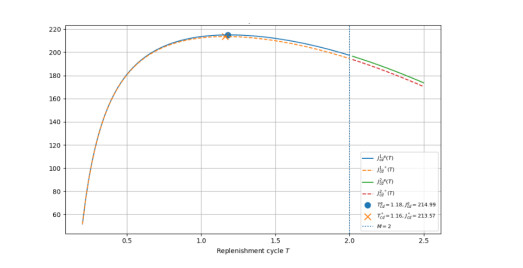
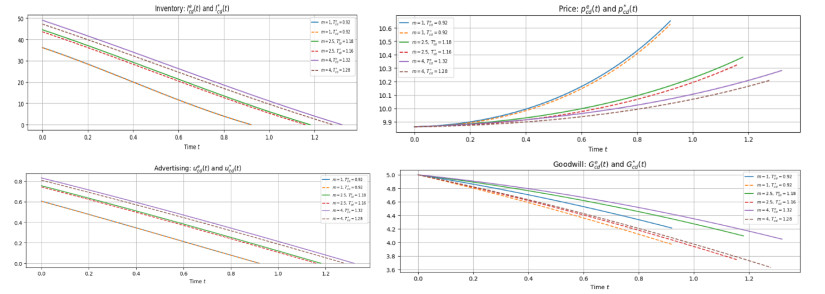
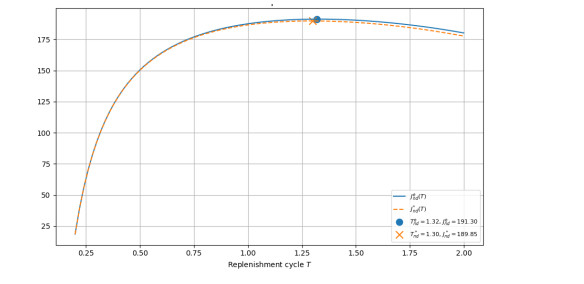
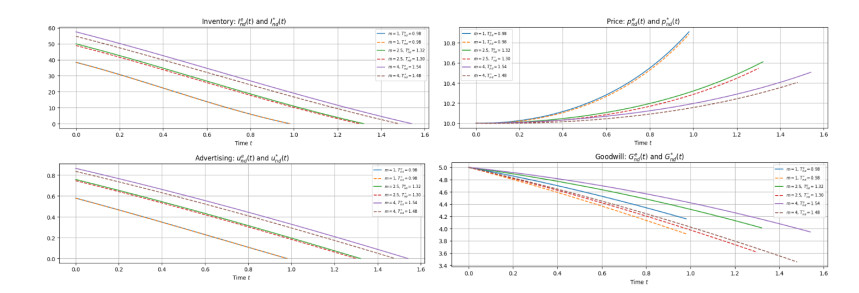
This paper develops a continuous-time model for expiration-sensitive products to jointly determine optimal dynamic pricing, advertising investment, and inventory decisions under trade-credit financing. Demand depends on both selling price and advertising-generated goodwill, with goodwill following Nerlove–Arrow dynamics, whereas inventory availability is subject to sales depletion and age-dependent deterioration over time. The trade-credit mechanism introduces regime-switching dynamics based on the relationship between the credit period and the replenishment cycle, leading to a hybrid optimal control problem analyzed using Pontryagin's Maximum Principle. A post-solution approximation of the goodwill trajectory is proposed that preserves the structure of the original optimality conditions while providing semi-closed-form expressions for the optimal policies. Numerical experiments demonstrate that the approximation closely reproduces the exact optimal trajectories and objective values. The results further show that trade credit enhances retailer profitability by relaxing liquidity constraints, thereby enabling lower inventory levels, stronger advertising investment, smoother pricing policies, and higher goodwill, particularly for products with longer expiration periods. The proposed framework provides a decision-support tool for jointly coordinating operational, marketing, and financial decisions in expiration-sensitive supply chains.
Citation: Yan Shi, Xiang Liu, Konstantina Skouri. Dynamic pricing, advertising and inventory optimization for perishable products under trade credit[J]. Journal of Industrial and Management Optimization, 2026, 22(9): 4231-4257. doi: 10.3934/jimo.2026148
This paper develops a continuous-time model for expiration-sensitive products to jointly determine optimal dynamic pricing, advertising investment, and inventory decisions under trade-credit financing. Demand depends on both selling price and advertising-generated goodwill, with goodwill following Nerlove–Arrow dynamics, whereas inventory availability is subject to sales depletion and age-dependent deterioration over time. The trade-credit mechanism introduces regime-switching dynamics based on the relationship between the credit period and the replenishment cycle, leading to a hybrid optimal control problem analyzed using Pontryagin's Maximum Principle. A post-solution approximation of the goodwill trajectory is proposed that preserves the structure of the original optimality conditions while providing semi-closed-form expressions for the optimal policies. Numerical experiments demonstrate that the approximation closely reproduces the exact optimal trajectories and objective values. The results further show that trade credit enhances retailer profitability by relaxing liquidity constraints, thereby enabling lower inventory levels, stronger advertising investment, smoother pricing policies, and higher goodwill, particularly for products with longer expiration periods. The proposed framework provides a decision-support tool for jointly coordinating operational, marketing, and financial decisions in expiration-sensitive supply chains.

| [1] |
L. Janssen, T. Claus, J. Sauer, Literature review of deteriorating inventory models by key topics from 2012 to 2015, Int. J. Prod. Econ., 182 (2016), 86–112.https://doi.org/10.1016/j.ijpe.2016.08.019 doi: 10.1016/j.ijpe.2016.08.019

|
| [2] |
M. Asghari, M. Y. Jaber, H. Afshari, C. Searcy, Deteriorating inventory models: a comprehensive review, Comput. Ind. Eng. , 216 (2026), 111993.https://doi.org/10.1016/j.cie.2026.111993 doi: 10.1016/j.cie.2026.111993
|
| [3] |
L. Feng, J. X. Zhang, W. S. Tang, A joint dynamic pricing and advertising model for perishable products, J. Oper. Res. Soc., 66 (2015), 1341–1351.https://doi.org/10.1057/jors.2014.89 doi: 10.1057/jors.2014.89
|
| [4] |
Y. Wang, J. X. Zhang, W. S. Tang, Dynamic pricing for non-instantaneous deteriorating items, J. Intell. Manuf., 26 (2015), 629–640.https://doi.org/10.1007/s10845-013-0822-2 doi: 10.1007/s10845-013-0822-2
|
| [5] |
J. Zhang, Y. Wang, L. Lu, W. Tang, Optimal dynamic pricing and replenishment cycle for non-instantaneous deterioration items with inventory-level-dependent demand, Int. J. Prod. Econ., 170 (2015), 136–145.https://doi.org/10.1016/j.ijpe.2015.09.016 doi: 10.1016/j.ijpe.2015.09.016
|
| [6] |
N. Tashakkor, S. H. Mirmohammadi, M. Iranpoor, Joint optimization of dynamic pricing and replenishment cycle considering variable non-instantaneous deterioration and stock-dependent demand, Comput. Ind. Eng., 123 (2018), 232–241.https://doi.org/10.1016/j.cie.2018.06.029 doi: 10.1016/j.cie.2018.06.029
|
| [7] |
A. Herbon, E. Khmelnitsky, Optimal dynamic pricing and ordering of a perishable product under additive effects of price and time on demand, Eur. J. Oper. Res., 260 (2017), 546–556.https://doi.org/10.1016/j.ejor.2016.12.033 doi: 10.1016/j.ejor.2016.12.033
|
| [8] |
L. Feng, J. Zhang, W. Tang, Dynamic joint pricing and production policy for perishable products, Int. Trans. Oper. Res., 25 (2018), 2031–2051.https://doi.org/10.1111/itor.12239 doi: 10.1111/itor.12239
|
| [9] |
O. Kaya, H. Bayer, Pricing and lot-sizing decisions for perishable products when demand changes by freshness, J. Ind. Manag. Optim., 17 (2021), 3113–3129.https://www.aimsciences.org/article/doi/10.3934/jimo.2020110 doi: 10.3934/jimo.2020110
|
| [10] | M. Xue, G. Zhu, Partial myopia vs. forward-looking behaviors in a dynamic pricing and replenishment model for perishable items, J. Ind. Manag. Optim., 17 (2021), 633–648.https://www.aimsciences.org//article/doi/10.3934/jimo.2019126 |
| [11] |
J. Zhang, J. Lu, G. W. Zhu, Optimal shipment consolidation and dynamic pricing policies for perishable items, J. Oper. Res. Soc., 74 (2023), 719–735.https://doi.org/10.1080/01605682.2022.2056529 doi: 10.1080/01605682.2022.2056529
|
| [12] |
X. Luo, Y. Chu, Optimal dynamic pricing and production policy for a stochastic inventory system with perishable products and inventory-level-dependent demand, J. Ind. Manag. Optim., 19 (2023), 8541–8557.https://doi.org/10.3934/jimo.2023050 doi: 10.3934/jimo.2023050
|
| [13] |
R. Shi, C. You, Joint dynamic pricing and freshness-keeping effort strategy for perishable products with price-, freshness-, and stock-dependent demand, J. Ind. Manag. Optim., 19 (2023), 6572–6592.https://www.aimsciences.org//article/doi/10.3934/jimo.2022228 doi: 10.3934/jimo.2022228
|
| [14] |
I. Modak, S. Bardhan, B. C. Giri, Dynamic pricing and preservation investment strategy for perishable products under quality, price and greenness dependent demand, J. Ind. Manag. Optim., 20 (2024), 2260–2281.https://doi.org/10.3934/jimo.2024001 doi: 10.3934/jimo.2024001
|
| [15] |
M. Nerlove, K. J. Arrow, Optimal advertising policy under dynamic conditions, Economica, 29 (1962), 129–142.https://doi.org/10.2307/2551549 doi: 10.2307/2551549
|
| [16] |
L. Grosset, B. Viscolani, Optimal dynamic advertising with an adverse exogenous effect on brand goodwill, Automatica, 45 (2009), 863–870.https://doi.org/10.1016/j.automatica.2008.10.027 doi: 10.1016/j.automatica.2008.10.027
|
| [17] |
J. Zhang, Q. Gou, L. Liang, Z. Huang, Supply chain coordination through cooperative advertising with reference price effect, Omega, 41 (2013), 345–353.https://doi.org/10.1016/j.omega.2012.03.009 doi: 10.1016/j.omega.2012.03.009
|
| [18] |
Q. Zhang, J. Zhang, W. Tang, A dynamic advertising model with reference price effect, RAIRO Oper. Res., 49 (2015), 669–688.https://doi.org/10.1051/ro/2014063 doi: 10.1051/ro/2014063
|
| [19] |
M. H. Xu, X. D. Zuo, An optimal dynamic advertising model with inverse inventory sensitive demand effect for deteriorating items, J. Syst. Sci. Syst. Eng., 26 (2017), 593–608.https://doi.org/10.1007/s11518-016-5316-2 doi: 10.1007/s11518-016-5316-2
|
| [20] |
C. Y. Dye, Optimal joint dynamic pricing, advertising and inventory control model for perishable items with psychic stock effect, Eur. J. Oper. Res., 283 (2020), 576–587.https://doi.org/10.1016/j.ejor.2019.11.008 doi: 10.1016/j.ejor.2019.11.008
|
| [21] |
S. G. Ma, Y. He, R. Gu, Dynamic generic and brand advertising decisions under supply disruption, Int. J. Prod. Res., 59 (2021), 188–212.https://doi.org/10.1080/00207543.2020.1812751 doi: 10.1080/00207543.2020.1812751
|
| [22] | X. Y. Wang, Y. X. Zhang, S. H. Zhang, Dynamic advertising, pricing, and the optimal elongation timing of the supply chain, Int. J. Prod. Res., (2025), 1–22.https://doi.org/10.1080/00207543.2025.2553833 |
| [23] |
J. H. Liu, C. Y. Dye, C. T. Yang, Sustainable dynamic pricing, advertising, and replenishment strategies under emissions constraints and time-varying demand, RAIRO Oper. Res., 59 (2025), 2517–2543.https://doi.org/10.1051/ro/2025101 doi: 10.1051/ro/2025101
|
| [24] |
S. K. Goyal, Economic order quantity under conditions of permissible delay in payments, J. Oper. Res. Soc., 36 (1985), 335–338.https://doi.org/10.1057/jors.1985.56 doi: 10.1057/jors.1985.56
|
| [25] |
J. T. Teng, J. Min, Q. Pan, Economic order quantity model with trade credit financing for non-decreasing demand, Omega, 40 (2012), 328–335.https://doi.org/10.1016/j.omega.2011.08.001 doi: 10.1016/j.omega.2011.08.001
|
| [26] |
Y. Shi, Z. Zhang, F. Zhou, Y. Shi, Optimal ordering policies for a single deteriorating item with ramp-type demand rate under permissible delay in payments, J. Oper. Res. Soc., 70 (2019), 1848–1868.https://doi.org/10.1080/01605682.2018.1468865 doi: 10.1080/01605682.2018.1468865
|
| [27] |
S. Tiwari, L. E. Cárdenas-Barrón, A. A. Shaikh, M. Goh, Retailer's optimal ordering policy for deteriorating items under order-size dependent trade credit and complete backlogging, Comput. Ind. Eng., 139 (2020), 105559.https://doi.org/10.1016/j.cie.2018.12.006 doi: 10.1016/j.cie.2018.12.006
|
| [28] | Y. C. Tsao, H. A. Fauziah, T. L. Vu, N. A. Masruroh, Optimal pricing, ordering, and credit period policies for deteriorating products under order-linked trade credit, J. Ind. Manag. Optim., 18 (2022), 4151–4182.https://www.aimsciences.org/article/doi/10.3934/jimo.2021152 |
| [29] | C. Mahato, G. C. Mahata, Optimal replenishment, pricing and preservation technology investment policies for non-instantaneous deteriorating items under two-level trade credit policy, J. Ind. Manag. Optim., 18 (2022), 3499–3537.https://www.aimsciences.org/article/doi/10.3934/jimo.2021123 |
| [30] | Q. Lin, Y. Xiao, J. Zheng, Selecting the supply chain financing mode under price-sensitive demand: confirmed warehouse financing vs. trade credit, J. Ind. Manag. Optim., 17 (2021), 2031–2049.https://www.aimsciences.org/article/doi/10.3934/jimo.2020057 |
| [31] |
L. Feng, J. T. Teng, F. Zhou, Pricing and lot-sizing decisions on buy-now-and-pay-later installments through a product life cycle, Eur. J. Oper. Res., 306 (2023), 754–763.https://doi.org/10.1016/j.ejor.2022.08.010 doi: 10.1016/j.ejor.2022.08.010
|
| [32] | C. Shekhar, V. Yadav, A. Saurav, Optimal analysis of time-price discount-advertisement dependent demand with credit policy for inventory models, Ann. Oper. Res., 2024.https://doi.org/10.1007/s10479-024-06175-2 |
| [33] | M. Pervin, S. K. Roy, G. W. Weber, Multi-item deteriorating two-echelon inventory model with price- and stock-dependent demand: A trade-credit policy, J. Ind. Manag. Optim., 15 (2019), 1345–1373.https://www.aimsciences.org//article/doi/10.3934/jimo.2018098 |
| [34] | L. Kumar, K. Sharma, S. Swain, U. K. Khedlekar, Mathematical modeling of sustainable food markets balancing organic consumer preferences and profitability, J. Ind. Manag. Optim., 21 (2025), 5241–5280.https://www.aimsciences.org//article/doi/10.3934/jimo.2025091 |
| [35] | L. Feng, Dynamic pricing, quality investment, and replenishment model for perishable items, Int. Trans. Oper. Res., 26(4) (2019), 1558–1575.https://doi.org/10.1111/itor.12505 |
| [36] |
S. C. Chen, J. Min, J. T. Teng, F. Li, Inventory and shelf-space optimization for perishable produce with expiration date under perishableness and stock-dependent demand rate, J. Oper. Res. Soc., 67 (2016), 884–896.https://doi.org/10.1057/jors.2015.100 doi: 10.1057/jors.2015.100
|
| [37] |
J. Wu, C. T. Chang, M. C. Cheng, J. T. Teng, F. B. Al-Khateeb, Inventory management for fresh produce when the time-varying demand depends on product freshness, stock level and expiration date, Int. J. Syst. Sci. Oper. Logist., 3 (2016), 138–147.https://doi.org/10.1080/23302674.2015.1068880 doi: 10.1080/23302674.2015.1068880
|
| [38] |
C. T. Chang, L. Y. Ouyang, J. T. Teng, K. K. Lai, L. E. Cárdenas-Barrón, Manufacturer's pricing and lot-sizing decisions for perishable goods under various payment terms by a discounted cash flow analysis, Int. J. Prod. Econ., 218 (2019), 83–95.https://doi.org/10.1016/j.ijpe.2019.04.039 doi: 10.1016/j.ijpe.2019.04.039
|
| [39] |
M. Hasiloglu-Ciftciler, O. Kaya, Dynamic inventory sharing, ordering, and pricing strategies for perishable foods to maximize profit and minimize waste, Comput. Ind. Eng., 205 (2025), 111158.https://doi.org/10.1016/j.cie.2025.111158 doi: 10.1016/j.cie.2025.111158
|
 jimo-22-09-148-s001.pdf |
 |
Figures(4) / Tables(2)
Yan Shi, Xiang Liu, Konstantina Skouri. Dynamic pricing, advertising and inventory optimization for perishable products under trade credit[J]. Journal of Industrial and Management Optimization, 2026, 22(9): 4231-4257. doi: 10.3934/jimo.2026148




 DownLoad: