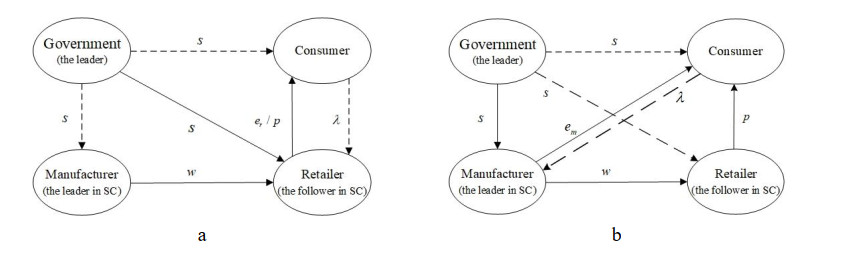
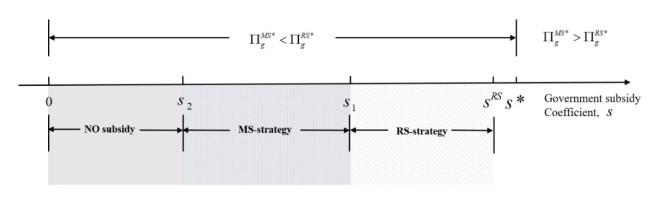
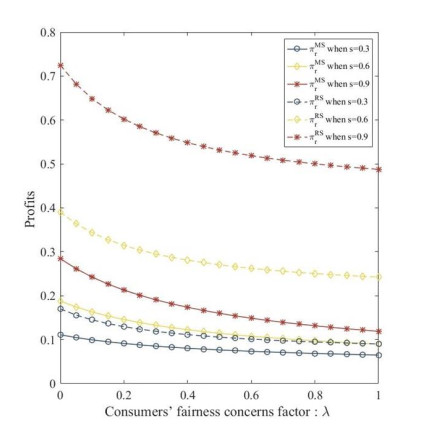
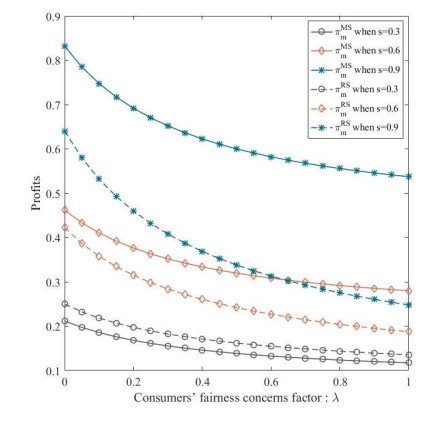
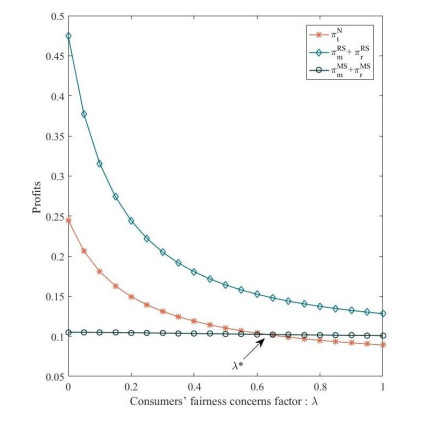
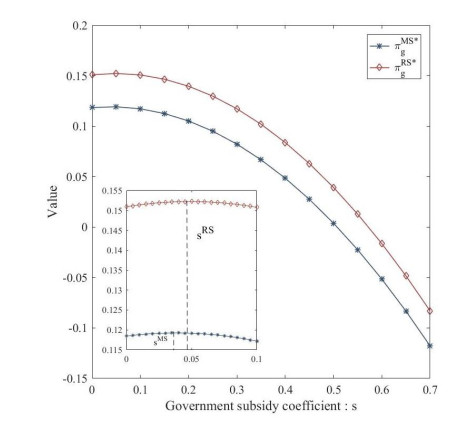
In this paper, we proposed two three-stage game theoretic models consisting of a government-manufacturer-retailer: Government subsidizes to the retailer (RS-strategy) and government subsidizes to the manufacturer (MS-strategy). We found that consumers' fairness concerns always perform a detrimental influence on supply chain members' CSR efforts and overall social welfare. Government subsidies can improve the adverse effects of consumer fairness concerns, supply chain members' performance and social welfare effects. In addition, we conducted a comparative study between no-government subsidies and two subsidy models in the numerical analysis section. Both subsidy strategies achieved Pareto improvement for supply chain members (manufacturer and retailer) compared with the no-subsidy decentralized scenario. The RS-strategy had higher expected returns but also higher risks regarding consumers' fairness concerns. The MS-strategy could optimize the risk of consumers' fairness concerns and address lower subsidy costs. Managerial implications provide insights into the decision-making of supply chain members and the choice of government strategies.
Citation: Xiaogang Cao, Zhaoyu Xu, Kewei Li, Hui Wen. Supply chain decision making under government subsidies: Considering CSR and consumer fairness concerns[J]. Journal of Industrial and Management Optimization, 2026, 22(9): 4258-4283. doi: 10.3934/jimo.2026149
In this paper, we proposed two three-stage game theoretic models consisting of a government-manufacturer-retailer: Government subsidizes to the retailer (RS-strategy) and government subsidizes to the manufacturer (MS-strategy). We found that consumers' fairness concerns always perform a detrimental influence on supply chain members' CSR efforts and overall social welfare. Government subsidies can improve the adverse effects of consumer fairness concerns, supply chain members' performance and social welfare effects. In addition, we conducted a comparative study between no-government subsidies and two subsidy models in the numerical analysis section. Both subsidy strategies achieved Pareto improvement for supply chain members (manufacturer and retailer) compared with the no-subsidy decentralized scenario. The RS-strategy had higher expected returns but also higher risks regarding consumers' fairness concerns. The MS-strategy could optimize the risk of consumers' fairness concerns and address lower subsidy costs. Managerial implications provide insights into the decision-making of supply chain members and the choice of government strategies.

| [1] |
O. M. Araz, T. M. Choi, D. L. Olson, F. Salman, Data analytics for operational risk management, Decis. Sci. , 51 (2020), 1316–1319. https://doi.org/10.1111/deci.12443 doi: 10.1111/deci.12443

|
| [2] |
D. Ivanov, A. Dolgui, Viability of intertwined supply networks: extending the supply chain resilience angles towards survivability. A position paper motivated by COVID-19 outbreak, Int. J. Prod. Res. , 58 (2020), 2904–2915. https://doi.org/10.1080/00207543.2020.1750727 doi: 10.1080/00207543.2020.1750727
|
| [3] |
K. P. Iyengar, R. Vaishya, S. Bahl, A. Vaish, Impact of the coronavirus pandemic on the supply chain in healthcare, Br. J. Health Care Manag. , 26 (2020), 1–4. https://doi.org/10.12968/bjhc.2020.0047 doi: 10.12968/bjhc.2020.0047
|
| [4] |
S. Singh, R. Kumar, R. Panchal, M. K. Tiwari, Impact of COVID-19 on logistics systems and disruptions in food supply chain, Int. J. Prod. Res. , 59 (2020), 1993–2008. https://doi.org/10.1080/00207543.2020.1792000 doi: 10.1080/00207543.2020.1792000
|
| [5] | L. Harbour, The coronavirus impact on the global automotive supply chains, 2020. Available from Forbes: https://www.forbes.com/sites/laurieharbour1/2020/03/13/the-coronavirus-impact-on-the-global-automotive-supply-chain. |
| [6] |
X. Li, Y. Fang, G. Chen, Z. Liu, Using pandemic data to examine the government's pandemic prevention measures and its support policies for vulnerable groups, Front. Pub. Health. , 10 (2022), 882872. https://doi.org/10.3389/fpubh.2022.882872 doi: 10.3389/fpubh.2022.882872
|
| [7] | Finance-division, Shanghai's policy measures to CSR and help enterprises to develop. National Development and Reform Commission, 2022. Available from: https://www.ndrc.gov.cn/xwdt/ztzl/fwyzqsk/zzhz/202205/t20220523_1325087.html?code = & state = 123. |
| [8] | Bluecore. Recognizing retail's social responsibility around COVID-19. 2022. |
| [9] |
X. Q. Wang, K. F. Yuen, Y. D. Wong, C. C. Teo, It is green, but is it fair? Investigating consumers' fairness perception of green service offerings, J. Clean. Prod., 181 (2018), 235–248. https://doi.org/10.1016/j.jclepro.2018.01.103 doi: 10.1016/j.jclepro.2018.01.103
|
| [10] |
M. Hou, K. Wang, H. Yang, Hub airport slot Re-allocation and subsidy policy to speed up air traffic recovery amid COVID-19 pandemic—case on the Chinese airline market, J. Air Transp. Manag. , 93 (2021), 102047. https://doi.org/10.1016/j.jairtraman.2021.102047 doi: 10.1016/j.jairtraman.2021.102047
|
| [11] | Y. Zhang, A. Zhang, COVID-19 and bailout policy: The case of Virgin Australia. Transp, Policy., 114 (2021), 174–181. https://doi.org/10.1016/j.tranpol.2021.09.015 |
| [12] |
D. Pan, J. Yang, G. Zhou, F. Kong, The influence of COVID-19 on agricultural economy and emergency mitigation measures in China: A text mining analysis, PLoS One, 15 (2020), e0241167. https://doi.org/10.1371/journal.pone.0241167 doi: 10.1371/journal.pone.0241167
|
| [13] |
E. Selerio, R. Maglasang, Minimizing production loss consequent to disasters using a subsidy optimization model: a pandemic case, Struct. Chang. Econ. Dyn. , 58 (2021), 112–124. https://doi.org/10.1016/j.strueco.2021.05.002 doi: 10.1016/j.strueco.2021.05.002
|
| [14] |
Y. Zhang, C. Xing, Q. Zhang, X. Zhang, Crises and changes: The impacts of CSR expenditure on loan and subsidy allocation in China's Pre- and Post-Pandemic periods, Financ. Res. Lett. , 47 (2022), 102697. https://doi.org/10.1016/j.frl.2022.102697 doi: 10.1016/j.frl.2022.102697
|
| [15] |
H. Khosroshahi, S. Dimitrov, S. R. Hejazi, Pricing, greening, and transparency decisions considering the impact of government subsidies and CSR behavior in supply chain decisions, J. Retail. Consum. Serv., 60 (2021), 102485. https://doi.org/10.1016/j.jretconser.2021.102485 doi: 10.1016/j.jretconser.2021.102485
|
| [16] |
Z. Chen, S. I. S. Ivan, Social welfare maximization with the least subsidy: Photovoltaic supply chain equilibrium and coordination with fairness concern, Renew. Energy, 132 (2019), 1332–1347. https://doi.org/10.1016/j.renene.2018.09.026 doi: 10.1016/j.renene.2018.09.026
|
| [17] |
Y. Liu, B. T. Quan, Q. Xu, J. Y. T. Forrest, Corporate social responsibility and decision analysis in a supply chain through government subsidy, J. Clean. Prod., 208 (2019), 436–447. https://doi.org/10.1016/j.jclepro.2018.10.121 doi: 10.1016/j.jclepro.2018.10.121
|
| [18] |
C. Su, X. J. Liu, W. Y. Du, Green supply chain decisions considering consumers' low-carbon awareness under different government subsidies, Sustainability, 12 (2020), 2281. https://doi.org/10.3390/su12062281 doi: 10.3390/su12062281
|
| [19] |
X. Wang, X. Y. Liu, S. Zhang, Operational and Expansion Strategies of Wind Farms Under Uncertainty: The Impact of Credit Risk and Production Flexibility, IEEE Trans. Eng. Manag., 73 (2026), 1512–1527. https://doi.org/10.1109/TEM.2026.3656529 doi: 10.1109/TEM.2026.3656529
|
| [20] |
X. Y. Wang, X. Y. Liu, S. H. Zhang, The impact of subsidies on wind farms under uncertainty: A real options approach, Omega, 144 (2026), 103592. https://doi.org/10.1016/j.omega.2026.103592. doi: 10.1016/j.omega.2026.103592
|
| [21] |
Y. C. Tsao, V. V. Thanh, Y. Y. Chang, H. H. Wei, COVID-19: Government subsidy models for sustainable energy supply with disruption risks, Renew. Sustain. Energy Rev. , 150 (2021), 111425. https://doi.org/10.1016/j.rser.2021.111425 doi: 10.1016/j.rser.2021.111425
|
| [22] |
K. Xie, S. Zhu, P. Gui, A game-theoretic approach for CSR emergency medical supply chain during COVID-19 crisis, Sustainability, 14 (2022), 1315. https://doi.org/10.3390/su14031315 doi: 10.3390/su14031315
|
| [23] | D. Louis, C. Lombart, F. Durif, Impact of a retailer's CSR activities on consumers' loyalty, Int. J. Retail Distrib. Manag., 47 (2019), 793–816. https://doi.org/10.1108/IJRDM-12-2018-0262 |
| [24] |
T. Schreiner, D. Baier, Online retailing during the COVID-19 pandemic: consumer preferences for marketing actions with consumer self-benefits versus other-benefit components, J. Mark. Manag. , 37 (2021), 1866–1902. https://doi.org/10.1080/0267257X.2022.2030784 doi: 10.1080/0267257X.2022.2030784
|
| [25] |
S. Kim, H. Woo, Global fashion retailers' responses to external and internal crises during the COVID-19 pandemic, Fash. Text., 8 (2021), 32. https://doi.org/10.1186/s40691-021-00260-x doi: 10.1186/s40691-021-00260-x
|
| [26] |
C. Lee, E. R. W. Bassam, I. Kuhn, Community-oriented actions by food retailers to support community well-being: a systematic scoping review, Public Health, 201 (2021), 115–124. https://doi.org/10.1016/j.puhe.2021.09.029 doi: 10.1016/j.puhe.2021.09.029
|
| [27] |
S. Liu, F. M. Yao, D. Y. Chen, CSR investment decision and coordination strategy for closed-loop supply chain with two competing retailers, J. Clean. Prod. , 310 (2021), 127378. https://doi.org/10.1016/j.jclepro.2021.127378 doi: 10.1016/j.jclepro.2021.127378
|
| [28] |
V. T. Dang, N. Nguyen, J. Wang, Consumers' perceptions and responses towards online retailers' CSR, Int. J. Retail Distrib. Manag. , 48 (2020), 1277–1299. https://doi.org/10.1108/IJRDM-10-2019-0339 doi: 10.1108/IJRDM-10-2019-0339
|
| [29] | S. Chang, T. Wang, X. Wang, Optimal investment portfolio and carbon emissions under climate risk ambiguity aversion, J. Oper. Res. Soc., (2026), 1–31. https://doi.org/10.1080/01605682.2026.2627328 |
| [30] |
J. Y. Chen, S. Dimitrov, H. Pun, The impact of government subsidy on supply Chains' sustainability innovation, Omega-Int. J. Manag. Sci. , 86 (2019), 42–58. https://doi.org/10.1016/j.omega.2018.06.012 doi: 10.1016/j.omega.2018.06.012
|
| [31] |
N. Yu, S. Wang, Z. Liu, Managing brand competition with consumer fairness concern via manufacturer incentive, Eur. J. Oper. Res. , 300 (2022), 661–675. https://doi.org/10.1016/j.ejor.2021.08.026 doi: 10.1016/j.ejor.2021.08.026
|
| [32] |
L. Yang, Y. Y. Zheng, J. S. Fan, S. Z. Dong, Online pricing strategy with considering consumers' fairness concerns, Asia-Pac. J. Oper. Res. , 39 (2022), 2140032. https://doi.org/10.1142/s0217595921400327 doi: 10.1142/s0217595921400327
|
| [33] |
X. Y. Wang, Y. X. Zhang, S. H. Zhang, Dynamic order allocation in a duopoly hybrid workforce of competition: A machine learning approach, Eur. J. Oper. Res., 315 (2024), 668–690. https://doi.org/10.1016/j.ejor.2023.12.026. doi: 10.1016/j.ejor.2023.12.026
|
| [34] | X. Wang, Y. Zhang, S. Zhang, Dynamic advertising, pricing, and the optimal elongation timing of the supply chain, Int. J. Prod. Res., (2025), 1–22. https://doi.org/10.1080/00207543.2025.2553833 |
| [35] |
W. Liu, D. Wang, X. Shen, X. Yan, W. Wei, The impacts of distributional and peer-induced fairness concerns on the decision-making of order allocation in logistics service supply chain, Transp. Res. Part E Logist. Transp. Rev. , 116 (2018), 102–122. https://doi.org/10.1016/j.tre.2018.05.006 doi: 10.1016/j.tre.2018.05.006
|
| [36] |
J. Fan, D. Ni, X. Fang, Liability cost sharing, product quality choice, and coordination in two-echelon supply chains, Eur. J. Oper. Res. , 284 (2020), 514–537. https://doi.org/10.1016/j.ejor.2020.01.003 doi: 10.1016/j.ejor.2020.01.003
|
| [37] |
F. Jiang, S. Mei, W. Zhong, Impact of customer's social value on optimizing referral reward programs, J. Organ. Comput. Electron. Commer. , 30 (2020), 279–295. https://doi.org/10.1080/10919392.2020.1761750 doi: 10.1080/10919392.2020.1761750
|
| [38] |
S. Yang, W. Qian, Effect of government subsidies on supply chain decision-making and coordination in the context of COVID-19, RAIRO-Oper. Res. , 55 (2021), 1885–1907. https://doi.org/10.1051/ro/2021089 doi: 10.1051/ro/2021089
|
| [39] | L. Xiao, Z. S. Chen, K. Govindan, M. J. Skibniewski, Effects of Online Consumer Reviews on a Dual-Channel Closed-Loop Supply Chain With Trade-In, IEEE Trans. Eng. Manag., (2022), 1–16. https://doi.org/10.1109/tem.2022.3167160 |
| [40] |
S. Panda, N. M. Modak, L. E. Cárdenas-Barrón, Coordinating a socially responsible closed-loop supply chain with product recycling, Int. J. Prod. Econ. , 188 (2017), 11–21. https://doi.org/10.1016/j.ijpe.2017.03.010 doi: 10.1016/j.ijpe.2017.03.010
|
| [41] |
Z. Yi, Y. Wang, Y. Liu, Y. J. Chen, The impact of consumer fairness seeking on distribution channel selection: Direct selling vs. agent selling, Prod. Oper. Manag., 27 (2018), 1148–1167. https://doi.org/10.1111/poms.12861 doi: 10.1111/poms.12861
|
| [42] |
Y. Li, Y. Tong, F. Ye, J. Song, The choice of the government green subsidy scheme: innovation subsidy vs. product subsidy, Int. J. Prod. Res. , 58 (2020), 4932–4946. https://doi.org/10.1080/00207543.2020.1730466 doi: 10.1080/00207543.2020.1730466
|
| [43] |
K. Kang, M. Z. Wang, X. F. Luan, Decision-making and coordination with government subsidies and fairness concerns in the poverty alleviation supply chain, Comput. Ind. Eng. , 152 (2021), 107058. https://doi.org/10.1016/j.cie.2020.107058 doi: 10.1016/j.cie.2020.107058
|
 jimo-22-09-149-s001.pdf |
 |
Figures(6) / Tables(7)
Xiaogang Cao, Zhaoyu Xu, Kewei Li, Hui Wen. Supply chain decision making under government subsidies: Considering CSR and consumer fairness concerns[J]. Journal of Industrial and Management Optimization, 2026, 22(9): 4258-4283. doi: 10.3934/jimo.2026149




 DownLoad: