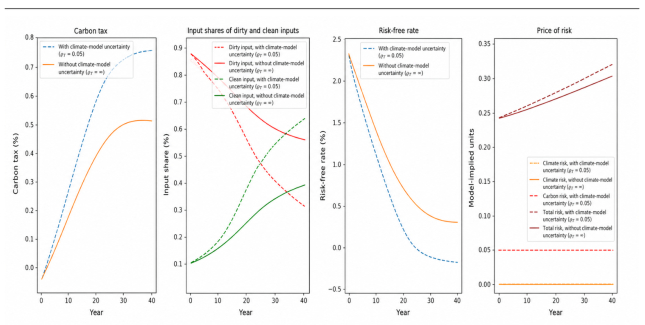
Climate change and climate-model uncertainty have important implications for macroeconomic allocation, carbon policy, and asset pricing. This paper develops a multi-sector Dynamic Stochastic General Equilibrium (DSGE) model with temperature dynamics, climate damages, carbon accumulation, productivity shocks, and ambiguity-averse preferences. Methodologically, we integrate climate-model uncertainty, ambiguity aversion, DSGE modeling, and the Deep Galerkin Method (DGM) into a unified computational framework. This approach enables us to solve a high-dimensional equilibrium system and examine resource allocation, carbon taxation, and asset-pricing responses under uncertainty. The framework extends conventional climate-economy and carbon-pricing studies by jointly analyzing macroeconomic and financial effects in the presence of climate-model uncertainty. The numerical results show that uncertainty accelerates the reallocation from brown inputs to green inputs, raises the model-implied carbon tax, and affects the equilibrium risk-free rate and price of risk. These findings provide a model-based benchmark for carbon-pricing design, sustainable investment, and climate-related risk management by policymakers, regulators, and financial market participants.
Citation: Shuhua Zhang, Tong Wang, Ning Ye, Xinyu Wang, Rui Wang. Climate uncertainty and asset pricing decisions: A machine learning analysis[J]. Journal of Industrial and Management Optimization, 2026, 22(7): 3386-3418. doi: 10.3934/jimo.2026124
Climate change and climate-model uncertainty have important implications for macroeconomic allocation, carbon policy, and asset pricing. This paper develops a multi-sector Dynamic Stochastic General Equilibrium (DSGE) model with temperature dynamics, climate damages, carbon accumulation, productivity shocks, and ambiguity-averse preferences. Methodologically, we integrate climate-model uncertainty, ambiguity aversion, DSGE modeling, and the Deep Galerkin Method (DGM) into a unified computational framework. This approach enables us to solve a high-dimensional equilibrium system and examine resource allocation, carbon taxation, and asset-pricing responses under uncertainty. The framework extends conventional climate-economy and carbon-pricing studies by jointly analyzing macroeconomic and financial effects in the presence of climate-model uncertainty. The numerical results show that uncertainty accelerates the reallocation from brown inputs to green inputs, raises the model-implied carbon tax, and affects the equilibrium risk-free rate and price of risk. These findings provide a model-based benchmark for carbon-pricing design, sustainable investment, and climate-related risk management by policymakers, regulators, and financial market participants.

| [1] |
H. D. Matthews, N. P. Gillett, P. A. Stott, K. Zickfeld, The proportionality of global warming to cumulative carbon emissions, Nature, 459 (2009), 829–832. https://doi.org/10.1038/nature08047 doi: 10.1038/nature08047

|
| [2] |
L. Berger, M. Marinacci, Model uncertainty in climate change economics: A review and proposed framework for future research: L. berger, m. marinacci, Environ. Resour. Econ., 77 (2020), 475–501. https://doi.org/10.1007/s10640-020-00503-3 doi: 10.1007/s10640-020-00503-3
|
| [3] |
R. S. Pindyck, The climate policy dilemma, Rev. Environ. Econ. Policy, 7 (2013), 219–237. https://doi.org/10.1093/reep/ret007 doi: 10.1093/reep/ret007
|
| [4] |
M. Burke, S. M. Hsiang, E. Miguel, Global non-linear effect of temperature on economic production, Nature, 527 (2015), 235–239. https://doi.org/10.1038/nature15725 doi: 10.1038/nature15725
|
| [5] |
F. Joos, R. Roth, J. S. Fuglestvedt, G. P. Peters, I. G. Enting, W. V. Bloh, et al., Carbon dioxide and climate impulse response functions for the computation of greenhouse gas metrics: a multi-model analysis, Atmos. Chem. Phys., 13 (2013), 2793–2825. https://doi.org/10.5194/acp-13-2793-2013 doi: 10.5194/acp-13-2793-2013
|
| [6] |
B. Kalaycı, A. Özmen, G. W. Weber, Mutual relevance of investor sentiment and finance by modeling coupled stochastic systems with mars, Ann. Oper. Res., 295 (2020), 183–206. https://doi.org/10.1007/s10479-020-03757-8 doi: 10.1007/s10479-020-03757-8
|
| [7] |
B. Z. Temoçin, G. W. Weber, Optimal control of stochastic hybrid system with jumps: a numerical approximation, J. Comput. Appl. Math., 259 (2014), 443–451. https://doi.org/10.1016/j.cam.2013.10.021 doi: 10.1016/j.cam.2013.10.021
|
| [8] |
İ. Özcan, S. Z. A. Gök, G. W. Weber, Peer group situations and games with fuzzy uncertainty, J. Ind. Manag. Optim., 20 (2024), 428–438. https://doi.org/10.3934/jimo.2023084 doi: 10.3934/jimo.2023084
|
| [9] |
M. Ferreira, D. Pinheiro, S. Pinheiro, Two-player zero-sum stochastic differential games with markov-switching jump-diffusion dynamics, J. Dyn. Games, 15 (2025), 1–35. https://doi.org/10.3934/jdg.2025028 doi: 10.3934/jdg.2025028
|
| [10] |
N. Azevedo, D. Pinheiro, S. Pinheiro, Dynamic programming for semi-markov modulated sdes, Optimization, 71 (2022), 2315–2342. https://doi.org/10.1080/02331934.2020.1839072 doi: 10.1080/02331934.2020.1839072
|
| [11] |
M. Ferreira, D. Pinheiro, S. Pinheiro, Two-player zero-sum stochastic differential games with random horizon, Adv. Appl. Probab., 51 (2019), 1209–1235. https://doi.org/10.1017/apr.2019.47 doi: 10.1017/apr.2019.47
|
| [12] |
C. Hambel, H. Kraft, E. Schwartz, Optimal carbon abatement in a stochastic equilibrium model with climate change, Eur. Econ. Rev., 132 (2021), 103642. https://doi.org/10.1016/j.euroecorev.2020.103642 doi: 10.1016/j.euroecorev.2020.103642
|
| [13] | T. V. D. Bremer, F. V. D. Ploeg, Pricing carbon under economic and climactic risks: leading-order results from asymptotic analysis, 2018. Available from: https://ideas.repec.org/p/cpr/ceprdp/12642.html. |
| [14] |
S. Olijslagers, S. V. Wijnbergen, Discounting the future: On climate change, ambiguity aversion and epstein–zin preferences: S. olijslagers, s. van wijnbergen, Environ. Resour. Econ., 87 (2024), 683–730. https://doi.org/10.1007/s10640-023-00832-z doi: 10.1007/s10640-023-00832-z
|
| [15] |
K. D. Daniel, R. B. Litterman, G. Wagner, Declining CO2 price paths, Proc. Natl. Acad. Sci. U.S.A., 116 (2019), 20886–20891. https://doi.org/10.1073/pnas.1817444116 doi: 10.1073/pnas.1817444116
|
| [16] |
W. Brock, A. Xepapadeas, Regional climate policy under deep uncertainty: robust control and distributional concerns, Environ. Dev. Econ., 26 (2021), 211–238. https://doi.org/10.1017/S1355770X20000248 doi: 10.1017/S1355770X20000248
|
| [17] |
E. Savku, G. W. Weber, A stochastic maximum principle for a markov regime-switching jump-diffusion model with delay and an application to finance, J. Optim. Theory Appl., 179 (2018), 696–721. https://doi.org/10.1007/s10957-017-1159-3 doi: 10.1007/s10957-017-1159-3
|
| [18] |
N. Azevedo, D. Pinheiro, G. W. Weber, Dynamic programming for a markov-switching jump–diffusion, J. Comput. Appl. Math., 267 (2014), 1–19. https://doi.org/10.1016/j.cam.2014.01.021 doi: 10.1016/j.cam.2014.01.021
|
| [19] |
E. Savku, G. W. Weber, Stochastic differential games for optimal investment problems in a markov regime-switching jump-diffusion market, Ann. Oper. Res., 312 (2022), 1171–1196. https://doi.org/10.1007/s10479-020-03768-5 doi: 10.1007/s10479-020-03768-5
|
| [20] |
M. Barnett, Climate change and uncertainty: An asset pricing perspective, Manag. Sci., 69 (2023), 7562–7584. https://doi.org/10.1287/mnsc.2022.4635 doi: 10.1287/mnsc.2022.4635
|
| [21] |
D. Lemoine, C. Traeger, Watch your step: Optimal policy in a tipping climate, Am. Econ. J. Econ. Policy, 6 (2014), 137–66. https://doi.org/10.1257/pol.6.1.137 doi: 10.1257/pol.6.1.137
|
| [22] |
M. Aengenheyster, Q. Y. Feng, F. V. D. Ploeg, H. A. Dijkstra, The point of no return for climate action: Effects of climate uncertainty and risk tolerance, Earth Syst. Dynam., 9 (2018), 1085–1095. https://doi.org/10.5194/esd-9-1085-2018 doi: 10.5194/esd-9-1085-2018
|
| [23] |
S. Hsiang, R. Kopp, A. Jina, J. Rising, M. Delgado, S. Mohan, et al., Estimating economic damage from climate change in the united states, Science, 356 (2017), 1362–1369. https://doi.org/10.1126/science.aal4369 doi: 10.1126/science.aal4369
|
| [24] |
R. G. Newell, B. C. Prest, S. E. Sexton, The gdp-temperature relationship: implications for climate change damages, J. Environ. Econ. Manag., 108 (2021), 102445. https://doi.org/10.1016/j.jeem.2021.102445 doi: 10.1016/j.jeem.2021.102445
|
| [25] |
M. Golosov, J. Hassler, P. Krusell, A. Tsyvinski, Optimal taxes on fossil fuel in general equilibrium, Econometrica, 82 (2014), 41–88. https://doi.org/10.3982/ECTA10217 doi: 10.3982/ECTA10217
|
| [26] |
S. Olijslagers, F. V. D. Ploeg, S. V. Wijnbergen, On current and future carbon prices in a risky world, J. Econ. Dyn. Control, 146 (2023), 104569. https://doi.org/10.1016/j.jedc.2022.104569 doi: 10.1016/j.jedc.2022.104569
|
| [27] |
Y. Cai, T. S. Lontzek, The social cost of carbon with economic and climate risks, J. Polit. Econ., 127 (2019), 2684–2734. https://doi.org/10.1086/701890 doi: 10.1086/701890
|
| [28] |
T. S. V. D. Bremer, F. V. D. Ploeg, The risk-adjusted carbon price, Am. Econ. Rev., 111 (2021), 2782–2810. https://doi.org/10.1257/aer.20180517 doi: 10.1257/aer.20180517
|
| [29] | M. Donadelli, P. Grüning, S. Hitzemann, Understanding macro and asset price dynamics during the climate transition, SSRN Electron. J., 2019. Available from: https://EconPapers.repec.org/RePEc: lie: dpaper: 18. |
| [30] |
H. Ai, D. Kiku, Volatility risks and growth options, Manag. Sci., 62 (2016), 741–763. https://doi.org/10.1287/mnsc.2014.2129 doi: 10.1287/mnsc.2014.2129
|
| [31] |
F. Ackerman, E. A. Stanton, Climate risks and carbon prices: Revising the social cost of carbon, Economics, 6 (2012), 1–25. https://doi.org/10.5018/economics-ejournal.ja.2012-10 doi: 10.5018/economics-ejournal.ja.2012-10
|
| [32] |
S. Dietz, N. Stern, Endogenous growth, convexity of damage and climate risk: How nordhaus' framework supports deep cuts in carbon emissions, Econ. J., 125 (2015), 574–620. https://doi.org/10.1111/ecoj.12188 doi: 10.1111/ecoj.12188
|
| [33] |
D. L. Kelly, C. D. Kolstad, Bayesian learning, growth, and pollution, J. Econ. Dyn. Control, 23 (1999), 491–518. https://doi.org/10.1016/S0165-1889(98)00034-7 doi: 10.1016/S0165-1889(98)00034-7
|
| [34] |
W. A. Pizer, The optimal choice of climate change policy in the presence of uncertainty, Resour. Energy Econ., 21 (1999), 255–287. https://doi.org/10.1016/S0928-7655(99)00005-6 doi: 10.1016/S0928-7655(99)00005-6
|
| [35] |
B. Crost, C. P. Traeger, Optimal climate policy: Uncertainty versus monte carlo, Econ. Lett., 120 (2013), 552–558. https://doi.org/10.1016/j.econlet.2013.05.019 doi: 10.1016/j.econlet.2013.05.019
|
| [36] |
F. Yılmaz, H. Ö. Bakan, G. W. Weber, Strong-order conditions of runge-kutta method for stochastic optimal control problems, Appl. Numer. Math., 157 (2020), 470–489. https://doi.org/10.1016/j.apnum.2020.07.002 doi: 10.1016/j.apnum.2020.07.002
|
| [37] |
F. Yılmaz, H. Ö. Bakan, G. W. Weber, Weak second-order conditions of runge–kutta method for stochastic optimal control problems, J. Optim. Theory Appl., 202 (2024), 497–517. https://doi.org/10.1007/s10957-023-02324-y doi: 10.1007/s10957-023-02324-y
|
| [38] | R. Knutti, D. Frame, M. Allen, Greenhousegas emission targets for limiting global warming to 2 ℃, Nature, 458 (2009), 1158–1162. https://doi.org/ 10.1038/nature00817 |
| [39] | M. Collins, R. Knutti, Long-term climate change: projections, commitments and irreversibility, University Press, 2013. https://doi.org/10.1017/CBO9781107415324.024 |
| [40] |
P. Goodwin, R. Williams, A. Ridgwell, Sensitivity of climate to cumulative carbon emissions due to compensation of ocean heat and carbon uptake, Nat. Geosci., 8 (2014), 29–34. https://doi.org/10.1038/ngeo2304 doi: 10.1038/ngeo2304
|
| [41] |
A. H. MacDougall, N. C. Swart, R. Knutti, The uncertainty in the transient climate response to cumulative CO2 emissions arising from the uncertainty in physical climate parameters, J. Climate, 30 (2017), 813–827. https://doi.org/10.1175/JCLI-D-16-0205.1 doi: 10.1175/JCLI-D-16-0205.1
|
| [42] |
D. Ehlert, K. Zickfeld, M. Eby, N. Gillett, The sensitivity of the proportionality between temperature change and cumulative CO2 emissions to ocean mixing, J. Climate, 30 (2017), 2921–2935. https://doi.org/10.1175/JCLI-D-16-0247.1 doi: 10.1175/JCLI-D-16-0247.1
|
| [43] |
C. D. Jones, P. Friedlingstein, Quantifying process-level uncertainty contributions to tcre and carbon budgets for meeting paris agreement climate targets, Environ. Res. Lett., 15 (2020), 74019. https://doi.org/10.1088/1748-9326/ab858a doi: 10.1088/1748-9326/ab858a
|
| [44] |
R. Millar, P. Friedlingstein, The utility of the historical record for assessing the transient climate response to cumulative emissions, Philos. Trans. R. Soc. A Math. Phys. Eng. Sci., 376 (2018), 20160449. https://doi.org/10.1098/rsta.2016.0449 doi: 10.1098/rsta.2016.0449
|
| [45] |
L. Drouet, V. Bosetti, M. Tavoni, Selection of climate policies under the uncertainties in the fifth assessment report of the ipcc, Nat. Clim. Change, 5 (2015), 937–940. https://doi.org/10.1038/nclimate2721 doi: 10.1038/nclimate2721
|
| [46] |
M. Barnett, W. Brock, L. P. Hansen, Pricing uncertainty induced by climate change, Rev. Financ. Stud., 33 (2020), 1024–1066. https://doi.org/10.1093/rfs/hhz144 doi: 10.1093/rfs/hhz144
|
| [47] | R. Bansal, M. Ochoa, D. Kiku, Climate change and growth risks, Working Paper, 2016. https://doi.org/10.3386/w23009 |
| [48] |
M. Weitzman, On modeling and interpreting the economics of catastrophic climate change, Rev. Econ. Stat., 91 (2009), 1–19. https://doi.org/10.1162/rest.91.1.1 doi: 10.1162/rest.91.1.1
|
| [49] |
W. Nordhaus, Estimates of the social cost of carbon: concepts and results from the dice-2013r model and alternative approaches, J. Assoc. Environ. Resour. Econ., 1 (2014), 273–312. https://doi.org/10.1086/676035 doi: 10.1086/676035
|
| [50] |
E. Anderson, L. Hansen, T. Sargent, A quartet of semigroups for model specification, robustness, prices of risk, and model detection, J. Eur. Econ. Assoc., 1 (2003), 68–123. https://doi.org/10.1162/154247603322256774 doi: 10.1162/154247603322256774
|
| [51] |
J. Sirignano, K. Spiliopoulos, Dgm: A deep learning algorithm for solving partial differential equations, J. Comput. Phys., 375 (2018), 1339–1364. https://doi.org/10.1016/j.jcp.2018.08.029 doi: 10.1016/j.jcp.2018.08.029
|
| [52] |
D. Acemoglu, U. Akcigit, D. Hanley, W. Kerr, Transition to clean technology, J. Polit. Econ., 124 (2016), 52–104. https://doi.org/10.1086/684511 doi: 10.1086/684511
|
| [53] |
S. Basu, J. G. Fernald, M. S. Kimball, Are technology improvements contractionary? Am. Econ. Rev., 96 (2006), 1418–1448. https://doi.org/10.1257/aer.96.5.1418 doi: 10.1257/aer.96.5.1418
|
| [54] |
M. G. Finn, Variance properties of solow's productivity residual and their cyclical implications, J. Econ. Dyn. Control, 19 (1995), 1249–1281. https://doi.org/10.1016/0165-1889(94)00826-4 doi: 10.1016/0165-1889(94)00826-4
|
| [55] |
D. Acemoglu, P. Aghion, L. Bursztyn, D. Hemous, The environment and directed technical change, Am. Econ. Rev., 102 (2012), 131–166. https://doi.org/10.1257/aer.102.1.131 doi: 10.1257/aer.102.1.131
|
| [56] |
A. Vissing-Jørgensen, Limited asset market participation and the elasticity of intertemporal substitution, J. Polit. Econ., 110 (2002), 825–853. https://doi.org/10.3386/w8896 doi: 10.3386/w8896
|
 jimo-22-07-124-s001.pdf |
 |
Figures(5) / Tables(10)
Shuhua Zhang, Tong Wang, Ning Ye, Xinyu Wang, Rui Wang. Climate uncertainty and asset pricing decisions: A machine learning analysis[J]. Journal of Industrial and Management Optimization, 2026, 22(7): 3386-3418. doi: 10.3934/jimo.2026124




 DownLoad: