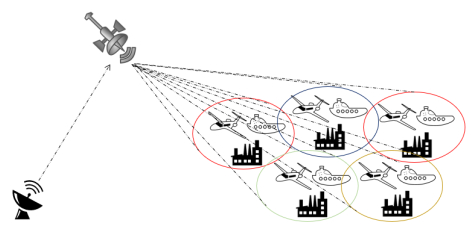
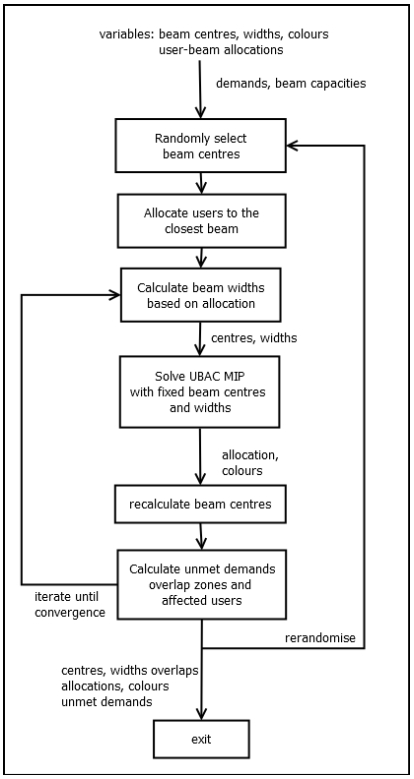
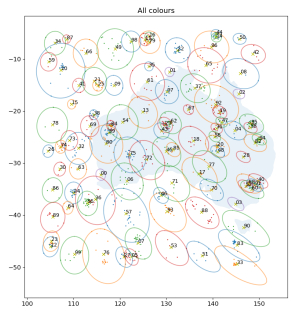
We addressed the problem of optimally allocating of spot-beams by high-throughput satellites to the terminals on the ground (users), each with different transmission demands and user terminal characteristics. The geostationary satellite antenna can form spot-beams of different sizes, at different locations, and employ different bandwidths and polarisations (referred to as colours). The objective is to provide an optimal coverage of a geographical region so that the users' demands are satisfied, inter-beam interference is minimised, and beam transmission capacities are not exceeded. We formulated this challenging large-scale optimisation problem as a bilevel mixed integer programming problem and presented numerical experiments that illustrate the quality of the obtained solutions and scalability of the proposed approach for up to 200 spot-beams and 2000 terminals.
Citation: Gleb Beliakov, Juan Calle Salazar, Mark Jacobs, Jeewani Kodithuwakkuge, Vicky Mak-Hau. Optimal spot-beam allocation by geostationary satellites[J]. Journal of Industrial and Management Optimization, 2026, 22(7): 3362-3385. doi: 10.3934/jimo.2026123
We addressed the problem of optimally allocating of spot-beams by high-throughput satellites to the terminals on the ground (users), each with different transmission demands and user terminal characteristics. The geostationary satellite antenna can form spot-beams of different sizes, at different locations, and employ different bandwidths and polarisations (referred to as colours). The objective is to provide an optimal coverage of a geographical region so that the users' demands are satisfied, inter-beam interference is minimised, and beam transmission capacities are not exceeded. We formulated this challenging large-scale optimisation problem as a bilevel mixed integer programming problem and presented numerical experiments that illustrate the quality of the obtained solutions and scalability of the proposed approach for up to 200 spot-beams and 2000 terminals.

| [1] | G. Maral, M. Bousquet, Z. L. Sun, Satellite communications systems: Systems, techniques and technology, John Wiley and Sons, 2020. https://doi.org/10.1002/9781119673811 |
| [2] |
N. Pachler, J. J. Garau-Luis, E. F. Crawley, B. G. Cameron, A unified resource allocation framework and impact evaluation for NGSO satellite constellations, Int. J. Satell. Commun. Netw., 43 (2025). 77–96. https://doi.org/10.1002/sat.1547 doi: 10.1002/sat.1547

|
| [3] |
X. Tong, N. X. Li, J. X. Liu, S. Peng, An efficient downlink resource allocation scheme in power-limited GEO satellite systems, Digit. Commun. Netw., 11 (2025), 1751–1761. https://doi.org/10.1016/j.dcan.2025.05.007 doi: 10.1016/j.dcan.2025.05.007
|
| [4] |
R. Chen, W. X. Long, B. Wang, Y. He, R. Sun, N. Cheng, et al., Multibeam high throughput satellite: Hardware foundation, resource allocation, and precoding, IEEE Commun. Surv. Tutor., 28 (2026), 5379–5415. https://doi.org/10.1109/COMST.2026.3673850 doi: 10.1109/COMST.2026.3673850
|
| [5] | J. F. Bard, Practical bilevel optimization, Springer, New York, 2010. https://doi.org/10.1007/978-1-4757-2836-1 |
| [6] | S. Dempe, A. Zemkoho, Bilevel optimization, Springer Nature, 2020. https://doi.org/10.1007/978-3-030-52119-6 |
| [7] |
X. W. Chen, Q. L. Liu, D. A. Ralescu, A bi-level optimization model for the asset-liability management of insurance companies, J. Ind. Manag. Optim., 19 (2023), 3003–3019. http://dx.doi.org/10.3934/jimo.2022074 doi: 10.3934/jimo.2022074
|
| [8] | N. D. I. O. Pachler, A complete resource allocation framework for flexible high throughput satellite constellations, Massachusetts Institute of Technology, 2022. |
| [9] |
P. J. Honnaiah, N. Maturo, S. Chatzinotas, S. Kisseleff, J. Krause, Demand-based adaptive multi-beam pattern and footprint planning for high throughput GEO satellite systems, IEEE Open J. Commun. Soc., 2 (2021), 1526–1540. https://doi.org/10.1109/OJCOMS.2021.3093106 doi: 10.1109/OJCOMS.2021.3093106
|
| [10] |
J. T. Camino, C. Artigues, L. Houssin, S. Mourgues, MILP formulation improvement with k-means clustering for the beam layout optimization in multibeam satellite systems, Comput. Ind. Eng., 158 (2021), 107228. https://doi.org/10.1016/j.cie.2021.107228 doi: 10.1016/j.cie.2021.107228
|
| [11] | N. Torkzaban, A. Zoulkarni, A. Gholami, J. S. Baras, Capacitated beam placement for multi-beam non-geostationary satellite systems, IEEE Wirel. Commun. Netw. Conf., 2023, 1–6. https://doi.org/10.1109/WCNC55385.2023.10118814 |
| [12] |
J. F. Zhu, Y. H. Sun, X. A. Feng, S. G. Wang, L. Liu, M. Peng, Beam footprint design, scheduling, and spectrum assignment in low earth orbit mega-constellations, IEEE Trans. Vehic. Tech., 74 (2025), 13968–13984. https://doi.org/10.1109/TVT.2025.3560320 doi: 10.1109/TVT.2025.3560320
|
| [13] |
O. B. Yahia, Z. Garroussi, O. Bélanger, B. Sansò, J. F. Frigon, S. Martel, et al., Evolution of high-throughput satellite systems: A vision of programmable regenerative payload, IEEE Commun. Surv. Tutor., 27 (2025), 1565–1597. https://doi.org/10.1109/COMST.2024.3450292 doi: 10.1109/COMST.2024.3450292
|
| [14] |
J. Y. Song, S. Chan, H. W. Kim, B. J. Ku, D. Oh, S. Kim, Dynamic resource allocation for LEO satellite systems under heterogeneous traffic distributions, Int. J. Satell. Commun. Netw., 44 (2026), 199–209. https://doi.org/10.1002/sat.70015 doi: 10.1002/sat.70015
|
| [15] | Y. He, K. Q. Qi, X. Feng, R. Chen, Load-balanced and full-coverage beam layout for multibeam satellite systems, Int. Conf. Commun. Sig. Proc. Appl., 2024, 1–5. https://doi.org/10.1109/ICCSPA61559.2024.10794213 |
| [16] |
J. F. Zhang, W. Li, Y. Li, H. M. Wang, S. L. Li, A framework for joint beam scheduling and resource allocation in beam-hopping-based satellite systems, Electronics, 14 (2025), 2887. https://doi.org/10.3390/electronics14142887 doi: 10.3390/electronics14142887
|
| [17] |
Q. Wei, Z. Li, J. Shi, Z. Bai, X. Liao, P. Xiao, et al., Evolutionary reinforcement learning for resource efficiency optimization in downlink multi-leo communication system with cross-layer interference, IEEE Trans. Cogn. Commun. Netw., 12 (2026), 4223–4236. https://doi.org/10.1109/TCCN.2025.3632396 doi: 10.1109/TCCN.2025.3632396
|
| [18] |
S. Kashyap, N. Gupta, Resource allocation techniques in multibeam satellites: Conventional methods vs. AI/ML approaches, Int. J. Satell. Commun. Netw., 43 (2025), 97–121. https://doi.org/10.1002/sat.1548 doi: 10.1002/sat.1548
|
| [19] |
P. S. Eftetahi, L. Cai, A. Sepahi, Fair beam scheduling in leo satellite networks with reinforcement learning, IEEE Trans. on Cogn. Commun. Netw., 12 (2026), 5438–5450. https://doi.org/10.1109/TCCN.2026.3657104 doi: 10.1109/TCCN.2026.3657104
|
| [20] |
T. S. Abdu, S. Kisseleff, E. Lagunas, S. Chatzinotas, Flexible resource optimization for GEO multibeam satellite communication system, IEEE Trans. Wireless Commun., 20 (2021), 7888–7902. https://doi.org/10.1109/TWC.2021.3088609 doi: 10.1109/TWC.2021.3088609
|
| [21] |
T. Van Chien, N. M. Quan, T. N. Do, C. Le, T. N. Nguyen, S. Chatzinotas, Fast beam placement for ultra-dense leo networks, IEEE Wireless Commun. Lett., 14 (2024), 621–625. https://doi.org/10.1109/LWC.2024.3516818 doi: 10.1109/LWC.2024.3516818
|
| [22] | A. Gaudry, R. Li, V. M. Hau, M. Jacobs, J. Kodithuwakkuge, Resource optimisation for geostationary communication satellites, Proc. Int. Congr. Model. Simul., 2024. https://doi.org/10.36334/modsim.2023.gaudry |
| [23] |
R. Li, A. Gaudry, V. M. Hau, CG‐FlexBeamOpt: Advanced solution methodology for high throughput GEO satellite beam laydown and resource allocation, Int. J. Satell. Commun. Netw., 42 (2024), 286–312. https://doi.org/10.1002/sat.1513 doi: 10.1002/sat.1513
|
| [24] | H. Shehata, H. Inaltekin, I. B. Collings, S. V. Hanly, P. Whiting, Beam direction optimization for next-generation geo satellite networks, Asia Pacific Conf. Commun., 2023,267–272. https://doi.org/10.1109/APCC60132.2023.10460601 |
| [25] | V. N. Ha, E. Lagunas, T. S. Abdu, H. Chaker, S. Chatzinotas, J. Grotz, Large-scale beam placement and resource allocation design for meo-constellation satcom, IEEE Int. Conf. Commun. workshops, 2023, 1240–1245. https://doi.org/10.1109/ICCWorkshops57953.2023.10283806 |
| [26] | V. P. Bui, T. Van Chien, E. Lagunas, J. Grotz, S. Chatzinotas, B. Ottersten, Joint beam placement and load balancing optimization for non-geostationary satellite systems, IEEE Int. Mediter. Conf. Commun. Netw., 2022,316–321. https://doi.org/10.1109/MeditCom55741.2022.9928761 |
| [27] |
P. J. Honnaiah, E. Lagunas, S. Chatzinotas, J. Krause, Demand-driven beam densification in multibeam satellite communication systems, IEEE Trans. Aerospace Elec. Sys., 59 (2023), 6534–6554. https://doi.org/10.1109/TAES.2023.3278253 doi: 10.1109/TAES.2023.3278253
|
| [28] | L. Yu, J. X. Wan, Y. K. Liu, K. Zhang, The latest developments of multi-beam phased array antennas for satellite communications, Int. Conf. Microwave and Millimeter Wave Tech., 2022. https://doi.org/10.1109/ICMMT55580.2022.10023090 |
| [29] | M. Takahashi, Y. Kawamoto, N. Kato, A. Miura, M. Toyoshima, Adaptive multi-beam arrangement for improving throughput in an hts communication system, IEEE Int. Conf. Commun., 2020, 1–6. https://doi.org/10.1109/ICC40277.2020.9148622 |
| [30] |
A. Gaudry, R. Li, V. Mak‐Hau, FlexBeamOpt: hybrid solution methodologies for high-throughput GEO satellite beam laydown and resource allocation, Int. J. Satell. Commun. Netw., 41 (2023), 515–538. https://doi.org/10.1002/sat.1481 doi: 10.1002/sat.1481
|
| [31] | A. Kyrgiazos, B. Evans, P. Thompson, Irregular beam sizes and non-uniform bandwidth allocation in HTS multibeam satellite systems, AIAA Int. Commun. Sat. Syst. Conf., 2013. https://doi.org/10.2514/6.2013-5617 |
| [32] | M. Cooley, Phased array fed reflector (PAFR) antenna architectures for space-based sensors, IEEE Aerospace Conf. Proc., 2015. https://doi.org/10.1109/AERO.2015.7118963 |
| [33] | G. Toso, P. Angeletti, C. Mangenot, Multibeam antennas based on phased arrays: An overview on recent ESA developments, The 8th Europ. Conf. Antennas and Propagation, 2014,178–181. https://doi.org/10.1109/EuCAP.2014.6901721 |
| [34] | D. Sikri, R. M. Jayasuriya, Multi-beam phased array with full digital beamforming for SATCOM and 5G, 5G Phased Array Techn., 30 (2019), 1–20. |
| [35] | R. E. Collin, Antennas and radiowave propagation, McGraw-Hill, New York, 1985. |
| [36] |
A. Kyrgiazos, B. Evans, P. Thompson, P. T. Mathiopoulos, S. Papaharalabos, A terabit/second satellite system for european broadband access: A feasibility study, Int. J. Satell. Commun. Netw., 32 (2014), 63–92. https://doi.org/10.1002/sat.1067 doi: 10.1002/sat.1067
|
| [37] |
C. Caini, G. E. Corazza, G. Falciasecca, M. Ruggieri, F. Vatalaro, A spectrum- and power-efficient ehf mobile satellite system to be integrated with terrestrial cellular systems, IEEE J. Sel. Areas Commun., 10 (1992), 1315–1325. https://doi.org/10.1109/49.166759 doi: 10.1109/49.166759
|
| [38] | S. Dempe, V. Kalashnikov, G. A. Perez-Valdes, N. Kalashnikova, Bilevel programming problems; Theory, algorithms and applications to energy networks, Energy Systems, Springer, New York, 2015. https://doi.org/10.1007/978-3-662-45827-3 |
| [39] | Y. Collette, P. Siarry, Multiobjective optimization, Springer, 2011. https://doi.org/10.1007/978-3-662-08883-8 |
| [40] | Y. C. Zhang, X. Hu, R. Chen, Z. L. Zhang, L. Q. Wang, W. D. Wang, Dynamic beam hopping for DVB-S2X satellite: A multi-objective deep reinforcement learning approach, IEEE Int. Conf. Ubiquit. Comput. Commun. and Data Sci. Comput. Intel. Smart Comput., Netw. Serv., 2019. https://doi.org/10.1109/IUCC/DSCI/SmartCNS.2019.00056 |
| [41] |
Y. B. Lv, Z. P. Wan, Linear bilevel multiobjective optimization problem: Penalty approach, J. Ind. Manag. Optim., 15 (2019), 1213–1223. http://dx.doi.org/10.3934/jimo.2018092 doi: 10.3934/jimo.2018092
|
| [42] |
F. Fali, M. Moulaï, Solving discrete linear fractional bilevel programs with multiple objectives at the upper level, J. Ind. Manag. Optim., 19 (2023), 2639–2654. https://doi.org/10.3934/jimo.2022059 doi: 10.3934/jimo.2022059
|
| [43] |
G. G. Brown, R. F. Dell, Formulating integer linear programs: A rogues' gallery, INFORMS Trans. Educ., 7 (2007), 153–159. https://doi.org/10.1287/ited.7.2.153 doi: 10.1287/ited.7.2.153
|
| [44] | A. Makhorin, GNU Linear programming kit, 2012. Available from: https://www.gnu.org/software/glpk/. |
| [45] | Y. X. Wang, D. M. Bian, J. Hu, J. Y. Tang, C. Wang, A flexible resource allocation algorithm in full bandwidth beam hopping satellite systems, IEEE Adv. Inf. Manag. Commun. Electron. Autom. Control Conf., 2019. https://doi.org/10.1109/IMCEC46724.2019.8984132 |
| [46] | X. Alberti, J. M. Cebrian, A. Del Bianco, Z. Katona, J. Lei, M. A. Vazquez-Castro, et al., System capacity optimization in time and frequency for multibeam multi-media satellite systems, Adv. Satell. Multimed. Syst. Conf. Signal Process. Space Commun. Workshop, 2010,226–233. https://doi.org/10.1109/ASMS-SPSC.2010.5586902 |
| [47] | R. Alegre, N. Alagha, M. A. V. Castro, Heuristic algorithms for flexible resource allocation in beam hopping multi-beam satellite systems, AIAA Int. Commun. Satell. Syst. Conf., 2011. https://doi.org/10.2514/6.2011-8001 |
| [48] |
M. W. Baidas, E. Alsusa, K. A. Hamdi, Performance analysis and SINR-based power allocation strategies for downlink NOMA networks, IET Commun., 14 (2020), 723–735. https://doi.org/10.1049/iet-com.2018.6112 doi: 10.1049/iet-com.2018.6112
|
| [49] | J. Lei, M. A. Vázquez-Castro, Joint power and carrier allocation for the multibeam satellite downlink with individual sinr constraints, IEEE Int. Conf. Commun., 2010, 1–5. https://doi.org/10.1109/ICC.2010.5502506 |
| [50] |
M. Schubert, H. Boche, QoS-based resource allocation and transceiver optimization, Found. Trends Commun. Inform. Theory, 2 (2005), 383–529. https://doi.org/10.1561/0100000010 doi: 10.1561/0100000010
|
| [51] |
G. Zheng, S. Chatzinotas, B. Ottersten, Generic optimization of linear precoding in multibeam satellite systems, IEEE Trans. Wireless Commun., 11 (2012), 2308–2320. https://doi.org/10.1109/TWC.2012.040412.111629 doi: 10.1109/TWC.2012.040412.111629
|
Figures(6) / Tables(6)
Gleb Beliakov, Juan Calle Salazar, Mark Jacobs, Jeewani Kodithuwakkuge, Vicky Mak-Hau. Optimal spot-beam allocation by geostationary satellites[J]. Journal of Industrial and Management Optimization, 2026, 22(7): 3362-3385. doi: 10.3934/jimo.2026123




 DownLoad: