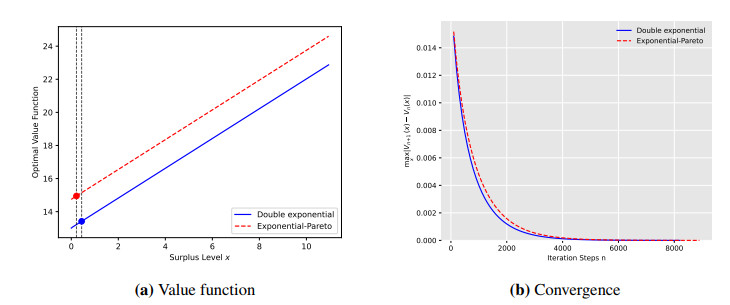
This paper investigates the optimal dividend and capital injection problem under a two-sided jump-diffusion model, incorporating the flexibility of liquidation when the surplus becomes negative. Unlike prior studies, we relax the constraint on capital injection, allowing decision-makers to choose between rescuing the firm via capital injection or liquidating it upon financial distress. We derive the dynamic programming principle and the Hamilton–Jacobi–Bellman (HJB) equation for this control problem. To overcome the analytical challenges posed by two-sided jumps, we use the Markov chain approximation (MCA) method, constructing a discrete-time controlled Markov chain that approximates the original jump-diffusion process. We show the convergence of the value function under MCA to the original value function through the weak convergence theory. We then solve the approximated problem numerically based on a value iteration algorithm. Extensive numerical examples illustrate the optimal strategies, showcasing the interplay among dividend payments, capital injections, and liquidation decisions.
Citation: Ningning Feng, Yixuan Liu, Ran Xu. Dividend and capital injection control with liquidation under two-sided jump-diffusion models[J]. Journal of Industrial and Management Optimization, 2026, 22(7): 3419-3455. doi: 10.3934/jimo.2026125
This paper investigates the optimal dividend and capital injection problem under a two-sided jump-diffusion model, incorporating the flexibility of liquidation when the surplus becomes negative. Unlike prior studies, we relax the constraint on capital injection, allowing decision-makers to choose between rescuing the firm via capital injection or liquidating it upon financial distress. We derive the dynamic programming principle and the Hamilton–Jacobi–Bellman (HJB) equation for this control problem. To overcome the analytical challenges posed by two-sided jumps, we use the Markov chain approximation (MCA) method, constructing a discrete-time controlled Markov chain that approximates the original jump-diffusion process. We show the convergence of the value function under MCA to the original value function through the weak convergence theory. We then solve the approximated problem numerically based on a value iteration algorithm. Extensive numerical examples illustrate the optimal strategies, showcasing the interplay among dividend payments, capital injections, and liquidation decisions.

| [1] | B. De Finetti, Su un'impostazione alternativa della teoria collettiva del rischio, Trans. XVth Int. Congr. Actuaries, 2 (1957), 433–443. |
| [2] |
B. HøJgaard, M. Taksar, Controlling risk exposure and dividends payout schemes: Insurance company example, Math. Finance, 9 (1999), 153–182. https://doi.org/10.1111/1467-9965.00066 doi: 10.1111/1467-9965.00066

|
| [3] |
H. U. Gerber, E. S. Shiu, On optimal dividend strategies in the compound Poisson model, N. Am. Actuar. J., 10 (2006), 76–93. https://doi.org/10.1080/10920277.2006.10596249 doi: 10.1080/10920277.2006.10596249
|
| [4] | H. Schmidli, Stochastic control in insurance, Springer Science & Business Media, 2007. https://doi.org/10.1007/978-1-84800-003-2 |
| [5] |
B. Avanzi, H. U. Gerber, E. S. W. Shiu, Optimal dividends in the dual model, Insur. Math. Econ., 41 (2007), 111–123. https://doi.org/10.1016/j.insmatheco.2006.10.002 doi: 10.1016/j.insmatheco.2006.10.002
|
| [6] |
F. Avram, Z. Palmowski, M. R. Pistorius, On the optimal dividend problem for a spectrally negative Lévy process, Ann. Appl. Probab., 17 (2007), 156–180. https://doi.org/10.1214/105051606000000709 doi: 10.1214/105051606000000709
|
| [7] |
R. L. Loeffen, An optimal dividends problem with transaction costs for spectrally negative Lévy processes, Insur. Math. Econ., 45 (2009), 41–48. https://doi.org/10.1016/j.insmatheco.2009.03.002 doi: 10.1016/j.insmatheco.2009.03.002
|
| [8] |
M. Belhaj, Optimal dividend payments when cash reserves follow a jump-diffusion process, Math. Finance, 20 (2010), 313–325. https://doi.org/10.1111/j.1467-9965.2010.00399.x doi: 10.1111/j.1467-9965.2010.00399.x
|
| [9] |
E. Bayraktar, A. E. Kyprianou, K. Yamazaki, On optimal dividends in the dual model, ASTIN Bull., 43 (2013), 359–372. https://doi.org/10.1017/asb.2013.17 doi: 10.1017/asb.2013.17
|
| [10] | P. Azcue, N. Muler, Stochastic optimization in insurance: a dynamic programming approach, Springer, 2014. https://doi.org/10.1007/978-1-4939-0995-7 |
| [11] |
D. C. Dickson, H. R. Waters, Some optimal dividends problems, ASTIN Bull., 34 (2004), 49–74. https://doi.org/10.2143/AST.34.1.504954 doi: 10.2143/AST.34.1.504954
|
| [12] |
H. U. Gerber, E. S. Shiu, N. Smith, Maximizing dividends without bankruptcy, ASTIN Bull., 36 (2006), 5–23. https://doi.org/10.2143/AST.36.1.2014143 doi: 10.2143/AST.36.1.2014143
|
| [13] |
N. Kulenko, H. Schmidli, Optimal dividend strategies in a Cramér–Lundberg model with capital injections, Insur. Math. Econ., 43 (2008), 270–278. https://doi.org/10.1016/j.insmatheco.2008.05.013 doi: 10.1016/j.insmatheco.2008.05.013
|
| [14] |
N. Scheer, H. Schmidli, Optimal dividend strategies in a Cramér–Lundberg model with capital injections and administration costs, Eur. Actuar. J., 1 (2011), 57–92. https://doi.org/10.1007/s13385-011-0007-3 doi: 10.1007/s13385-011-0007-3
|
| [15] |
J. Zhu, Optimal financing and dividend distribution with transaction costs in the case of restricted dividend rates, ASTIN Bull., 47 (2017), 239–268. https://doi.org/10.1017/asb.2016.29 doi: 10.1017/asb.2016.29
|
| [16] |
X. Peng, M. Chen, J. Guo, Optimal dividend and equity issuance problem with proportional and fixed transaction costs, Insur. Math. Econ., 51 (2012), 576–585. https://doi.org/10.1016/j.insmatheco.2012.08.004 doi: 10.1016/j.insmatheco.2012.08.004
|
| [17] |
J. L. Pérez, K. Yamazaki, On the refracted–reflected spectrally negative Lévy processes, Stochastic Process. Their Appl., 128 (2018), 306–331. https://doi.org/10.1016/j.spa.2017.03.024 doi: 10.1016/j.spa.2017.03.024
|
| [18] |
J. L. Pérez, K. Yamazaki, X. Yu, On the bail-out optimal dividend problem, J. Optim. Theory Appl., 179 (2018), 553–568. https://doi.org/10.1007/s10957-018-1340-3 doi: 10.1007/s10957-018-1340-3
|
| [19] |
D. Yao, H. Yang, R. Wang, Optimal financing and dividend strategies in a dual model with proportional costs, J. Ind. Manag. Optim., 6 (2010), 761–777. https://doi.org/10.3934/jimo.2010.6.761 doi: 10.3934/jimo.2010.6.761
|
| [20] |
D. Yao, H. Yang, R. Wang, Optimal dividend and capital injection problem in the dual model with proportional and fixed transaction costs, Eur. J. Oper. Res., 211 (2011), 568–576. https://doi.org/10.1016/j.ejor.2011.01.015 doi: 10.1016/j.ejor.2011.01.015
|
| [21] |
B. Avanzi, J. Shen, B. Wong, Optimal dividends and capital injections in the dual model with diffusion, ASTIN Bull., 41 (2011), 611–644. https://doi.org/10.2143/AST.41.2.2136990 doi: 10.2143/AST.41.2.2136990
|
| [22] |
J. L. Pérez, K. Yamazaki, On the optimality of periodic barrier strategies for a spectrally positive Lévy process, Insur. Math. Econ., 77 (2017), 1–13. https://doi.org/10.1016/j.insmatheco.2017.08.001 doi: 10.1016/j.insmatheco.2017.08.001
|
| [23] |
E. L. Porteus, On optimal dividend, reinvestment, and liquidation policies for the firm, Oper. Res., 25 (1977), 818–834. https://doi.org/10.1287/opre.25.5.818 doi: 10.1287/opre.25.5.818
|
| [24] |
H. U. Gerber, X. S. Lin, H. Yang, A note on the dividends-penalty identity and the optimal dividend barrier, ASTIN Bull., 36 (2006), 489–503. https://doi.org/10.2143/AST.36.2.2017931 doi: 10.2143/AST.36.2.2017931
|
| [25] |
R. L. Loeffen, J. F. Renaud, De Finetti's optimal dividends problem with an affine penalty function at ruin, Insur. Math. Econ., 46 (2010), 98–108. https://doi.org/10.1016/j.insmatheco.2009.09.006 doi: 10.1016/j.insmatheco.2009.09.006
|
| [26] |
F. Avram, Z. Palmowski, M. R. Pistorius, On gerber-shiu functions and optimal dividend distribution for a Lévy risk process in the presence of penalty function, Ann. Appl. Probab., 25 (2015), 1868–1935. https://doi.org/10.1214/14-AAP1038 doi: 10.1214/14-AAP1038
|
| [27] |
C. Yin, Y. Wen, Optimal dividend problem with a terminal value for spectrally positive Lévy processes, Insur. Math. Econ., 53 (2013), 769–773. https://doi.org/10.1016/j.insmatheco.2013.09.019 doi: 10.1016/j.insmatheco.2013.09.019
|
| [28] |
D. Yao, H. Yang, R. Wang, Optimal dividend and reinsurance strategies with financing and liquidation value, ASTIN Bull., 46 (2016), 365–399. https://doi.org/10.1017/10.1017/asb.2015.28 doi: 10.1017/10.1017/asb.2015.28
|
| [29] |
M. Vierkötter, H. Schmidli, On optimal dividends with exponential and linear penalty payments, Insur. Math. Econ., 72 (2017), 265–270. https://doi.org/10.1016/j.insmatheco.2016.12.001 doi: 10.1016/j.insmatheco.2016.12.001
|
| [30] |
R. Xu, J. K. Woo, Optimal dividend and capital injection strategy with a penalty payment at ruin: Restricted dividend payments, Insur. Math. Econ., 92 (2020), 1–16. https://doi.org/10.1016/j.insmatheco.2020.02.008 doi: 10.1016/j.insmatheco.2020.02.008
|
| [31] |
R. Xu, Optimal singular dividend control with capital injection and affine penalty payment at ruin, Probab. Eng. Inf. Sci., 37 (2023), 462–490. https://doi.org/10.1017/S0269964822000249 doi: 10.1017/S0269964822000249
|
| [32] |
S. Zhang, J. Xiong, Optimal dividend and capital injection for the classical risk model with perturbaion, Sci. Sin. Math., 55 (2025), 1301–1318. https://doi.org/10.1360/SSM-2024-0153 doi: 10.1360/SSM-2024-0153
|
| [33] |
X. Han, Y. Cen, C. Guan, Finite horizon optimal dividend and capital injection problem driven by a jump-diffusion process, Commun. Nonlinear Sci. Numer. Simul., 152 (2026), 109189. https://doi.org/10.1016/j.cnsns.2025.109189 doi: 10.1016/j.cnsns.2025.109189
|
| [34] |
Y. Chi, X. S. Lin, On the threshold dividend strategy for a generalized jump–diffusion risk model, Insur. Math. Econ., 48 (2011), 326–337. https://doi.org/10.1016/j.insmatheco.2010.11.006 doi: 10.1016/j.insmatheco.2010.11.006
|
| [35] |
L. Bo, R. Song, D. Tang, Y. Wang, X. Yang, Lévy risk model with two-sided jumps and a barrier dividend strategy, Insur. Math. Econ., 50 (2012), 280–291. https://doi.org/10.1016/j.insmatheco.2011.12.002 doi: 10.1016/j.insmatheco.2011.12.002
|
| [36] |
K. C. Yuen, C. Yin, On optimality of the barrier strategy for a general Lévy risk process, Math. Comput. Model., 53 (2011), 1700–1707. https://doi.org/10.1016/j.mcm.2010.12.042 doi: 10.1016/j.mcm.2010.12.042
|
| [37] |
C. Yin, K. C. Yuen, Y. Shen, Convexity of ruin probability and optimal dividend strategies for a general Lévy process, Sci. World J., 2015 (2015), 354129. https://doi.org/10.1155/2015/354129 doi: 10.1155/2015/354129
|
| [38] |
K. Noba, On the optimality of double barrier strategies for Lévy processes, Stochastic Process. Their Appl., 131 (2021), 73–102. https://doi.org/10.1016/j.spa.2020.08.008 doi: 10.1016/j.spa.2020.08.008
|
| [39] |
H. J. Kushner, L. F. Martins, Numerical methods for stochastic singular control problems, SIAM J. Control Optim., 29 (1991), 1443–1475. https://doi.org/10.1137/0329073 doi: 10.1137/0329073
|
| [40] |
S. G. Kou, A jump–diffusion model for option pricing, Manag. Sci., 48 (2002), 1086–1101. https://doi.org/10.1287/mnsc.48.8.1086.166 doi: 10.1287/mnsc.48.8.1086.166
|
| [41] |
S. G. Kou, H. Wang, First passage times of a jump diffusion process, Adv. Appl. Probab., 35 (2003), 504–531. https://doi.org/10.1239/aap/1051201658 doi: 10.1239/aap/1051201658
|
| [42] | H. Pham, Continuous-time stochastic control and optimization with financial applications, vol. 61, Springer Science & Business Media, 2009. https://doi.org/10.1007/978-3-540-89500-8 |
| [43] | H. J. Kushner, P. Dupuis, Numerical methods for stochastic control problems in continuous time, vol. 24, Springer Science & Business Media, 2001. https://doi.org/10.1007/978-1-4613-0007-6 |
| [44] |
Z. Jin, G. Yin, C. Zhu, Numerical solutions of optimal risk control and dividend optimization policies under a generalized singular control formulation, Automatica, 48 (2012), 1489–1501. https://doi.org/10.1016/j.automatica.2012.05.039 doi: 10.1016/j.automatica.2012.05.039
|
| [45] |
Z. Jin, H. Yang, G. Yin, Numerical methods for optimal dividend payment and investment strategies of regime–switching jump–diffusion models with capital injections, Automatica, 49 (2013), 2317–2329. https://doi.org/10.1016/j.automatica.2013.04.043 doi: 10.1016/j.automatica.2013.04.043
|
| [46] |
Z. Jin, G. Yin, Numerical methods for optimal dividend payment and investment strategies of Markov–modulated jump diffusion models with regular and singular controls, J. Optim. Theory Appl., 159 (2013), 246–271. https://doi.org/10.1007/s10957-012-0263-7 doi: 10.1007/s10957-012-0263-7
|
| [47] |
A. Budhiraja, K. Ross, Convergent numerical scheme for singular stochastic control with state constraints in a portfolio selection problem, SIAM J. Control Optim., 45 (2007), 2169–2206. https://doi.org/10.1137/050640515 doi: 10.1137/050640515
|
| [48] |
E. Bayraktar, A. Budhiraja, A. Cohen, A numerical scheme for a mean field game in some queueing systems based on Markov chain approximation method, SIAM J. Control Optim., 56 (2018), 4017–4044. https://doi.org/10.1137/17M1154357 doi: 10.1137/17M1154357
|
| [49] |
Z. Jin, G. Liu, H. Yang, Optimal consumption and investment strategies with liquidity risk and lifetime uncertainty for Markov regime-switching jump diffusion models, Eur. J. Oper. Res., 280 (2020), 1130–1143. https://doi.org/10.1016/j.ejor.2019.07.066 doi: 10.1016/j.ejor.2019.07.066
|
| [50] |
Z. Jin, H. Yang, G. Yin, A hybrid deep learning method for optimal insurance strategies: Algorithms and convergence analysis, Insur. Math. Econ., 96 (2021), 262–275. https://doi.org/10.1016/j.insmatheco.2020.11.012 doi: 10.1016/j.insmatheco.2020.11.012
|
| [51] |
T. Phelan, K. Eslami, Applications of markov chain approximation methods to optimal control problems in economics, J. Econ. Dyn. Control, 143 (2022), 104437. https://doi.org/10.1016/j.jedc.2022.104437 doi: 10.1016/j.jedc.2022.104437
|
Figures(1) / Tables(4)
Ningning Feng, Yixuan Liu, Ran Xu. Dividend and capital injection control with liquidation under two-sided jump-diffusion models[J]. Journal of Industrial and Management Optimization, 2026, 22(7): 3419-3455. doi: 10.3934/jimo.2026125




 DownLoad: