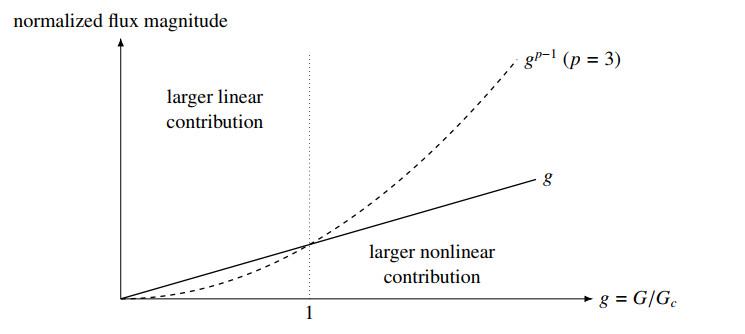
A scalar parabolic model was proposed for pressure equalization in a fluid-saturated complex medium in which two dissipative mobility channels act in parallel. The pressure flux contains a persistent Darcy contribution and a gradient-activated power-law contribution. In dimensional variables, the closure is
$ Q = -K_1\nabla P-K_p\left|{\nabla P}\right|^{p-2}\nabla P, \qquad K_1, K_p>0, \quad p>2, $
and the corresponding nondimensional equation is
$ \partial_tu- \operatorname{div}\!\left(\nu\nabla u+\kappa\left|{\nabla u}\right|^{p-2}\nabla u\right) = f. $
This is a standard monotone operator with $ (2, p) $-growth. No novelty was claimed for the algebraic sum of the Laplacian and the $ p $-Laplacian. The model-level contribution was the constitutive interpretation and its measurable crossover observables. On bounded connected Lipschitz domains, including homogeneous mixed boundaries, an implicit-Euler/Browder–Minty construction proved global well-posedness, energy balance, comparison, positivity, continuous dependence, and pure-Neumann mass conservation. The convex gradient-flow structure gave positive-time energy regularization and sign-preserving $ L^2 $-to-$ L^\infty $ smoothing. A separate whole-space theorem proved conditional Gaussian asymptotics with a first-moment correction. For $ p\ge3 $ and $ L^1\cap L^2 $ initial data, a new lemma verified the basic flux hypotheses for $ 1\le r\le p' = p/(p-1) $. The high-gradient similarity and crossover-time predictions were explicitly heuristic, not transition-time bounds.
Citation: José Luis Díaz Palencia. A mixed Darcy–power-law mobility model for pressure diffusion in complex fluids: Constitutive structure, global well-posedness, regularization, and asymptotics[J]. Electronic Research Archive, 2026, 34(12): 9406-9437. doi: 10.3934/era.2026395
A scalar parabolic model was proposed for pressure equalization in a fluid-saturated complex medium in which two dissipative mobility channels act in parallel. The pressure flux contains a persistent Darcy contribution and a gradient-activated power-law contribution. In dimensional variables, the closure is
$ Q = -K_1\nabla P-K_p\left|{\nabla P}\right|^{p-2}\nabla P, \qquad K_1, K_p>0, \quad p>2, $
and the corresponding nondimensional equation is
$ \partial_tu- \operatorname{div}\!\left(\nu\nabla u+\kappa\left|{\nabla u}\right|^{p-2}\nabla u\right) = f. $
This is a standard monotone operator with $ (2, p) $-growth. No novelty was claimed for the algebraic sum of the Laplacian and the $ p $-Laplacian. The model-level contribution was the constitutive interpretation and its measurable crossover observables. On bounded connected Lipschitz domains, including homogeneous mixed boundaries, an implicit-Euler/Browder–Minty construction proved global well-posedness, energy balance, comparison, positivity, continuous dependence, and pure-Neumann mass conservation. The convex gradient-flow structure gave positive-time energy regularization and sign-preserving $ L^2 $-to-$ L^\infty $ smoothing. A separate whole-space theorem proved conditional Gaussian asymptotics with a first-moment correction. For $ p\ge3 $ and $ L^1\cap L^2 $ initial data, a new lemma verified the basic flux hypotheses for $ 1\le r\le p' = p/(p-1) $. The high-gradient similarity and crossover-time predictions were explicitly heuristic, not transition-time bounds.

| [1] |
H. Darcy, Les Fontaines Publiques de la Ville de Dijon, Victor Dalmont, Paris, 1856. |
| [2] |
J. Bear, Dynamics of Fluids in Porous Media, American Elsevier, New York, 1972, Dover reprint, New York, 1988. |
| [3] |
R. B. Bird, R. C. Armstrong, O. Hassager, Dynamics of Polymeric Liquids, Vol. 1: Fluid Mechanics, 2nd edition, Wiley, New York, 1987. |
| [4] |
T. Sochi, Non-Newtonian flow in porous media, Polymer, 51 (2010), 5007–5023. https://doi.org/10.1016/j.polymer.2010.07.047 doi: 10.1016/j.polymer.2010.07.047
|
| [5] |
T. Sochi, Flow of non-Newtonian fluids in porous media, J. Polym. Sci., Part B: Polym. Phys., 48 (2010), 2437–2467. https://doi.org/10.1002/polb.22144 doi: 10.1002/polb.22144
|
| [6] |
C. A. Bowers, C. T. Miller, Generalized Newtonian fluid flow in porous media, Phys. Rev. Fluids, 6 (2021), 123302. https://doi.org/10.1103/PhysRevFluids.6.123302 doi: 10.1103/PhysRevFluids.6.123302
|
| [7] |
V. J. Ervin, H. Lee, A. J. Salgado, Generalized Newtonian fluid flow through a porous medium, J. Math. Anal. Appl., 433 (2016), 603–621. https://doi.org/10.1016/j.jmaa.2015.07.054 doi: 10.1016/j.jmaa.2015.07.054
|
| [8] |
J. Sánchez-Vargas, F. J. Valdés-Parada, D. Lasseux, Macroscopic model for unsteady generalized Newtonian fluid flow in homogeneous porous media, J. Non-Newtonian Fluid Mech., 306 (2022), 104840. https://doi.org/10.1016/j.jnnfm.2022.104840 doi: 10.1016/j.jnnfm.2022.104840
|
| [9] |
P. Marcellini, Regularity and existence of solutions of elliptic equations with $p, q$-growth conditions, J. Differ. Equations, 90 (1991), 1–30. https://doi.org/10.1016/0022-0396(91)90158-6 doi: 10.1016/0022-0396(91)90158-6
|
| [10] |
M. Colombo, G. Mingione, Regularity for double phase variational problems, Arch. Ration. Mech. Anal., 215 (2015), 443–496. https://doi.org/10.1007/s00205-014-0785-2 doi: 10.1007/s00205-014-0785-2
|
| [11] |
G. J. Minty, Monotone (nonlinear) operators in Hilbert space, Duke Math. J., 29 (1962), 341–346. https://doi.org/10.1215/S0012-7094-62-02933-2 doi: 10.1215/S0012-7094-62-02933-2
|
| [12] |
F. E. Browder, Nonlinear elliptic boundary value problems, Bull. Am. Math. Soc., 69 (1963), 862–874. |
| [13] |
J. Leray, J. L. Lions, Quelques résultats de Višik sur les problémes elliptiques non linéaires par les méthodes de Minty–Browder, Bull. Soc. Math. Fr., 93 (1965), 97–107. https://doi.org/10.24033/bsmf.1627 doi: 10.24033/bsmf.1627
|
| [14] |
J. L. Lions, Quelques Méthodes de Résolution des Problémes aux Limites Non Linéaires, Dunod and Gauthier-Villars, Paris, 1969. |
| [15] |
R. E. Showalter, Monotone Operators in Banach Space and Nonlinear Partial Differential Equations, American Mathematical Society, Providence, 1997. https://doi.org/10.1090/surv/049 |
| [16] |
E. Zeidler, Nonlinear Functional Analysis and Its Applications II/B: Nonlinear Monotone Operators, Springer, New York, 1990. https://doi.org/10.1007/978-1-4612-0981-2 |
| [17] |
T. Roubíček, Nonlinear Partial Differential Equations with Applications, 2nd edition, Birkhäuser, Basel, 2013. https://doi.org/10.1007/978-3-0348-0513-1 |
| [18] |
H. Brezis, Functional Analysis, Sobolev Spaces and Partial Differential Equations, Springer, New York, 2011. https://doi.org/10.1007/978-0-387-70914-7 |
| [19] |
W. P. Ziemer, Weakly Differentiable Functions, Springer, New York, 1989. https://doi.org/10.1007/978-1-4612-1015-3 |
| [20] |
E. DiBenedetto, Degenerate Parabolic Equations, Springer, New York, 1993. https://doi.org/10.1007/978-1-4612-0895-2 |
| [21] |
P. Lindqvist, Notes on the $p$-Laplace Equation, 2nd edition, Report 161, University of Jyväskylä, 2017. |
| [22] |
S. Kamin, J. L. Vázquez, Fundamental solutions and asymptotic behaviour for the $p$-Laplacian equation, Rev. Mat. Iberoam., 4 (1988), 339–354. https://doi.org/10.4171/RMI/77 doi: 10.4171/RMI/77
|
| [23] |
J. L. Vázquez, Smoothing and Decay Estimates for Nonlinear Diffusion Equations, Oxford Lecture Series in Mathematics and its Applications 33, Oxford University Press, Oxford, 2006. https://doi.org/10.1093/acprof: oso/9780199202973.001.0001 |
| [24] |
J. L. Vázquez, The Porous Medium Equation: Mathematical Theory, Oxford University Press, Oxford, 2007. https://doi.org/10.1093/acprof: oso/9780198569039.001.0001 |
| [25] |
D. G. Aronson, Bounds for the fundamental solution of a parabolic equation, Bull. Am. Math. Soc., 73 (1967), 890–896. https://doi.org/10.1090/S0002-9904-1967-11830-5 doi: 10.1090/S0002-9904-1967-11830-5
|
| [26] |
M. Escobedo, E. Zuazua, Large time behavior for convection-diffusion equations in $\mathbb R^N$, J. Funct. Anal., 100 (1991), 119–161. https://doi.org/10.1016/0022-1236(91)90105-E doi: 10.1016/0022-1236(91)90105-E
|
| [27] |
J. Duoandikoetxea, E. Zuazua, Moments, masses de Dirac et décomposition de fonctions, C. R. Acad. Sci. Paris, Ser. I, 315 (1992), 693–698. |
| [28] |
J. Nash, Continuity of solutions of parabolic and elliptic equations, Am. J. Math., 80 (1958), 931–954. https://doi.org/10.2307/2372841 doi: 10.2307/2372841
|
| [29] |
S. Whitaker, The Forchheimer equation: A theoretical development, Transp. Porous Media, 25 (1996), 27–61. https://doi.org/10.1007/BF00141261 doi: 10.1007/BF00141261
|
| [30] |
E. Aulisa, L. Bloshanskaya, L. Hoang, A. Ibragimov, Analysis of generalized Forchheimer flows of compressible fluids in porous media, J. Math. Phys., 50 (2009), 103102. https://doi.org/10.1063/1.3204977 doi: 10.1063/1.3204977
|
| [31] |
U. Hornung, Homogenization and Porous Media, Interdisciplinary Applied Mathematics, Springer, New York, 1997. https://doi.org/10.1007/978-1-4612-1920-0 |
Figures(1)
José Luis Díaz Palencia. A mixed Darcy–power-law mobility model for pressure diffusion in complex fluids: Constitutive structure, global well-posedness, regularization, and asymptotics[J]. Electronic Research Archive, 2026, 34(12): 9406-9437. doi: 10.3934/era.2026395





 DownLoad: