The inventory routing problem is a frequently occurring optimization problem in logistics processes, which considers scenarios where a vendor must find optimal solutions to distribute goods to multiple customers while having some flexibility regarding shipping times (i.e., on which days which quantities are delivered to a customer) due to warehousing possibilities. Due to the complexity of the problem, various optimization algorithms have been applied to the problem. As there is still potential for further improvements, we investigate whether the Archimedes optimization algorithm, a rather novel metaheuristic approach, can perform better compared to established algorithms such as genetic algorithms or ant colony optimization. The results show that the Archimedes optimization algorithm can be adapted and successfully applied to both basic cases of the inventory routing problem and more complex cases in small and large scenarios. In the multi-depot IRP, the algorithm finds better solutions than a genetic algorithm, which can be attributed to the fact that the genetic algorithm makes smaller changes, and more solutions must be generated to explore the solution space. However, these smaller changes are faster and allow the genetic algorithm to fine-tune solutions that are close to a local or global optimum. In the multi-product inventory routing problem, the Archimedes optimization algorithm is compared with ant colony optimization. The more complex route determination logic makes ant colony optimization slower than the Archimedes optimization algorithm but allows ant colony optimization to achieve better routes. However, ant colony optimization cannot define the delivery quantities very well, which is better achieved by the Archimedes optimization algorithm. Using the advantages of all three algorithms and generating a combined algorithm may help find even better solutions to inventory routing problems.
Citation: Kevin Neuschwander, Thomas Hanne. Solving the inventory routing problem with the Archimedes optimization algorithm[J]. Electronic Research Archive, 2026, 34(12): 9386-9405. doi: 10.3934/era.2026394
The inventory routing problem is a frequently occurring optimization problem in logistics processes, which considers scenarios where a vendor must find optimal solutions to distribute goods to multiple customers while having some flexibility regarding shipping times (i.e., on which days which quantities are delivered to a customer) due to warehousing possibilities. Due to the complexity of the problem, various optimization algorithms have been applied to the problem. As there is still potential for further improvements, we investigate whether the Archimedes optimization algorithm, a rather novel metaheuristic approach, can perform better compared to established algorithms such as genetic algorithms or ant colony optimization. The results show that the Archimedes optimization algorithm can be adapted and successfully applied to both basic cases of the inventory routing problem and more complex cases in small and large scenarios. In the multi-depot IRP, the algorithm finds better solutions than a genetic algorithm, which can be attributed to the fact that the genetic algorithm makes smaller changes, and more solutions must be generated to explore the solution space. However, these smaller changes are faster and allow the genetic algorithm to fine-tune solutions that are close to a local or global optimum. In the multi-product inventory routing problem, the Archimedes optimization algorithm is compared with ant colony optimization. The more complex route determination logic makes ant colony optimization slower than the Archimedes optimization algorithm but allows ant colony optimization to achieve better routes. However, ant colony optimization cannot define the delivery quantities very well, which is better achieved by the Archimedes optimization algorithm. Using the advantages of all three algorithms and generating a combined algorithm may help find even better solutions to inventory routing problems.

| [1] |
L. Bertazzi, M. G. Speranza, Inventory routing problems: An introduction, EURO J. Transp. Logist., 1 (2012), 307–326. https://doi.org/10.1007/s13676-012-0016-7 doi: 10.1007/s13676-012-0016-7
|
| [2] |
C. Archetti, M. G. Speranza, The inventory routing problem: The value of integration, Int. Trans. Oper. Res., 23 (2016), 393–407. https://doi.org/10.1111/itor.12226 doi: 10.1111/itor.12226
|
| [3] |
H. Shaabani, A literature review of the perishable inventory routing problem, Asian J. Shipping Logist., 38 (2022), 143–161. https://doi.org/10.1016/j.ajsl.2022.05.002 doi: 10.1016/j.ajsl.2022.05.002
|
| [4] |
I. T. Pere, H. M. Repolh, R. Martinelli, N. J. Monteiro, Optimization in inventory-routing problem with planned transshipment: A case study in the retail industry, Int. J. Prod. Econ., 193 (2017), 748–756. https://doi.org/10.1016/j.ijpe.2017.09.002 doi: 10.1016/j.ijpe.2017.09.002
|
| [5] |
A. Hiassat, A. Diabat, I. Rahwan, A genetic algorithm approach for location-inventory-routing problem with perishable products, J. Manuf. Syst., 42 (2017), 93–103. https://doi.org/10.1016/j.jmsy.2016.10.004 doi: 10.1016/j.jmsy.2016.10.004
|
| [6] |
F. A. Touzout, A. Ladier, K. Hadj-Hamou, An assign-and-route matheuristic for the time-dependent inventory routing problem, Eur. J. Oper. Res., 300 (2022), 1081–1097. https://doi.org/10.1016/j.ejor.2021.09.025 doi: 10.1016/j.ejor.2021.09.025
|
| [7] |
E. Nikzad, M. Bashiri, F. Oliveira, Two-stage stochastic programming approach for the medical drug inventory routing problem under uncertainty, Comput. Ind. Eng., 128 (2019), 358–370. https://doi.org/10.1016/j.cie.2018.12.055 doi: 10.1016/j.cie.2018.12.055
|
| [8] |
K. T. Malladi, T. Sowlati, Sustainability aspects in inventory routing problem: A review of new trends in the literature, J. Cleaner Prod., 197 (2018), 804–814. https://doi.org/10.1016/j.jclepro.2018.06.224 doi: 10.1016/j.jclepro.2018.06.224
|
| [9] |
C. Archetti, L. Bertazzi, Recent challenges in routing and inventory routing: E-commerce and last-mile delivery, Networks, 77 (2021), 255–268. https://doi.org/10.1002/net.21995 doi: 10.1002/net.21995
|
| [10] |
A. C. Baller, M. van Ee, M. Hoogeboom, L. Stougie, Complexity of inventory routing problems when routing is easy, Networks, 75 (2020), 113–123. https://doi.org/10.1002/net.21908 doi: 10.1002/net.21908
|
| [11] |
M. Çelik, C. Archetti, H. Süral, Inventory routing in a warehouse: The storage replenishment routing problem, Eur. J. Oper. Res., 301 (2022), 1117–1132. https://doi.org/10.1016/j.ejor.2021.11.056 doi: 10.1016/j.ejor.2021.11.056
|
| [12] |
N. I. Saragih, S. N. Bahagia, Suprayogi, I. Syabri, A heuristic method for location-inventory-routing problem in a three-echelon supply chain system, Comput. Ind. Eng., 127 (2019), 875–886. https://doi.org/10.1016/j.cie.2018.11.026 doi: 10.1016/j.cie.2018.11.026
|
| [13] |
F. A. Hashim, K. Hussain, E. H. Houssein, M. S. Mabrouk, W. Al-Atabany, Archimedes optimization algorithm: A new metaheuristic algorithm for solving optimization problems, Appl. Intell., 51 (2021), 1531–1551. https://doi.org/10.1007/s10489-020-01893-z doi: 10.1007/s10489-020-01893-z
|
| [14] |
K. G. Dhal, S. Ray, R. Rai, A. Das, Archimedes optimizer: Theory, analysis, improvements, and applications, Arch. Comput. Methods Eng., 30 (2023), 2543–2578. https://doi.org/10.1007/s11831-022-09876-8 doi: 10.1007/s11831-022-09876-8
|
| [15] |
C. Archetti, I. Ljubić, Comparison of formulations for the inventory routing problem, Eur. J. Oper. Res., 303 (2022), 997–1008. https://doi.org/10.1016/j.ejor.2021.12.051 doi: 10.1016/j.ejor.2021.12.051
|
| [16] |
Z. Cui, D. Z. Long, J. Qi, L. Zhang, The inventory routing problem under uncertainty, Oper. Res., 71 (2022), 378–395. https://doi.org/10.1287/opre.2022.2407 doi: 10.1287/opre.2022.2407
|
| [17] |
A. Gutierrez-Alcoba, R. Rossi, B. Martin-Barragan, T. Embley, The stochastic inventory routing problem on electric roads, Eur. J. Oper. Res., 310 (2023), 156–167. https://doi.org/10.1016/j.ejor.2023.02.024 doi: 10.1016/j.ejor.2023.02.024
|
| [18] |
S. Prakash, I. Mukherjee, G. Soni, R. Piplani, An enhanced multiobjective inventory routing model to meet sustainable goals for assembly supply network under uncertainty, Ann. Oper. Res. 364 (2026), 1289–1339. https://doi.org/10.1007/s10479-024-06222-y doi: 10.1007/s10479-024-06222-y
|
| [19] |
T. Liu, J. Liu, H. Xu, A multi-population multi-objective maritime inventory routing optimization algorithm with three-level dynamic encoding, Sci. Rep., 15 (2025), 13242. https://doi.org/10.1038/s41598-025-86091-y doi: 10.1038/s41598-025-86091-y
|
| [20] |
X. Shang, G. Zhang, B. Jia, M. Almanaseer, The healthcare supply location-inventory-routing problem: A robust approach, Transp. Res. Part E: Logist. Transp. Rev., 158 (2022), 102588. https://doi.org/10.1016/j.tre.2021.102588 doi: 10.1016/j.tre.2021.102588
|
| [21] |
K. Govindan, F. Salehian, H. Kian, S. T. Hosseini, H. Mina, A location-inventory-routing problem to design a circular closed-loop supply chain network with carbon tax policy for achieving circular economy: An augmented epsilon-constraint approach, Int. J. Prod. Econ., 257 (2023), 108771. https://doi.org/10.1016/j.ijpe.2023.108771 doi: 10.1016/j.ijpe.2023.108771
|
| [22] |
L. Song, Z. Wu, An integrated approach for optimizing location-inventory and location-inventory-routing problem for perishable products, Int. J. Transp. Sci. Technol., 12 (2023), 148–172. https://doi.org/10.1016/j.ijtst.2022.02.002 doi: 10.1016/j.ijtst.2022.02.002
|
| [23] |
M. R. Pourhassan, M. R. K. Roshandeh, P. Ghasemi, M. S. S. Bathaee, A multi echelon location-routing-inventory model for a supply chain network: NSGA Ⅱ and multi-objective whale optimization algorithm, Int. J. Supply Oper. Manage., 12 (2025), 81–104. https://doi.org/10.22034/ijsom.2023.109996.2804 doi: 10.22034/ijsom.2023.109996.2804
|
| [24] |
J. Cao, J. Gao, B. Li, X. Wang, The inventory routing problem: A review, in 20th COTA International Conference of Transportation Professionals, (2020), 4488–4499. https://doi.org/10.1061/9780784482933.385 |
| [25] |
O. Solyalı, H. Süral, An effective matheuristic for the multivehicle inventory routing problem, Transp. Sci., 56 (2022), 1044–1057. https://doi.org/10.1287/trsc.2021.1123 doi: 10.1287/trsc.2021.1123
|
| [26] |
J. Skålnes, S. T. Vadseth, H. Andersson, M. Stålhane, A branch-and-cut embedded matheuristic for the inventory routing problem, Comput. Oper. Res., 159 (2023), 106353. https://doi.org/10.1016/j.cor.2023.106353 doi: 10.1016/j.cor.2023.106353
|
| [27] |
D. Laganà, E. Malaguti, M. Monaci, R. Musmanno, P. Paronuzzi, An iterated local search matheuristic approach for the multi-vehicle inventory routing problem, Comput. Oper. Res., 169 (2024), 106717. https://doi.org/10.1016/j.cor.2024.106717 doi: 10.1016/j.cor.2024.106717
|
| [28] |
S. Charaf, D. Taş, S. D. P. Flapper, T. Van Woensel, A matheuristic for the two-echelon inventory-routing problem, Comput. Oper. Res., 171 (2024), 106778. https://doi.org/10.1016/j.cor.2024.106778 doi: 10.1016/j.cor.2024.106778
|
| [29] |
M. Krisnawati, A. C. Monita, A. Sofiana, Solving inventory routing problems with crow search algorithm, J. Ind. Eng. Int., 21 (2025), 41–48. |
| [30] |
Z. Dai, Y. Zhou, B. C. Giri, Two heuristic algorithms for location-inventory-routing models involving two warehouses within multi-echelon supply chain networks, Sci. Rep., 15 (2025), 43964. https://doi.org/10.1038/s41598-025-27614-5 doi: 10.1038/s41598-025-27614-5
|
| [31] |
L. Wong, N. H. Moin, Ant colony optimization for split delivery inventory routing problem, Malays. J. Comput. Sci., 30 (2017), 333–348. https://doi.org/10.22452/mjcs.vol30no4.5 doi: 10.22452/mjcs.vol30no4.5
|
| [32] |
A. Tian, J. Pan, H. Lv, Optimizing train scheduling in heavy-haul railways using diversified cooperative deep reinforcement learning, Transp. Res. Rec., 2680 (2026), 286–312. https://doi.org/10.1177/03611981251364832 doi: 10.1177/03611981251364832
|
Figures(1) / Tables(7)
Kevin Neuschwander, Thomas Hanne. Solving the inventory routing problem with the Archimedes optimization algorithm[J]. Electronic Research Archive, 2026, 34(12): 9386-9405. doi: 10.3934/era.2026394

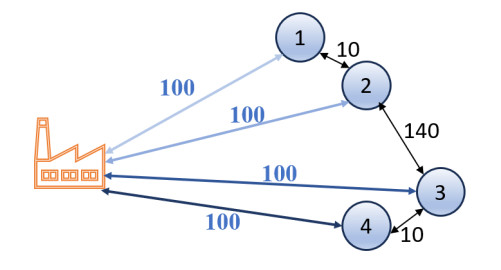
Vehicle Routing Problem Example based on [1]




 DownLoad: