This paper studies practical event-triggered intermittent stabilization for stochastic differential equations driven by $G$-Brownian motion. A nonlinear feedback controller is applied only on prescribed active windows and is implemented through the latest transmitted state. The triggering rule contains a constant practical threshold, which leads to an ultimate bound in the mean-square estimate and provides a positive margin for excluding Zeno behavior. Under explicit Lyapunov conditions, practical exponential stability in $G$-mean square is established with an explicit decay rate and residual bound. When the constant threshold is removed, the residual term disappears and, provided that the closed-loop solution is globally defined quasi-surely, a capacity Borel–Cantelli argument yields quasi-sure exponential stability. For a positive constant threshold, quasi-sure Zeno-freeness is proved by a finite-horizon increment estimate and a capacity argument. A nonlinear example illustrates the theoretical conditions.
Citation: Bingjun Wang, Mingxia Yuan. Practical event-triggered intermittent stabilization of stochastic differential equations driven by $ G $-Brownian motion via nonlinear feedback[J]. Electronic Research Archive, 2026, 34(12): 9438-9461. doi: 10.3934/era.2026396
This paper studies practical event-triggered intermittent stabilization for stochastic differential equations driven by $G$-Brownian motion. A nonlinear feedback controller is applied only on prescribed active windows and is implemented through the latest transmitted state. The triggering rule contains a constant practical threshold, which leads to an ultimate bound in the mean-square estimate and provides a positive margin for excluding Zeno behavior. Under explicit Lyapunov conditions, practical exponential stability in $G$-mean square is established with an explicit decay rate and residual bound. When the constant threshold is removed, the residual term disappears and, provided that the closed-loop solution is globally defined quasi-surely, a capacity Borel–Cantelli argument yields quasi-sure exponential stability. For a positive constant threshold, quasi-sure Zeno-freeness is proved by a finite-horizon increment estimate and a capacity argument. A nonlinear example illustrates the theoretical conditions.

| [1] |
S. Peng, $G$-expectation, $G$-Brownian motion and related stochastic calculus of Itô type, in Stochastic Analysis and Applications, Springer, (2007), 541–567. https://doi.org/10.1007/978-3-540-70847-6_25 |
| [2] |
S. Peng, Multi-dimensional $G$-Brownian motion and related stochastic calculus under $G$-expectation, Stoch. Process. Appl., 118 (2008), 2223–2253. https://doi.org/10.1016/j.spa.2007.10.015 doi: 10.1016/j.spa.2007.10.015
|
| [3] |
S. Peng, Survey on normal distributions, central limit theorem, Brownian motion and the related stochastic calculus under sublinear expectation, Sci. China Ser. A Math., 52 (2009), 1391–1411. https://doi.org/10.1007/s11425-009-0121-8 doi: 10.1007/s11425-009-0121-8
|
| [4] |
L. Denis, M. Hu, S. Peng, Function spaces and capacity related to a sublinear expectation: application to $G$-Brownian motion paths, Potential Anal., 34 (2011), 139–161. https://doi.org/10.1007/s11118-010-9185-x doi: 10.1007/s11118-010-9185-x
|
| [5] |
F. Gao, Pathwise properties and homeomorphic flows for stochastic differential equations driven by $G$-Brownian motion, Stoch. Process. Appl., 119 (2009), 3356–3382. https://doi.org/10.1016/j.spa.2009.05.010 doi: 10.1016/j.spa.2009.05.010
|
| [6] |
X. Bai, Y. Lin, On the existence and uniqueness of solutions to stochastic differential equations driven by $G$-Brownian motion with integral-Lipschitz coefficients, Acta Math. Appl. Sin. Engl. Ser., 30 (2014), 589–610. https://doi.org/10.1007/s10255-014-0405-9 doi: 10.1007/s10255-014-0405-9
|
| [7] |
X. Li, X. Lin, Y. Lin, Lyapunov-type conditions and stochastic differential equations driven by $G$-Brownian motion, J. Math. Anal. Appl., 439 (2016), 235–255. https://doi.org/10.1016/j.jmaa.2016.02.042 doi: 10.1016/j.jmaa.2016.02.042
|
| [8] |
X. Mao, Almost sure exponential stabilization by discrete-time stochastic feedback control, IEEE Trans. Autom. Control, 61 (2016), 1619–1624. https://doi.org/10.1109/TAC.2015.2471696 doi: 10.1109/TAC.2015.2471696
|
| [9] |
L. Hu, Y. Ren, T. Xu, $p$-moment stability of solutions to stochastic differential equations driven by $G$-Brownian motion, Appl. Math. Comput., 230 (2014), 231–237. https://doi.org/10.1016/j.amc.2013.12.111 doi: 10.1016/j.amc.2013.12.111
|
| [10] |
W. Yin, J. Cao, Y. Ren, Quasi-sure exponential stabilization of stochastic systems induced by $G$-Brownian motion with discrete time feedback control, J. Math. Anal. Appl., 474 (2019), 276–289. https://doi.org/10.1016/j.jmaa.2019.01.045 doi: 10.1016/j.jmaa.2019.01.045
|
| [11] |
Y. Ren, W. Yin, R. Sakthivel, Stabilization of stochastic differential equations driven by $G$-Brownian motion with feedback control based on discrete-time state observation, Automatica, 95 (2018), 146–151. https://doi.org/10.1016/j.automatica.2018.05.039 doi: 10.1016/j.automatica.2018.05.039
|
| [12] |
W. Yin, J. Cao, Y. Ren, G. Zheng, Improved result on stabilization of $G$-SDEs by feedback control based on discrete-time observations, SIAM J. Control Optim., 59 (2021), 1927–1950. https://doi.org/10.1137/20M1338720 doi: 10.1137/20M1338720
|
| [13] |
B. Wang, H. Gao, M. Yuan, A note for discrete time feedback control for stochastic systems driven by $G$-Brownian motion, Probab. Uncertain. Quant. Risk, 10 (2025), 559–568. https://doi.org/10.3934/puqr.2025024 doi: 10.3934/puqr.2025024
|
| [14] |
B. Wang, H. Gao, M. Yuan, Exponential stabilization via discrete-time feedback control for stochastic systems driven by $G$-Lévy process, Statist. Probab. Lett., 232 (2026), 1–7. https://doi.org/10.1016/j.spl.2026.110639 doi: 10.1016/j.spl.2026.110639
|
| [15] |
Q. Zhu, T. Huang, Stability analysis for a class of stochastic delay nonlinear systems driven by $G$-Brownian motion, Syst. Control Lett., 140 (2020), 1–9. https://doi.org/10.1016/j.sysconle.2020.104699 doi: 10.1016/j.sysconle.2020.104699
|
| [16] |
X. Yang, Q. Zhu, Event-triggered control of stochastic functional differential systems via degenerate Lyapunov functionals, IEEE Trans. Syst. Man Cybern. Syst., 53 (2023), 2492–2499. https://doi.org/10.1109/TSMC.2022.3212340 doi: 10.1109/TSMC.2022.3212340
|
| [17] |
W. P. M. H. Heemels, M. C. F. Donkers, A. R. Teel, Periodic event-triggered control for linear systems, IEEE Trans. Autom. Control, 58 (2013), 847–861. https://doi.org/10.1109/TAC.2012.2220443 doi: 10.1109/TAC.2012.2220443
|
| [18] |
H. Yang, Y. Ren, W. Lu, Stabilisation of stochastic differential equations driven by $G$-Brownian motion via aperiodically intermittent control, Int. J. Control, 93 (2020), 565–574. https://doi.org/10.1080/00207179.2018.1480836 doi: 10.1080/00207179.2018.1480836
|
| [19] |
S. Li, B. Zhang, W. Li, Stabilization of multi-weights stochastic complex networks with time-varying delay driven by $G$-Brownian motion via aperiodically intermittent adaptive control, Int. J. Control, 94 (2021), 7–20. https://doi.org/10.1080/00207179.2019.1577562 doi: 10.1080/00207179.2019.1577562
|
| [20] |
J. Ma, J. Hu, S. Li, Y. Li, Stability in dynamic event-triggered control of stochastic nonlinear systems: A $G$-Brownian motion scenario, ISA Trans., 167 (2025), 1119–1136. https://doi.org/10.1016/j.isatra.2025.10.007 doi: 10.1016/j.isatra.2025.10.007
|
| [21] |
X. Li, S. Peng, Stopping times and related Itô's calculus with $G$-Brownian motion, Stoch. Process. Appl., 121 (2011), 1492–1508. https://doi.org/10.1016/j.spa.2011.03.008 doi: 10.1016/j.spa.2011.03.008
|
| [22] |
S. Peng, Nonlinear Expectations and Stochastic Calculus under Uncertainty, Springer, Berlin, 2019. https://doi.org/10.1007/978-3-662-59903-7 |
Figures(2)
Bingjun Wang, Mingxia Yuan. Practical event-triggered intermittent stabilization of stochastic differential equations driven by $ G $-Brownian motion via nonlinear feedback[J]. Electronic Research Archive, 2026, 34(12): 9438-9461. doi: 10.3934/era.2026396

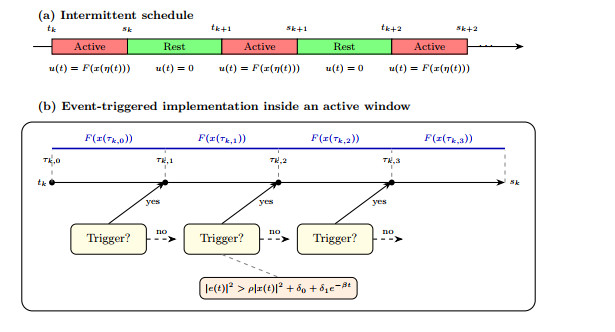
Hybrid event-triggered intermittent control mechanism. (a) Alternating active and rest windows: the active window $ [t_k, s_k) $ is followed by the rest window $ [s_k, t_{k+1}) $. (b) Zoom into an active window: at each triggering instant the condition is evaluated; if it is satisfied, the control input is updated; otherwise the previous value is held. The active window is terminated at $ s_k $
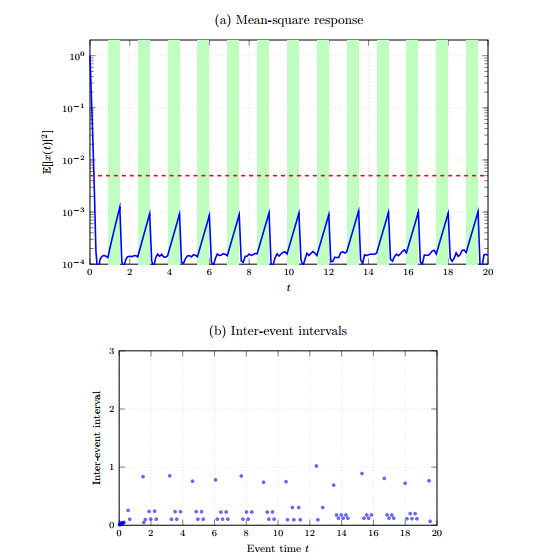
Numerical simulation results for the event-triggered intermittent control scheme: (a) mean-square trajectory; the red dashed line indicates the empirical ultimate bound; (b) inter-event intervals




 DownLoad: