This paper investigates the spectral recoverability of a final-time inverse load problem for a Caputo fractionally damped Euler–Bernoulli beam. The unknown source is assumed to be separable in space and time, and the aim is to recover the spatial load profile from terminal displacement data. For a simply supported beam with constant coefficients, the terminal input-output map is diagonalized by the beam eigenfunctions, leading to a modal relation between the unknown load and the observation. The associated singular values are determined by the terminal responses of fractional-order modal equations and depend explicitly on the damping order. A truncated spectral reconstruction method with Tikhonov filtering is used for stable recovery from noisy data. Several effective indicators, including the minimum retained singular value, the effective condition number, and the maximum regularized amplification factor, are introduced to assess reconstruction stability. Numerical experiments show that the fractional damping order can reshape the effective terminal spectrum and influence the stability of the inverse problem. In suitable parameter regimes, fractional memory damping improves recoverable modal responses and reduces noise amplification compared with the classical integer-order damping model.
Citation: Huaqing Ma, Jichen Zhang, Min Liu, Chen Gao, Zhiwei Yang. Spectral recoverability of inverse loads for fractionally damped beams[J]. Electronic Research Archive, 2026, 34(12): 9169-9189. doi: 10.3934/era.2026386
This paper investigates the spectral recoverability of a final-time inverse load problem for a Caputo fractionally damped Euler–Bernoulli beam. The unknown source is assumed to be separable in space and time, and the aim is to recover the spatial load profile from terminal displacement data. For a simply supported beam with constant coefficients, the terminal input-output map is diagonalized by the beam eigenfunctions, leading to a modal relation between the unknown load and the observation. The associated singular values are determined by the terminal responses of fractional-order modal equations and depend explicitly on the damping order. A truncated spectral reconstruction method with Tikhonov filtering is used for stable recovery from noisy data. Several effective indicators, including the minimum retained singular value, the effective condition number, and the maximum regularized amplification factor, are introduced to assess reconstruction stability. Numerical experiments show that the fractional damping order can reshape the effective terminal spectrum and influence the stability of the inverse problem. In suitable parameter regimes, fractional memory damping improves recoverable modal responses and reduces noise amplification compared with the classical integer-order damping model.

| [1] |
H. W. Engl, M. Hanke, A. Neubauer, Regularization of Inverse Problems, Kluwer Academic Publishers, Dordrecht, 1996. |
| [2] |
A. Kirsch, An Introduction to the Mathematical Theory of Inverse Problems, Springer, New York, 2011. |
| [3] |
V. Isakov, Inverse Problems for Partial Differential Equations, Springer, New York, 2006. |
| [4] |
H. Diao, X. Fei, H. Liu, On a novel unique continuation principle result and its application to inverse conductive scattering, SIAM J. Math. Anal., 57 (2025), 3386–3421. https://doi.org/10.1137/24M1704762 doi: 10.1137/24M1704762
|
| [5] |
H. Diao, X. Fei, H. Liu, L. Wang, Determining anomalies in a semilinear elliptic equation by a minimal number of measurements, Inverse Problems, 41 (2025), 055004. https://doi.org/10.1088/1361-6420/adc82a doi: 10.1088/1361-6420/adc82a
|
| [6] |
H. Diao, H. Liu, Q. Meng, Dislocations with corners in an elastic body with applications to fault detection, SIAM J. Appl. Math., 85 (2025), 2399–2424. https://doi.org/10.1137/24M1710267 doi: 10.1137/24M1710267
|
| [7] |
L. Meirovitch, Fundamentals of Vibrations, McGraw-Hill, New York, 2001. https://doi.org/10.1115/1.1421112 |
| [8] |
S. S. Rao, Vibration of Continuous Systems, Wiley, Hoboken, 2007. |
| [9] |
X. Q. Fang, H. W. Ma, C. S. Zhu, Non-local multi-fields coupling response of a piezoelectric semiconductor nanofiber under shear force, Mech. Adv. Mater. Struct., 31 (2024), 2452–2459. https://doi.org/10.1080/15376494.2022.2158503 doi: 10.1080/15376494.2022.2158503
|
| [10] |
X. Q. Fang, Y. F. Hu, C. S. Zhu, S. An, L. Q. Chen, Size-dependent vibration of laminated functionally graded curved beams covered with piezoelectric layers, Mech. Adv. Mater. Struct., 30 (2023), 3257–3266. |
| [11] |
F. C. Meng, X. T. Ai, H. Z. Cai, Y. S. Wang, T. Ren, MSFFCN: A multi-scale feature fusion network for rapid intensity classification of ground vibration signals, MetaResource, 2 (2025), 105–114. https://doi.org/10.23919/METAR.2025.000007 doi: 10.23919/METAR.2025.000007
|
| [12] |
Q. Zhang, W. Liu, Y. Liu, W. Yang, Y. Tian, X. Dong, et al., Physics-informed neural network framework for stress field modeling in coal matrix with hard inclusions, MetaResource, 2 (2025), 321–355. https://doi.org/10.23919/METAR.2025.000019 doi: 10.23919/METAR.2025.000019
|
| [13] |
I. Podlubny, Fractional Differential Equations, Academic Press, San Diego, 1999. |
| [14] |
A. A. Kilbas, H. M. Srivastava, J. J. Trujillo, Theory and Applications of Fractional Differential Equations, Elsevier, Amsterdam, 2006. |
| [15] |
F. Mainardi, Fractional Calculus and Waves in Linear Viscoelasticity, Imperial College Press, London, 2010. |
| [16] |
C. Li, F. Zeng, Numerical Methods for Fractional Calculus, Chapman and Hall/CRC, Boca Raton, 2015. |
| [17] |
B. Boukhari, F. Mtiri, A. Bchatnia, A. Beniani, Fractional derivative boundary control in coupled Euler–Bernoulli beams: stability and discrete energy decay, AIMS Math., 9 (2024), 32102–32123. https://doi.org/10.3934/math.20241541 doi: 10.3934/math.20241541
|
| [18] |
S. A. Mohamed, M. A. Eltaher, N. Mohamed, R. M. Abo-bakr, Nonlinear dynamics and forced vibrations of simply-supported fractional viscoelastic microbeams using a fractional differential quadrature method, Mech. Based Des. Struct. Mach., 52 (2024), 10006–10025. https://doi.org/10.1080/15397734.2024.2353321 doi: 10.1080/15397734.2024.2353321
|
| [19] |
A. E. Abouelregal, M. Marin, A. Foul, S. S. Askar, Coupled responses of thermomechanical waves in functionally graded viscoelastic nanobeams via thermoelastic heat conduction model including Atangana–Baleanu fractional derivative, Sci. Rep., 14 (2024), 9122. https://doi.org/10.1038/s41598-024-58866-2 doi: 10.1038/s41598-024-58866-2
|
| [20] |
Z. Achouri, N. E. Amroun, A. Benaissa, The Euler–Bernoulli beam equation with boundary dissipation of fractional derivative type, Math. Methods Appl. Sci., 40 (2017), 3837–3854. https://doi.org/10.1002/mma.4267 doi: 10.1002/mma.4267
|
| [21] |
M. Akil, I. Issa, A. Wehbe, Energy decay of some boundary coupled systems involving wave/Euler–Bernoulli beam with one locally singular fractional Kelvin–Voigt damping, Math. Control Relat. Fields, 13 (2023), 330–381. https://doi.org/10.3934/mcrf.2021059 doi: 10.3934/mcrf.2021059
|
| [22] |
C. Zhang, F. Yang, X. Li, Two regularization methods for identifying the spatial source term problem for a space-time fractional diffusion-wave equation, Mathematics, 12 (2024), 231. https://doi.org/10.3390/math12020231 doi: 10.3390/math12020231
|
| [23] |
S. Liu, L. Feng, C. Liu, A fractional Tikhonov regularization method for identifying a time-independent source in the fractional Rayleigh–Stokes equation, Fractal Fract., 8 (2024), 601. https://doi.org/10.3390/fractalfract8100601 doi: 10.3390/fractalfract8100601
|
| [24] |
L. Sun, Z. Zhang, Exponential Tikhonov regularization method for an inverse source problem in a sub-diffusion equation, Taiwan. J. Math., 28 (2024), 1111–1136. https://doi.org/10.11650/tjm/240901 doi: 10.11650/tjm/240901
|
| [25] |
Y. Chen, H. Cheng, Conditional stability and regularization method for inverse source for distributed order time-fractional diffusion equation, Comput. Appl. Math., 43 (2024), 408. https://doi.org/10.1007/s40314-024-02924-y doi: 10.1007/s40314-024-02924-y
|
| [26] |
D. N. D. Hai, L. V. Chanh, Regularization of an inverse source problem for fractional diffusion-wave equations under a general noise assumption, Fract. Calc. Appl. Anal., 27 (2024), 2544–2576. https://doi.org/10.1007/s13540-024-00315-y doi: 10.1007/s13540-024-00315-y
|
| [27] |
B. Jin, R. Lazarov, Z. Zhou, An analysis of the L1 scheme for the subdiffusion equation with nonsmooth data, IMA J. Numer. Anal., 36 (2016), 197–221. https://doi.org/10.1093/imanum/dru063 doi: 10.1093/imanum/dru063
|
Figures(6)
Huaqing Ma, Jichen Zhang, Min Liu, Chen Gao, Zhiwei Yang. Spectral recoverability of inverse loads for fractionally damped beams[J]. Electronic Research Archive, 2026, 34(12): 9169-9189. doi: 10.3934/era.2026386

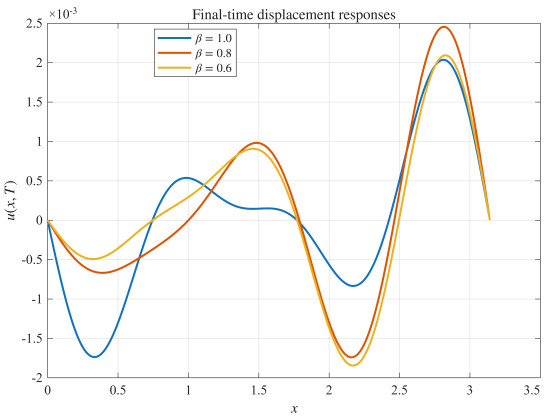
Terminal displacement responses for different fractional damping orders
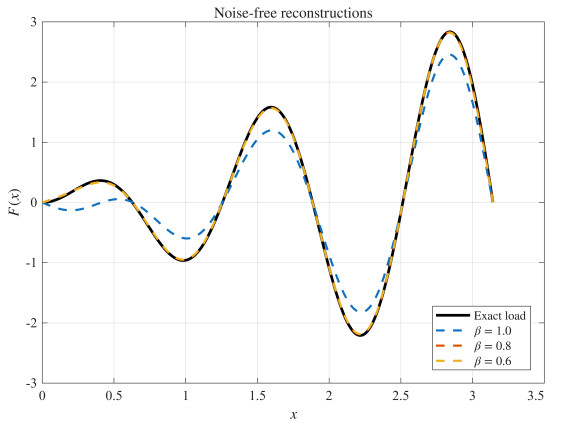
Noise-free reconstructions for different fractional damping orders
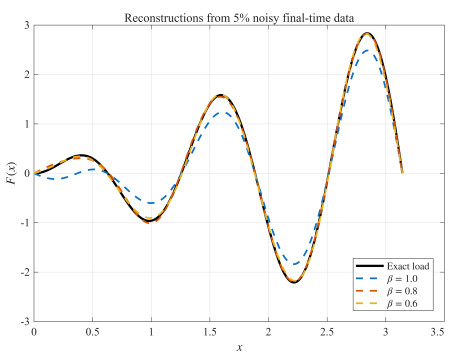
Reconstructions from terminal data with 5% relative noise
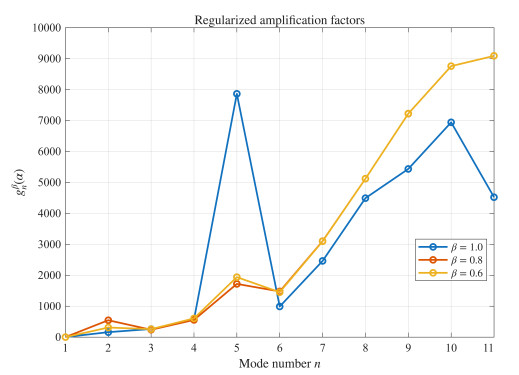
Regularized amplification factors for different fractional damping orders
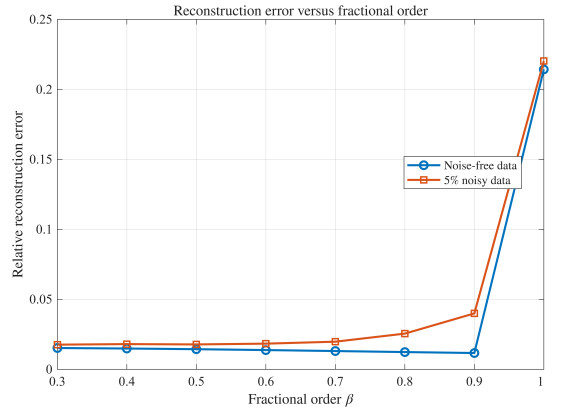
Relative reconstruction error as a function of the fractional damping order $ \beta $
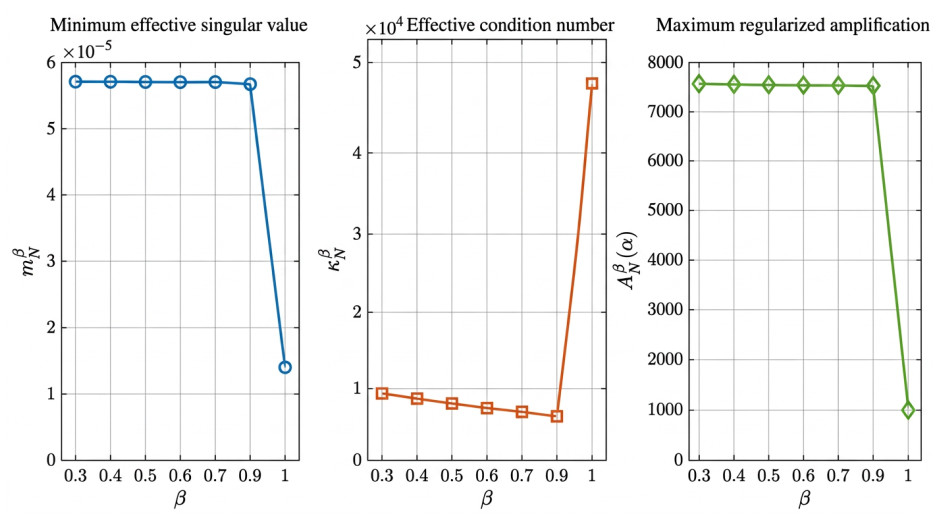
Spectral indicators as functions of the fractional damping order $ \beta $




 DownLoad: