To investigate how a finite-duration protective intervention interacts with hypovirus-mediated biological control, we formulate a chestnut blight-inspired host–pathogen–hyperparasite model containing susceptible, temporarily protected, pathogen-infected, and hyperparasite-associated host classes. Although no broadly effective and scalable chemical treatment is currently available for chestnut blight, several experimental studies have reported temporary reductions in canker expansion or disease incidence following chemical treatment under specimen-tree, orchard, nursery, or otherwise managed conditions. Motivated by these limited observations, the class $ M $ is interpreted as a temporarily protected class rather than as an immunologically immune class. Susceptible hosts enter this class at rate $ \delta $ and return to the susceptible class after protection is lost at rate $ \rho $. Basic reproduction numbers $ R_{0IS} $ and $ R_{0HS} $ are derived, and the existence and stability of the boundary, disease-free, and positive equilibria are analyzed. We further introduce the composite protection index $ \Theta(\delta, \rho) = 1+\frac{\delta}{\rho+d}, $ which quantifies the combined influence of entry into and loss from the temporarily protected class. Increasing $ \delta $ decreases the effective reproduction numbers and raises the pathogen-invasion thresholds, whereas increasing $ \rho $ has the opposite effect. The parameters $ \delta $ and $ \rho $ also shift the transcritical-bifurcation thresholds associated with hyperparasite invasion and alter the equilibrium distribution among the pathogen-only and hyperparasite-associated classes. Numerical simulations illustrate these threshold shifts and the nonmonotone interaction between temporary protection and hypovirus transmission. The chemical component of the model therefore represents a finite-duration protective effect under idealized conditions, rather than a chemical cure or chemically induced immunity. The results should be interpreted as a theoretical investigation of how temporary protection may affect chestnut blight transmission dynamics, not as a directly validated management prescription for chestnut blight.
Citation: Xiaoyu Jin, Shuhe Wang, Longxing Qi. Dynamical analysis of a chestnut blight model with two control strategies[J]. Electronic Research Archive, 2026, 34(12): 9190-9229. doi: 10.3934/era.2026387
To investigate how a finite-duration protective intervention interacts with hypovirus-mediated biological control, we formulate a chestnut blight-inspired host–pathogen–hyperparasite model containing susceptible, temporarily protected, pathogen-infected, and hyperparasite-associated host classes. Although no broadly effective and scalable chemical treatment is currently available for chestnut blight, several experimental studies have reported temporary reductions in canker expansion or disease incidence following chemical treatment under specimen-tree, orchard, nursery, or otherwise managed conditions. Motivated by these limited observations, the class $ M $ is interpreted as a temporarily protected class rather than as an immunologically immune class. Susceptible hosts enter this class at rate $ \delta $ and return to the susceptible class after protection is lost at rate $ \rho $. Basic reproduction numbers $ R_{0IS} $ and $ R_{0HS} $ are derived, and the existence and stability of the boundary, disease-free, and positive equilibria are analyzed. We further introduce the composite protection index $ \Theta(\delta, \rho) = 1+\frac{\delta}{\rho+d}, $ which quantifies the combined influence of entry into and loss from the temporarily protected class. Increasing $ \delta $ decreases the effective reproduction numbers and raises the pathogen-invasion thresholds, whereas increasing $ \rho $ has the opposite effect. The parameters $ \delta $ and $ \rho $ also shift the transcritical-bifurcation thresholds associated with hyperparasite invasion and alter the equilibrium distribution among the pathogen-only and hyperparasite-associated classes. Numerical simulations illustrate these threshold shifts and the nonmonotone interaction between temporary protection and hypovirus transmission. The chemical component of the model therefore represents a finite-duration protective effect under idealized conditions, rather than a chemical cure or chemically induced immunity. The results should be interpreted as a theoretical investigation of how temporary protection may affect chestnut blight transmission dynamics, not as a directly validated management prescription for chestnut blight.

| [1] |
Y. F. Liu, J. D. Yang, Research advance on related mechanism of adaptation of bacterial infection to its host (in Chinese), J. Tianjin Agric. Univ., 25 (2018), 90–93. https://doi.org/10.19640/j.cnki.jtau.2018.01.020 doi: 10.19640/j.cnki.jtau.2018.01.020
|
| [2] |
K. E. Ashelford, M. J. Day, J. C. Fry, Elevated abundance of bacteriophage infecting bacteria in soil, Appl. Environ. Microbiol., 69 (2003), 285–289. https://doi.org/10.1128/AEM.69.1.285-289.2003 doi: 10.1128/AEM.69.1.285-289.2003
|
| [3] |
G. Deepa, I. Daniel, S. Sugumar, An insight into the applications of bacteriophages against food-borne pathogens, J. Food Sci. Technol., 62 (2025), 1–10. https://doi.org/10.1007/s13197-024-06070-5 doi: 10.1007/s13197-024-06070-5
|
| [4] |
K. V. Mikhailov, T. G. Simdyanov, V. V. Aleoshin, Genomic survey of a hyperparasitic microsporidian Amphiamblys sp. (Metchnikovellidae), Genome Biol. Evol., 9 (2017), 454–467. https://doi.org/10.1093/gbe/evw235 doi: 10.1093/gbe/evw235
|
| [5] |
C. C. Wendling, A. Piecyk, D. Refardt, C. Chibani, R. Hertel, H. Liesegang, et al., Tripartite species interaction: eukaryotic hosts suffer more from phage susceptible than from phage resistant bacteria, BMC Evol. Biol., 17 (2017), 98. https://doi.org/10.1186/s12862-017-0930-2 doi: 10.1186/s12862-017-0930-2
|
| [6] |
J. Song, Q. X. Yuan, S. B. Yang, Z. X. Zhou, D. B. Sun, Recent advances in bacteriophage entry into cells by carrier delivery and against intracellular bacteria (in Chinese), J. China Agric. Univ., 28 (2023), 12–21. https://doi.org/10.11841/j.issn.1007-4333.2023.06.02 doi: 10.11841/j.issn.1007-4333.2023.06.02
|
| [7] |
K. D. Munns, L. B. Selinger, K. Stanford, L. Guan, T. R. Callaway, T. A. McAllister, Perspectives on super-shedding of Escherichia coli O157:H7 by cattle, Foodborne Pathog. Dis., 12 (2015), 89–103. https://doi.org/10.1089/fpd.2014.1829 doi: 10.1089/fpd.2014.1829
|
| [8] |
S. R. Parratt, A. L. Laine, Pathogen dynamics under both bottom-up host resistance and top-down hyperparasite attack, J. Appl. Ecol., 55 (2018), 2976–2985. https://doi.org/10.1111/1365-2664.13185 doi: 10.1111/1365-2664.13185
|
| [9] |
S. R. Parratt, A. L. Laine, The role of hyperparasitism in microbial pathogen ecology and evolution, ISME J., 10 (2016), 1815–1822. https://doi.org/10.1038/ismej.2015.247 doi: 10.1038/ismej.2015.247
|
| [10] |
J. R. Huang, G. S. Wang, C. H. Tian, S. K. Li, Y. J. Zhang, G. P. Li, et al., Classification methods of the damaged maize plant leaves by fall armyworm Spodoptera frugiperda and its performance in the control efficacy assessment of insecticides in the field (in Chinese), J. Plant Prot., 49 (2022), 1482–1492. https://doi.org/10.13802/j.cnki.zwbhxb.2022.2022858 doi: 10.13802/j.cnki.zwbhxb.2022.2022858
|
| [11] |
Y. B. Bian, J. Y. Zhao, S. F. Han, C. Y. Hou, M. Qiao, D. M. Wang, Synergistic control of wheat common rot by Bacillus subtilis JY214 and chemical fungicides (in Chinese), J. Hebei Agric. Univ., 48 (2025), 73–80. https://doi.org/10.13320/j.cnki.jauh.2025.0010 doi: 10.13320/j.cnki.jauh.2025.0010
|
| [12] |
Z. Y. Huang, Integrated control measures for tomato diseases and insect pests in plastic greenhouses in Biyang, Henan (in Chinese), Agric. Eng. Technol., 45 (2025), 45–46. https://doi.org/10.16815/j.cnki.11-5436/s.2025.09.015 doi: 10.16815/j.cnki.11-5436/s.2025.09.015
|
| [13] |
X. Zeng, S. R. Zheng, C. L. Chang, F. Qu, H. Feng, L. L. Huang, Evaluation of the in vitro activity of biofungicides and their mixtures with tebuconazole against major apple anthracnose fungi (in Chinese), China Fruit., 5 (2023), 72–77. https://doi.org/10.16626/j.cnki.issn1000-8047.2023.01.013 doi: 10.16626/j.cnki.issn1000-8047.2023.01.013
|
| [14] |
Y. L. Yang, B. Z. Feng, P. Q. Li, Inhibitory of cypress extract treatment on apple anthracnose during storage (in Chinese), Jiangsu Agric. Sci., 53 (2025), 215–220. |
| [15] |
S. Prospero, L. Botella, A. Santini, C. Robin, Biological control of emerging forest diseases: how can we move from dreams to reality? For. Ecol. Manage., 496 (2021), 119377. https://doi.org/10.1016/j.foreco.2021.119377 |
| [16] |
M. Bardin, S. Ajouz, M. Comby, M. Lopez-Ferber, B. Graillot, M. Siegwart, et al., Is the efficacy of biological control against plant diseases likely to be more durable than that of chemical pesticides? Front. Plant Sci., 6 (2015), 00566. https://doi.org/10.3389/fpls.2015.00566 |
| [17] |
D. Rigling, S. Prospero, Cryphonectria parasitica, the causal agent of chestnut blight: invasion history, population biology and disease control, Mol. Plant Pathol, 19 (2018), 7–20. https://doi.org/10.1111/mpp.12542 doi: 10.1111/mpp.12542
|
| [18] |
M. G. Milgroom, P. Cortesi, Biological control of chestnut blight with hypovirulence: a critical analysis, Annu. Rev. Phytopathol., 42 (2004), 311–338. https://doi.org/10.1146/annurev.phyto.42.040803.140325 doi: 10.1146/annurev.phyto.42.040803.140325
|
| [19] |
R. A. Jaynes, N. K. Van Alfen, Control of American chestnut blight by trunk injection with methyl-2-benzimidazole carbamate (MBC), Phytopathology, 64 (1974), 1479–1480. https://doi.org/10.1094/Phyto-64-1479 doi: 10.1094/Phyto-64-1479
|
| [20] |
H. M. Aksoy, U. Serdar, A research on chemical control against chestnut blight (Cryphonectria parasitica (Murrill) Barr), Plant Pathol. J., 3 (2004), 44–47. https://doi.org/10.3923/ppj.2004.44.47 doi: 10.3923/ppj.2004.44.47
|
| [21] |
E. Trapiello, G. Gonzalez-Varela, A. J. Gonzalez, Chestnut blight control by agrochemicals in Castanea sativa under managed conditions, J. Plant Dis. Prot., 122 (2015), 120–124. https://doi.org/10.1007/BF03356540 doi: 10.1007/BF03356540
|
| [22] |
A. Cheradil, G. Tarcali, K. Csullog, M. Boukhili, Study of chemical control options against chestnut blight disease, Rev. Agric. Rural Dev., 11 (2022), 20–25. https://doi.org/10.14232/rard.2022.1-2.20-25 doi: 10.14232/rard.2022.1-2.20-25
|
| [23] |
D. R. Taylor, A. M. Jarosz, D. W. Fulbright, R. E. Lenski, The acquisition of hypovirulence in host-pathogen systems with three trophic levels, Am. Nat., 151 (1998), 343–355. https://doi.org/10.1086/286123 doi: 10.1086/286123
|
| [24] |
A. Y. Morozov, C. Robin, A. Franc, A simple model for the dynamics of a host-parasite-hyperparasite interaction, J. Theor. Biol., 249 (2007), 246–253. https://doi.org/10.1016/j.jtbi.2007.05.041 doi: 10.1016/j.jtbi.2007.05.041
|
| [25] |
G. R. Northrup, A. White, S. R. Parratt, C. Rozins, A. L. Laine, M. Boots, The evolutionary dynamics of hyperparasites, J. Theor. Biol., 582 (2024), 111741. https://doi.org/10.1016/j.jtbi.2024.111741 doi: 10.1016/j.jtbi.2024.111741
|
| [26] |
S. K. Sandhu, A. Y. Morozov, R. D. Holt, M. Barfield, Revisiting the role of hyperparasitism in the evolution of virulence, Am. Nat., 197 (2021), 216–235. https://doi.org/10.1086/712351 doi: 10.1086/712351
|
| [27] |
D. R. Taylor, Ecology and evolution of chestnut blight fungus, in Adaptive Dynamics of Infectious Diseases: In Pursuit of Virulence Management, (2002), 286–296. |
| [28] |
B. Pirayesh, A. Pazirandeh, M. Akbari, Local bifurcation analysis in nuclear reactor dynamics by Sotomayor's theorem, Ann. Nucl. Energy, 94 (2016), 716–731. https://doi.org/10.1016/j.anucene.2016.04.021 doi: 10.1016/j.anucene.2016.04.021
|
| [29] |
X. N. Wang, J. Y. Gu, X. Zhang, L. H. Bai, Molecular mechanism by which the moderately halophilic bacterium NY-011 enhances the colonization stability of Bacillus subtilis KK (in Chinese), J. Sichuan Univ. (Nat. Sci. Ed.), 62 (2025), 704–707. https://doi.org/10.19907/j.0490-6756.240132 doi: 10.19907/j.0490-6756.240132
|
| [30] |
S. K. Hu, B. Wang, H. P. Qin, X. Z. Liao, C. B. Sun, Y. S. Liu, et al., Effects of antimicrobial peptides on disease resistance and immune indices of Litopenaeus vannamei (in Chinese), J. Trop. Biol., 9 (2018), 281–286. https://doi.org/10.15886/j.cnki.rdswxb.2018.03.003 doi: 10.15886/j.cnki.rdswxb.2018.03.003
|
Figures(11) / Tables(5)
Xiaoyu Jin, Shuhe Wang, Longxing Qi. Dynamical analysis of a chestnut blight model with two control strategies[J]. Electronic Research Archive, 2026, 34(12): 9190-9229. doi: 10.3934/era.2026387

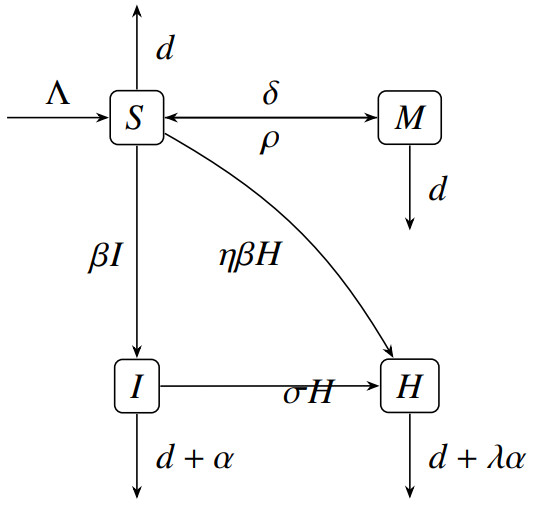
Schematic diagram of the model structure and transmission mechanism
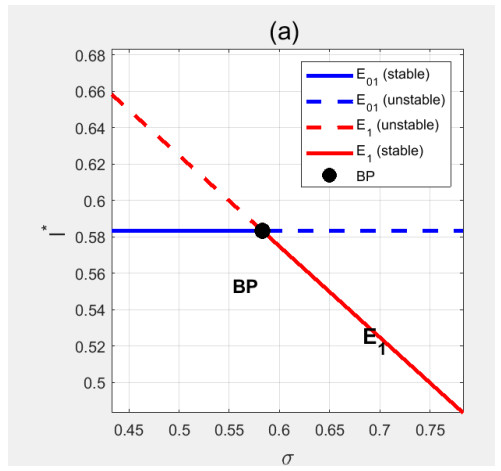
Transcritical bifurcation at $ E_{01} $
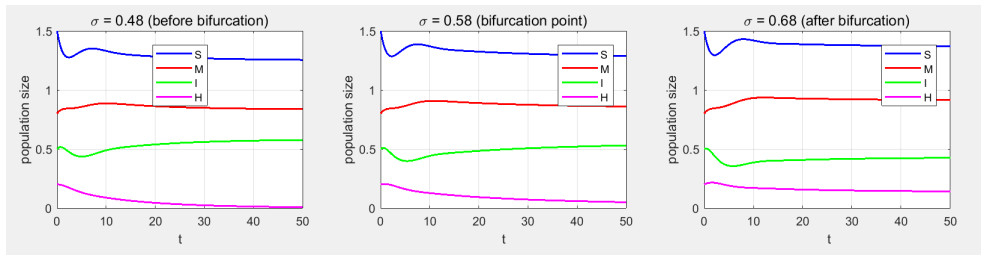
Time-series plots near $ E_{01} $ for different bifurcation regimes
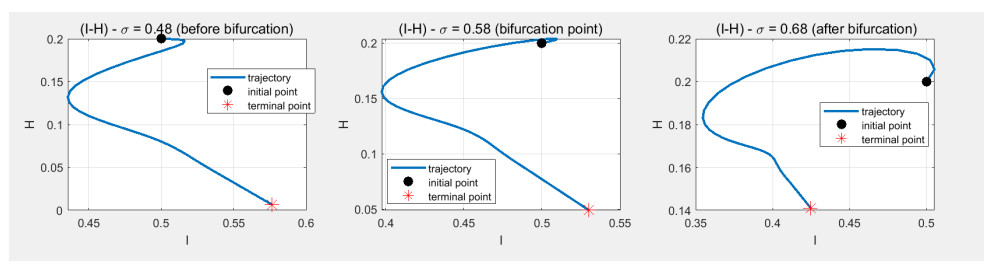
Phase portraits near $ E_{01} $ for different bifurcation regimes
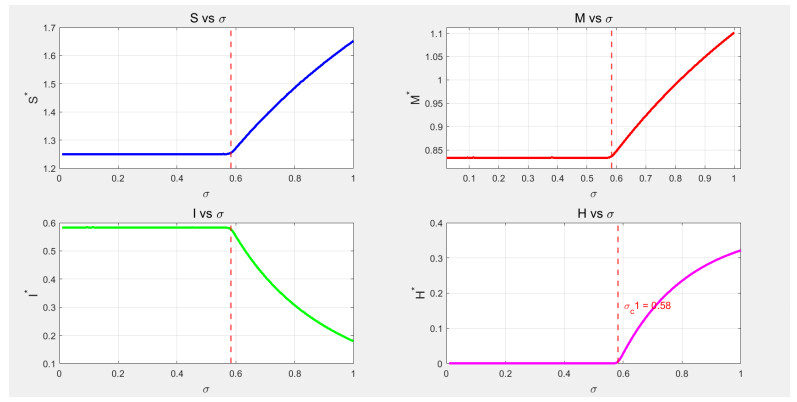
Population levels as $ \sigma $ varies
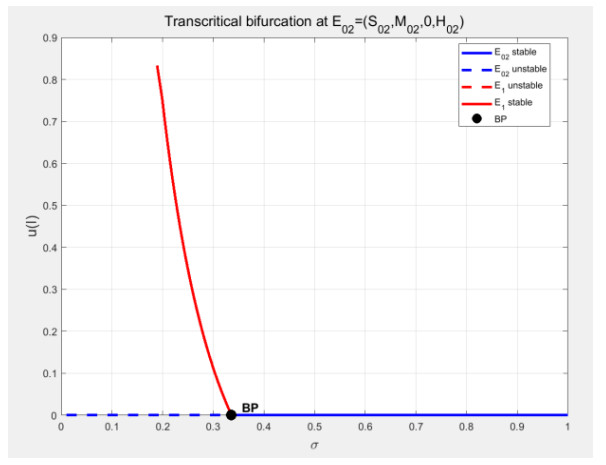
Transcritical bifurcation at the boundary equilibrium $ E_{02} $
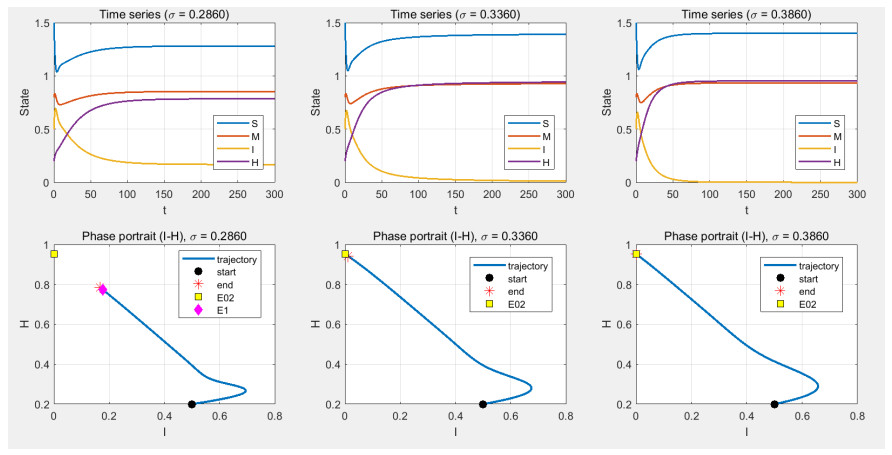
Time series and trajectories in the $ I $–$ H $ plane
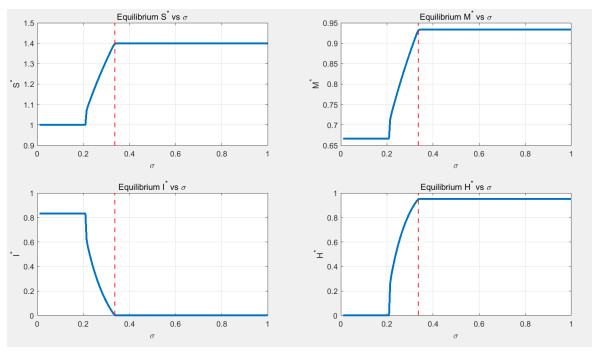
Population levels as $ \sigma $ varies
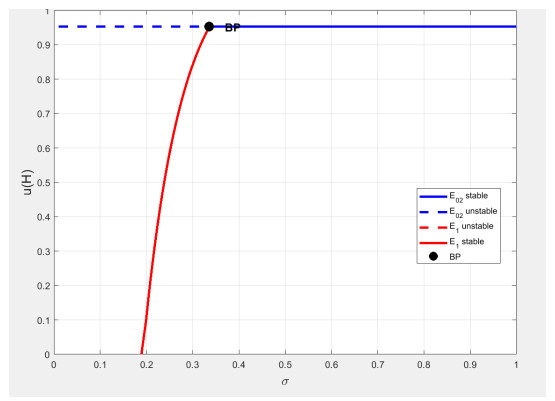
Bifurcation diagram of $ u(H) $ with respect to $ \sigma $
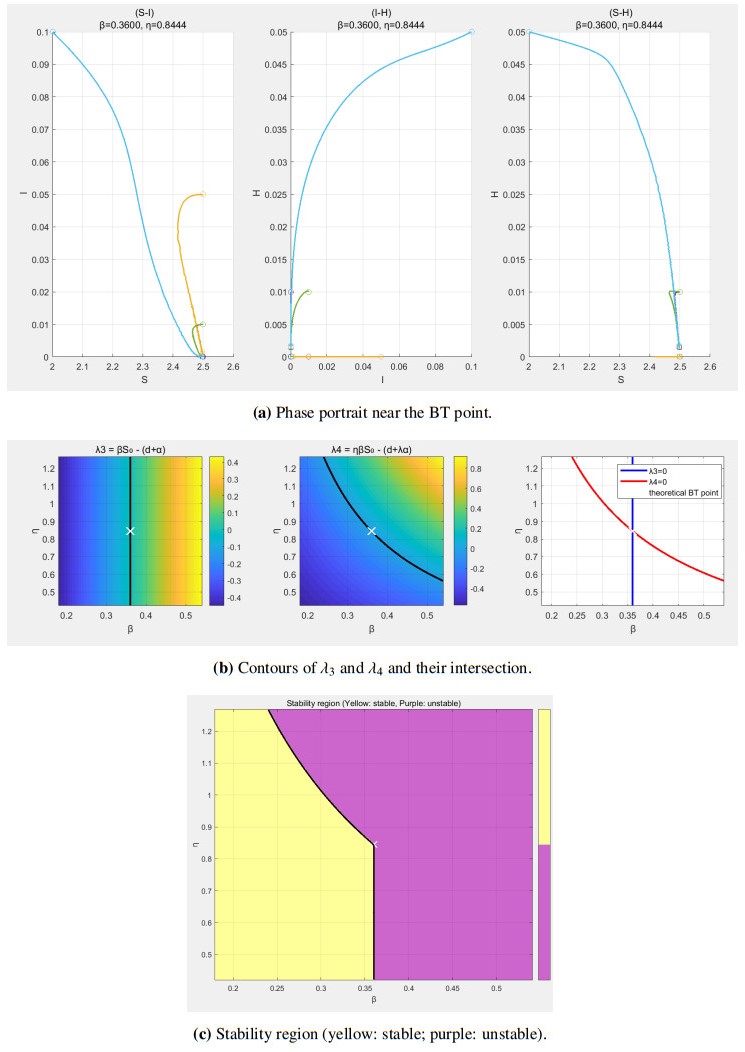
Characteristics of the BT bifurcation and analysis of stability regions
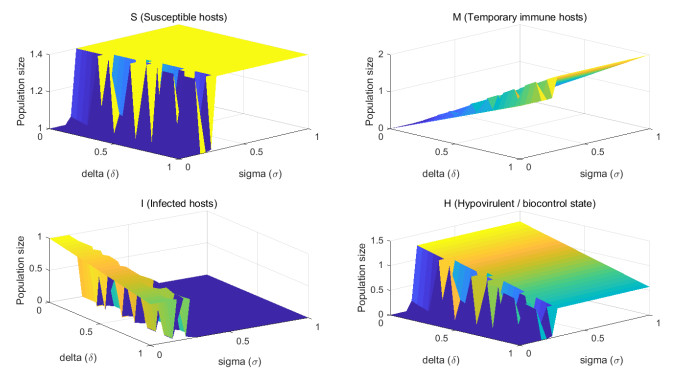
Variation of different host populations with $ \delta $ and $ \sigma $ (3D surfaces)




 DownLoad: