The low structural damping characteristics of a large slender tower crane leads to challenges with respect to vibrations and structural failure risk due to external load excitation. The finite element method is often used for dynamic analysis of tower crane jib, while a model‑order reduction technique with advantages is rarely studied and applied to this engineering field. With the reduced-order model, the essential cause of system dynamic characteristics and the physical meaning of key control parameters can be revealed in an intuitive way. Therefore, a novel and competitive reduced-order model of large slender tower crane jib was introduced and was well-suited for the complex truss structure with multiple flexible beams in this study. In this work, we were concerned with the equivalent continuum modeling procedure for the large slender tower crane jib with asymmetric configuration and analysis of coupling vibration characteristics, aiming to focus more on potential studies of nonlinear vibration and vibration control. First, the equivalent anisotropic continuum beam model for tower crane jib with oblique triangular prism configuration was established by means of energy equivalence formulation. Subsequently, an equivalent 6-DOFs coupled beam model, including multiple and complex coupling terms, was solved by the finite element method, leading to reduced-order representation. In the numerical studies, a cantilevered truss structure of a large slender tower crane jib was simulated by commercial finite element software ANSYS to check the accuracy and validity of the proposed reduced-order model. The results, including the natural characteristic and dynamic response of the proposed reduced-order model, were presented by comparison with those of the finite element model for the original tower crane jib, indicating that the established reduced-order model is valid. Moreover, the coupled vibration characteristics were studied between the reduced-order model and original tower crane jib, indicating that the coupled vibration strength is weak.
Citation: Mei Liu, Lishan Ma, Huaqiang Ge, Xiaoyun Zhang, Zunbing Sheng. Reduced-order modeling and comparative dynamic analysis of large slender tower crane jib[J]. Electronic Research Archive, 2026, 34(12): 9230-9249. doi: 10.3934/era.2026388
The low structural damping characteristics of a large slender tower crane leads to challenges with respect to vibrations and structural failure risk due to external load excitation. The finite element method is often used for dynamic analysis of tower crane jib, while a model‑order reduction technique with advantages is rarely studied and applied to this engineering field. With the reduced-order model, the essential cause of system dynamic characteristics and the physical meaning of key control parameters can be revealed in an intuitive way. Therefore, a novel and competitive reduced-order model of large slender tower crane jib was introduced and was well-suited for the complex truss structure with multiple flexible beams in this study. In this work, we were concerned with the equivalent continuum modeling procedure for the large slender tower crane jib with asymmetric configuration and analysis of coupling vibration characteristics, aiming to focus more on potential studies of nonlinear vibration and vibration control. First, the equivalent anisotropic continuum beam model for tower crane jib with oblique triangular prism configuration was established by means of energy equivalence formulation. Subsequently, an equivalent 6-DOFs coupled beam model, including multiple and complex coupling terms, was solved by the finite element method, leading to reduced-order representation. In the numerical studies, a cantilevered truss structure of a large slender tower crane jib was simulated by commercial finite element software ANSYS to check the accuracy and validity of the proposed reduced-order model. The results, including the natural characteristic and dynamic response of the proposed reduced-order model, were presented by comparison with those of the finite element model for the original tower crane jib, indicating that the established reduced-order model is valid. Moreover, the coupled vibration characteristics were studied between the reduced-order model and original tower crane jib, indicating that the coupled vibration strength is weak.

| [1] |
M. H. El Ouni, N. Ben Kahla, S. Islam, M. Jameel, A smart tower crane to mitigate turbulent wind loads, Struct. Eng. Int. , 31 (2021), 18-29. https://doi.org/10.1080/10168664.2019.1668334 doi: 10.1080/10168664.2019.1668334
|
| [2] |
L. Ramli, Z. Mohamed, H. I. Jaafar, A neural network-based input shaping for swing suppression of an overhead crane under payload hoisting and mass variations, Mech. Syst. Signal Process. , 107 (2018), 484-501. https://doi.org/10.1016/j.ymssp.2018.01.029 doi: 10.1016/j.ymssp.2018.01.029
|
| [3] |
H. Jiang, Y. Li, Dynamic reliability analysis of tower crane with wind loading, IOP Conf. Ser. Mater. Sci. Eng. , 677 (2019), 052031. https://doi.org/10.1088/1757-899X/677/5/052031 doi: 10.1088/1757-899X/677/5/052031
|
| [4] |
W. Chen, X. Qin, Z. Yang, P. Zhan, Wind-induced tower crane vibration and safety evaluation, J. Low Freq. Noise Vib. Act. Control, 39 (2020), 297-312. https://doi.org/10.1177/1461348419847306 doi: 10.1177/1461348419847306
|
| [5] |
H. Chen, Y. Fang, N. Sun, An adaptive tracking control method with swing suppression for 4-DOF tower crane systems, Mech. Syst. Signal Process. , 123 (2019), 426-442. https://doi.org/10.1016/j.ymssp.2018.11.018 doi: 10.1016/j.ymssp.2018.11.018
|
| [6] |
H. Kenan, O. Azeloğlu, Design of scaled down model of a tower crane mast by using similitude theory, Eng. Struct. , 220 (2020), 110985. https://doi.org/10.1016/j.engstruct.2020.110985 doi: 10.1016/j.engstruct.2020.110985
|
| [7] |
J. Ye, J. Huang, Analytical analysis and oscillation control of payload twisting dynamics in a tower crane carrying a slender payload, Mech. Syst. Signal Process. , 158 (2021), 107763. https://doi.org/10.1016/j.ymssp.2021.107763 doi: 10.1016/j.ymssp.2021.107763
|
| [8] |
M. Zhang, X. Jing, Z. Zhu, Disturbance employment-based sliding mode control for 4-DOF tower crane systems, Mech. Syst. Signal Process. , 161 (2021), 107946. https://doi.org/10.1016/j.ymssp.2021.107946 doi: 10.1016/j.ymssp.2021.107946
|
| [9] |
F. Liu, D. Jin, X. Li, G. Wei, Equivalent continuum modeling method for transient response analysis of large space truss structures with nonlinear elastic joints, Acta Mech. , 234 (2023), 3499-3517. https://doi.org/10.1007/s00707-023-03565-8 doi: 10.1007/s00707-023-03565-8
|
| [10] |
M. Liu, D. Cao, X. Zhang, J. Wei, D. Zhu, Nonlinear dynamic responses of beamlike truss based on the equivalent nonlinear beam model, Int. J. Mech. Sci. , 194 (2021), 106197. https://doi.org/10.1016/j.ijmecsci.2020.106197 doi: 10.1016/j.ijmecsci.2020.106197
|
| [11] |
S. Cao, M. Huo, N. Qi, C. Zhao, D. Zhu, L. Sun, Extended continuum model for dynamic analysis of beam-like truss structures with geometrical nonlinearity, Aerosp. Sci. Technol. , 103 (2020), 105927. https://doi.org/10.1016/j.ast.2020.105927 doi: 10.1016/j.ast.2020.105927
|
| [12] |
H. Guo, C. Shi, M. Li, Z. Deng, R. Liu, Design and dynamic equivalent modeling of double-layer hoop deployable antenna, Int. J. Aerosp. Eng. , 2018 (2018), 1-15. https://doi.org/10.1155/2018/2941981 doi: 10.1155/2018/2941981
|
| [13] |
F. Liu, L. Wang, D. Jin, H. Wen, Equivalent continuum modeling of beam-like truss structures with flexible joints, Acta Mech. Sin. , 35 (2019), 1067-1078. https://doi.org/10.1007/s10409-019-00872-z doi: 10.1007/s10409-019-00872-z
|
| [14] |
A. K. Noor, M. P. Nemeth, Micropolar beam models for lattice grids with rigid joints, Comput. Methods Appl. Mech. Eng. , 21 (1980), 249-263. https://doi.org/10.1016/0045-7825(80)90034-1 doi: 10.1016/0045-7825(80)90034-1
|
| [15] |
Y. Tang, X. Liu, G. Cai, X. Liu, C. You, S. Yao, Active vibration control based on the equivalent dynamic model of a large space telescope truss structure, Int. J. Dyn. Control, 11 (2023), 1718-1735. https://doi.org/10.1007/s40435-022-01098-x doi: 10.1007/s40435-022-01098-x
|
| [16] |
J. Sun, J. Sun, D. Zhu, X. Yan, Equivalent plate dynamic modeling of space periodic truss structures, Aerosp. Sci. Technol. , 138 (2023), 108315. https://doi.org/10.1016/j.ast.2023.108315 doi: 10.1016/j.ast.2023.108315
|
| [17] |
X. Li, G. Wei, J. Guo, F. Liu, D. Jin, Multi-harmonic equivalent dynamic model of the gyroelastic repetitive truss with nonlinear joints, Acta Mech. , 234 (2023), 3361-3375. https://doi.org/10.1007/s00707-023-03560-z doi: 10.1007/s00707-023-03560-z
|
| [18] |
S. Jiang, G. P. Cai, Equivalent beam model and improved structure design of large space antenna truss with geometric nonlinearity, J. Comput. Nonlinear Dyn. , 18 (2023), 051003. https://doi.org/10.1115/1.4057043 doi: 10.1115/1.4057043
|
| [19] |
J. Chen, W. Zhang, Y. F. Zhang, Equivalent continuum model and nonlinear breathing vibrations of rotating circular truss antenna subjected to thermal excitation, Thin-Walled Struct. , 157 (2020), 107127. https://doi.org/10.1016/j.tws.2020.107127 doi: 10.1016/j.tws.2020.107127
|
| [20] |
B. Li, Y. Wang, Y. Liu, J. Tao, H. Ren, H. Yang, Equivalent continuum modeling for flexible slender quadrilateral truss structure, Machines, 12 (2024), 111. https://doi.org/10.3390/machines12020111 doi: 10.3390/machines12020111
|
| [21] |
T. Yuan, W. Fan, H. Ren, Y. Liu, Efficient reduced order modeling for nonlinear dynamic analysis of beamlike truss structures, Aerosp. Sci. Technol. , 159 (2025), 109952. https://doi.org/10.1016/j.ast.2025.109952 doi: 10.1016/j.ast.2025.109952
|
| [22] |
I. A. Martin, R. A. Irani, Dynamic modeling and self-tuning anti-sway control of a seven degree of freedom shipboard knuckle boom crane, Mech. Syst. Signal Process. , 153 (2021), 107441. https://doi.org/10.1016/j.ymssp.2020.107441 doi: 10.1016/j.ymssp.2020.107441
|
| [23] |
R. C. Roman, R. E. Precup, E. M. Petriu, Hybrid data-driven fuzzy active disturbance rejection control for tower crane systems, Eur. J. Control, 58 (2021), 373-387. https://doi.org/10.1016/j.ejcon.2020.08.001 doi: 10.1016/j.ejcon.2020.08.001
|
| [24] |
R. E. Samin, Z. Mohamed, Comparative assessment of anti-sway control strategy for tower crane system, AIP Conf. Proc. , 1883 (2017), 020035. https://doi.org/10.1063/1.5002053 doi: 10.1063/1.5002053
|
| [25] |
Z. Sun, H. Ouyang, Fuzzy adaptive controller design for double-pendulum tower crane with distribute mass payload, preprint, (2021), 1-8. https://doi.org/10.21203/rs.3.rs-911408/v1 |
| [26] |
M. Zhang, Y. Zhang, H. Ouyang, C. Ma, X. Cheng, Adaptive integral sliding mode control with payload sway reduction for 4-DOF tower crane systems, Nonlinear Dyn. , 99 (2020), 2727-2741. https://doi.org/10.1007/s11071-020-05471-3 doi: 10.1007/s11071-020-05471-3
|
| [27] |
F. Rauscher, O. Sawodny, Modeling and control of tower cranes with elastic structure, IEEE Trans. Control Syst. Technol. , 29 (2021), 64-79. https://doi.org/10.1109/TCST.2019.2961639 doi: 10.1109/TCST.2019.2961639
|
| [28] |
S. Hric, J. Tkac, D. Matiskova, M. Micko, D. Mandulak, Preliminary analysis of tower crane as a type of truss structure, MATEC Web Conf. , 299 (2019), 03003. https://doi.org/10.1051/matecconf/201929903003 doi: 10.1051/matecconf/201929903003
|
| [29] |
H. Kenan, C. O. Azeloglu, Seismic performance analysis of tower crane mast types with different bracing configurations, Structures, 34 (2021), 286-302. https://doi.org/10.1016/j.istruc.2021.07.052 doi: 10.1016/j.istruc.2021.07.052
|
| [30] |
G. Yao, H. Li, Y. Yang, W. Pu, Seismic responses and dynamic characteristics of boom tower crane basing on measured strong earthquake excitation, J. Vibroeng. , 21 (2019), 154-169. https://doi.org/10.21595/jve.2018.19626 doi: 10.21595/jve.2018.19626
|
| [31] |
Q. Liu, R. Zhang, S. Sun, J. Zhang, Aerodynamic load variation and wind-induced vibration analysis of tower cranes under full wind angles, Int. J. Acoust. Vib. , 29 (2024), 101-115. https://doi.org/10.20855/ijav.2024.29.22016 doi: 10.20855/ijav.2024.29.22016
|
| [32] |
S. Sun, Q. Zhang, J. Zhang, X. Zhang, Q. Meng, Tower cranes mixed H2/H∞ under wind load research on active vibration control, Proc. Inst. Mech. Eng., Part E J. Process Mech. Eng., 240 (2026), 4200-4214. https://doi.org/10.1177/09544089241302963 |
| [33] |
Y. Cao, D. Cao, G. He, X. Ge, Y. Hao, Vibration analysis and distributed piezoelectric energy harvester design for the L-shaped beam, Eur. J. Mech. A Solids, 87 (2021), 104214. https://doi.org/10.1016/j.euromechsol.2021.104214 doi: 10.1016/j.euromechsol.2021.104214
|
| [34] |
Y. Cao, D. Cao, G. He, Y. Hao, X. Ge, Nonlinear dynamic modelling and analysis of multiple thin plates connected by long hinges, Nonlinear Dyn. , 110 (2022), 1199-1222. https://doi.org/10.1007/s11071-022-07726-7 doi: 10.1007/s11071-022-07726-7
|
| [35] |
M. Z. Akber, W. K. Chan, H. H. Lee, G. A. Anwar, TPE-optimized DNN with attention mechanism for prediction of tower crane payload moving conditions, Mathematics, 12 (2024), 3006. https://doi.org/10.3390/math12193006 doi: 10.3390/math12193006
|
Figures(8) / Tables(3)
Mei Liu, Lishan Ma, Huaqiang Ge, Xiaoyun Zhang, Zunbing Sheng. Reduced-order modeling and comparative dynamic analysis of large slender tower crane jib[J]. Electronic Research Archive, 2026, 34(12): 9230-9249. doi: 10.3934/era.2026388

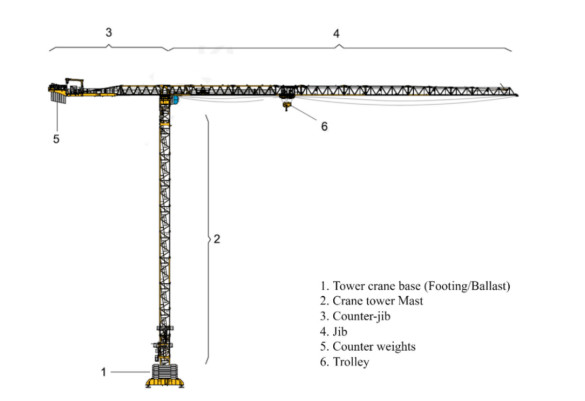
The prototype of the tower crane system [35]
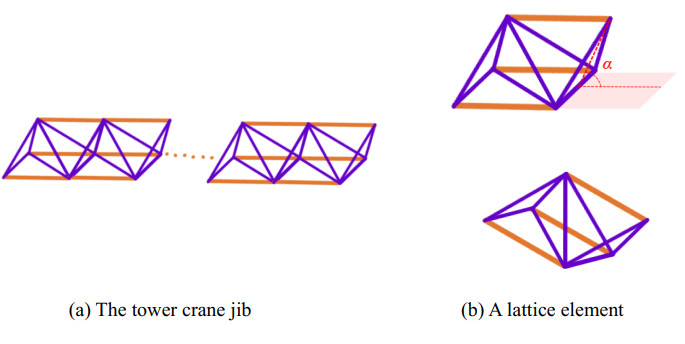
Structure of the large slender tower crane jib
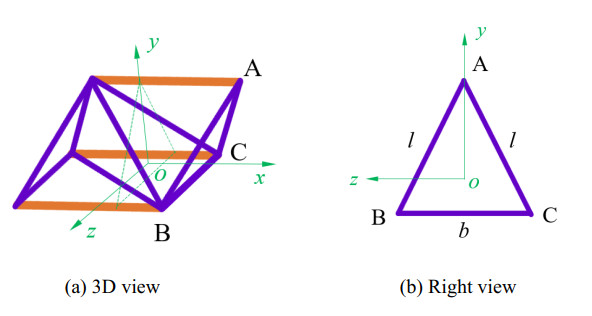
Cartesian coordinate system in the lattice element
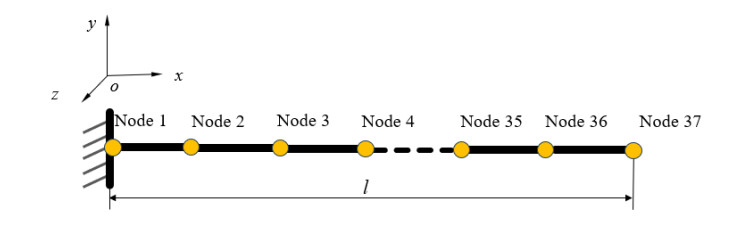
Finite element discretization of the equivalent continuum model
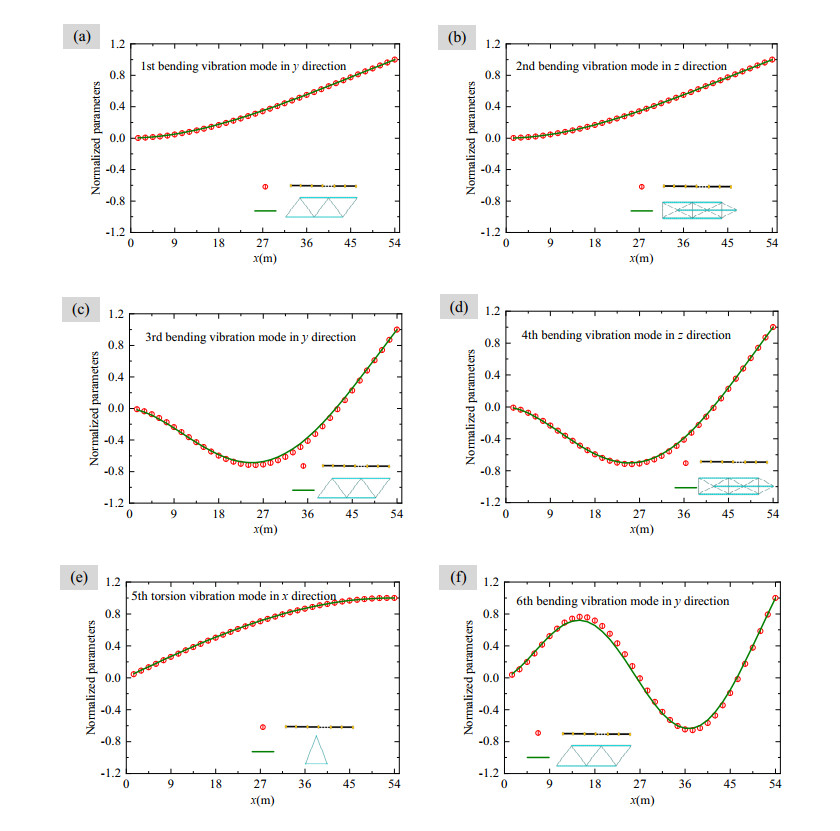
Mode shape comparisons of the tower crane jib and its reduced-order model: (a) 1st order bending mode, (b) 2nd order bending mode, (c) 3rd order bending mode, (d) 4th order bending mode, (e) 5th order torsional mode, and (f) 6th order bending mode
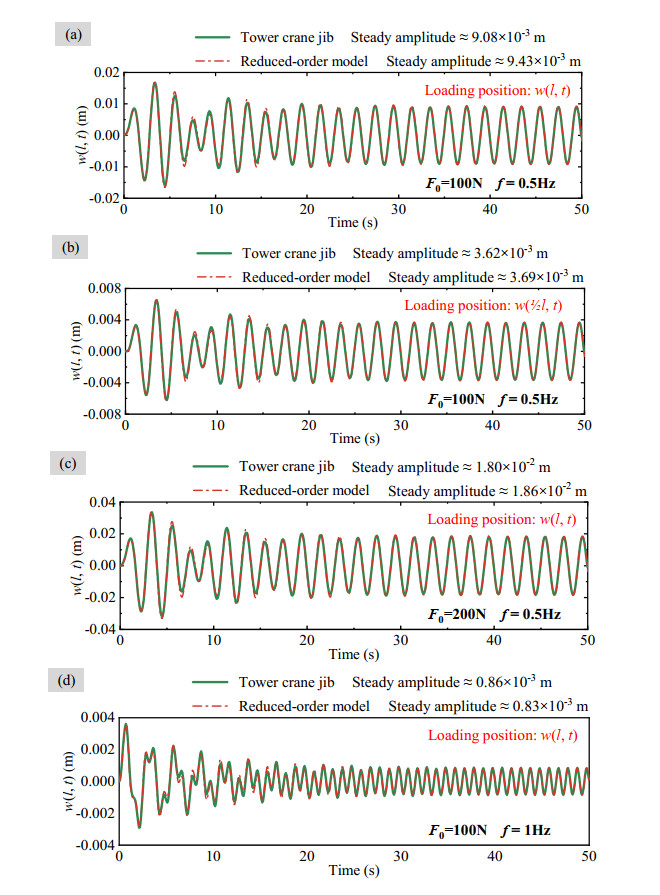
Z-direction dynamic response comparisons of the tower crane jib and its reduced-order model: (a) External excitation with magnitude $ {F}_{0} = 100 \hspace{0.17em}\text{N} $, $ f = 0.5\hspace{0.17em}\text{Hz} $, and position $ x = l $, (b) External excitation with magnitude $ {F}_{0} = 100 \hspace{0.17em}\text{N} $, $ f = 0.5\hspace{0.17em}\text{Hz} $, and position $ x = \frac{1}{2}l $, (c) External excitation with magnitude $ {F}_{0} = 200\hspace{0.17em}\text{N} $, $ f = 0.5\hspace{0.17em}\text{Hz} $, and position $ x = l $, and (d) External excitation with magnitude $ {F}_{0} = 100\hspace{0.17em}\text{N} $, $ f = 1 \hspace{0.17em}\text{Hz} $, and position $ x = l $
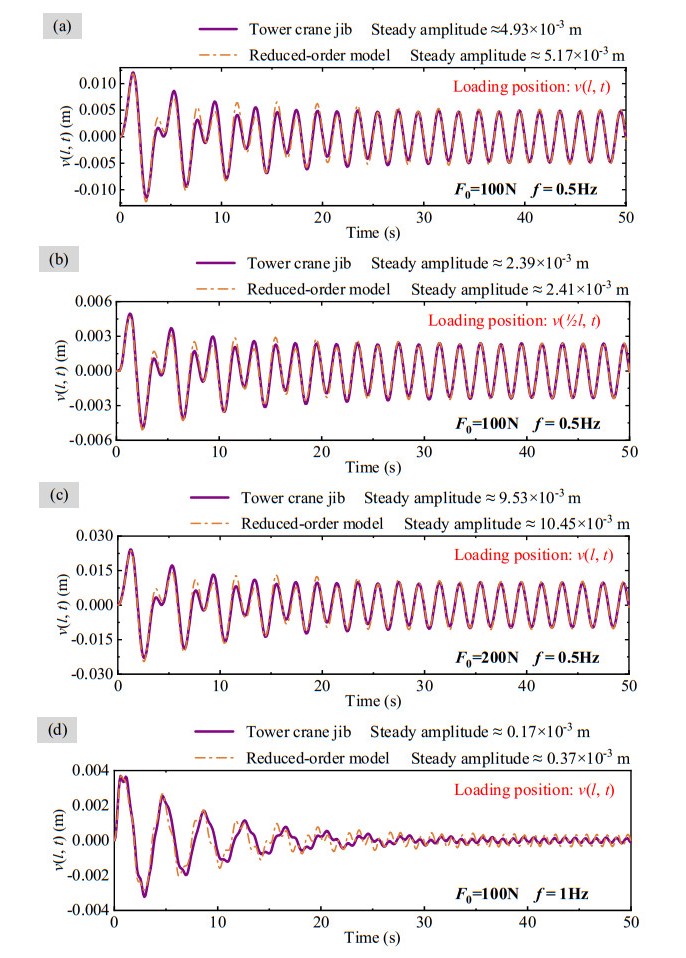
Y-direction dynamic response comparisons of the tower crane jib and its reduced-order model: (a) External excitation with magnitude $ {F}_{0} = 100 \hspace{0.17em}\text{N} $, $ f = 0.5 \hspace{0.17em}\text{Hz} $, and position $ x = l $, (b) External excitation with magnitude $ {F}_{0} = 100\hspace{0.17em}\text{N} $, $ f = 0.5 \hspace{0.17em}\text{Hz} $, and position $ x = \frac{1}{2}l $, (c) External excitation with magnitude $ {F}_{0} = 200\hspace{0.17em}\text{N} $, $ f = 0.5\hspace{0.17em}\text{Hz} $, and position $ x = l $, and (d) External excitation with magnitude $ {F}_{0} = 100\hspace{0.17em}\text{N} $, $ f = 1 \hspace{0.17em}\text{Hz} $, and position $ x = l $
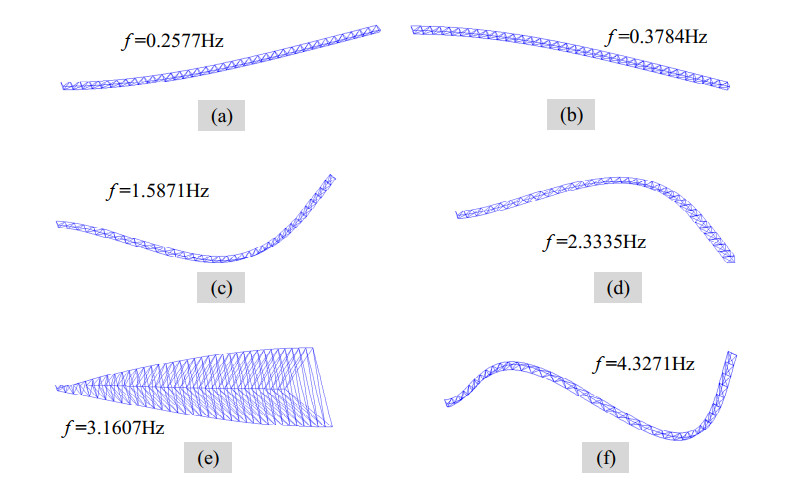
First six orders of the tower crane jib: (a) 1st order bending mode, (b) 2nd order bending mode, (c) 3rd order bending mode, (d) 4th order bending mode, (e) 5th order torsional mode, and (f) 6th order bending mode




 DownLoad: