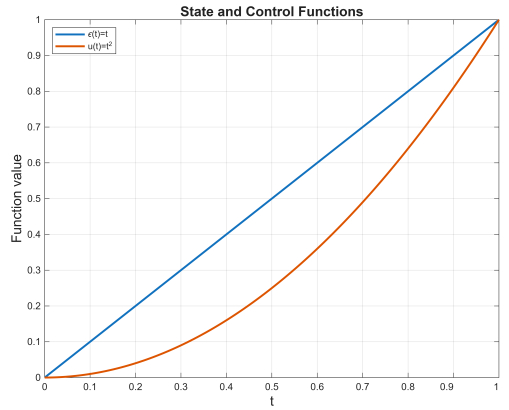
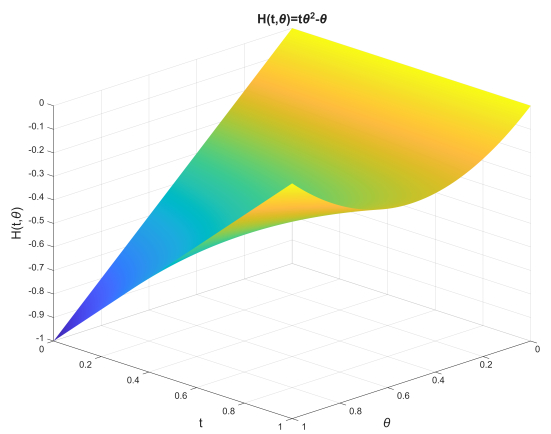
In this paper, we extend semi-infinite variational programming problems to a class of fractional variational control problems using Caputo-Fabrizio fractional derivatives. In this context, by using integration by parts, the necessary optimality conditions for these problems are obtained, incorporating complete Karush-Kuhn-Tucker (KKT) criteria which include both state and control stationarity conditions. Then, we build a Lagrange functional, where duality properties are derived under suitable assumptions of the involved functions. Furthermore, saddle point criteria connected to the considered Lagrange functional are developed. The main contribution of the study is the extension of semi-infinite fractional variational programming to a controlled setting, leading to a unified framework that combines state and control stationarity conditions, Lagrange duality, and saddle-point characterization. An illustrative numerical example is also provided to demonstrate the applicability of the developed framework to a specific state-control pair.
Citation: Savin Treanţă, Ali Maadarani. On solution set associated with a class of fractional variational control problems with semi-infinite constraints[J]. Electronic Research Archive, 2026, 34(12): 8786-8802. doi: 10.3934/era.2026370
In this paper, we extend semi-infinite variational programming problems to a class of fractional variational control problems using Caputo-Fabrizio fractional derivatives. In this context, by using integration by parts, the necessary optimality conditions for these problems are obtained, incorporating complete Karush-Kuhn-Tucker (KKT) criteria which include both state and control stationarity conditions. Then, we build a Lagrange functional, where duality properties are derived under suitable assumptions of the involved functions. Furthermore, saddle point criteria connected to the considered Lagrange functional are developed. The main contribution of the study is the extension of semi-infinite fractional variational programming to a controlled setting, leading to a unified framework that combines state and control stationarity conditions, Lagrange duality, and saddle-point characterization. An illustrative numerical example is also provided to demonstrate the applicability of the developed framework to a specific state-control pair.

| [1] |
O. P. Agrawal, Generalized Euler-Lagrange equations and transversality conditions for FVPs in terms of the Caputo derivative, J. Vib. Control, 13 (2007), 1217–1237. https://doi.org/10.1177/1077546307077472 doi: 10.1177/1077546307077472

|
| [2] |
R. Almeida, Variational problems involving a Caputo-type fractional derivative, J. Optim. Theory Appl., 174 (2017), 276–294. https://doi.org/10.1007/s10957-016-0883-4 doi: 10.1007/s10957-016-0883-4
|
| [3] | A. A. Kilbas, H. M. Srivastava, J. J. Trujillo, Theory and Applications of Fractional Differential Equations, Elsevier, 204 (2006). |
| [4] | I. Podlubny, Fractional Differential Equations: An Introduction to Fractional Derivatives, Fractional Differential Equations, to Methods of Their Solution and Some of Their Applications, Academic Press, 198 (1999). |
| [5] |
A. Atangana, D. Baleanu, New fractional derivatives with nonlocal and non-singular kernel: theory and application to heat transfer model, Therm. Sci., 20 (2016), 763–769. https://doi.org/10.2298/TSCI160111018A doi: 10.2298/TSCI160111018A
|
| [6] |
M. Caputo, M. Fabrizio, A new definition of fractional derivative without singular kernel, Progr. Fract. Differ. Appl., 1 (2015), 73–85. https://doi.org/10.12785/pfda/010201 doi: 10.12785/pfda/010201
|
| [7] |
A. Jayswal, G. Uniyal, Lagrange duality and saddle point criteria for semi-infinite variational programming problem with Caputo-Fabrizio fractional derivative, J. Appl. Math. Comput., 71 (2025), 5955–5975. https://doi.org/10.1007/s12190-025-02469-1 doi: 10.1007/s12190-025-02469-1
|
| [8] | R. E. Moore, Interval Analysis, Prentice-Hall, Englewood Cliffs, NJ, 1966. |
| [9] | M. A. Goberna, M. A. López, Linear Semi-Infinite Optimization, John Wiley & Sons, 1998. |
| [10] |
A. Shapiro, Semi-infinite programming, duality, discretization and optimality conditions, Optimization, 58 (2009), 133–161. https://doi.org/10.1080/02331930902730070 doi: 10.1080/02331930902730070
|
| [11] | S. Boyd, L. Vandenberghe, Convex Optimization, Cambridge University Press, Cambridge, 2004. |
| [12] |
A. Jayswal, G. Uniyal, Optimal conditions and duality results for a semi-infinite variational programming problem and its Mond–Weir dual involving Caputo–Fabrizio fractional derivatives, J. Comput. Appl. Math., 468 (2025), 116628. https://doi.org/10.1016/j.cam.2025.116628 doi: 10.1016/j.cam.2025.116628
|
| [13] |
V. Rayanki, I. Ahmad, K. Kummari, Interval-valued variational programming problem with Caputo-Fabrizio fractional derivative, Math. Methods Appl. Sci., 46 (2023), 17485–17510. https://doi.org/10.1002/mma.9512 doi: 10.1002/mma.9512
|
| [14] |
O. P. Agrawal, A general formulation and solution scheme for fractional optimal control problems, Nonlinear Dyn., 38 (2004), 323–337. https://doi.org/10.1007/s11071-004-3764-6 doi: 10.1007/s11071-004-3764-6
|
| [15] |
R. Almeida, D. F. M. Torres, Necessary and sufficient conditions for the fractional calculus of variations with Caputo derivatives, Commun. Nonlinear Sci. Numer. Simul., 16 (2011), 1490–1500. https://doi.org/10.1016/j.cnsns.2010.07.016 doi: 10.1016/j.cnsns.2010.07.016
|
| [16] |
S. Ghaderi, S. Effati, A. Heydari, A new numerical approach for solving fractional optimal control problems with the Caputo–Fabrizio fractional operator, J. Math., 2022 (2022), 6680319. https://doi.org/10.1155/2022/6680319 doi: 10.1155/2022/6680319
|
| [17] |
A. B. Malinowska, D. F. M. Torres, Fractional calculus of variations for a combined Caputo derivative, Fract. Calc. Appl. Anal., 14 (2011), 523–537. https://doi.org/10.2478/s13540-011-0032-6 doi: 10.2478/s13540-011-0032-6
|
| [18] |
G. u. Rahman, F. Wahid, J. F. Gómez-Aguilar, A. Ali, Analysis of multi-term arbitrary order implicit differential equations with variable type delay, Phys. Scr., 99 (2024), 115246. https://doi.org/10.1088/1402-4896/ad837b doi: 10.1088/1402-4896/ad837b
|
| [19] |
G. u. Rahman, H. Naz, H. Alrabaiah, J. F. Gómez-Aguilar, Study of integral type implicit multi term fractional delay differential equation with multi strip conditions, Phys. Scr., 99 (2024), 115261. https://doi.org/10.1088/1402-4896/ad85a2 doi: 10.1088/1402-4896/ad85a2
|
| [20] |
R. Dhayal, J. F. Gómez-Aguilar, E. Pérez-Careta, Controllability results for impulsive Atangana–Baleanu fractional stochastic differential systems with second-order Hermite process, Acta Appl. Math., 201 (2026), 16. https://doi.org/10.1007/s10440-026-00773-x doi: 10.1007/s10440-026-00773-x
|
| [21] |
V. P. Dubey, D. Kumar, J. Singh, D. Baleanu, Fractional calculus approach for variational problems: Characterization of sufficient optimality conditions and duality, Partial Differ. Equations Appl. Math., 12 (2024), 100999. https://doi.org/10.1016/j.padiff.2024.100999 doi: 10.1016/j.padiff.2024.100999
|
| [22] |
B. Mond, I. Husain, Sufficient optimality criteria and duality for variational problems with generalised invexity, ANZIAM J., 31 (1989), 108–121. https://doi.org/10.1017/S0334270000006512 doi: 10.1017/S0334270000006512
|
| [23] |
I. Ahmad, A. Jayswal, S. Al-Homidan, J. Banerjee, Sufficiency and duality in interval valued variational programming, Neural Comput. Appl., 31 (2019), 4423–4433. https://doi.org/10.1007/s00521-017-3307-y doi: 10.1007/s00521-017-3307-y
|
| [24] |
A. K. Bhurjee, G. Panda, Sufficient optimality conditions and duality theory for interval optimization problem, Ann. Oper. Res., 243 (2016), 335–348. https://doi.org/10.1007/s10479-014-1644-0 doi: 10.1007/s10479-014-1644-0
|
| [25] |
O. S. Fard, M. Salehi, A survey on fuzzy fractional variational problems, J. Comput. Appl. Math., 271 (2014), 71–82. https://doi.org/10.1016/j.cam.2014.03.019 doi: 10.1016/j.cam.2014.03.019
|
| [26] |
K. Kummari, R. Jaichander, S. Treanţă, C. F. Pirje, Robust parametric ${\mathbb{E}_{\mathbb{R}}}$-Karush-Kuhn-Tucker optimality criteria for fractional interval-valued optimization problems, Rend. Circ. Mat. Palermo Ser. II, 74 (2025), 121. https://doi.org/10.1007/s12215-025-01239-z doi: 10.1007/s12215-025-01239-z
|
| [27] |
C. F. Pirje, S. Treanţă, Y. Guo, B. B. Upadhyay, F. Shi, On dual problems of second order for $(\eta, \xi)$-bonvex interval-valued control problems, Control Cybern., 54 (2025), 5–25. https://doi.org/10.2478/candc-2025-0001 doi: 10.2478/candc-2025-0001
|
| [28] |
Preeti, S. Treanţă, M. Ciontescu, On multiple objective interval-valued optimization models with controlled dynamical system constraints, Int. J. Control, 98 (2025), 1713–1721. https://doi.org/10.1080/00207179.2024.2423212 doi: 10.1080/00207179.2024.2423212
|
Figures(2) / Tables(1)
Savin Treanţă, Ali Maadarani. On solution set associated with a class of fractional variational control problems with semi-infinite constraints[J]. Electronic Research Archive, 2026, 34(12): 8786-8802. doi: 10.3934/era.2026370





 DownLoad: