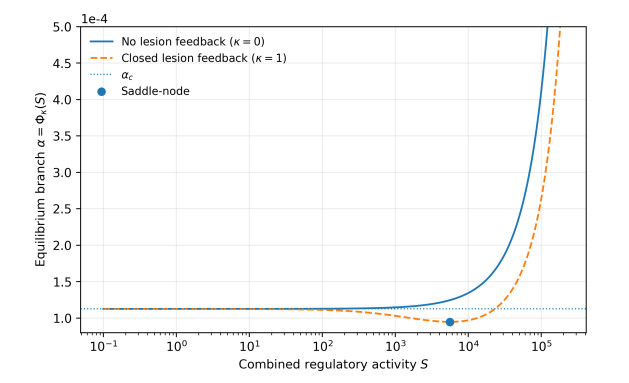
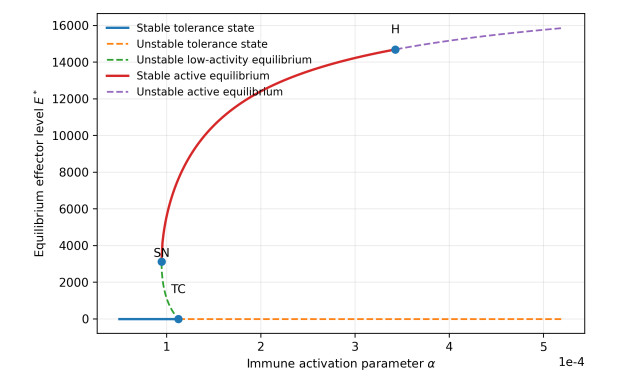
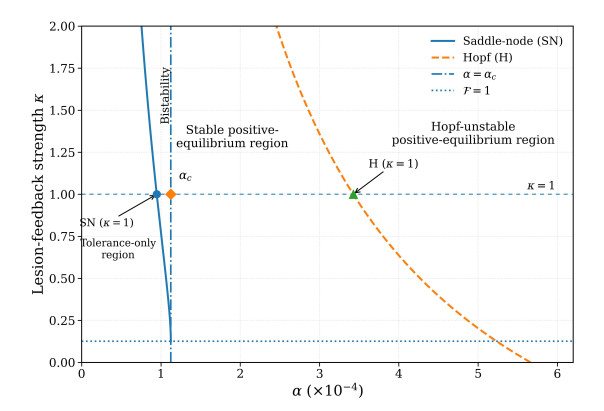
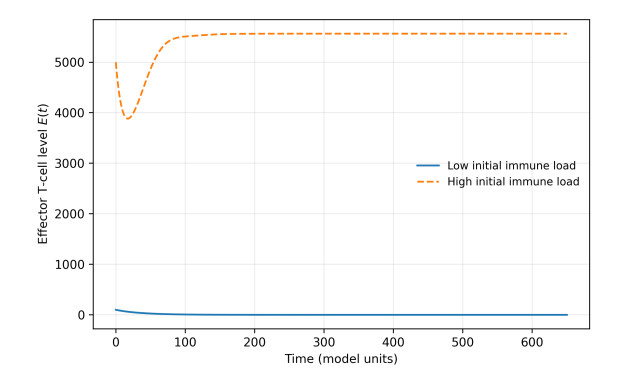
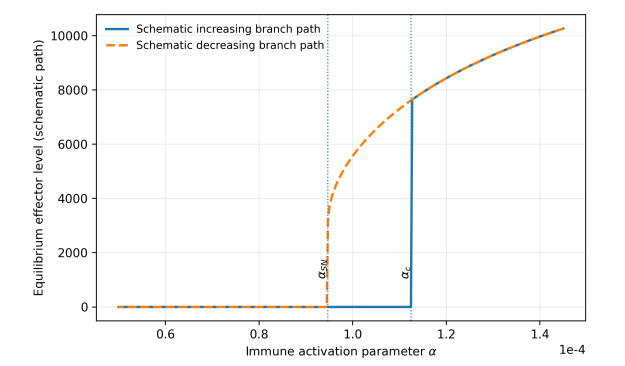
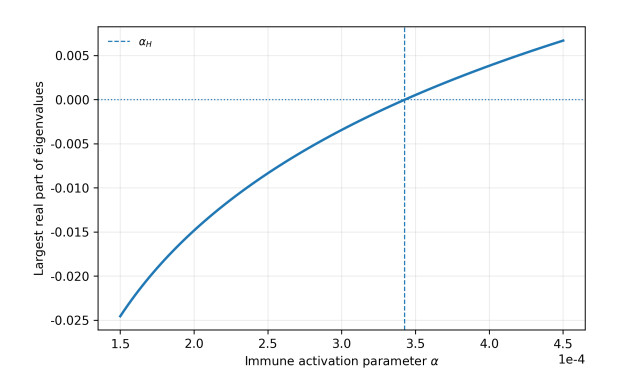
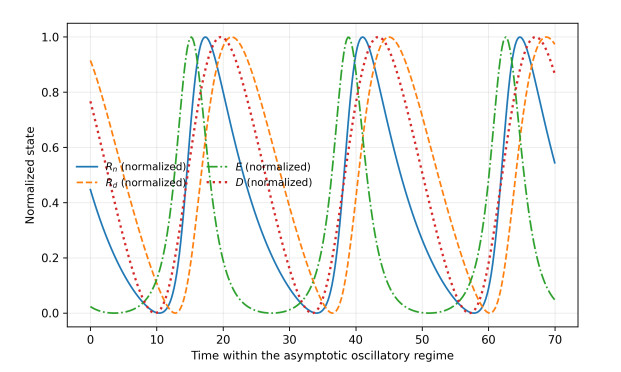
Relapsing–remitting multiple sclerosis (RRMS) is characterized by recurrent immune activation, lesion development, and marked variability in disease activity. To investigate how lesion-associated activity may feed back on immune regulation, we extend an established effector T cell–regulatory T cell (Teff–Treg) model by introducing a normalized lesion-activity variable and a feedback factor that amplifies antigen-presentation-related immune activation. The resulting closed-loop system links autoreactive effector T-cell activity, lesion-associated activity, and subsequent immune reactivation through lesion–immune feedback. Positivity, global existence, and uniform boundedness hold in the feasible region. Positive equilibria satisfy $ \alpha = \Phi_\kappa(S) $, with $ S $ the combined regulatory strength. The feedback-free branch is monotone, and $ \mathcal F > 1 $ gives backward bending and at least two positive equilibria for $ \alpha_{SN} < \alpha < \alpha_c $, though their exact number and stability remain analytically undetermined. For the working parameters, branch reconstruction and full-Jacobian spectral checks reveal a nondegenerate fold and coexisting stable tolerant and active equilibria separated by a saddle; time integration shows initial-condition dependence, and a schematic branch-following construction illustrates hysteresis-like switching. Routh–Hurwitz conditions, together with conditional saddle-node and Hopf criteria, are derived. Numerical verification identifies a transverse imaginary-pair crossing and a negative first Lyapunov coefficient, consistent with a supercritical Hopf bifurcation, with simulations showing sustained coupled oscillations. The computed two-parameter boundaries concern equilibrium existence and local stability in the scanned regime, not a global classification of attractors or calibrated clinical relapse intervals.
Citation: Lianxia Jiang, Shengmao Fu. Lesion–immune feedback induces bistability and oscillatory dynamics in a reduced model of multiple sclerosis[J]. Electronic Research Archive, 2026, 34(12): 8803-8836. doi: 10.3934/era.2026371
Relapsing–remitting multiple sclerosis (RRMS) is characterized by recurrent immune activation, lesion development, and marked variability in disease activity. To investigate how lesion-associated activity may feed back on immune regulation, we extend an established effector T cell–regulatory T cell (Teff–Treg) model by introducing a normalized lesion-activity variable and a feedback factor that amplifies antigen-presentation-related immune activation. The resulting closed-loop system links autoreactive effector T-cell activity, lesion-associated activity, and subsequent immune reactivation through lesion–immune feedback. Positivity, global existence, and uniform boundedness hold in the feasible region. Positive equilibria satisfy $ \alpha = \Phi_\kappa(S) $, with $ S $ the combined regulatory strength. The feedback-free branch is monotone, and $ \mathcal F > 1 $ gives backward bending and at least two positive equilibria for $ \alpha_{SN} < \alpha < \alpha_c $, though their exact number and stability remain analytically undetermined. For the working parameters, branch reconstruction and full-Jacobian spectral checks reveal a nondegenerate fold and coexisting stable tolerant and active equilibria separated by a saddle; time integration shows initial-condition dependence, and a schematic branch-following construction illustrates hysteresis-like switching. Routh–Hurwitz conditions, together with conditional saddle-node and Hopf criteria, are derived. Numerical verification identifies a transverse imaginary-pair crossing and a negative first Lyapunov coefficient, consistent with a supercritical Hopf bifurcation, with simulations showing sustained coupled oscillations. The computed two-parameter boundaries concern equilibrium existence and local stability in the scanned regime, not a global classification of attractors or calibrated clinical relapse intervals.

| [1] |
A. Compston, A. Coles, Multiple sclerosis, Lancet, 372 (2008), 1502–1517. https://doi.org/10.1016/S0140-6736(08)61620-7 doi: 10.1016/S0140-6736(08)61620-7

|
| [2] |
H. Lassmann, Multiple sclerosis pathology, Cold Spring Harbor Perspect. Med., 8 (2018), a028936. https://doi.org/10.1101/cshperspect.a028936 doi: 10.1101/cshperspect.a028936
|
| [3] |
F. D. Lublin, S. C. Reingold, J. A. Cohen, G. R. Cutter, P. S. Sørensen, A. J. Thompson, et al., Defining the clinical course of multiple sclerosis: the 2013 revisions, Neurology, 83 (2014), 278–286. https://doi.org/10.1212/WNL.0000000000000560 doi: 10.1212/WNL.0000000000000560
|
| [4] |
M. P. McGinley, C. H. Goldschmidt, A. D. Rae-Grant, Diagnosis and treatment of multiple sclerosis: a review, JAMA, 325 (2021), 765–779. https://doi.org/10.1001/jama.2020.26858 doi: 10.1001/jama.2020.26858
|
| [5] |
T. Kuhlmann, M. Moccia, T. Coetzee, J. A. Cohen, J. Correale, J. Graves, et al., Multiple sclerosis progression: time for a new mechanism-driven framework, Lancet Neurol., 22 (2023), 78–88. https://doi.org/10.1016/S1474-4422(22)00289-7 doi: 10.1016/S1474-4422(22)00289-7
|
| [6] |
M. Bisi, M. Groppi, G. Martalò, R. Travaglini, Derivation from kinetic theory and 2-D pattern analysis of chemotaxis models for multiple sclerosis, J. Math. Biol., 91 (2025), 43. https://doi.org/10.1007/s00285-025-02282-1 doi: 10.1007/s00285-025-02282-1
|
| [7] |
C. A. Dendrou, L. Fugger, M. A. Friese, Immunopathology of multiple sclerosis, Nat. Rev. Immunol., 15 (2015), 545–558. https://doi.org/10.1038/nri3871 doi: 10.1038/nri3871
|
| [8] |
B. Hemmer, M. Kerschensteiner, T. Korn, Role of the innate and adaptive immune responses in the course of multiple sclerosis, Lancet Neurol., 14 (2015), 406–419. https://doi.org/10.1016/S1474-4422(14)70305-9 doi: 10.1016/S1474-4422(14)70305-9
|
| [9] |
M. Sospedra, R. Martin, Immunology of multiple sclerosis, Semin. Neurol., 36 (2016), 115–127. https://doi.org/10.1055/s-0036-1579739 doi: 10.1055/s-0036-1579739
|
| [10] |
J. Goverman, Autoimmune T cell responses in the central nervous system, Nat. Rev. Immunol., 9 (2009), 393–407. https://doi.org/10.1038/nri2550 doi: 10.1038/nri2550
|
| [11] |
S. Sakaguchi, T. Yamaguchi, T. Nomura, M. Ono, Regulatory T cells and immune tolerance, Cell, 133 (2008), 775–787. https://doi.org/10.1016/j.cell.2008.05.009 doi: 10.1016/j.cell.2008.05.009
|
| [12] |
D. A. A. Vignali, L. W. Collison, C. J. Workman, How regulatory T cells work, Nat. Rev. Immunol., 8 (2008), 523–532. https://doi.org/10.1038/nri2343 doi: 10.1038/nri2343
|
| [13] |
M. T. Cencioni, M. Mattoscio, R. Magliozzi, A. Bar-Or, P. A. Muraro, B cells in multiple sclerosis–-from targeted depletion to immune reconstitution therapies, Nat. Rev. Neurol., 17 (2021), 399–414. https://doi.org/10.1038/s41582-021-00498-5 doi: 10.1038/s41582-021-00498-5
|
| [14] |
M. Absinta, D. Maric, M. Gharagozloo, T. Garton, M. D. Smith, J. Jin, et al., A lymphocyte–microglia–astrocyte axis in chronic active multiple sclerosis, Nature, 597 (2021), 709–714. https://doi.org/10.1038/s41586-021-03892-7 doi: 10.1038/s41586-021-03892-7
|
| [15] |
P. Ostkamp, M. Deffner, A. Schulte-Mecklenbeck, C. Wünsch, I-N. Lu, G. F. Wu, et al., A single-cell analysis framework allows for characterization of CSF leukocytes and their tissue of origin in multiple sclerosis, Sci. Transl. Med., 14 (2022), eadc9778. https://doi.org/10.1126/scitranslmed.adc9778 doi: 10.1126/scitranslmed.adc9778
|
| [16] |
T. V. Lanz, R. C. Brewer, P. P. Ho, J. Moon, K. M. Jude, D. Fernandez, et al., Clonally expanded B cells in multiple sclerosis bind EBV EBNA1 and GlialCAM, Nature, 603 (2022), 321–327. https://doi.org/10.1038/s41586-022-04432-7 doi: 10.1038/s41586-022-04432-7
|
| [17] |
H. K. Alexander, L. M. Wahl, Self-tolerance and autoimmunity in a regulatory T cell model, Bull. Math. Biol., 73 (2011), 33–71. https://doi.org/10.1007/s11538-010-9519-2 doi: 10.1007/s11538-010-9519-2
|
| [18] |
W. Zhang, L. M. Wahl, P. Yu, Modeling and analysis of recurrent autoimmune disease, SIAM J. Appl. Math., 74 (2014), 1998–2025. https://doi.org/10.1137/140955823 doi: 10.1137/140955823
|
| [19] |
W. Zhang, P. Yu, Hopf and generalized Hopf bifurcations in a recurrent autoimmune disease model, Int. J. Bifurcation Chaos, 26 (2016), 1650079. https://doi.org/10.1142/S0218127416500796 doi: 10.1142/S0218127416500796
|
| [20] |
W. Zhang, P. Yu, Revealing the role of the effector-regulatory t cell loop on autoimmune disease symptoms via nonlinear analysis, Commun. Nonlinear Sci. Numer. Simul., 93 (2021), 105529. https://doi.org/10.1016/j.cnsns.2020.105529 doi: 10.1016/j.cnsns.2020.105529
|
| [21] |
J. M. Oliveira, R. Travaglini, Reaction–diffusion systems derived from kinetic theory for multiple sclerosis, Math. Models Methods Appl. Sci., 34 (2024), 1279–1308. https://doi.org/10.1142/S0218202524500222 doi: 10.1142/S0218202524500222
|
| [22] |
Y. Lebel, T. Milo, A. Bar, A. Mayo, U. Alon, Excitable dynamics of flares and relapses in autoimmune diseases, iScience, 26 (2023), 108084. https://doi.org/10.1016/j.isci.2023.108084 doi: 10.1016/j.isci.2023.108084
|
| [23] |
M. Menale, R. Travaglini, A nonconservative kinetic model under the action of an external force field for modeling the medical treatment of autoimmune response, Commun. Nonlinear Sci. Numer. Simul., 137 (2024), 108126. https://doi.org/10.1016/j.cnsns.2024.108126 doi: 10.1016/j.cnsns.2024.108126
|
| [24] |
N. Moise, A. Friedman, A mathematical model of the multiple sclerosis plaque, J. Theor. Biol., 512 (2021), 110532. https://doi.org/10.1016/j.jtbi.2020.110532 doi: 10.1016/j.jtbi.2020.110532
|
| [25] |
V. K. Tuohy, M. Yu, L. Yin, J. A. Kawczak, J. M. Johnson, P. M. Mathisen, et al., The epitope spreading cascade during progression of experimental autoimmune encephalomyelitis and multiple sclerosis, Immunol. Rev., 164 (1998), 93–100. https://doi.org/10.1111/j.1600-065X.1998.tb01211.x doi: 10.1111/j.1600-065X.1998.tb01211.x
|
| [26] | Y. A. Kuznetsov, Elements of Applied Bifurcation Theory, Springer, New York, 2004. https://doi.org/10.1007/978-1-4757-3978-7 |
| [27] | J. Guckenheimer, P. Holmes, Nonlinear Oscillations, Dynamical Systems, and Bifurcations of Vector Fields, Springer, New York, 1983. https://doi.org/10.1007/978-1-4612-1140-2 |
| [28] |
P. Virtanen, R. Gommers, T. E. Oliphant, M. Haberland, T. Reddy, D. Cournapeau, et al., SciPy 1.0: fundamental algorithms for scientific computing in Python, Nat. Methods, 17 (2020), 261–272. https://doi.org/10.1038/s41592-019-0686-2 doi: 10.1038/s41592-019-0686-2
|
Figures(7) / Tables(2)
Lianxia Jiang, Shengmao Fu. Lesion–immune feedback induces bistability and oscillatory dynamics in a reduced model of multiple sclerosis[J]. Electronic Research Archive, 2026, 34(12): 8803-8836. doi: 10.3934/era.2026371





 DownLoad: