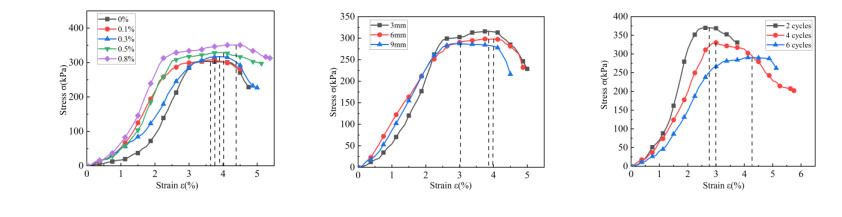
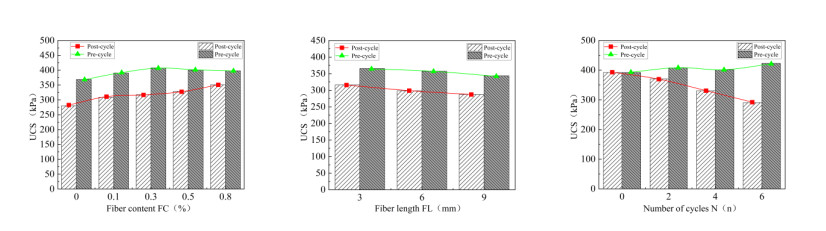
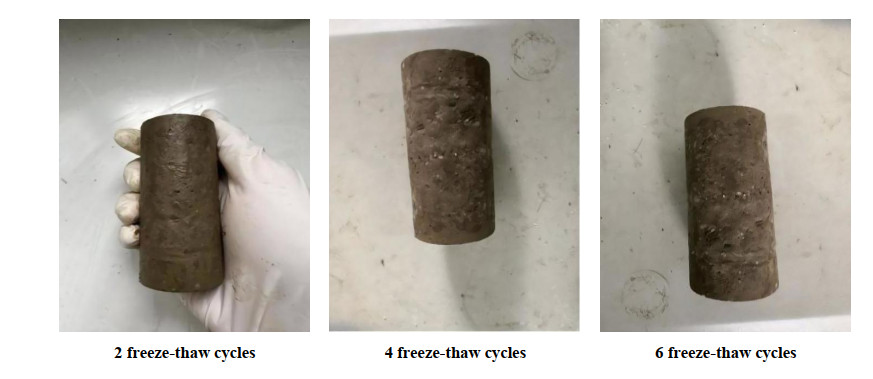
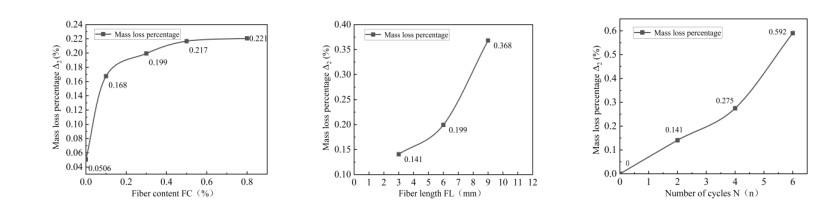
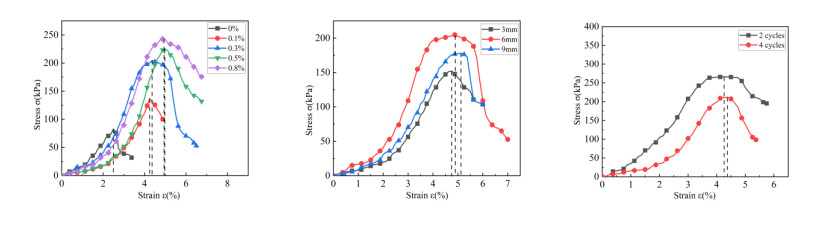
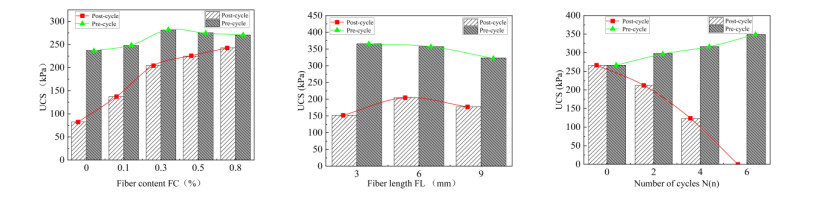
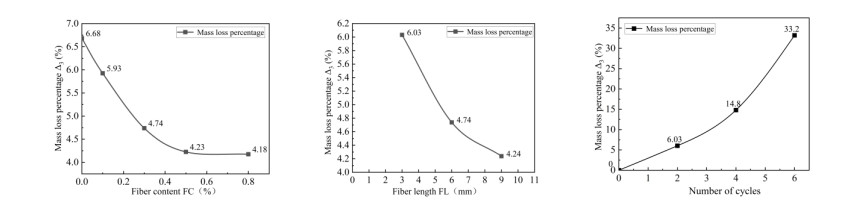
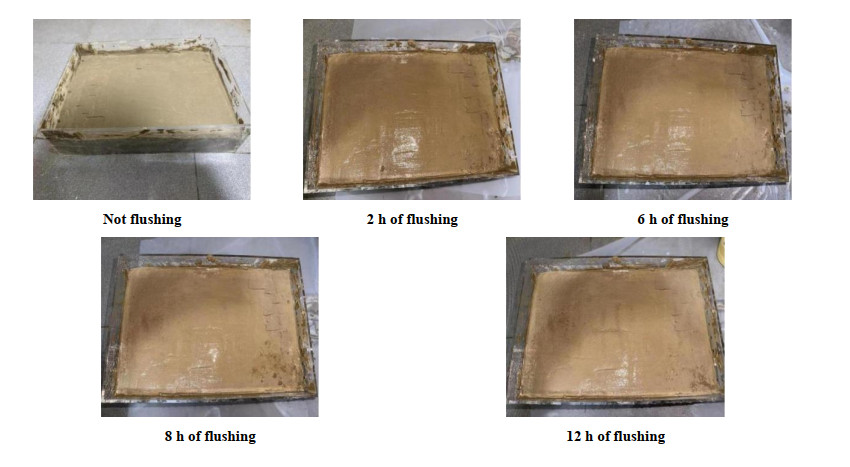
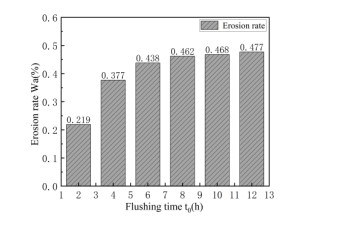
To investigate the effect of Polyvinyl Alcohol (PVA) fiber incorporation on the erosion resistance of soil under different environmental conditions, this study selected fiber length and fiber content as variables and systematically compared the performance difference between fiber-reinforced soil and plain soil through dry and wet cycles, freeze-thaw cycles, sulfate erosion, and scouring tests. The fiber soil was found to have significant erosion resistance compared to the plain soil. The results showed that, for dry-wet cycling, the addition of PVA fibers effectively enhances the soil sample's resistance. Particularly, when the fiber content ranges from 0.5% to 0.8%, the soil sample's resistance to dry-wet cycles is significantly improved. Moreover, the influence of fiber content on enhancing the dry-wet cycling performance of the sample is more pronounced than that of fiber length. Shrinkage tests showed that the soil undergoes three distinct stages during the drying process: constant rate, deceleration, and residual phases. Under the action of freeze-thaw cycles, specimens containing PVA fibers demonstrate good deformation resistance and high unconfined compressive strength and do not appear to be damaged in the process of freezing and thawing, indicating good freeze-thaw resistance. Meanwhile, the effect of fiber length on the strength-loss rate is minor, suggesting that the freeze-thaw resistance of the specimens is relatively insensitive to fiber length. For the sulfate erosion resistance test, with an increase in fiber content, the strength of the specimen improves, and its strength loss rate is significantly reduced, whereas the influence of fiber length on the specimen remains limited. In the scouring test, soil samples show good scour resistance after fiber content, and the scour growth rate decreases with time.
Citation: Yuexiang Wang, Haigao Jia, Kaiyu Chen. Study of PVA fibers to improve the corrosion resistance of Suzhou Typical River Mucky Clay[J]. AIMS Environmental Science, 2025, 12(6): 999-1030. doi: 10.3934/environsci.2025044
To investigate the effect of Polyvinyl Alcohol (PVA) fiber incorporation on the erosion resistance of soil under different environmental conditions, this study selected fiber length and fiber content as variables and systematically compared the performance difference between fiber-reinforced soil and plain soil through dry and wet cycles, freeze-thaw cycles, sulfate erosion, and scouring tests. The fiber soil was found to have significant erosion resistance compared to the plain soil. The results showed that, for dry-wet cycling, the addition of PVA fibers effectively enhances the soil sample's resistance. Particularly, when the fiber content ranges from 0.5% to 0.8%, the soil sample's resistance to dry-wet cycles is significantly improved. Moreover, the influence of fiber content on enhancing the dry-wet cycling performance of the sample is more pronounced than that of fiber length. Shrinkage tests showed that the soil undergoes three distinct stages during the drying process: constant rate, deceleration, and residual phases. Under the action of freeze-thaw cycles, specimens containing PVA fibers demonstrate good deformation resistance and high unconfined compressive strength and do not appear to be damaged in the process of freezing and thawing, indicating good freeze-thaw resistance. Meanwhile, the effect of fiber length on the strength-loss rate is minor, suggesting that the freeze-thaw resistance of the specimens is relatively insensitive to fiber length. For the sulfate erosion resistance test, with an increase in fiber content, the strength of the specimen improves, and its strength loss rate is significantly reduced, whereas the influence of fiber length on the specimen remains limited. In the scouring test, soil samples show good scour resistance after fiber content, and the scour growth rate decreases with time.

| [1] | Shen Zhujiang (1998) Engineering Characteristics of Soft Soil and Design of Soft Soil Foundation. Chin J Geotech Eng 01: 100-111. |
| [2] | Kang Chenglei, Lin Wenquan (2015) Research on Disease Prevention of Bridge Engineering in Deep Soft Soil Area. J Railway Eng 32: 73-78. |
| [3] |
Yan Zhen ying (2019) Soft Soil Foundation Problems and Treatment Techniques in Highway Engineering Construction. China Highway 2: 114-115. DOI: 10.13468/j.cnki.chw.2019.02.038. doi: 10.13468/j.cnki.chw.2019.02.038

|
| [4] |
CHA Fusheng, LIU Jingjing, HAO Ailing, et al. (2015) Experimental study on strength and microscopic properties of cement-cured lead-contaminated soil under NaCl erosion environment. J Rock Mech Eng 34: 4325-4332. DOI: 10.13722/j.cnki.jrme.2014.0929. doi: 10.13722/j.cnki.jrme.2014.0929
|
| [5] | FIRAT O E M (2017) Research on Thermal and Mechanical Properties of Fiber Reinforced Soil. Beijing Jiao tong University, 2017. |
| [6] | Tao Yingyang (2014) A Brief Analysis of the Future Development Direction of PVA Fibers. High-tech Fiber Appl 39: 34-37. |
| [7] | Liu Yan Ning, Zhang Tao, Li Shan (2022) Experimental Study on Mechanical Properties of Cement-based Composite Materials Mixed with Fine Steel Fiber/PVA Fiber. Concrete 2022: 112-115. |
| [8] | Zheng Rui (2021) Research on Mechanical Properties and Chloride Ion-Resistant Erosion Resistance of PVA Fiber-impregnated Granular Concrete. Jilin University, 2021. |
| [9] | Zhang Peng, Li Chen-di, Wang Juan, et al. (2021) Synergistic reinforcement of nano-SiO2 and PVA fibers in concrete for improving mechanical properties. Highway 66: 271-275. |
| [10] |
Ramesh Talreja (2014) Assessment of the fundamentals of failure theories for composite materials. Compos Sci Technol 105: 190-201.https://doi.org/10.1016/j.compscitech.2014.10.014 doi: 10.1016/j.compscitech.2014.10.014
|
| [11] |
Ding J, Ma D, Zhang R, et al. (2025) Investigating on dynamic and static mechanical characteristics and microscopic mechanism of fiber-reinforced and rubberized cement stabilized soil under dry-wet cycle sulfate erosion. Constr Build Mater 487: 142083.https://doi.org/10.1016/j.conbuildmat.2025.142083 doi: 10.1016/j.conbuildmat.2025.142083
|
| [12] |
Rawat V, Satyam N (2024) Enhancing the durability of coastal soil treated with fiber-reinforced microbial-induced calcite precipitation (MICP). Appl Ocean Res 150: 104106.https://doi.org/10.1016/j.apor.2024.104106 doi: 10.1016/j.apor.2024.104106
|
| [13] |
Shettigar S, Gowrishankar M C, Shettar M (2025) Review on aging behavior and durability enhancement of bamboo fiber-reinforced polymer composites. Molecules 30: 3062.https://doi.org/10.3390/molecules30153062 doi: 10.3390/molecules30153062
|
| [14] |
Zhang P, Li Q, Wang J, et al. (2019) Effect of PVA fiber on durability of cementitious composite containing nano-SiO2. Nanotechnol Rev 8: 116-127.https://doi.org/10.1515/ntrev-2019-0011 doi: 10.1515/ntrev-2019-0011
|
| [15] |
Lei B, Pang S, Sun J, et al. (2025) Rheological Properties and Freeze-Thaw Durability of Fiber-Reinforced Flowable Solidified Soil Incorporating Multi-Source Waste. Results Eng 2025: 107892.https://doi.org/10.1016/j.rineng.2025.107892 doi: 10.1016/j.rineng.2025.107892
|
| [16] |
Zeng Y, Peng L, Ma B, et al. (2025) Influence of multi-walled carbon nanotubes on the performance of nano-silica enhanced lightweight cement-based composites under cyclic action of freeze-thaw and erosion. Constr Build Mater 493: 143132.https://doi.org/10.1016/j.conbuildmat.2025.143132 doi: 10.1016/j.conbuildmat.2025.143132
|
| [17] |
Zeng Y, Li X, Tang A, et al. (2023) Axial compressive behavior of basalt and polyacrylonitrile fibers reinforced lightweight aggregate concrete with industrial waste ceramsite-Lytag after freeze-thaw cycles. J Build Eng 76: 107402.https://doi.org/10.1016/j.jobe.2023.107402 doi: 10.1016/j.jobe.2023.107402
|
| [18] |
Qu W, Maimt N, Qu J (2025) Effects of zeolite and palm fiber on the weathering resistance and durability characteristic of cement soil. Sci Rep 15: 4408.https://doi.org/10.1038/s41598-025-88841-4 doi: 10.1038/s41598-025-88841-4
|
| [19] |
Dhakal S, Kolay P, Puri V (2024) Durability of clayey soil stabilized with calcium sulfoaluminate cement and polypropylene fiber under extreme environment. Transp Geotech 44: 101164.https://doi.org/10.1016/j.trgeo.2023.101164 doi: 10.1016/j.trgeo.2023.101164
|
| [20] |
Youn I, Bang S, Jeong Y, et al. (2023) Evaluating the Strength and Durability of Eco-Friendly Stabilized Soil Bricks Incorporating Wood Chips. Appl Sci 13: 10929.https://doi.org/10.3390/app131910929 doi: 10.3390/app131910929
|
| [21] |
Liang Z, Yan C, Cao Y, et al. (2025) Influence of dry-wet cycles on the strength behavior of biopolymer and fiber composite modified loess. J Mater Res Technol 2025.https://doi.org/10.1016/j.jmrt.2025.07.071 doi: 10.1016/j.jmrt.2025.07.071
|
| [22] |
Wan L, Zhao Y, Yu M, et al. (2024) Durability and Mechanical Properties of Nano-SiO2 and Polyvinyl Alcohol Fiber-Reinforced Cementitious Composites Subjected to Saline Freeze-Thaw Cycles. Materials 17: 2542.https://doi.org/10.3390/ma17112542 doi: 10.3390/ma17112542
|
| [23] |
Zhang P, Sun X, Wei J, et al. (2023) Influence of PVA fibers on the durability of cementitious composites under the wet-heat-salt coupling environment. Rev Adv Mater Sci 62: 20230155.https://doi.org/10.1515/rams-2023-0155 doi: 10.1515/rams-2023-0155
|
| [24] | Yan Changwang, Cao Yunfei, Liu Shuguang, et al. (2020) Experimental study on salt erosion resistance of PVA fiber concrete. Concrete 2020: 56-60. |
| [25] | MA Nan, WANG Lin, LI Yingle (2021) Experimental study on sulphate erosion resistance of PVA fiber-reinforced concrete under dry and wet alternation mechanism. China Test 47: 142-147. |
| [26] | ZHAO Xiaoming, WANG Xinke, QIAO Hongxia, et al. (2022) Study on the damage law and model of freeze-thaw cycle of PVA fiber concrete. Concr Cem Prod 2022: 53-57. |
| [27] |
Tan H, Ma C, Li S, et al. (2024) Experimental study on the influence of fiber characteristics on the working property of underwater flowable solidified soil: Flowability, anti-dispersion, strength and anti-scour resistance. Ocean Eng 312: 119230.https://doi.org/10.1016/j.oceaneng.2024.119230 doi: 10.1016/j.oceaneng.2024.119230
|
| [28] |
Li L, Li S, Li W, et al. (2025) Mechanical properties of soil reinforced by fiber and alkaline-activated rice husk ash, and rainfall erosion model tests. Sci Total Environ 958: 178099.https://doi.org/10.1016/j.scitotenv.2024.178099 doi: 10.1016/j.scitotenv.2024.178099
|
| [29] | National Standard of the People's Republic of China. GB/T 50123-2019, Standard for geotechnical testing method. Beijing: China Planning Press, 2019. |
| [30] | ZHU Dinghua, DONG Leiping, HE Feng, et al. (2010) Compressive strength characteristics of lightweight mixed soil with polystyrene fiber. J Nanjing Univ Technol 32: 53-57. |
| [31] | Wang Lu-ming, wang di-fei (2015) Experiments and research on promoting the agglomeration and hardening of cement foam concrete. Functl Mater 46: 84-87. |
| [32] | Ma Cong (017) Research on efficient curing agents and strength characteristics of cured soil in saturated soft soil. Shanghai Jiao tong University, 2017. |
| [33] | WANG Tian, WENG Xingzhong, ZHANG Jun, et al. (2017) Experimental study on compressive strength of composite cured sandy soil under dry and wet cycle conditions. J Railway Sci Eng 14: 721-729. |
| [34] | Yan Xiaowei (2020) Experimental study on the effect of freezing and thawing on the properties of river silt bubble mixed soil. Suzhou University of Science and Technology, 2020. |
| [35] | Zhou Cuiying, Zhao Shanshan, Yang Xu, et al. (2019) Application of ecological ester materials for sand soil improvement and engineering slope protection. Geotechnics 40: 4828-4837. |
| [36] | LI Guoxun, ZHANG Yanmei, MARTIN, et al. (2020) Effect of fiber on the mechanical properties of nanosilica lime-amended chalk. J Civil Environ Eng 42: 37-44. |
| [37] |
ZHANG Jianwei, LU Zizhuang, LI Xiang, et al. (2025) Durability of polypropylene fibers on enzyme-induced carbonate precipitation-cured sandy soil under dry and wet cycling. J Compos Mater 42: 1000-1009. DOI:10.13801/j.cnki.fhclxb.20240521.006. doi: 10.13801/j.cnki.fhclxb.20240521.006
|
| [38] | Liang Pentao (2018) Experimental research on mechanical properties and durability of air bubble lightweight soil. Hebei University of Architecture and Engineering, 2018. |
| [39] |
Deng J (2023) Research on the effect of PVA fiber admixture on the performance of high-performance sprayed waterproof concrete. China Build Waterproofing 2023: 53-56. DOI: 10.15901/j.cnki.1007-497x.2023.02.012. doi: 10.15901/j.cnki.1007-497x.2023.02.012
|
| [40] |
WANG Liming, LIU Shiguang, WANG Caixia, et al. (1997) Effect of specimen length on mechanical properties of fibers. Text J 1997: 7-8+3. DOI: 10.13475/j.fzxb.1997.04.002. doi: 10.13475/j.fzxb.1997.04.002
|
| [41] | Niu Weiwei (2019) Research on the mechanical properties of basalt fiber-cement improved soil under freeze-thaw cycle. Beijing Jiaotong University, 2019. |
| [42] | Tian Jiayi (2019) Analysis of mechanical properties and reinforcement mechanism of fibrous soil under freeze-thaw action. Northeast Forestry University, 2019. |
| [43] | NING Xingtao, TAO Zhong, HUANG Ronggui, et al. (2024) Study on the improvement of properties of phosphorus building gypsum matrix composites by polyvinyl alcohol fibers. Mater Her 38: 646-650. |
| [44] |
Wu J Q, Li B, Chen Y T, et al. (2023) Effects of polyethylene fiber content and length on the properties of high-tensile-strength engineered geopolymer composite. J Mater Civ Eng 35: 04023224.https://doi.org/10.1061/JMCEE7.MTENG-14763 doi: 10.1061/JMCEE7.MTENG-14763
|
| [45] |
Xie L, Sun X, Yu Z, et al. (2024) Effects of nano-silica on fracture properties and mechanism analysis of basalt fiber reinforced concrete. Constr Build Mater 439: 137375.https://doi.org/10.1016/j.conbuildmat.2024.137375 doi: 10.1016/j.conbuildmat.2024.137375
|
| [46] | Fan Jinyuan, Jiang Yi, Wang Limin, et al. (2020) Study on sulfate erosion resistance of sisal-PVA hybrid fiber-reinforced geopolymer. Silic Bull 39: 1430-1437+1443. |
| [47] | WANG Zhenshan, ZONG Mengyuan, ZHAO Kai, et al. (2020) Experimental study on corrosion resistance and mechanical properties of basalt fiber concrete under sodium sulfate environment. Build Struct 50: 118-123+37. |
| [48] |
Zhang S, He S, Ghiassi B, et al. (2023) Interface bonding properties of polyvinyl alcohol (PVA) fiber in alkali-activated slag/fly ash. Cem Concr Res 173: 107308.https://doi.org/10.1016/j.cemconres.2023.107308 doi: 10.1016/j.cemconres.2023.107308
|
Figures(18) / Tables(14)

Yuexiang Wang, Haigao Jia, Kaiyu Chen. Study of PVA fibers to improve the corrosion resistance of Suzhou Typical River Mucky Clay[J]. AIMS Environmental Science, 2025, 12(6): 999-1030. doi: 10.3934/environsci.2025044





 DownLoad: