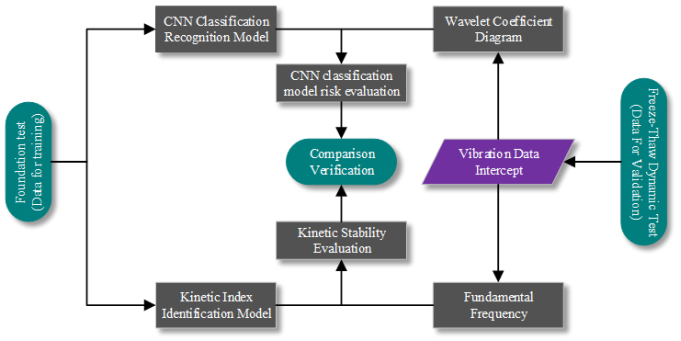
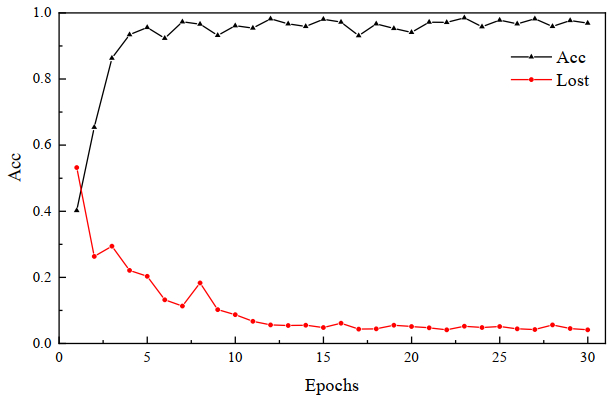
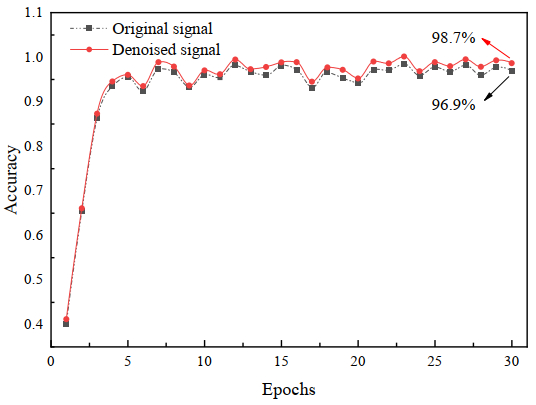
Geological hazards caused by unstable rocks, including rock collapse and fall, pose significant threats to both engineering productivity and the safety of residents, resulting in substantial economic losses. This study proposed a comprehensive CNN (Convolutional Neural Networks) classification recognition algorithm based on continuous wavelet analysis of microseismic monitoring data, which establishes a CNN recognition-based method for identifying risk levels of unstable rocks to predict their real-time collapse. To collect training data, fixed-base tests were conducted, and validation was performed using vibration data from freeze-thaw tests. Results of the study showed that the accuracy of the CNN classification recognition model trained with fixed-base test data reached 97.6%, and the per-second classification accuracy of vibration segments from freeze-thaw tests was above 86%. Furthermore, the study discussed the correlation between the calculated risk-level eigenvalues and safety coefficients. The CNN risk-level eigenvalues were found to be highly negatively correlated with the safety coefficients, with correlation coefficients as high as 0.8703. Finally, the study verified the superiority of the precursor identification of the risk-level evaluation method by comparing it with the safety coefficients.
Citation: Yan Du, Renjian Li, Mowen Xie, Yujing Jiang, Santos Daniel CHICAS, Jingnan Liu, Weikang Lu. A real-time evaluation method of unstable rock risk level based on Microseismic data and CWT-CNN integrated algorithm[J]. AIMS Environmental Science, 2025, 12(6): 979-998. doi: 10.3934/environsci.2025043
Geological hazards caused by unstable rocks, including rock collapse and fall, pose significant threats to both engineering productivity and the safety of residents, resulting in substantial economic losses. This study proposed a comprehensive CNN (Convolutional Neural Networks) classification recognition algorithm based on continuous wavelet analysis of microseismic monitoring data, which establishes a CNN recognition-based method for identifying risk levels of unstable rocks to predict their real-time collapse. To collect training data, fixed-base tests were conducted, and validation was performed using vibration data from freeze-thaw tests. Results of the study showed that the accuracy of the CNN classification recognition model trained with fixed-base test data reached 97.6%, and the per-second classification accuracy of vibration segments from freeze-thaw tests was above 86%. Furthermore, the study discussed the correlation between the calculated risk-level eigenvalues and safety coefficients. The CNN risk-level eigenvalues were found to be highly negatively correlated with the safety coefficients, with correlation coefficients as high as 0.8703. Finally, the study verified the superiority of the precursor identification of the risk-level evaluation method by comparing it with the safety coefficients.

| [1] |
Vick L, Bohme M, Rouyet L, et al. (2020) Structurally controlled rock slope deformation in northern Norway. Landslides 17: 1745–1776. https://doi.org/10.1007/s10346-020-01421-7 doi: 10.1007/s10346-020-01421-7

|
| [2] |
Bolla A, Paronuzzi P (2020) Geomechanical Field Survey to Identify an Unstable Rock Slope: The Passo della Morte Case History (NE Italy). Rock Mech Rock Eng 53: 1521–1544. https://doi.org/10.1007/s00603-019-01963-w doi: 10.1007/s00603-019-01963-w
|
| [3] |
Bolla A, Paronuzzi P (2020) Numerical Investigation of the Pre-collapse Behavior and Internal Damage of an Unstable Rock Slope. Rock Mech Rock Eng 53: 2279–2300. https://doi.org/10.1007/s00603-019-02031-z doi: 10.1007/s00603-019-02031-z
|
| [4] |
Du Y, Xie MW, Jiang Y, et al. (2015) Methods for determining early warning indices Based on natural frequency monitoring. Rock Soil Mech 36: 2284–2290. https://doi.org/10.16285/j.rsm.2015.08.022L doi: 10.16285/j.rsm.2015.08.022L
|
| [5] |
Du Y, Xie MW, Jiang Y, et al. (2019) Research progress on dynamic monitoring index for early warning of rock collapse. Chin J Eng 41: 427–435. https://doi.org/10.13374/j.issn2095-9389.2019.04.002 doi: 10.13374/j.issn2095-9389.2019.04.002
|
| [6] |
Ma G. (2012) Study on Evaluating Rock Block Stability by Using A Remotely Positioned Laser Doppler Vibrometer. Int J Geomate 2: 247–252. https://doi.org/10.21660/2012.4.3j doi: 10.21660/2012.4.3j
|
| [7] |
Ma G, Sawada K, Yashima A, et al. (2014) Experimental Study of the Applicability of the Remotely Positioned Laser Doppler Vibrometer to Rock-Block Stability Assessment. Rock Mech Rock Eng 48: 787–802. https://doi.org/10.1007/s00603-014-0577-x doi: 10.1007/s00603-014-0577-x
|
| [8] |
Du Y, Xie MW (2022) Indirect method for the quantitative identification of unstable rock. Nat Hazards 112: 1005–1012. https://doi.org/10.1007/s11069-021-05197-4 doi: 10.1007/s11069-021-05197-4
|
| [9] |
Du Y, Wu Z, Xie MW, et al. (2018) Early-warning method of rock collapse and its experimental verification. J China Coal Soc 44: 3069–3075. https://doi.org/10.13225/j.cnki.jccs.2018.1467 doi: 10.13225/j.cnki.jccs.2018.1467
|
| [10] |
Du Y, Xie MW, Jiang YJ, et al. (2017) Experimental Rock Stability Assessment Using the Frozen-Thawing Test. Rock Mech Rock Eng 50: 1049–1053. https://doi.org/10.1007/s00603-016-1138-2 doi: 10.1007/s00603-016-1138-2
|
| [11] |
Jia YC, Song GH, Jiang T et al. (2022) Buried depth calculation of the slope of the unstable rock based on natural vibration frequency. Front Earth Sci 10. https://doi.org/10.3389/feart.2022.929825 doi: 10.3389/feart.2022.929825
|
| [12] |
Jia B, Wu Z, Du Y (2019) Real-time stability assessment of unstable rocks based on fundamental natural frequency. Int J Rock Mech Min Sci 124: 104–134. https://doi.org/10.1016/j.ijrmms.2019.104134 doi: 10.1016/j.ijrmms.2019.104134
|
| [13] |
Cao JH, Wei ZB (2011) Denoising in Steel Structural Impulsive Vibration Signal Based on Independent Component Analysis. Adv Mat Res 219–220: 1337–1341. https://doi.org/10.4028/www.scientific.net/AMR.219-220.1337 doi: 10.4028/www.scientific.net/AMR.219-220.1337
|
| [14] |
Fan G, Li J, Hao H. (2020) Vibration signal denoising for structural health monitoring by residual convolutional neural networks. Measurement 157. https://doi.org/10.1016/j.measurement.2020.107651 doi: 10.1016/j.measurement.2020.107651
|
| [15] |
Huo L, Du Y, Xie M, et al. (2021) Unstable rock mass identification method based on multi-level dynamic parameters. Chin J Rock Mech Eng 41: 3124–3131. https://doi.org/10.13722/j.cnki.jrme.2021.1058 doi: 10.13722/j.cnki.jrme.2021.1058
|
| [16] |
Huo L, Du Y, Xie M, et al. (2021) Chinese Journal of Rock Mechanics and Engineering. Chin J Rock Mech Eng 40: 3156–3162. https://doi.org/10.13722/j.cnki.jrme.2021.0337 doi: 10.13722/j.cnki.jrme.2021.0337
|
| [17] |
Jooshaki M, Nad A, Michaux S. (2021) A Systematic Review on the Application of Machine Learning in Exploiting Mineralogical Data in Mining and Mineral Industry. Minerals 11: https://doi.org/10.3390/min11080816 doi: 10.3390/min11080816
|
| [18] |
Kang J, Ullah Z, Gwak J (2021) MRI-Based Brain Tumor Classification Using Ensemble of Deep Features and Machine Learning Classifiers. Sensors 21: https://doi.org/10.3390/s21062222 doi: 10.3390/s21062222
|
| [19] |
Liao YY, Han L, Wang HY, et al. (2022) Prediction Models for Railway Track Geometry Degradation Using Machine Learning Methods: A Review. Sensors https://doi.org/10.3390/s22197275 doi: 10.3390/s22197275
|
| [20] |
Cheng HD, Chen HX, Li ZF, et al. (2020) Ensemble 1-D CNN diagnosis model for VRF system refrigerant charge faults under heating condition. Energy Build 224: 110256. https://doi.org/10.1016/j.enbuild.2020.110256 doi: 10.1016/j.enbuild.2020.110256
|
| [21] |
Oh BK, Park Y, Park HS (2022) Seismic response prediction method for building structures using convolutional neural network. Struct Control Hlth 27: https://doi.org/10.1002/stc.2519 doi: 10.1002/stc.2519
|
| [22] |
Hu XD, Zhang PL, Zhang Q, et al. (2020) A novel framework of cnn integrated with adaboost for remote sensing scene classification. IGARSS 2020 - 2020 Ieee International Geoscience and Remote Sensing Symposium 2643–2646. https://doi.org/10.1109/IGARSS39084.2020.9324261. doi: 10.1109/IGARSS39084.2020.9324261
|
| [23] |
Zhu HH, Azarafza M, Akgun H (2022) Deep learning-based key-block classification framework for discontinuous rock slopes. J Rock Mech Geotech Eng 14: 1131–1139. https://doi.org/10.1016/j.jrmge.2022.06.007 doi: 10.1016/j.jrmge.2022.06.007
|
| [24] |
Zhang H, Ma C, Pazzi V, et al. (2020) Deep Convolutional Neural Network for Microseismic Signal Detection and Classification. Pure Appl Geophys 177: 5781–5797. https://doi.org/10.1007/s00024-020-02617-7 doi: 10.1007/s00024-020-02617-7
|
| [25] |
Zhang T, Shi D, Wang Z, et al. (2022) Vibration-based structural damage detection via phase-based motion estimation using convolutional neural networks. Mech Syst Signal Process 178: 109320. https://doi.org/10.1016/j.ymssp.2022.109320 doi: 10.1016/j.ymssp.2022.109320
|
| [26] |
Yin X, Liu Q, Huang X, et al. (2021) Real-time prediction of rockburst intensity using an integrated CNN-Adam-BO algorithm based on microseismic data and its engineering application. Tunn Undergr Space Technol 117: 104133. https://doi.org/10.1016/j.tust.2021.104133 doi: 10.1016/j.tust.2021.104133
|
| [27] |
LeCun Y, Bengio Y, Hinton G (2015) Deep learning. Nature 521(7553): 436–444. doi: 10.1038/nature14539.PMID:26017442. doi: 10.1038/nature14539
|
| [28] | Alex Krizhevsky, Ilya Sutskever, Geoffrey Hinton. (2017) ImageNet Classification with Deep Convolutional Neural Networks. Communications of the ACM 60: 84–90. |
| [29] |
Du Y, Huo L, Zhang H, et al. (2022) Experimental research on remote monitoring and early warning of rock collapse. J China Univ Min Technol 51: 1201–1208. https://doi.org/10.13247/j.cnki.jcumt.001427 doi: 10.13247/j.cnki.jcumt.001427
|
| [30] |
Zhang X, Xie M, Zhang L, et al. (2022) Study on calculation model of stability coefficient of falling dangerous rock mass based on natural frequency. Chin J Rock Mech Eng 1–9. https://doi.org/10.13722/j.cnki.jrme.2022.0361 doi: 10.13722/j.cnki.jrme.2022.0361
|
| [31] |
Zhang WG, Li HR, Li YQ, et al. (2021) Application of deep learning algorithms in geotechnical engineering: a short critical review. Artif Intell Rev 54: 5633–5673. https://doi.org/10.1007/s10462-021-09967-1 doi: 10.1007/s10462-021-09967-1
|
| [32] |
Lin H, Kumar Singh S, Xiang Z, et al. (2022) An investigation of machine learning techniques to estimate minimum horizontal stress magnitude from borehole breakout. Int J Min Sci Technol 32: 1021–1029. https://doi.org/10.1016/j.ijmst.2022.06.005 doi: 10.1016/j.ijmst.2022.06.005
|
| [33] |
Bai F, Fan M, Yang H, et al. (2021) Fast recognition using convolutional neural network for the coal particle density range based on images captured under multiple light sources. Int J Min Sci Technol 31: 1053–1061. https://doi.org/10.1016/j.ijmst.2021.09.004 doi: 10.1016/j.ijmst.2021.09.004
|
| [34] |
Zhang Y, Tang J, Cheng Y, et al. (2022) Prediction of landslide displacement with dynamic features using intelligent approaches. Int J Min Sci Technol 32: 539–549. https://doi.org/10.1016/j.ijmst.2022.02.004 doi: 10.1016/j.ijmst.2022.02.004
|
| [35] |
Jong SC, Ong DEL, Oh E. (2021) State-of-the-art review of geotechnical-driven artificial intelligence techniques in underground soil-structure interaction. Tunn Undergr Sp Tech 113. https://doi.org/10.1016/j.tust.2021.103946 doi: 10.1016/j.tust.2021.103946
|
| [36] |
Zhong T, Cheng M, Lu SP, et al. (2022) RCEN: A Deep-Learning-Based Background Noise Suppression Method for DAS-VSP Records. IEEE Geosci Remote Sens Lett 19: 1–5. https://doi.org/10.1109/LGRS.2021.3127637 doi: 10.1109/LGRS.2021.3127637
|
| [37] |
Tang HH, Cheng SJ, Li WQ, et al. (2022) Simultaneous reconstruction and denoising for DAS-VSP seismic data by RRU-net. Front Earth Sci 10. https://doi.org/10.3389/feart.2022.993465 doi: 10.3389/feart.2022.993465
|
| [38] |
Sadeqi A, Moradi S. (2021) A new SVD-based filtering technique for operational modal analysis in the presence of harmonic excitation and noise. J Sound Vib 510. https://doi.org/10.1016/j.jsv.2021.116252 doi: 10.1016/j.jsv.2021.116252
|
| [39] |
Temeng VA, Ziggah YY, Arthur CK. (2020) A novel artificial intelligent model for predicting air overpressure using brain inspired emotional neural network. Int J Min Sci Technol 30: 683–689. https://doi.org/10.1016/j.ijmst.2020.05.020 doi: 10.1016/j.ijmst.2020.05.020
|
| [40] |
Soofastaei A, Aminossadati SM, Arefi MM, et al. (2016) Development of a multi-layer perceptron artificial neural network model to determine haul trucks energy consumption. Int J Min Sci Technol 26: 285–293. https://doi.org/10.1016/j.ijmst.2015.12.015 doi: 10.1016/j.ijmst.2015.12.015
|
| [41] |
Luo Z, Zuo H, Jia N, et al. (2013) Instability identification on large scale underground mined-out area in the metal mine based on the improved FRBFNN. Int J Min Sci Technol 23: 821–826. https://doi.org/10.1016/j.ijmst.2013.10.007 doi: 10.1016/j.ijmst.2013.10.007
|
| [42] |
Shrestha A, Mahmood A. (2020) Review of Deep Learning Algorithms and Architectures. IEEE Access 7: 53040–53065.10.1109/ACCESS.2019.2912200 doi: 10.1109/ACCESS.2019.2912200
|
| [43] |
Monga V, Li YL, Eldar YC. (2020) Algorithm Unrolling: Interpretable, Efficient Deep Learning for Signal and Image Processing. IEEE Signal Process Mag 38: 18–44. https://doi.org/10.1109/MSP.2020.3016905 doi: 10.1109/MSP.2020.3016905
|
Figures(13) / Tables(3)

Yan Du, Renjian Li, Mowen Xie, Yujing Jiang, Santos Daniel CHICAS, Jingnan Liu, Weikang Lu. A real-time evaluation method of unstable rock risk level based on Microseismic data and CWT-CNN integrated algorithm[J]. AIMS Environmental Science, 2025, 12(6): 979-998. doi: 10.3934/environsci.2025043





 DownLoad: