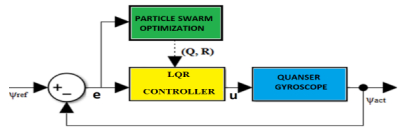
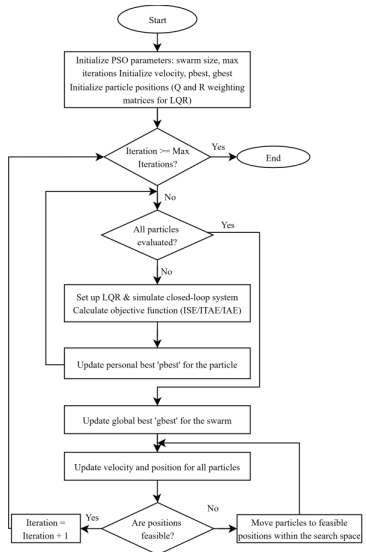
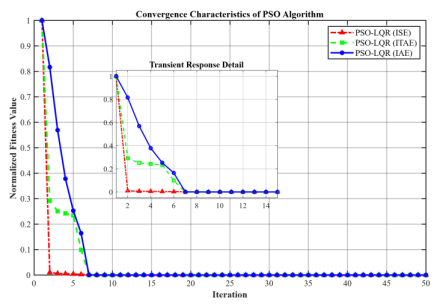
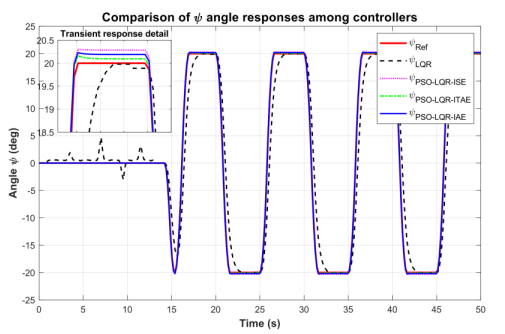
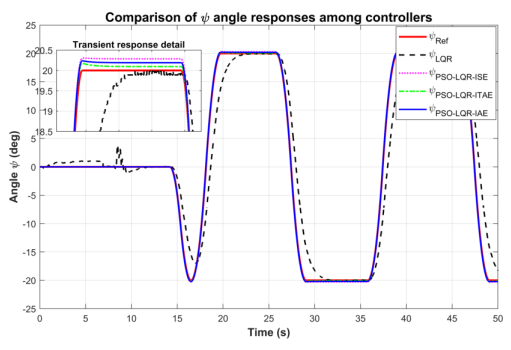
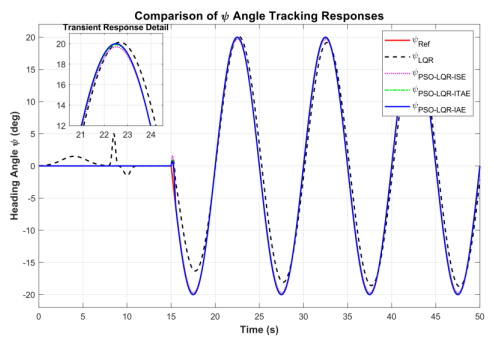
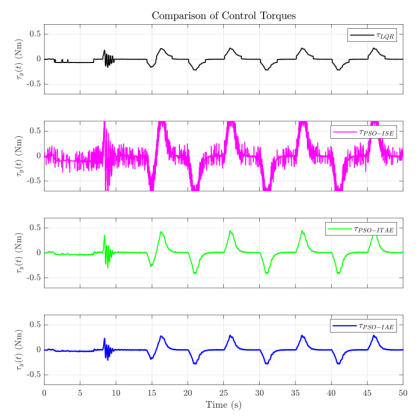
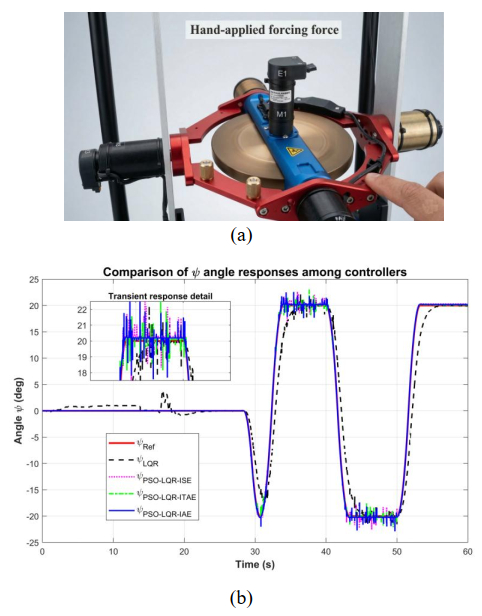
This paper presents a rigorous experimental evaluation of a particle swarm optimization (PSO)-optimized linear quadratic regulator (LQR) controller deployed on a physical Quanser 3-degree-of-freedom (3-DOF) gyroscope platform. To address the limitations of manual trial-and-error parameter tuning under real-world constraints, a multi-criteria optimization framework was established using three distinct performance indices: integral of absolute error (IAE), integral of time-weighted absolute error (ITAE), and integral of squared error (ISE). Real-time hardware experiments under multi-frequent square-wave and continuous sinusoidal trajectories, alongside impulse disturbance scenarios, demonstrated that the proposed PSO-LQR configured via the IAE criterion achieves the most superior balance between dynamic tracking agility and actuator energy efficiency. Specifically, the proposed PSO-IAE framework yields a settling time of 1.68 s, zero overshoot, and a minimal steady-state error of 0.10°. Crucially, quantitative energy analysis revealed that the proposed framework effectively circumvents motor voltage saturation, operating at an optimal control torque root mean square (RMS) value of 0.0962 Nm, which significantly outperforms the ISE configuration (0.3184 Nm) and the ITAE variant (0.1446 Nm). These empirical findings provide valuable practical benchmarks for constraint-enforced automation in high-level mechatronic mechanisms.
Citation: Hoai-Thuong Luong, Thanh-Tung Pham, Minh-Thanh Le, Chi-Ngon Nguyen. Experimental evaluation of PSO-optimized LQR control for a Quanser 3-DOF gyroscope: A multi-criteria comparative study under practical constraints[J]. AIMS Electronics and Electrical Engineering, 2026, 10(4): 627-647. doi: 10.3934/electreng.2026026
This paper presents a rigorous experimental evaluation of a particle swarm optimization (PSO)-optimized linear quadratic regulator (LQR) controller deployed on a physical Quanser 3-degree-of-freedom (3-DOF) gyroscope platform. To address the limitations of manual trial-and-error parameter tuning under real-world constraints, a multi-criteria optimization framework was established using three distinct performance indices: integral of absolute error (IAE), integral of time-weighted absolute error (ITAE), and integral of squared error (ISE). Real-time hardware experiments under multi-frequent square-wave and continuous sinusoidal trajectories, alongside impulse disturbance scenarios, demonstrated that the proposed PSO-LQR configured via the IAE criterion achieves the most superior balance between dynamic tracking agility and actuator energy efficiency. Specifically, the proposed PSO-IAE framework yields a settling time of 1.68 s, zero overshoot, and a minimal steady-state error of 0.10°. Crucially, quantitative energy analysis revealed that the proposed framework effectively circumvents motor voltage saturation, operating at an optimal control torque root mean square (RMS) value of 0.0962 Nm, which significantly outperforms the ISE configuration (0.3184 Nm) and the ITAE variant (0.1446 Nm). These empirical findings provide valuable practical benchmarks for constraint-enforced automation in high-level mechatronic mechanisms.

| [1] |
Rahmani M (2018) MEMS gyroscope control using a novel compound robust control. ISA Trans 72: 37-43. https://doi.org/10.1016/j.isatra.2017.11.009 doi: 10.1016/j.isatra.2017.11.009

|
| [2] |
Pedapati PR, Chidambaram RK (2025) A review on control momentum gyroscopic stabilization for intelligent balance assistance in electric two-wheeler. Results in Engineering 26. https://doi.org/10.1016/j.rineng.2025.105069 doi: 10.1016/j.rineng.2025.105069
|
| [3] | Richie DJ, Tsiotras P, Fausz JL (2001) Variable Speed Control Moment Gyroscope Workbench: a new simulation tool for tomorrow's spacecraft. In 20th DASC. 20th Digital Avionics Systems Conference (Cat. No. 01CH37219), 8A3/1-8A3/12. https://doi.org/10.1109/DASC.2001.964219 |
| [4] | Cannon RH (2003) Dynamics of Physical Systems, Mineola, NY: Dover Publications. |
| [5] |
Hounnan SO, Miwadinou CH, Monwanou VA (2023) Nonlinear Dynamics of a Nonlinear Damping Gyroscope and Its Passive Control. J Control Sci Eng 2023: 2036300. https://doi.org/10.1155/2023/2036300 doi: 10.1155/2023/2036300
|
| [6] | Ogata K (2010) Modern Control Engineering, 5 Eds., Upper Saddle River: Prentice Hall. |
| [7] | Nise NS (2020) Control Systems Engineering, John Wiley & Sons, Inc. |
| [8] |
Deb K, Pratap A, Agarwal S, Meyarivan TA (2002) A fast and elitist multiobjective genetic algorithm: NSGA-Ⅱ. IEEE T Evolut Comput 6: 182‒197. https://doi.org/10.1109/4235.996017 doi: 10.1109/4235.996017
|
| [9] |
Kumar Elumalai V, Ganapathy Subramanian R (2017) A new algebraic LQR weight selection algorithm for tracking control of 2 DoF torsion system. Arch Electr Eng 66: 55‒75. https://doi.org/10.1515/aee-2017-0005 doi: 10.1515/aee-2017-0005
|
| [10] |
Luong HT, Le MT, Pham TT, Nguyen CN (2026) Improving a linear–quadratic regulator controller by genetic algorithm on a Quanser gyroscope. Acta IMEKO 15: 1‒7. https://doi.org/10.21014/actaimeko.v15i1.2163 doi: 10.21014/actaimeko.v15i1.2163
|
| [11] |
Khodja MA, Tadjine M, Boucherit MS, Benzaoui M (2017) Tuning PID attitude stabilization of a quadrotor using particle swarm optimization (experimental). Int J Simul Multidisci Des Optim 8: A8. https://doi.org/10.1051/smdo/2017001 doi: 10.1051/smdo/2017001
|
| [12] |
Abdalla MO, Al-Baradie S (2020) Real Time Optimal Tuning of Quadcopter Attitude Controller Using Particle Swarm Optimization. J Eng Technol Sci 52: 745‒764. https://doi.org/10.5614/j.eng.technol.sci.2020.52.5.10 doi: 10.5614/j.eng.technol.sci.2020.52.5.10
|
| [13] |
Thanh BT, Parnichkun M (2008) Balancing Control of Bicyrobo by Particle Swarm Optimization-Based Structure-Specified Mixed H2/H∞ Control. Int J Adv Robot Syst 5: 39. https://doi.org/10.5772/6235 doi: 10.5772/6235
|
| [14] |
Li S, Mohammadzadeh A, Zhang C (2025) An Applied Type-3 Fuzzy Controller for Gyroscopes. Int J Fuzzy Syst 27: 2177‒2194. https://doi.org/10.1007/s40815-024-01909-7 doi: 10.1007/s40815-024-01909-7
|
| [15] |
Zhang C, Du C, Sakthivel R, Mohammadzadeh A (2025) Observer-based type-3 fuzzy control for gyroscopes: Experimental/theoretical study. Inform Sciences 702: 121907. https://doi.org/10.1016/j.ins.2025.121907 doi: 10.1016/j.ins.2025.121907
|
| [16] |
Srivastava S, Misra A, Thakur SK, Pandit VS (2016) An optimal PID controller via LQR for standard second order plus time delay systems. ISA Trans 60: 244‒253. https://doi.org/10.1016/j.isatra.2015.11.020 doi: 10.1016/j.isatra.2015.11.020
|
| [17] | Bučevac Z, Jovanović R (2022) Discrete-Time System Conditional Optimization in the Parameter Space with Nonzero Initial Conditions. Tehnički vjesnik 29: 200‒207. |
| [18] |
Park HC, Chakir S, Kim YB, Huynh T (2021) A Nonlinear Backstepping Controller Design for High-Precision Tracking Applications with Input-Delay Gimbal Systems. J Mar Sci Eng 9: 530. https://doi.org/10.3390/jmse9050530 doi: 10.3390/jmse9050530
|
| [19] |
Falcon R, Rios H, Dzul A (2022) A Robust Fault Diagnosis for Quad-Rotors: A Sliding-Mode Observer Approach. IEEE/ASME T Mech 27: 4487‒4496. https://doi.org/10.1109/tmech.2022.3156854 doi: 10.1109/tmech.2022.3156854
|
| [20] |
Ouyang Y, Dong L, Xue L, Sun C (2019) Adaptive control based on neural networks for an uncertain 2-DOF helicopter system with input deadzone and output constraints. IEEE/CAA J Automatic Sin 6: 807‒815. https://doi.org/10.1109/jas.2019.1911495 doi: 10.1109/jas.2019.1911495
|
| [21] |
Zhao Z, Ren Y, Mu C, Zou T, Hong KS (2022) Adaptive Neural-Network-Based Fault-Tolerant Control for a Flexible String With Composite Disturbance Observer and Input Constraints. IEEE Trans Cybern 52: 12843‒12853. https://doi.org/10.1109/TCYB.2021.3090417 doi: 10.1109/TCYB.2021.3090417
|
| [22] |
Prakosa JA, Wang H, Kurniawan E, Agmal S, Kholili MJ (2022) Experimental studies of linear quadratic regulator (LQR) cost matrices weighting to control an accurate take-off position of bicopter unmanned aerial vehicles (UAVs). Journal of Mechatronics, Electrical Power, and Vehicular Technology 13: 101‒112. https://doi.org/10.14203/j.mev.2022.v13.101-112 doi: 10.14203/j.mev.2022.v13.101-112
|
| [23] |
Zirkohi MM (2022) Adaptive interval type-2 fuzzy recurrent RBFNN control design using ellipsoidal membership functions with application to MEMS gyroscope. ISA Trans 119: 25‒40. https://doi.org/10.1016/j.isatra.2021.02.046 doi: 10.1016/j.isatra.2021.02.046
|
| [24] |
Shao X, Zhang F, Liu J, Zhang Q (2025) Finite-Time Learning-Based Optimal Elliptical Encircling Control for UAVs With Prescribed Constraints. IEEE T Intell Transp Syst 26: 7065‒7080. https://doi.org/10.1109/tits.2025.3549827 doi: 10.1109/tits.2025.3549827
|
| [25] |
Mei Z, Shao X, Xia Y, Liu J (2024) Enhanced Fixed-Time Collision-Free Elliptical Circumnavigation Coordination for UAVs. IEEE T Aero Electr Syst 60: 4257‒4270. https://doi.org/10.1109/taes.2024.3374708 doi: 10.1109/taes.2024.3374708
|
| [26] |
Li S, Shao X, Wang H, Liu J, Zhang Q (2025) Adaptive Critic Attitude Learning Control for Hypersonic Morphing Vehicles Without Backstepping. IEEE T Aero Electr Syst 61: 8787‒8803. https://doi.org/10.1109/taes.2025.3542345 doi: 10.1109/taes.2025.3542345
|
| [27] |
Cheng Y, Shao X, Li J, Liu J, Zhang Q (2025) Concurrent-Learning-Based Adaptive Critic Formation for Multirobots Under Safety Constraints. IEEE Internet of Things Journal 12: 7610‒7621. https://doi.org/10.1109/jiot.2024.3497979 doi: 10.1109/jiot.2024.3497979
|
| [28] |
Shao X, Du J, Xia Y, Zhang Z, Hou X, Debbah M (2025) Efficient Path-Following for Urban Logistics: A Fuzzy Control Strategy for Consumer UAVs Under Disturbance Constraints. IEEE T Consum Electr 71: 7117‒7128. https://doi.org/10.1109/tce.2025.3564412 doi: 10.1109/tce.2025.3564412
|
| [29] |
Li X, Cheng Y, Shao X, Liu J, Zhang Q (2025) Safety-Certified Optimal Formation Control for Nonlinear Multiagents via High-Order Control Barrier Function. IEEE Internet of Things Journal 12: 24586‒24598. https://doi.org/10.1109/jiot.2025.3557790 doi: 10.1109/jiot.2025.3557790
|
| [30] |
Zhang Q, He D, Li X, Liu H, Shao X (2026) Enhanced state-constrained adaptive fuzzy exact tracking control for nonlinear strict-feedback systems. Fuzzy Set Syst 522: 109598. https://doi.org/10.1016/j.fss.2025.109598 doi: 10.1016/j.fss.2025.109598
|
| [31] | Quanser I (2012) 3-DOF Gyroscope Laboratory Guide. Markham, Ontario, Canada: Quanser Inc. Available from: https://drive.google.com/file/d/1MCUhjErsnKFtTdauCuCIOHFFwBTo1kg9/view?usp = sharing |
| [32] | Quanser I (2012) 3-DOF Gyroscope User Manual. Markham, Ontario, Canada: Quanser Inc. Available from: https://www.quanser.com/products/3-dof-gyroscope/ |
| [33] | Nguyen CN (2008) Optimization of PID controller using genetic algorithm. Can Tho Univ J Sci 9: 241‒248. Available from: https://ctujsvn.ctu.edu.vn/index.php/ctujsvn/article/view/530 |
| [34] |
Jibril M, Tadese M, Hassen N (2020) Position Control of a Three Degree of Freedom Gyroscope using Optimal Control. New York Science Journal 13: 1‒5. https://doi.org/10.7537/marsnys131120.01 doi: 10.7537/marsnys131120.01
|
| [35] |
Nagarkar M, Vikhe Patil GJ (2016) Optimization of the linear quadratic regulator (LQR) control quarter car suspension system using genetic algorithm. Ingeniería e Investigación 36: 23‒30. https://doi.org/10.15446/ing.investig.v36n1.49253 doi: 10.15446/ing.investig.v36n1.49253
|
| [36] |
Jian F, Liu JY (2014) PSO in Two-Wheeled Self-Balancing Robot Control Research. Advanced Materials Research 898: 534‒537. https://doi.org/10.4028/www.scientific.net/AMR.898.534 doi: 10.4028/www.scientific.net/AMR.898.534
|
Figures(14) / Tables(4)

Hoai-Thuong Luong, Thanh-Tung Pham, Minh-Thanh Le, Chi-Ngon Nguyen. Experimental evaluation of PSO-optimized LQR control for a Quanser 3-DOF gyroscope: A multi-criteria comparative study under practical constraints[J]. AIMS Electronics and Electrical Engineering, 2026, 10(4): 627-647. doi: 10.3934/electreng.2026026





 DownLoad: