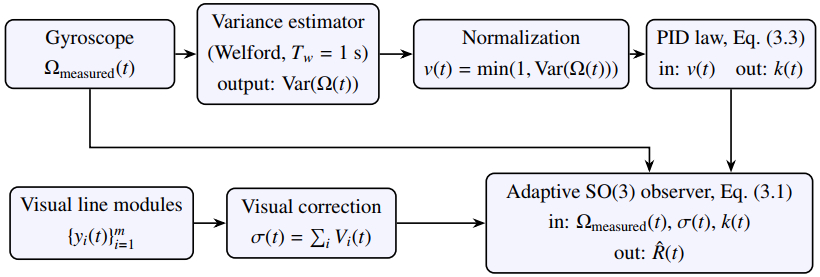
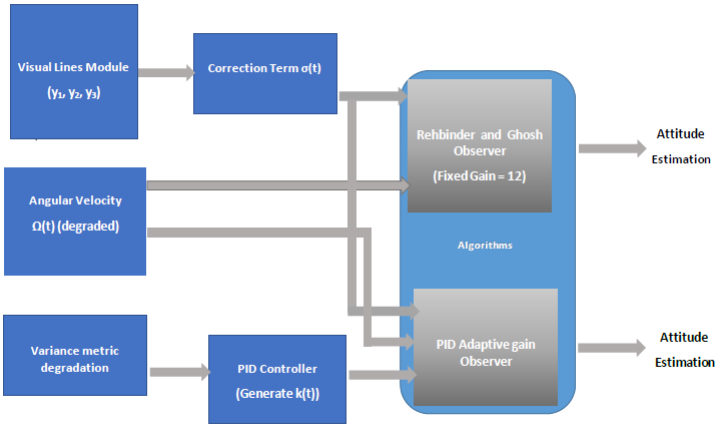
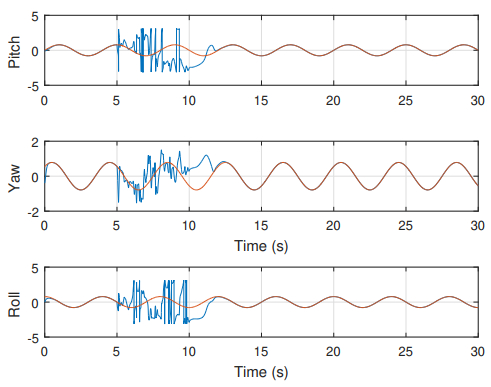
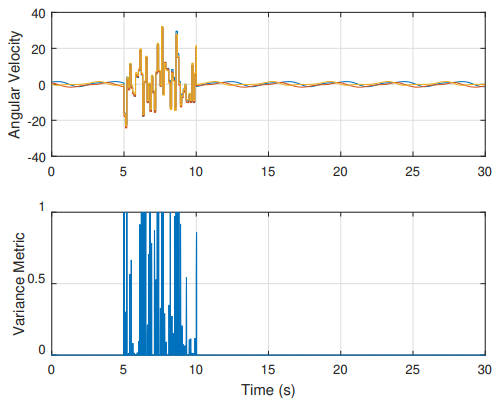
Existing solutions to attitude estimation for unmanned aerial vehicles (UAVs) in GPS-denied environments face a persistent trade-off: classical filtering approaches such as the extended Kalman filter (EKF) suffer from linearization errors, while geometric nonlinear observers on the special orthogonal (SO(3)) Lie group avoid this issue but rely on a manually tuned, fixed correction gain. A fixed gain cannot simultaneously deliver fast convergence during nominal operation and robust noise rejection when inertial sensors degrade, and existing adaptive or gain-scheduled alternatives either require manual heuristics or lack a real-time responsiveness mechanism, leaving gain tuning an open and recognized limitation in this line of work. This paper proposes a robust vision-inertial fusion method for UAV attitude estimation using a nonlinear observer on the SO(3) Lie group with adaptive gain control that directly addresses this gap. We introduce a PID-based gain adaptation mechanism that dynamically modulates the observer's correction term based on real-time gyroscope variance metrics. When inertial data deteriorates due to noise or bias, the observer automatically relies more on visual corrections; during stable periods, it prioritizes inertial data for faster convergence. MATLAB/Simulink simulation results demonstrate that the adaptive observer reduces attitude estimation error by approximately 65 percent during disturbances and achieves reconvergence over 10 times faster after disturbances compared to fixed-gain baselines, while maintaining bounded errors during severe gyroscope perturbations where fixed gain observers diverge. This work provides a computationally efficient solution to the gain-tuning challenge in geometric attitude estimation for autonomous UAVs operating in GPS-denied environments. Validation is performed through comprehensive simulation studies.
Citation: Abdelwahhab Khaldi, Choukri Bensalah, Amal Choukchou Braham. Adaptive PID-based gain control for robust vision-inertial attitude estimation on SO(3)[J]. AIMS Electronics and Electrical Engineering, 2026, 10(4): 648-676. doi: 10.3934/electreng.2026027
Existing solutions to attitude estimation for unmanned aerial vehicles (UAVs) in GPS-denied environments face a persistent trade-off: classical filtering approaches such as the extended Kalman filter (EKF) suffer from linearization errors, while geometric nonlinear observers on the special orthogonal (SO(3)) Lie group avoid this issue but rely on a manually tuned, fixed correction gain. A fixed gain cannot simultaneously deliver fast convergence during nominal operation and robust noise rejection when inertial sensors degrade, and existing adaptive or gain-scheduled alternatives either require manual heuristics or lack a real-time responsiveness mechanism, leaving gain tuning an open and recognized limitation in this line of work. This paper proposes a robust vision-inertial fusion method for UAV attitude estimation using a nonlinear observer on the SO(3) Lie group with adaptive gain control that directly addresses this gap. We introduce a PID-based gain adaptation mechanism that dynamically modulates the observer's correction term based on real-time gyroscope variance metrics. When inertial data deteriorates due to noise or bias, the observer automatically relies more on visual corrections; during stable periods, it prioritizes inertial data for faster convergence. MATLAB/Simulink simulation results demonstrate that the adaptive observer reduces attitude estimation error by approximately 65 percent during disturbances and achieves reconvergence over 10 times faster after disturbances compared to fixed-gain baselines, while maintaining bounded errors during severe gyroscope perturbations where fixed gain observers diverge. This work provides a computationally efficient solution to the gain-tuning challenge in geometric attitude estimation for autonomous UAVs operating in GPS-denied environments. Validation is performed through comprehensive simulation studies.

| [1] |
Rehbinder H, Ghosh B (2003) Pose estimation using line-based dynamic vision and inertial sensors. IEEE T Automat Contr 48: 186–191. https://doi.org/10.1109/TAC.2002.808464 doi: 10.1109/TAC.2002.808464

|
| [2] | Berkane M, Tayebi A (2016) On the Design of Attitude Observers on the Special Orthogonal Group SO(3). arXiv: 1606.06208. |
| [3] |
Ma F, Shi J, Yang Y, Li J, Dai K (2019) ACK-MSCKF: Tightly-coupled Ackermann multi-state constraint Kalman filter for VIO under special motions. Sensors 19: Article 4816. https://doi.org/10.3390/s19214816 doi: 10.3390/s19214816
|
| [4] |
Abdollahi MR, Pourtakdoust SH, Nooshabadi MY, Pishkenari HN (2024) An improved multi-State constraint Kalman filter for visual-inertial odometry. J Franklin Ins 361: 107130. https://doi.org/10.1016/j.jfranklin.2024.107130 doi: 10.1016/j.jfranklin.2024.107130
|
| [5] | Negru SA, Geragersian P, Petrunin I, Guo W (2024) Resilient multi-sensor UAV navigation with a hybrid federated fusion architecture. Sensors 24: 981. |
| [6] |
An L, Li X, Li H (2022) A robust visual-aided inertial navigation algorithm for pedestrians: Improved accuracy in dynamic environments. J Sensors 2022: 1311221. https://doi.org/10.1155/2022/1311221 doi: 10.1155/2022/1311221
|
| [7] | Pandey Y, Bhattacharyya R, Singh YN (2024) Adaptive invariant extended Kalman filter with noise covariance tuning for attitude estimation. arXiv preprint arXiv: 2410.01958. |
| [8] | Singh A, Sieb TS, Howe JH, Hashim HA (2020) Nonlinear attitude filter on SO(3): Fast adaptation and robustness. In 2020 IEEE 16th International Conference on Automation Science and Engineering (CASE), 869–874. |
| [9] | Goffin S, Barrau A, Bonnabel S, Brüls O, Sacré P (2025) Iterated invariant extended Kalman filter (IterIEKF). IEEE T Automat Contr. |
| [10] | Goodarzi F, Lee D, Lee T (2013) Geometric nonlinear PID control of a quadrotor UAV on SE(3). In Proc European Control Conference (ECC), 3845–3850. https://doi.org/10.23919/ECC.2013.6669644 |
| [11] |
Noordin A, Mohd Basri MA, Mohamed Z, Mat Lazim I (2021) Adaptive PID controller using sliding mode control approaches for quadrotor UAV attitude and position stabilization. Arab J Sci Eng 46: 963–981. https://doi.org/10.1007/s13369-020-04742-w doi: 10.1007/s13369-020-04742-w
|
| [12] | Chen J, Long Y, Li T, Huang T (2023) Attitude tracking control for quadrotor based on time-varying gain extended state observer. Proceedings of the Institution of Mechanical Engineers, Part Ⅰ: Journal of Systems and Control Engineering 237: 585–95. |
| [13] | Zhang J, Yu X, Sier H, Zhang H, Westerlund T (2024) Event-based sensor fusion and application on odometry: A survey. In 2025 IEEE 6th International Conference on Image Processing, Applications and Systems (IPAS), 1–6. |
| [14] | Yi B, Jin C, Wang L, Shi G, Ila V, Manchester IR (2024) PEBO-SLAM: Observer design for visual inertial SLAM with convergence guarantees. IEEE T Automat Contr 70: 1714–1729. |
| [15] | Wang M, Berkane S, Tayebi A (2021) Nonlinear observers design for vision-aided inertial navigation systems. IEEE T Automat Contr 67: 1853–1868. |
| [16] |
Wang J, Li M (2021) Adaptive invariant Kalman filtering for attitude estimation on SO(3) thorough feedback calibration of prior error covariance. IET Control Theory Appl 15: 1906–1914. https://doi.org/10.1049/cth2.12166 doi: 10.1049/cth2.12166
|
| [17] | Song W, Li P, Wang M (2024) Transmission line detection based on improved Hough transform. arXiv preprint arXiv: 2402.02761. |
| [18] |
Teplyakov L, Erlygin L, Shvets E (2022) LSDNet: Trainable modification of LSD algorithm for real-time line segment detection. IEEE Access 10: 45256–45265. https://doi.org/10.1109/ACCESS.2022.3169177 doi: 10.1109/ACCESS.2022.3169177
|
| [19] | Pautrat R, Barath D, Larsson V, Oswald MR, Pollefeys M (2023) DeepLSD: Line segment detection and refinement with deep image gradients. In 2023 IEEE/CVF Conference on Computer Vision and Pattern Recognition (CVPR), 17327–17336. |
| [20] | Xue N, Wu T, Bai S, Wang F, Xia GS, Zhang L, et al. (2020) Holistically-Attracted Wireframe Parsing. CVPR, 2785–2794. https://doi.org/10.1109/CVPR42600.2020.00286 |
| [21] | Lucas BD, Kanade T (1981) An iterative image registration technique with an application to stereo vision. In IJCAI'81: 7th international joint conference on Artificial intelligence 2: 674–679. |
| [22] |
Horn BK, Schunck BG (1981) B. K. Horn and B. G. Schunck, Determining optical flow. Artif Intell 17: 185–203. https://doi.org/10.1016/0004-3702(81)90024-2 doi: 10.1016/0004-3702(81)90024-2
|
| [23] | Farnebäck G (2003) Two-frame motion estimation based on polynomial expansion. Proc SCIA, 363–370. https://doi.org/10.1007/3-540-45103-X_50 |
| [24] | Teed Z, Deng J (2020) RAFT: Recurrent all-pairs field transforms for optical flow. In European conference on computer vision, 402–419. Cham: Springer International Publishing. |
| [25] | Huang Z, Shi X, Zhang C, Wang Q, Cheung KC, Qin H, et al. (2022) FlowFormer: A transformer architecture for optical flow. In European conference on computer vision, 668–685. |
| [26] | Zhan H, Weerasekera CS, Bian JW, Garg R, Reid I Y. Pan et al., DF-VO: What should be learnt for visual odometry?. arXiv preprint arXiv: 2103.00933. |
| [27] | van Goor P, Hamel T, Mahony R (2025) Synchronous observer design for inertial navigation systems with almost-global convergence. Automatica 177: 112328. |
| [28] |
Jiang P, Liu C, Cong H, Zhang F (2024) A fuzzy adaptive complementary filter for attitude estimation based on norm judgment. Measurement and Control 57: 1161–1180. https://doi.org/10.1177/00202940241227069 doi: 10.1177/00202940241227069
|
| [29] |
Suid MH, Ahmad MA (2022) Optimal tuning of sigmoid PID controller using nonlinear Sine Cosine algorithm for the automatic voltage regulator system. ISA Transactions 128: 265–286. https://doi.org/10.1016/j.isatra.2021.11.037 doi: 10.1016/j.isatra.2021.11.037
|
| [30] | Ghazali MR, Ahmad MA, Jusof MF, Ismail RM (2018) A data-driven neuroendocrine-PID controller for underactuated systems based on safe experimentation dynamics. In Proc IEEE 14th Int Colloq Signal Process Its Appl (CSPA), 61–66. https://doi.org/10.1109/CSPA.2018.8368686 |
| [31] |
Lucas C, Shahmirzadi D, Sheikholeslami N (2004) Introducing BELBIC: Brain emotional learning based intelligent controller. Intell Autom Soft Comput 10: 11–21. https://doi.org/10.1080/10798587.2004.10642862 doi: 10.1080/10798587.2004.10642862
|
| [32] |
Izci D, Ekinci S, Jabari M, Kocaman B, Güneş BB, Adas E, et al. (2026) A novel gudermannian function-driven controller architecture optimized by starfish optimizer for superior transient performance of automatic voltage regulation. Biomimetics 11: art. 7. https://doi.org/10.3390/biomimetics11010007 doi: 10.3390/biomimetics11010007
|
| [33] |
Izci D, Ekinci S, Mohd Tumari MZ, Ahmad MA (2025) A novel softsign fractional-order controller optimized by an intelligent nature-inspired algorithm for magnetic levitation control. Fractal Fract 9: art. 801. https://doi.org/10.3390/fractalfract9120801 doi: 10.3390/fractalfract9120801
|
| [34] | Pan Y, Zhou W, Cao Y, Zha H (2024) Adaptive VIO: Deep visual-inertial odometry with online continual learning. In 2024 IEEE/CVF Conference on Computer Vision and Pattern Recognition (CVPR), 18019–18028. |
| [35] | Chen C, Rosa S, Miao Y, Lu CX, Wu W, Markham A, et al. (2019) Selective Sensor Fusion for Neural Visual-Inertial Odometry. CVPR, 10534–10543. https://doi.org/10.48550/arXiv.1903.01534 |
| [36] | Khaldi A, Bensalah C, Braham AC, Cherki B (2019) UAV attitude estimation using visual and inertial data fusion based on observer in SO(3). Proc ICAEE, 1–5. |
| [37] | Wang Q, Liu K, Cao Z (2023) System noise variance matrix adaptive Kalman filter method for AUV INS/DVL navigation system. Ocean Eng 267: 113269. |
Figures(6) / Tables(5)

Abdelwahhab Khaldi, Choukri Bensalah, Amal Choukchou Braham. Adaptive PID-based gain control for robust vision-inertial attitude estimation on SO(3)[J]. AIMS Electronics and Electrical Engineering, 2026, 10(4): 648-676. doi: 10.3934/electreng.2026027





 DownLoad: