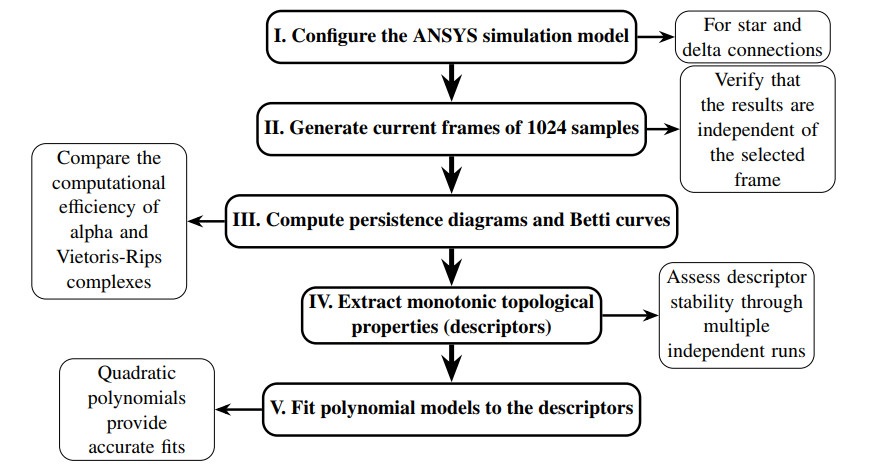
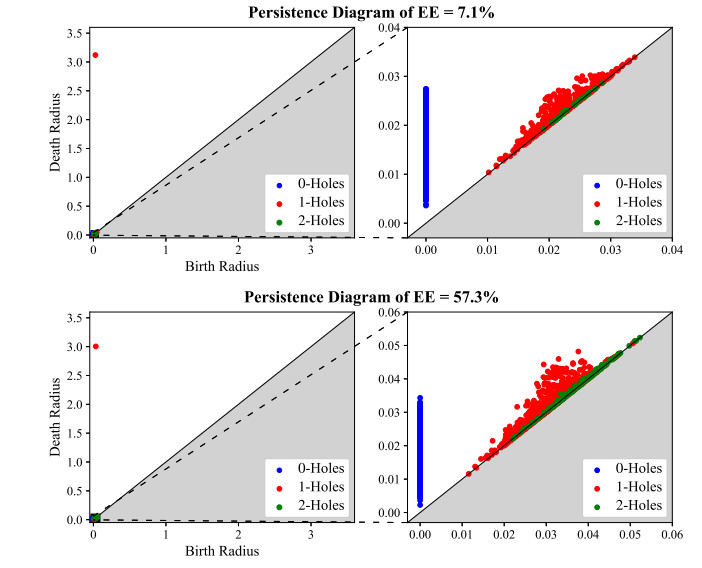
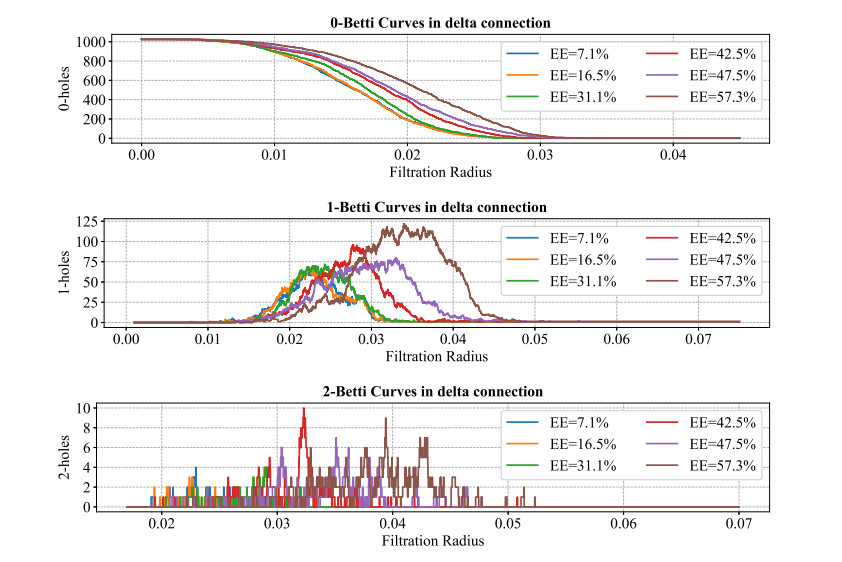
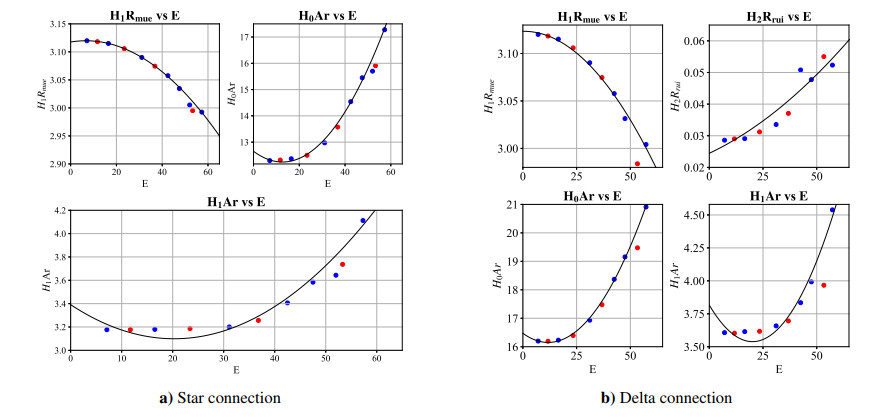
We propose a persistent homology procedure to estimate the severity of mixed eccentricity in three-phase induction motors from line-current measurements. Currents are generated in ANSYS RMxprt/Maxwell under no-load operation for both star and delta connections across six eccentricity levels. Each steady-state frame is embedded as a point cloud in $ \mathbb{R}^3 $ and approximated with alpha complexes to compute persistence diagrams and Betti curves. We define descriptors based on the topological properties and behaviors of the Betti curves. Under the delta connection, we add a new descriptor associated with noise in 2-homology. All descriptors exhibit monotonic trends with increasing eccentricity and allow quadratic fits that enable interpolation of intermediate eccentricity levels. We also show that alpha complexes implemented in GUDHI provide substantial computational advantages over Vietoris-Rips complexes implemented in Ripser.
Citation: Kristian Gochi, Ahtziri González, Juan Anzurez. Detecting eccentricity levels in induction motors via persistent homology[J]. AIMS Electronics and Electrical Engineering, 2026, 10(4): 605-626. doi: 10.3934/electreng.2026025
We propose a persistent homology procedure to estimate the severity of mixed eccentricity in three-phase induction motors from line-current measurements. Currents are generated in ANSYS RMxprt/Maxwell under no-load operation for both star and delta connections across six eccentricity levels. Each steady-state frame is embedded as a point cloud in $ \mathbb{R}^3 $ and approximated with alpha complexes to compute persistence diagrams and Betti curves. We define descriptors based on the topological properties and behaviors of the Betti curves. Under the delta connection, we add a new descriptor associated with noise in 2-homology. All descriptors exhibit monotonic trends with increasing eccentricity and allow quadratic fits that enable interpolation of intermediate eccentricity levels. We also show that alpha complexes implemented in GUDHI provide substantial computational advantages over Vietoris-Rips complexes implemented in Ripser.

| [1] |
De Almeida A, Fong J, Brunner CU, Werle R, Van Werkhoven M (2019) New technology trends and policy needs in energy efficient motor systems - a major opportunity for energy and carbon savings. Renew Sust Energ Rev 115: 109384. https://doi.org/10.1016/j.rser.2019.109384 doi: 10.1016/j.rser.2019.109384

|
| [2] |
Bonnett AH, and Soukup GC (1992) Cause and analysis of stator and rotor failures in three-phase squirrel-cage induction motors. IEEE T Ind Appl 28: 921–937. https://doi.org/10.1109/28.148460 doi: 10.1109/28.148460
|
| [3] |
Simões MG (2023) A concise history of induction motor drives—part 1 [history]. IEEE Electrif Mag 11: 5–11. https://doi.org/10.1109/MELE.2023.3264888 doi: 10.1109/MELE.2023.3264888
|
| [4] |
Hamani K, Kuchar M, Kubatko M, Kirschner S (2025) Advancements in induction motor fault diagnosis and condition monitoring: A comprehensive review. Sensors 25: 5942. https://doi.org/10.3390/s25195942 doi: 10.3390/s25195942
|
| [5] |
Thomson WT, Fenger M (2001) Current signature analysis to detect induction motor faults. IEEE Ind Appl Mag 7: 26–34. https://doi.org/10.1109/2943.930988 doi: 10.1109/2943.930988
|
| [6] |
Kim DY, Kim DK, Park MR (2026) Rotor eccentricity in electric machines: An analytical framework with experimental validation for fault diagnosis. Mech Syst Signal Pro 244: 113776. https://doi.org/10.1016/j.ymssp.2025.113776 doi: 10.1016/j.ymssp.2025.113776
|
| [7] |
Mhaske P, Ghosh S, Birajdar R, Gosavi K, Yadav VK (2026) Rotor eccentricity fault in induction motors for special applications: Its effects and detection. IEEE T Ind Appl 62: 6277–6287. https://doi.org/10.1109/TIA.2025.3645016 doi: 10.1109/TIA.2025.3645016
|
| [8] |
Glowacz A (2026) Thermal imaging fault diagnosis of three-phase induction motors using neural networks. Infrared Phys Techn 155: 106490. https://doi.org/10.1016/j.infrared.2026.106490 doi: 10.1016/j.infrared.2026.106490
|
| [9] |
Calderon-Uribe U, Lizarraga-Morales RA, Guryev IV (2024) Fault diagnosis in induction motors through infrared thermal images using convolutional neural network feature extraction. Machines 12: 497. https://doi.org/10.3390/machines12080497 doi: 10.3390/machines12080497
|
| [10] |
Uzel H, Özüpak Y, Alpsalaz F, Aslan E, Zaitsev I (2025) Acoustic-based fault diagnosis of electric motors using mel spectrograms and convolutional neural networks. Sci Rep 16: 3379. https://doi.org/10.1038/s41598-025-33269-z doi: 10.1038/s41598-025-33269-z
|
| [11] |
Glowacz A, Sulowicz M, Zielonka J, Li Z, Glowacz W, Kumar A (2025) Acoustic fault diagnosis of three-phase induction motors using smartphone and deep learning. Expert Syst Appl 262: 125633. https://doi.org/10.1016/j.eswa.2024.125633 doi: 10.1016/j.eswa.2024.125633
|
| [12] |
Diversi R, Lenzi A, Speciale N, Barbieri M (2025) An autoregressive-based motor current signature analysis approach for fault diagnosis of electric motor-driven mechanisms. Sensors 25: 1130. https://doi.org/10.3390/s25041130 doi: 10.3390/s25041130
|
| [13] |
Wang B, Lin C, Inoue H, Kanemaru M (2024) Induction motor eccentricity fault detection and quantification using topological data analysis. IEEE Access 12: 37891–37902. https://doi.org/10.1109/ACCESS.2024.3376249 doi: 10.1109/ACCESS.2024.3376249
|
| [14] |
Dehnavi VS, Shafiee M (2025) Fault diagnosis of induction motors using novel measurement techniques and data fusion. Measurement 256: 118135. https://doi.org/10.1016/j.measurement.2025.118135 doi: 10.1016/j.measurement.2025.118135
|
| [15] |
Chazal F, Michel B (2021) An introduction to topological data analysis: Fundamental and practical aspects for data scientists. Frontiers in Artificial Intelligence 4: 667963. https://doi.org/10.3389/frai.2021.667963 doi: 10.3389/frai.2021.667963
|
| [16] | Virk Ž (2022) Introduction to Persistent Homology. Založba UL FRI. https://doi.org/10.51939/0002 |
| [17] |
Gravot E, Torregrosa S, Hascoët N, Kestelyn X, Chinesta F (2025) Topological data analysis for fault classification on transmission lines. Electr Pow Syst Res 248: 111915. https://doi.org/10.1016/j.epsr.2025.111915 doi: 10.1016/j.epsr.2025.111915
|
| [18] |
Levenson RM, Singh Y, Rieck B, Hathaway QA, Farrelly C, Rozenblit J, et al. (2024) Advancing precision medicine: Algebraic topology and differential geometry in radiology and computational pathology. Lab Invest 104: 102060. https://doi.org/10.1016/j.labinv.2024.102060 doi: 10.1016/j.labinv.2024.102060
|
| [19] |
Wei Q, Zeng S, Jiang Z, Xu F, Shi S, Wen W, et al. (2025) Topological representation based on wavelet transform as a novel imaging biomarker for tumor diagnosis in ultrasound images: A comprehensive study. Comput Meth Prog Bio 269: 108859. https://doi.org/10.1016/j.cmpb.2025.108859 doi: 10.1016/j.cmpb.2025.108859
|
| [20] | Bilsky J, Clark AE (2025) Understanding the shape of chemistry data applications with persistent homology. The Journal of Chemical Physics 163. https://doi.org/10.1063/5.0281156 |
| [21] |
Mandal SK, Kumar R, Rizwee M, Kumar D (2024) Tuning thermal and structural properties of nano-filled pdms elastomer. Polym Composite 45: 14832–14844. https://doi.org/10.1002/pc.28804 doi: 10.1002/pc.28804
|
| [22] |
Hernández-Lemus E (2025) Topological data analysis in single cell biology. Front Immunol 16: 1615278. https://doi.org/10.3389/fimmu.2025.1615278 doi: 10.3389/fimmu.2025.1615278
|
| [23] | Hartsock I, Park E, Toppen J, Bubenik P, Dimitrova ES, Kemp ML, et al. Topological data analysis of pattern formation of human induced pluripotent stem cell colonies. Scientific Reports 15: 11544. https://doi.org/10.1038/s41598-025-90592-1 |
| [24] | González A, Hernández B, Acosta-Zamora KP, Ramos E, Núñez J (2025) Topological data analysis of three dimensional orbits in a convective flow. Physica D, 134841. https://doi.org/10.1016/j.physd.2025.134841 |
| [25] |
Bohlsen N, Robins V, Hole M (2025) Automatic classification of magnetic field line topology by persistent homology. Physica D 475: 134595. https://doi.org/10.1016/j.physd.2025.134595 doi: 10.1016/j.physd.2025.134595
|
| [26] |
Sagming M, Heymann R, Visaya MV (2024) Using topological data analysis and machine learning to predict customer churn. Journal of Big Data 11: 160. https://doi.org/10.1186/s40537-024-01020-6 doi: 10.1186/s40537-024-01020-6
|
| [27] |
Uray M, Giunti B, Kerber M, Huber S (2024) Topological data analysis in smart manufacturing: State of the art and future directions. J Manuf Syst 76: 75–91. https://doi.org/10.1016/j.jmsy.2024.07.006 doi: 10.1016/j.jmsy.2024.07.006
|
| [28] | Edelsbrunner H, Harer J (2010) Computational Topology: An Introduction, American Mathematical Society, 2010. https://doi.org/10.1090/mbk/069 |
| [29] |
Hadj Salem M, Mansouri K, Chauveau E, Ben Salem Y, Abdelkrim MN (2024) Multi-power system electrical source fault review. Energies 17: 1187. https://doi.org/10.3390/en17051187 doi: 10.3390/en17051187
|
| [30] | ANSYS, Inc. (2024) Defining a three-phase induction motor. Accessed December 1, 2025. |
| [31] |
Somasundaram EV, Brown SE, Litzler A, Scott JG, Wadhwa RR (2021) Benchmarking r packages for calculation of persistent homology. The R Journal 13: 184. https://doi.org/10.32614/RJ-2021-033 doi: 10.32614/RJ-2021-033
|
Figures(12) / Tables(7)

Kristian Gochi, Ahtziri González, Juan Anzurez. Detecting eccentricity levels in induction motors via persistent homology[J]. AIMS Electronics and Electrical Engineering, 2026, 10(4): 605-626. doi: 10.3934/electreng.2026025





 DownLoad: