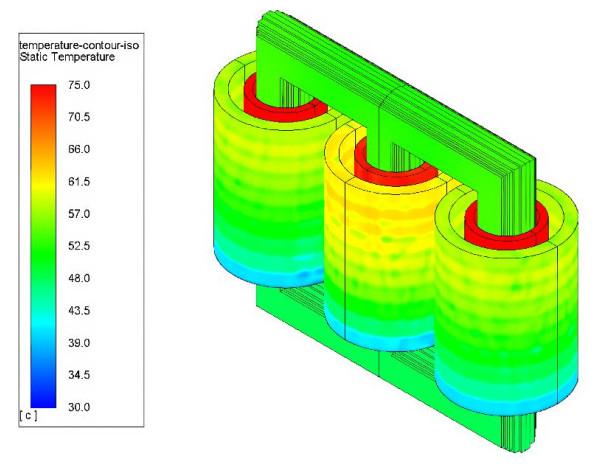
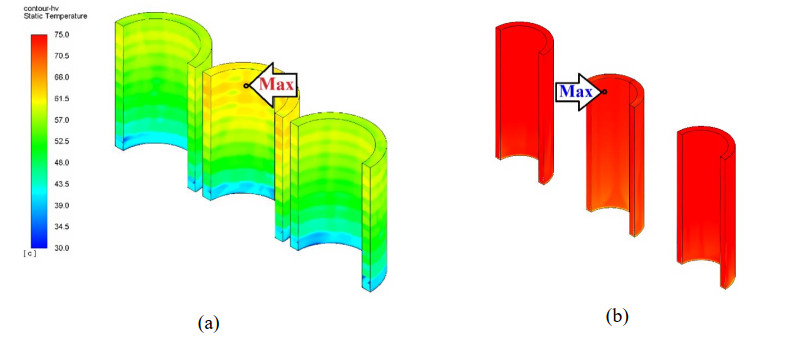
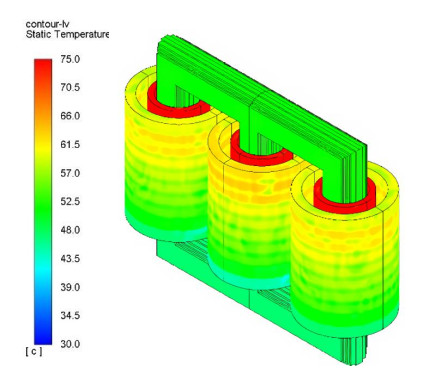
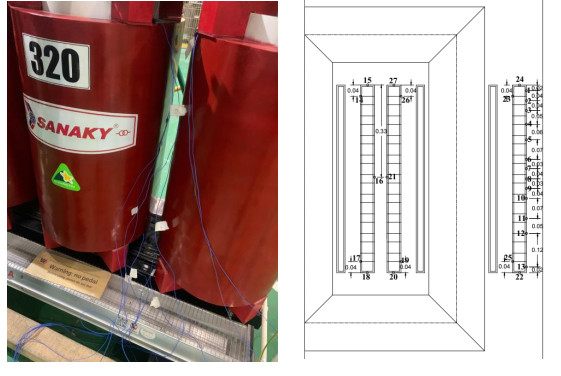
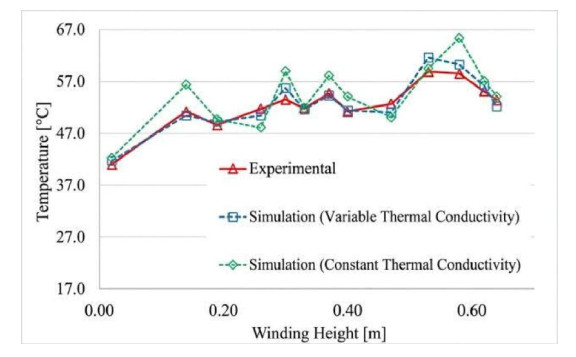
This study presents an enhanced three-dimensional conjugate heat transfer (CHT) model designed to improve the thermal simulation accuracy of a 320 kVA, 22/0.4 kV cast-resin dry-type transformer (CRDT). While conventional thermal modeling commonly assumes constant thermophysical properties for epoxy encapsulation, this research dynamically incorporates temperature-dependent functions for thermal conductivity (λ) and specific heat capacity ($ {C}_{p} $). These parameters, previously identified through experimental measurements (ASTM D5334) on the specific 8055A/8055B epoxy system, are continuously updated at every solver iteration according to the local temperature field. By utilizing a one-way multiphysics coupling strategy, the non-uniform electromagnetic losses computed via ANSYS Maxwell are explicitly mapped as volumetric heat sources into the ANSYS Fluent CHT model. The proposed framework was rigorously validated against empirical data collected from 27 thermocouples installed on an actual industrial prototype operating under rated load conditions. The integration of temperature-dependent material properties significantly reduced the maximum relative prediction error from 10.9% (using conventional constant properties) to 4.59% along the axial profile of the high-voltage winding. Furthermore, the error margin remained below 5.1% across all 27 validated locations, successfully pinpointing the hotspot temperature of 75.0℃ at the upper section of the phase-B low-voltage winding. Given that the thermal aging of epoxy insulation accelerates exponentially with rising temperatures, this substantial improvement in prediction accuracy provides a highly credible foundation for estimating insulation service life and establishing safer, better-founded design margins for CRDTs.
Citation: Hai Pham Hong, Tung Le Duc, Minh Tran Anh. Improving thermal simulation accuracy of dry-type transformers using experimentally identified temperature-dependent epoxy properties[J]. AIMS Electronics and Electrical Engineering, 2026, 10(4): 585-604. doi: 10.3934/electreng.2026024
This study presents an enhanced three-dimensional conjugate heat transfer (CHT) model designed to improve the thermal simulation accuracy of a 320 kVA, 22/0.4 kV cast-resin dry-type transformer (CRDT). While conventional thermal modeling commonly assumes constant thermophysical properties for epoxy encapsulation, this research dynamically incorporates temperature-dependent functions for thermal conductivity (λ) and specific heat capacity ($ {C}_{p} $). These parameters, previously identified through experimental measurements (ASTM D5334) on the specific 8055A/8055B epoxy system, are continuously updated at every solver iteration according to the local temperature field. By utilizing a one-way multiphysics coupling strategy, the non-uniform electromagnetic losses computed via ANSYS Maxwell are explicitly mapped as volumetric heat sources into the ANSYS Fluent CHT model. The proposed framework was rigorously validated against empirical data collected from 27 thermocouples installed on an actual industrial prototype operating under rated load conditions. The integration of temperature-dependent material properties significantly reduced the maximum relative prediction error from 10.9% (using conventional constant properties) to 4.59% along the axial profile of the high-voltage winding. Furthermore, the error margin remained below 5.1% across all 27 validated locations, successfully pinpointing the hotspot temperature of 75.0℃ at the upper section of the phase-B low-voltage winding. Given that the thermal aging of epoxy insulation accelerates exponentially with rising temperatures, this substantial improvement in prediction accuracy provides a highly credible foundation for estimating insulation service life and establishing safer, better-founded design margins for CRDTs.

| [1] | Kumar P, Verma P (2021) Review paper on diagnostics study of dry transformer. CEUR Workshop Proceedings 3058: 1–9. Available from: https://ceur-ws.org/Vol-3058/Paper-101.pdf |
| [2] | Chen P, Huang Y, Zeng FJ, Jin Y, Zhao X, Wang J (2019) Review on insulation and reliability of dry-type transformer. Proceedings of the 2019 IEEE Sustainable Power and Energy Conference (iSPEC), 398–402. https://doi.org/10.1109/iSPEC48194.2019.8975106 |
| [3] |
Mafra G, Dos Santos Magalhães E, De Campos Salles Anselmo B, Belchior FN, Lima e Silva SMM (2019) Winding hottest-spot temperature analysis in dry-type transformer using numerical simulation. Energies 12(1): 68. https://doi.org/10.3390/en12010068 doi: 10.3390/en12010068

|
| [4] | Yin X, Yan L, Zhang Y, Wang X, Lu X, Zhang A, et al. (2022) Hot spot temperature estimation method for dry-type transformers considering heat dissipation characteristics of the insulation layer. Proceedings of the 2022 IEEE Advanced Information Technology, Electronic and Automation Control Conference (IAEAC), 1864–1868. https://doi.org/10.1109/IAEAC54830.2022.9929555 |
| [5] | Xu G, Sun Y, Zhong H, Li N, Wang E, Zhang L, et al. (2020) Analysis of hot spot temperature of dry-type transformer based on finite element method. Proceedings of the 2020 IEEE International Conference on Power Systems Asia (ICPS Asia), 449‒453. https://doi.org/10.1109/ICPSAsia48933.2020.9208365 |
| [6] |
Wang Y, Feng C, Fei R, Luo Y (2020) Thermal-ageing characteristics of dry-type transformer epoxy composite insulation. High Perform Polym 32(7): 741–752. https://doi.org/10.1177/0954008320906439 doi: 10.1177/0954008320906439
|
| [7] |
Shang X, Pang L, Bu Q, Zhang Q (2024) Thermal runaway and induced electrical failure of epoxy resin in high-frequency transformers: insulation design reference. High Volt 9(5): 989–1000. https://doi.org/10.1049/hve2.12424 doi: 10.1049/hve2.12424
|
| [8] |
Ritamäki M, Rytöluoto I, Lahti K (2017) Temperature effect on breakdown performance of insulating polymer thin films. Proceedings of the Nordic Insulation Symposium 24: 75–79. https://doi.org/10.5324/nordis.v0i24.2288 doi: 10.5324/nordis.v0i24.2288
|
| [9] |
Sun Y, Xu G, Li N, Li K, Liang Y, Zhong H, et al. (2021) Hotspot temperature prediction of dry-type transformers based on particle filter optimization with support vector regression. Symmetry 13(8): 1320. https://doi.org/10.3390/sym13081320 doi: 10.3390/sym13081320
|
| [10] |
Sorte S, Monteiro AF, Ventura D, Salgado A, Oliveira MSA, Martins N (2025) Power transformers cooling design: a comprehensive review. Energies 18(5): 1051. https://doi.org/10.3390/en18051051 doi: 10.3390/en18051051
|
| [11] | Chen Y, Zhang C, Li Y, Zhang Z, Ying W, Yang Q (2019) Comparison between thermal-circuit model and finite element model for dry-type transformer. Proceedings of the 22nd International Conference on Electrical Machines and Systems (ICEMS 2019), 1‒5. https://doi.org/10.1109/ICEMS.2019.8922410 |
| [12] | Xu H, Matharage S, Wang Z, Squire D, Syzwala H, Fazakarley M (2024) Thermal analysis of cast resin dry-type transformers based on finite element method. Proceedings of the 2024 IEEE Electrical Insulation Conference (EIC), 384‒387. https://doi.org/10.1109/EIC58847.2024.10579359 |
| [13] |
Seddik MS, Shazly J, Eteiba MB (2024) Thermal analysis of power transformer using 2D and 3D finite element method. Energies 17(13): 3203. https://doi.org/10.3390/en17133203 doi: 10.3390/en17133203
|
| [14] |
Yan X, Li Y, Cheng Z, Zhang C (2020) Prediction of temperature rise for ventilated dry-type transformer by 3-D coupled magneto-fluid-thermal model. Int J Appl Electrom Mech 62(4): 725–735. https://doi.org/10.3233/JAE-190054 doi: 10.3233/JAE-190054
|
| [15] | Doan BT (2022) Calculation of temperature distribution of air-cooled three-phase dry transformer. Journal of Science and Technology – University of Danang 20: 38–43. Available from: https://jst-ud.vn/jst-ud/article/view/8108/5712 |
| [16] | Ning W, Ding X (2012) Three-dimensional finite element analysis on fluid thermal field of dry-type transformer. Proceedings of the 2012 Second International Conference on Instrumentation, Measurement, Computer, Communication and Control (IMCCC), 516–519. https://doi.org/10.1109/IMCCC.2012.128 |
| [17] |
Américo JP, Leite JV, Mazzola CF (2024) Enhanced thermal modeling of three-phase dry-type transformers. Case Stud Therm Eng 58: 104445. https://doi.org/10.1016/j.csite.2024.104445 doi: 10.1016/j.csite.2024.104445
|
| [18] |
He DS, Jia ZD, Wang JX, Fu JB, He F, Dai F (2024) Investigating temperature rise dynamics at hot-spots within dry-type transformer windings: a comparative analysis across varied loading rates and an extrapolative computational model. Case Stud Therm Eng 60: 104699. https://doi.org/10.1016/j.csite.2024.104699 doi: 10.1016/j.csite.2024.104699
|
| [19] |
Dawood K, Kul S (2025) Influence of core window height on thermal characteristics of dry-type transformers. Case Stud Therm Eng 66: 105746. https://doi.org/10.1016/j.csite.2025.105746 doi: 10.1016/j.csite.2025.105746
|
| [20] |
Dawood K, Tursun S (2024) Optimized gap positions for improved leakage impedance in dry-type transformer design. Results in Engineering 23: 102632. https://doi.org/10.1016/j.rineng.2024.102632 doi: 10.1016/j.rineng.2024.102632
|
| [21] |
Zhu Y, Qiu Z, Wu R (2025) Thermal performance optimization of 10 kV dry-type transformer: a dual-strategy approach combining silicone rubber-enhanced insulation material and air gaps redesign. Case Stud Therm Eng 73: 106652. https://doi.org/10.1016/j.csite.2025.106652 doi: 10.1016/j.csite.2025.106652
|
| [22] | Pham VB, Le VD (2011) Máy biến áp – Lý thuyết – Vận hành – Bảo dưỡng – Thử nghiệm [Transformers: Theory, Operation, Maintenance and Testing]. Hanoi: Science and Technics Publishing House, Vol. 2, 1–619. (In Vietnamese) |
| [23] | Hai PH, Tung LD, Vuong DQ, Dung DC, Hiep LK, Cong DT (2021) Nghiên cứu đặc tính nhiệt của vật liệu epoxy trong máy biến áp khô [A study on thermal properties of epoxy materials in a dry-type transformer]. Journal of Science and Technology – University of Danang 19: 29–34. Available from: https://jst-ud.vn/jst-ud/article/view/7543/5393 (In Vietnamese) |
| [24] | Eteiba MB, Alzahab EA, Shaker YO (2010) Steady state temperature distribution of cast-resin dry-type transformer based on new thermal model using finite element method. International Journal of Electrical, Computer, Energetic, Electronic and Communication Engineering 4: 361‒365. Available from: https://www.researchgate.net/publication/290887919 |
| [25] |
Dudek JA, Kargol JA (1988) Linear thermal expansion coefficients for an epoxy/glass matte-insulated solid cast transformer. Int J Thermophys 9: 245–253. https://doi.org/10.1007/BF00504244 doi: 10.1007/BF00504244
|
Figures(9) / Tables(10)

Hai Pham Hong, Tung Le Duc, Minh Tran Anh. Improving thermal simulation accuracy of dry-type transformers using experimentally identified temperature-dependent epoxy properties[J]. AIMS Electronics and Electrical Engineering, 2026, 10(4): 585-604. doi: 10.3934/electreng.2026024





 DownLoad: