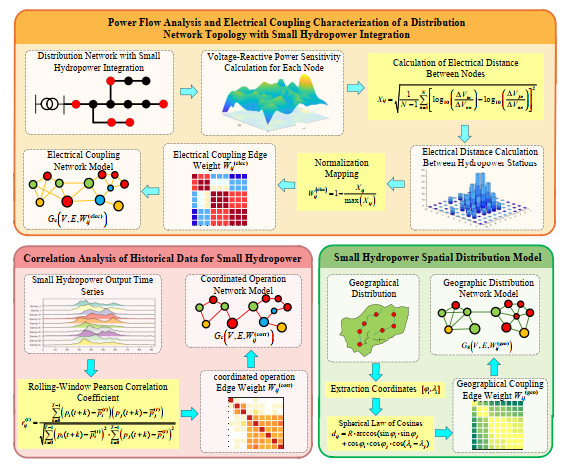
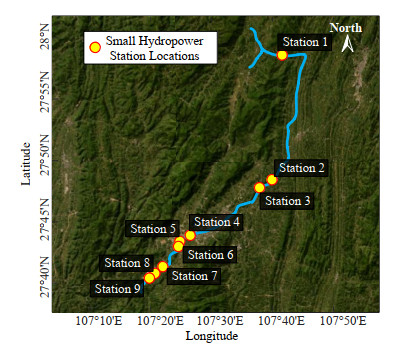
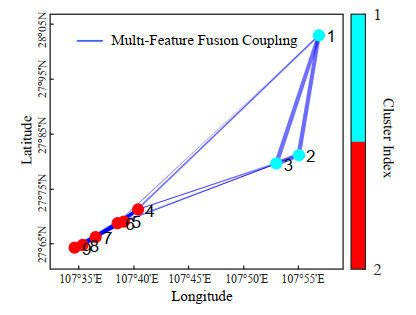
The disorderly integration of small hydropower plants into distribution networks can easily lead to problems such as curtailed power generation, voltage overshooting, and difficulty in regulation. Therefore, it is crucial to study small hydropower clustering methods for regional coordinated control and optimal scheduling. Traditional methods often rely on geographic location or administrative divisions for clustering, but they struggle to simultaneously account for multidimensional characteristics such as electrical characteristics, operational characteristics, and spatial distribution of power plants, thus failing to meet the optimized regulation requirements of distribution networks. To this end, this paper introduces complex network analysis methods and proposes a small hydropower cluster partitioning method based on the multidimensional feature network model and the community detection algorithm. Hydropower stations are modeled as network nodes, different coupling dimensions are mapped into weighted edges, and the similarity network fusion (SNF) method is employed to achieve multidimensional feature fusion. Furthermore, a hydropower coordination index is defined to quantify cluster quality in multiple spatiotemporal scenarios. Clustering is then performed using the Louvain community detection algorithm. Small hydropower stations in the Meijiang River Basin, Zunyi, China, were selected as the case study. The results show that the proposed method can improve the physical interpretability of the partitioning results and provide an effective solution for the coordinated control and optimized regional scheduling of small hydropower stations.
Citation: Meiqi Yuan, Jun Cai, Xinyu Luo, Ying Lu, Tinghao Ren. Small hydropower cluster partitioning based on multidimensional feature network model and community detection algorithm[J]. AIMS Electronics and Electrical Engineering, 2026, 10(4): 565-584. doi: 10.3934/electreng.2026023
The disorderly integration of small hydropower plants into distribution networks can easily lead to problems such as curtailed power generation, voltage overshooting, and difficulty in regulation. Therefore, it is crucial to study small hydropower clustering methods for regional coordinated control and optimal scheduling. Traditional methods often rely on geographic location or administrative divisions for clustering, but they struggle to simultaneously account for multidimensional characteristics such as electrical characteristics, operational characteristics, and spatial distribution of power plants, thus failing to meet the optimized regulation requirements of distribution networks. To this end, this paper introduces complex network analysis methods and proposes a small hydropower cluster partitioning method based on the multidimensional feature network model and the community detection algorithm. Hydropower stations are modeled as network nodes, different coupling dimensions are mapped into weighted edges, and the similarity network fusion (SNF) method is employed to achieve multidimensional feature fusion. Furthermore, a hydropower coordination index is defined to quantify cluster quality in multiple spatiotemporal scenarios. Clustering is then performed using the Louvain community detection algorithm. Small hydropower stations in the Meijiang River Basin, Zunyi, China, were selected as the case study. The results show that the proposed method can improve the physical interpretability of the partitioning results and provide an effective solution for the coordinated control and optimized regional scheduling of small hydropower stations.

| [1] |
Qiu J, Zhao J, Wen F, Zhao J, Gao C, Zhou Y, et al. (2023) Challenges and Pathways of Low-Carbon Oriented Energy Transition and Power System Planning Strategy: A Review. IEEE Trans Netw Sci Eng 11: 5396–5416. https://doi.org/10.1109/TNSE.2023.3344729 doi: 10.1109/TNSE.2023.3344729

|
| [2] |
Koç C (2022) A study on solutions and problems of hydroelectric power plants in the operation. Sustainable Water Resour. Manage 8: 90. https://doi.org/10.1007/s40899-022-00677-2 doi: 10.1007/s40899-022-00677-2
|
| [3] |
Wang Z, Fang G, Wen X, Tan Q, Zhang P, Liu Z (2023) Coordinated operation of conventional hydropower plants as hybrid pumped storage hydropower with wind and photovoltaic plants. Energy Convers Manage 277: 116654. https://doi.org/10.1016/j.enconman.2022.116654 doi: 10.1016/j.enconman.2022.116654
|
| [4] | Song Y, Wang J, Wang Y (2025) Non-Iterative Market Participation of Virtual Power Plants via Bidding Function Representation. J Mod Power Syst Clean Energy, 1‒12. |
| [5] |
Liu J, Hu H, Yu SS, Trinh H (2023) Virtual Power Plant with Renewable Energy Sources and Energy Storage Systems for Sustainable Power Grid-Formation, Control Techniques and Demand Response. Energies 16: 3705. https://doi.org/10.3390/en16093705 doi: 10.3390/en16093705
|
| [6] |
Sun J, Xu J, Ke D, Liao S, Ling Z (2023) Cluster partition for distributed energy resources in Regional Integrated Energy System. Energy Rep 9: 613–619. https://doi.org/10.1016/j.egyr.2023.04.312 doi: 10.1016/j.egyr.2023.04.312
|
| [7] |
Resch B, Sagl G, Törnros T, Bachmaier A, Eggers JB, Herkel S, et al. (2014) GIS-Based Planning and Modeling for Renewable Energy: Challenges and Future Research Avenues. ISPRS Int J Geo-Inf 3: 662–692. https://doi.org/10.3390/ijgi3020662 doi: 10.3390/ijgi3020662
|
| [8] |
Ruan G, Qiu D, Sivaranjani S, Awad ASA, Strbac G (2024) Data-driven energy management of virtual power plants: a review. Adv Appl Energy 14: 100170. https://doi.org/10.1016/j.adapen.2024.100170 doi: 10.1016/j.adapen.2024.100170
|
| [9] |
Zhang R, Hredzak B (2021) Distributed Dynamic Clustering Algorithm for Formation of Heterogeneous Virtual Power Plants Based on Power Requirements. IEEE Trans Smart Grid 12: 192–204. https://doi.org/10.1109/TSG.2020.3020163 doi: 10.1109/TSG.2020.3020163
|
| [10] |
Song Y, Li T, Geng Y, Wu C, Wang Y, Wang J (2026) Explanation-enhanced federated fine-tuning of large language models for photovoltaic power forecasting. IEEE T Sustain Energy, 1‒14. https://doi.org/10.1109/TSTE.2026.3655809 doi: 10.1109/TSTE.2026.3655809
|
| [11] | Mao M, Wu Z, Xu D, Xu J, Hu Q (2024) Community-detection-based Approaches for Distribution Network Partition. CSEE J Power Energy Syst 10: 1965–1976. |
| [12] |
Zhang J, Zhang Y, Wang G, Li F, Xie J (2025) Vulnerability and resilience assessments of power grid based on community partition. IEEE T Netw Sci Eng 12: 3131–3144. https://doi.org/10.1109/TNSE.2025.3556836 doi: 10.1109/TNSE.2025.3556836
|
| [13] |
Ngo QH, Nguyen BLH, Zhang J, Schoder K, Ginn H, Vu T (2025) Deep graph neural network for fault detection and identification in distribution systems. Electr Power Syst Res 247: 111721. https://doi.org/10.1016/j.epsr.2025.111721 doi: 10.1016/j.epsr.2025.111721
|
| [14] |
Hasanvand S, Sobhani H, Khooban MH (2025) Distribution network clustering for reactive power planning and distributed voltage control. IET Gener Transm Distrib 19: e70002. https://doi.org/10.1049/gtd2.70002 doi: 10.1049/gtd2.70002
|
| [15] |
Meng L, Yang X, Zhu J, Wang X, Meng X (2024) Network partition and distributed voltage coordination control strategy of active distribution network system considering photovoltaic uncertainty. Appl Energy 362: 122846. https://doi.org/10.1016/j.apenergy.2024.122846 doi: 10.1016/j.apenergy.2024.122846
|
| [16] |
Li Y, Ge Y, Xu T, Zhu M, He Z (2024) Controllability evaluation of complex networks in cyber–physical power systems via critical nodes and edges. Int J Electr Power Energy Syst 155: 109625. https://doi.org/10.1016/j.ijepes.2023.109625 doi: 10.1016/j.ijepes.2023.109625
|
| [17] |
Cotilla-Sanchez E, Hines PD, Barrows C, Blumsack S, Patel M (2013) Multi-Attribute Partitioning of Power Networks Based on Electrical Distance. IEEE Trans Power Syst 28: 4979–4987. https://doi.org/10.1109/TPWRS.2013.2263886 doi: 10.1109/TPWRS.2013.2263886
|
| [18] |
Wang X, Xue F, Lu S, Jiang L, Bompard E, Masera M (2022) Understanding communities from a new functional perspective in power grids. IEEE Syst J 16: 3072–3083. https://doi.org/10.1109/JSYST.2022.3151388 doi: 10.1109/JSYST.2022.3151388
|
| [19] |
Zhao C, Zhao J, Wu C, Wang X, Xue F, Lu S (2019) Power Grid Partitioning Based on Functional Community Structure. IEEE Access 7: 152624–152634. https://doi.org/10.1109/ACCESS.2019.2948606 doi: 10.1109/ACCESS.2019.2948606
|
| [20] |
Cheng Z, Wang L, Zeng S, Su C, Zhang R, Zhou W (2024) Partition-global dual-layer collaborative voltage control strategy for active distribution network with high proportion of renewable energy. IEEE Access 12: 22546–22556. https://doi.org/10.1109/ACCESS.2024.3364543 doi: 10.1109/ACCESS.2024.3364543
|
| [21] | Song Y, Wang J, Zhang T, He G, Wang Y (2025) Characterizing spatiotemporal-coupled resilience of power systems via a security region-based method. CSEE J Power Energy Syst, 1‒12. |
| [22] |
Song Y, Gu J, Mao H, Deng G, Wang J (2026) Proactive scheduling of resilient networked microgrids via data-efficient security region learning. Energy AI 24: 100720. https://doi.org/10.1016/j.egyai.2026.100720 doi: 10.1016/j.egyai.2026.100720
|
| [23] | Wen X, Gao X, Su L, Fan Q, Peng W (2017) Analysis of influencing factors and characteristics of small hydropower generation. 2017 9th International Conference on Modelling, Identification and Control (ICMIC), 658–662. https://doi.org/10.1109/ICMIC.2017.8321537 |
| [24] |
Li Z, Liu J, Wu K (2018) A multiobjective evolutionary algorithm based on structural and attribute similarities for community detection in attributed networks. IEEE Trans Cybern 48: 1963–1976. https://doi.org/10.1109/TCYB.2017.2720180 doi: 10.1109/TCYB.2017.2720180
|
| [25] |
Saleh M, Esa Y, Mohamed A (2023) Applications of Complex Network Analysis in Electric Power Systems. Energies 11: 1381. https://doi.org/10.3390/en11061381 doi: 10.3390/en11061381
|
| [26] |
Teklebrhan N, Seres I, Farkas I (2023) Energetic complementarity solar PV and wind power based on satellite data. Eur J Energy Res 3: 7–12. https://doi.org/10.24018/ejenergy.2023.3.4.97 doi: 10.24018/ejenergy.2023.3.4.97
|
| [27] |
Wang B, Mezlini AM, Demir F, Fiume M, Tu Z, Brudno M, et al. (2014) Similarity network fusion for aggregating data types on a genomic scale. Nat Methods 11: 333–337. https://doi.org/10.1038/nmeth.2810 doi: 10.1038/nmeth.2810
|
| [28] |
Newman MEJ (2004) Fast algorithm for detecting community structure in networks. Phys Rev E 69: 66133. https://doi.org/10.1103/PhysRevE.69.066133 doi: 10.1103/PhysRevE.69.066133
|
| [29] |
Mucha PJ, Richardson T, Macon K, Porter MA, Onnela JP (2010) Community structure in time-dependent, multiscale, and multiplex networks. science 328: 876–878. https://doi.org/10.1126/science.1184819 doi: 10.1126/science.1184819
|
| [30] |
Bazzi M, Porter MA, Williams S, McDonald M, Fenn DJ, Howison SD (2016) Community detection in temporal multilayer networks, with an application to correlation networks. Multiscale Model Simul 14: 1‒41. https://doi.org/10.1137/15M1009615 doi: 10.1137/15M1009615
|
Figures(9) / Tables(1)

Meiqi Yuan, Jun Cai, Xinyu Luo, Ying Lu, Tinghao Ren. Small hydropower cluster partitioning based on multidimensional feature network model and community detection algorithm[J]. AIMS Electronics and Electrical Engineering, 2026, 10(4): 565-584. doi: 10.3934/electreng.2026023





 DownLoad: