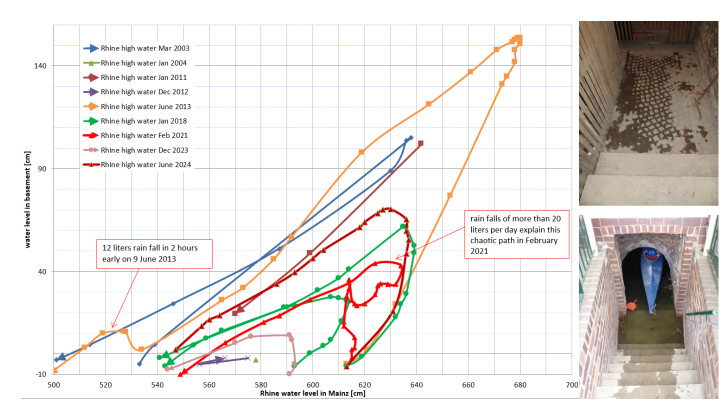
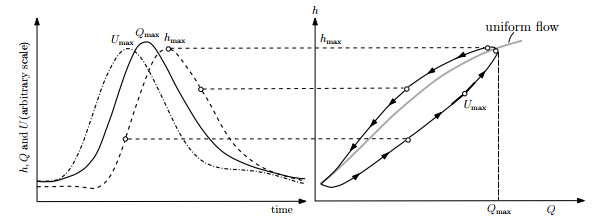
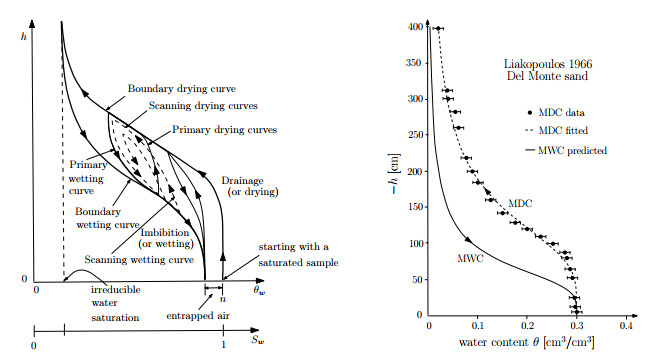
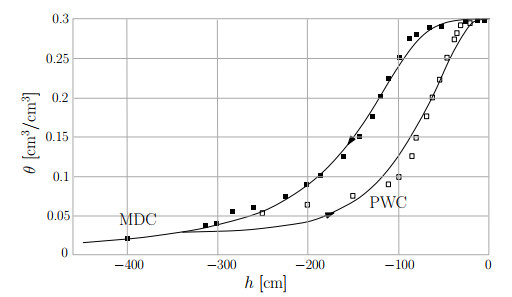
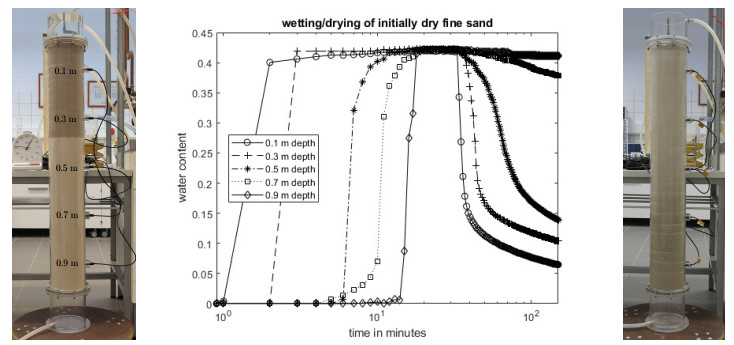
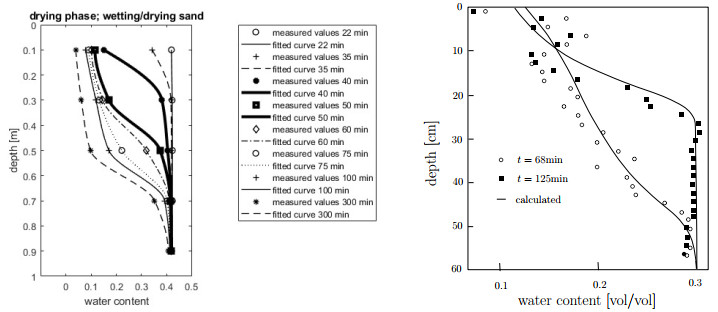
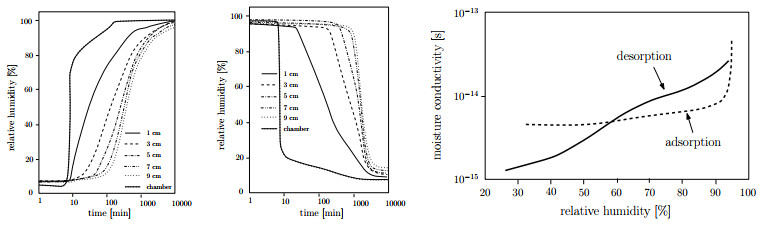
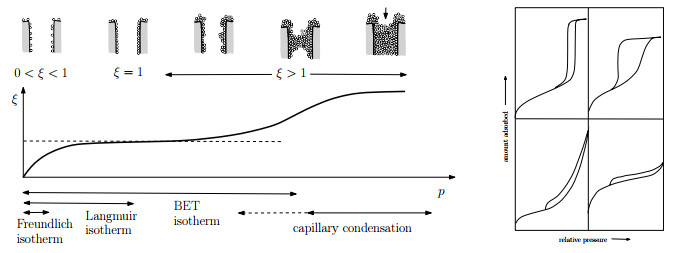
This article deals with several hysteresis effects occurring in soils and other porous media. Soils consist of solid particles which are of different size, shape and material behavior depending on the soil type. The pore space is filled with one pore fluid for saturated porous media, with two or more immiscible fluids for partially or unsaturated media. Most of the hysteresis phenomena described can be traced back to the behavior of the pore fluids, e.g., they have to do with different capillary pressures for different degrees of saturation. Hysteresis describes that a quantity or process is not single-valued, that in dependence on the prehistory for the same input value two or more possible output values may occur. The aim of the paper is to show various examples for which hysteresis effects occur and to discuss the reasons – either theoretically or experimentally. Triggered by an actual incident, highlighted in the introduction, in a first paragraph stage/discharge hysteresis of rivers is explained. The most prominent type of hysteresis, hydraulic hysteresis, is treated in the next section. Engineering and mathematical approaches are discussed and results of own laboratory experiments are shown. Further pairs of processes leading to non-unique behavior are adsorption/desorption processes or freezing/thawing processes. But not only the behavior and properties of the pore fluids lead to hysteretic effects. Also the constitutive relations of dry soils exhibit hysteresis. Generally, soils behave differently if first loaded, unloaded and reloaded. It is shown in a further paragraph that the stress-strain curves are hysteretic. The aim of the paper is to show that in porous media where the solid and fluid components interact, accordingly, a variety of hysteresis effects appear and to highlight the different phenomena, show the variety of hysteresis curves and indicate description methods.
Citation: Bettina Detmann. On several types of hysteresis phenomena appearing in porous media[J]. Mathematics in Engineering, 2025, 7(3): 384-405. doi: 10.3934/mine.2025016
This article deals with several hysteresis effects occurring in soils and other porous media. Soils consist of solid particles which are of different size, shape and material behavior depending on the soil type. The pore space is filled with one pore fluid for saturated porous media, with two or more immiscible fluids for partially or unsaturated media. Most of the hysteresis phenomena described can be traced back to the behavior of the pore fluids, e.g., they have to do with different capillary pressures for different degrees of saturation. Hysteresis describes that a quantity or process is not single-valued, that in dependence on the prehistory for the same input value two or more possible output values may occur. The aim of the paper is to show various examples for which hysteresis effects occur and to discuss the reasons – either theoretically or experimentally. Triggered by an actual incident, highlighted in the introduction, in a first paragraph stage/discharge hysteresis of rivers is explained. The most prominent type of hysteresis, hydraulic hysteresis, is treated in the next section. Engineering and mathematical approaches are discussed and results of own laboratory experiments are shown. Further pairs of processes leading to non-unique behavior are adsorption/desorption processes or freezing/thawing processes. But not only the behavior and properties of the pore fluids lead to hysteretic effects. Also the constitutive relations of dry soils exhibit hysteresis. Generally, soils behave differently if first loaded, unloaded and reloaded. It is shown in a further paragraph that the stress-strain curves are hysteretic. The aim of the paper is to show that in porous media where the solid and fluid components interact, accordingly, a variety of hysteresis effects appear and to highlight the different phenomena, show the variety of hysteresis curves and indicate description methods.

| [1] |
B. Albers, Coupling of adsorption and diffusion in porous and granular materials. A 1D example of the boundary value problem, Arch. Appl. Mech., 70 (2000), 519–531. https://doi.org/10.1007/s004190000082 doi: 10.1007/s004190000082

|
| [2] | B. Albers, Makroskopische Beschreibung von Adsorptions-Diffusions-Vorgängen in porösen Körpern, Ph.D. Thesis, TU Berlin, Logos-Verlag, 2000. |
| [3] | B. Albers, Modeling and numerical analysis of wave propagation in saturated and partially saturated porous media, Vol. 48, In: Veröffentlichungen des Grundbauinstitutes der Technischen Universität Berlin, Habilitation thesis, Shaker Verlag, Aachen, 2010. |
| [4] |
B. Albers, Modeling the hysteretic behavior of the capillary pressure in partially saturated porous media: a review, Acta Mech., 225 (2014), 2163–2189. https://doi.org/10.1007/s00707-014-1122-4 doi: 10.1007/s00707-014-1122-4
|
| [5] | B. Albers, On modeling three-component porous media incorporating hysteresis, In: E. Onate, J. Oliver, A. Huerta, Proceedings of the 11th World Congress on Computational Mechanics (WCCM XI), 2014, 3240–3251. |
| [6] |
B. Albers, Main drying and wetting curves of soils: on measurements, prediction and influence on wave propagation, Eng. Trans., 63 (2015), 5–34. https://doi.org/10.24423/engtrans.286.2015 doi: 10.24423/engtrans.286.2015
|
| [7] |
B. Albers, On the influence of the hysteretic behavior of the capillary pressure on the wave propagation in partially saturated soils, J. Phys.: Conf. Ser., 727 (2016), 012001. https://doi.org/10.1088/1742-6596/727/1/012001 doi: 10.1088/1742-6596/727/1/012001
|
| [8] | B. Albers, P. Krejčí, Hysteresis in unsaturated porous media–two models for wave propagation and engineering applications, In: B. Albers, M. Kuczma, Continuous media with microstructure 2, Springer, Cham, 2016,217–229. https://doi.org/10.1007/978-3-319-28241-1_15 |
| [9] |
B. Albers, P. Krejčí, Unsaturated porous media flow with thermomechanical interaction, Math. Methods Appl. Sci., 39 (2016), 2220–2238. https://doi.org/10.1002/mma.3635 doi: 10.1002/mma.3635
|
| [10] |
A. Basile, G. Ciollaro, A. Coppola, Hysteresis in soil water characteristics as a key to interpreting comparisons of laboratory and field measured hydraulic properties, Water Resour. Res., 39 (2003), 1355. https://doi.org/10.1029/2003WR002432 doi: 10.1029/2003WR002432
|
| [11] | J. Bear, Y. Bachmat, Introduction to modeling of transport phenomena in porous media, Springer Dordrecht, 1990. https://doi.org/10.1007/978-94-009-1926-6 |
| [12] | J. Bear, A. Verruijt, Modeling flow in the unsaturated zone, In: Modeling groundwater flow and pollution, Theory and Applications of Transport in Porous Media, Springer, Dordrecht, 2 (1987), 123–152. https://doi.org/10.1007/978-94-009-3379-8_5 |
| [13] | G. Bertotti, I. D. Mayergoyz, The science of hysteresis: 3-volume set, Academic Press, 2005. |
| [14] | G. Bonan, Predictor–Corrector solution for the $\varphi$-based Richards equation, accessed: 2023/08/18. Available form: https://zmoon.github.io/bonanmodeling/08/01.html. |
| [15] | R. H. Brooks, A. T. Corey, Hydraulic properties of porous media, Colorado State University ProQuest Dissertations & Theses, 1965. |
| [16] |
S. Brunauer, L. S. Deming, W. E. Deming, E. Teller, On a theory of the van der Waals adsorption of gases, J. Am. Chem. Soc., 62 (1940), 1723–1732. https://doi.org/10.1021/ja01864a025 doi: 10.1021/ja01864a025
|
| [17] |
S. Brunauer, P. H. Emmet, E. Teller, Adsorption of gases in multimolecular layers, J. Am. Chem. Soc., 60 (1938), 309–319. https://doi.org/10.1021/ja01269a023 doi: 10.1021/ja01269a023
|
| [18] |
I. Chatzis, F. A. L. Dullien, Dynamic immiscible displacement mechanisms in pore doublets: theory versus experiment, J. Colloid Interf. Sci., 91 (1983), 199–222. https://doi.org/10.1016/0021-9797(83)90326-0 doi: 10.1016/0021-9797(83)90326-0
|
| [19] |
H. Chen, K. Chen, M. Yang, A new hysteresis model of the water retention curve based on pore expansion and contraction, Comput. Geotech., 121 (2020), 103482. https://doi.org/10.1016/j.compgeo.2020.103482 doi: 10.1016/j.compgeo.2020.103482
|
| [20] | O. Coussy, Poromechanics, John Wiley & Sons, 2004. |
| [21] |
O. Coussy, L. Dormieux, E. Detourney, From mixture theory to Biot's approach for porous media, Int. J. Solids Struct., 35 (1998), 4619–4635. https://doi.org/10.1016/S0020-7683(98)00087-0 doi: 10.1016/S0020-7683(98)00087-0
|
| [22] | B. Detmann, Capillary rise and infiltration in sand – phenomena, 1D tests and analysis, submitted for publication, 2024. |
| [23] |
B. Detmann, P. Krejčí, A multicomponent flow model in deformable porous media, Math. Methods Appl. Sci., 42 (2019), 1894–1906. https://doi.org/10.1002/mma.5482 doi: 10.1002/mma.5482
|
| [24] |
A. S. Dias, M. Pirone, M. V. Nicotera, G. Urciuoli, Hydraulic hysteresis of natural pyroclastic soils in partially saturated conditions: experimental investigation and modelling, Acta Geotech., 17 (2022), 837–855. https://doi.org/10.1007/s11440-021-01273-y doi: 10.1007/s11440-021-01273-y
|
| [25] |
J. A. Ewing, X. Experimental researches in magnetism, Phil. Trans. R. Soc., 176 (1885), 523–640. https://doi.org/10.1098/rstl.1885.0010 doi: 10.1098/rstl.1885.0010
|
| [26] |
M. J. Fayer, C. S. Simmons, Modified soil water retention functions for all matric suctions, Water Resour. Res., 31 (1995), 1233–1238. https://doi.org/10.1029/95WR00173 doi: 10.1029/95WR00173
|
| [27] | D. Flynn, Modelling the flow of water through multiphase porous media with the Preisach model, Ph.D. Thesis, University College Cork, 2008. |
| [28] |
D. Flynn, H. McNamara, P. O'Kane, A. Pokrovskii, Chapter 7 – Application of the Preisach model to soil-moisture hysteresis, In: G. Bertotti, I. D. Mayergoyz, The science of hysteresis, III (2005), 689–744. https://doi.org/10.1016/B978-012480874-4/50025-7 doi: 10.1016/B978-012480874-4/50025-7
|
| [29] | D. G. Fredlund, H. Rahardjo, M. D. Fredlund, Unsaturated soil mechanics in engineering practice, John Wiley & Sons, 2012. https://doi.org/10.1002/9781118280492 |
| [30] | H. Freundlich, Kapillarchemie, Akademische Verlagsgeselschaft, Leipzig, 1923. |
| [31] |
D. Gallipoli, A hysteretic soil-water retention model accounting for cyclic variations of suction and void ratio, Géotechnique, 62 (2012), 605–616. https://doi.org/10.1680/geot.11.P.007 doi: 10.1680/geot.11.P.007
|
| [32] |
R. W. Gillham, A. Klute, D. F. Heermann, Hydraulic properties of a porous medium: Measurement and empirical representation, Soil Sci. Soc. Amer. J., 40 (1976), 203–207. https://doi.org/10.2136/sssaj1976.03615995004000020008x doi: 10.2136/sssaj1976.03615995004000020008x
|
| [33] |
R. W. Gillham, A. Klute, D. F. Heermann, Measurement and numerical simulation of hysteretic flow in a heterogeneous porous medium, Soil Sci. Soc. Amer. J., 43 (1979), 1061–1067. https://doi.org/10.2136/sssaj1979.03615995004300060001x doi: 10.2136/sssaj1979.03615995004300060001x
|
| [34] | W. H. Graf, Fluvial hydraulics: flow and transport processes in channels of simple geometry, John Wiley & Sons, New York, 1998. |
| [35] |
W. H. Graf, Z. Qu, Flood hydrographs in open channels, Proceedings of the Institution of Civil Engineers–Water Management, 157 (2004), 45–52. https://doi.org/10.1680/wama.2004.157.1.45 doi: 10.1680/wama.2004.157.1.45
|
| [36] | S. J. Gregg, K. S. W. Sing, Adsorption, surface area and porosity, Academic Press, London, 1982. |
| [37] |
S. Guglielmi, M. Pirone, A. S. Dias, F. Cotecchia, G. Urciuoli, Thermohydraulic numerical modeling of slope-vegetation-atmosphere interaction: case study of the pyroclastic slope cover at Monte Faito, Italy, J. Geotechn. Geoenviron. Eng., 149 (2023), 05023005. https://doi.org/10.1061/JGGEFK.GTENG-11240 doi: 10.1061/JGGEFK.GTENG-11240
|
| [38] | R. Haverkamp, P. Reggiani, P. J. Ross, J. Y. Parlange, Soil water hysteresis prediction model based on theory and geometric scaling, In: P. A. C. Raats, D. Smiles, A. Warrick, Environmental mechanics, water, mass and energy transfer in the biosphere, American Geophysical Union, 129 (2002), 213–246. https://doi.org/10.1029/129GM19 |
| [39] | P. P. Jansen, L. van Bendegom, J. van den Berg, M. de Vries, A. Zanen, Principles of river engineering: the non-tidal alluvial river, Water Resources Engineering Series, Pitman, 1979. |
| [40] |
D. B. Jaynes, Comparison of soil-water hysteresis models, J. Hydrol., 75 (1984), 287–299. https://doi.org/10.1016/0022-1694(84)90054-4 doi: 10.1016/0022-1694(84)90054-4
|
| [41] | B. E. Jones, A method of correcting river discharge for a changing stage, Technical report, US Geological Survey, 1916. |
| [42] | D. Kolymbas, Introduction to hypoplasticity: advances in geotechnical engineering and tunnelling, CRC Press, 2000. |
| [43] |
R. W. R. Koopmans, R. D. Miller, Soil freezing and soil water characteristic curves, Soil Sci. Soc. Amer. J., 30 (1966), 680–685. https://doi.org/10.2136/sssaj1966.03615995003000060011x doi: 10.2136/sssaj1966.03615995003000060011x
|
| [44] |
I. Langmuir, The adsorption of gases on plane surfaces of glass, mica and platinum, J. Am. Chem. Soc., 40 (1918), 1361–1403. https://doi.org/10.1021/ja02242a004 doi: 10.1021/ja02242a004
|
| [45] |
V. H. Le, R. Glasenapp, F. Rackwitz, Cyclic hysteretic behavior and development of the secant shear modulus of sand under drained and undrained conditions, Int. J. Geomech., 24 (2024), 04024126. https://doi.org/10.1061/IJGNAI.GMENG-9380 doi: 10.1061/IJGNAI.GMENG-9380
|
| [46] |
R. J. Lenhard, J. C. Parker, J. J. Kaluarachchi, Comparing simulated and experimental hysteretic two-phase transient fluid flow phenomena, Water Resour. Res., 27 (1991), 2113–2124. https://doi.org/10.1029/91WR01272 doi: 10.1029/91WR01272
|
| [47] |
A. C. Liakopoulos, Theoretical approach to the solution of the infiltration problem, International Association of Scientific Hydrology. Bulletin, 11 (1966), 69–110. https://doi.org/10.1080/02626666609493444 doi: 10.1080/02626666609493444
|
| [48] | N. Lu, W. J. Likos, Unsaturated soil mechanics, Wiley, Hoboken, New Jersey, 2004. |
| [49] | R. J. Mander, Aspects of unsteady flow and variable backwater, In: R. W. Herschy, Hydrometry: principles and practices, Wiley: Chichester, 1978. |
| [50] | I. D. Mayergoyz, Mathematical models of hysteresis, Springer, 1991. https://doi.org/10.1007/978-1-4612-3028-1 |
| [51] | A. Niemunis, T. Wichtmann, T. Triantafyllidis, Long-term deformations in soils due to cyclic loading, In: W. Wu, H. S. Yu, Modern trends in geomechanics, Springer Proceedings in Physics, Springer, 106 (2006), 427–462. https://doi.org/10.1007/978-3-540-35724-7_26 |
| [52] |
J. Y. Parlange, Capillary hysteresis and the relationship between drying and wetting curves, Water Resour. Res., 12 (1976), 224–228. https://doi.org/10.1029/WR012i002p00224 doi: 10.1029/WR012i002p00224
|
| [53] |
E. Perret, M. Lang, J. Le Coz, A framework for detecting stage-discharge hysteresis due to flow unsteadiness: application to France's national hydrometry network, J. Hydrol., 608 (2022), 127567. https://doi.org/10.1016/j.jhydrol.2022.127567 doi: 10.1016/j.jhydrol.2022.127567
|
| [54] |
A. Petersen-Øverleir, Modelling stage–discharge relationships affected by hysteresis using the Jones formula and nonlinear regression, Hydrol. Sci. J., 51 (2006), 365–388. https://doi.org/10.1623/hysj.51.3.365 doi: 10.1623/hysj.51.3.365
|
| [55] |
R. Plagge, G. Scheffler, J. Grunewald, M. Funk, On the hysteresis in moisture storage and conductivity measured by the instantaneous profile method, J. Build. Phys., 29 (2006), 247–259. https://doi.org/10.1177/1744259106060706 doi: 10.1177/1744259106060706
|
| [56] |
F. Preisach, Über die magnetische Nachwirkung, Z. Physik, 94 (1935), 277–302. https://doi.org/10.1007/BF01349418 doi: 10.1007/BF01349418
|
| [57] |
R. Scarfone, S. J. Wheeler, M. Lloret-Cabot, A hysteretic hydraulic constitutive model for unsaturated soils and application to capillary barrier systems, Geomech. Energy Environ., 30 (2022), 100224. https://doi.org/10.1016/j.gete.2020.100224 doi: 10.1016/j.gete.2020.100224
|
| [58] | T. Schanz, P. A. Vermeer, P. G. Bonnier, The hardening soil model: formulation and verification, In: Beyond 2000 in computational geotechnics, Routledge, 2019,281–296. |
| [59] | H. Sheta, Simulation von Mehrphasenvorgängen in porösen Medien unter Einbeziehung von Hysterese-Effekten, Ph.D. Thesis, Universität Stuttgart, 1999. |
| [60] |
P. Sitarenios, F. Casini, A. Askarinejad, S. Springman, Hydro-mechanical analysis of a surficial landslide triggered by artificial rainfall: the Ruedlingen field experiment, Géotechnique, 71 (2021), 96–109. https://doi.org/10.1680/jgeot.18.P.188 doi: 10.1680/jgeot.18.P.188
|
| [61] |
M. Tafili, T. Wichtmann, T. Triantafyllidis, Experimental investigation and constitutive modeling of the behaviour of highly plastic lower rhine clay under monotonic and cyclic loading, Can. Geotechn. J., 58 (2021), 1396–1410. https://doi.org/10.1139/cgj-2020-0012 doi: 10.1139/cgj-2020-0012
|
| [62] |
J. Teng, D. Antai, S. Zhang, X. Zhang, D. Sheng, Freezing-thawing hysteretic behavior of soils, Water Resour. Res., 60 (2024), e2024WR037280. https://doi.org/10.1029/2024WR037280 doi: 10.1029/2024WR037280
|
| [63] |
M. Thommes, K. Kaneko, A. V. Neimark, J. P. Olivier, F. Rodriguez-Reinoso, J. Rouquerol, et al., Physisorption of gases, with special reference to the evaluation of surface area and pore size distribution (IUPAC Technical Report), Pure Appl. Chem., 87 (2015), 1051–1069. https://doi.org/10.1515/pac-2014-1117 doi: 10.1515/pac-2014-1117
|
| [64] |
A. Tsiampousi, L. Zdravković, D. M. Potts, A three-dimensional hysteretic soil-water retention curve, Géotechnique, 63 (2013), 155–164. https://doi.org/10.1680/geot.11.P.074 doi: 10.1680/geot.11.P.074
|
| [65] |
N. Vaiana, L. Rosati, Classification and unified phenomenological modeling of complex uniaxial rate-independent hysteretic responses, Mech. Syst. Signal Pr., 182 (2023), 109539. https://doi.org/10.1016/j.ymssp.2022.109539 doi: 10.1016/j.ymssp.2022.109539
|
| [66] | M. T. van Genuchten, A closed-form equation for predicting the hydraulic conductivity of unsaturated soils Soil Sci. Soc. Amer. J., 44 (1980), 892–898. https://doi.org/10.2136/sssaj1980.03615995004400050002x |
| [67] | K. Wilmanski, B. Albers, Continuum thermodynamics, part II: applications and examples, World Scientific, Singapore, 2015. |
| [68] | T. Wichtmann, Soil behaviour under cyclic loading-experimental observations, constitutive description and applications, Vol. 181, Habilitation thesis, 2016. |
| [69] |
K. Wilmanski, Lagrangean model of two-phase porous material, J. Non-Equilibrium Thermodyn., 20 (1995), 50–77. https://doi.org/10.1515/jnet.1995.20.1.50 doi: 10.1515/jnet.1995.20.1.50
|
| [70] |
Y. Zhou, J. Zhou, X. Shi, G. Zhou. Practical models describing hysteresis behavior of unfrozen water in frozen soil based on similarity analysis, Cold Reg. Sci. Technol., 157 (2019), 215–223. https://doi.org/10.1016/j.coldregions.2018.11.002 doi: 10.1016/j.coldregions.2018.11.002
|
Figures(10)

Bettina Detmann. On several types of hysteresis phenomena appearing in porous media[J]. Mathematics in Engineering, 2025, 7(3): 384-405. doi: 10.3934/mine.2025016





 DownLoad: