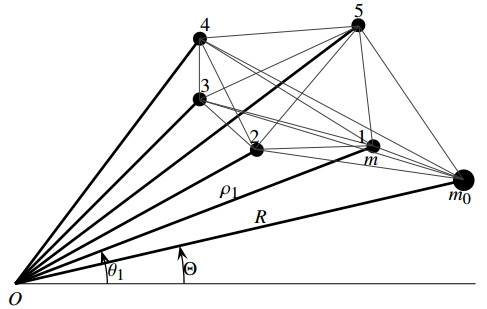
We consider a differential system coupled to a hysteresis operator of Preisach type. It is assumed that the system is equivariant with respect to an action of the group $ \Gamma\times S^1 $ (where $ \Gamma $ is a finite group) in the phase space. Moreover, there is a branch of symmetric relative equilibria. We develop an application of the equivariant twisted topological degree, which detects branches of relative periodic solutions bifurcating from the relative equilibrium at an equivariant Hopf bifurcation point. These branches are classified according to their symmetric properties. The general theorem is illustrated with an example, where equations of motion of an $ S_5\times S^1 $-equivariant electromechanical system are coupled with the Prandtl–Ishlinskii hysteresis operator; this operator models the stress-strain constitutive relation of an elastoplastic spring. Hysteresis operators are non-smooth but can be differentiable at particular points. At the same time, applications of the equivariant degree require the vector field to be differentiable at the bifurcation point. To satisfy this requirement, we construct $ \Gamma\times S^1 $-vector fields, for which the zero set consists of the relative equilibria and relative periodic solutions of the system with the hysteresis operator, and ensure the differentiability at the zeros corresponding to the relative equilibria. This construction is the main technical contribution of the paper.
Citation: Dmitrii Rachinskii. Bifurcation of relative periodic solutions in symmetric systems with hysteretic constitutive relations[J]. Mathematics in Engineering, 2025, 7(2): 61-95. doi: 10.3934/mine.2025004
We consider a differential system coupled to a hysteresis operator of Preisach type. It is assumed that the system is equivariant with respect to an action of the group $ \Gamma\times S^1 $ (where $ \Gamma $ is a finite group) in the phase space. Moreover, there is a branch of symmetric relative equilibria. We develop an application of the equivariant twisted topological degree, which detects branches of relative periodic solutions bifurcating from the relative equilibrium at an equivariant Hopf bifurcation point. These branches are classified according to their symmetric properties. The general theorem is illustrated with an example, where equations of motion of an $ S_5\times S^1 $-equivariant electromechanical system are coupled with the Prandtl–Ishlinskii hysteresis operator; this operator models the stress-strain constitutive relation of an elastoplastic spring. Hysteresis operators are non-smooth but can be differentiable at particular points. At the same time, applications of the equivariant degree require the vector field to be differentiable at the bifurcation point. To satisfy this requirement, we construct $ \Gamma\times S^1 $-vector fields, for which the zero set consists of the relative equilibria and relative periodic solutions of the system with the hysteresis operator, and ensure the differentiability at the zeros corresponding to the relative equilibria. This construction is the main technical contribution of the paper.

| [1] |
F. Al-Bender, V. Lampaert, J. Swevers, The generalized Maxwell-slip model: a novel model for friction simulation and compensation, IEEE Trans. Autom. Control, 50 (2005), 1883–1887. https://doi.org/10.1109/TAC.2005.858676 doi: 10.1109/TAC.2005.858676

|
| [2] |
Z. Balanov, W. Krawcewicz, D. Rachinskii, A. Zhezherun, Hopf bifurcation in symmetric networks of coupled oscillators with hysteresis, J. Dyn. Diff. Equat., 24 (2012), 713–759. https://doi.org/10.1007/s10884-012-9271-4 doi: 10.1007/s10884-012-9271-4
|
| [3] |
Z. Balanov, W. Krawcewicz, H. Steinlein, Applied equivariant degree, part I: an axiomatic approach to primary degree, Discrete Cont. Dyn. Syst., 15 (2006), 983–1016. https://doi.org/10.3934/dcds.2006.15.983 doi: 10.3934/dcds.2006.15.983
|
| [4] | Z. Balanov, W. Krawcewiczf, D. Rachinskii, H. P. Wu, J. Yu, Degree theory and symmetric equations assisted by GAP system: with a special focus on systems with hysteresis, American Mathematical Society, 2025. |
| [5] | M. Brakate, J. Sprekels, Hysteresis and phase transitions, Vol. 121, Springer, 1996. https://doi.org/10.1007/978-1-4612-4048-8 |
| [6] |
D. Davino, P. Krejčí, C. Visone, Fully coupled modeling of magneto-mechanical hysteresis through 'thermodynamic' compatibility, Smart Mater. Struct., 22 (2013), 095009. https://doi.org/10.1088/0964-1726/22/9/095009 doi: 10.1088/0964-1726/22/9/095009
|
| [7] |
C. O. Frederick, P. J. Armstrong, A mathematical representation of the multiaxial Bauschinger effect, Mat. High Temp., 24 (2007), 1–26. https://doi.org/10.1179/096034007X207589 doi: 10.1179/096034007X207589
|
| [8] |
D. C. Jiles, D. L. Atherton, Theory of ferromagnetic hysteresis (invited), J. Appl. Phys., 55 (1984), 2115–2120. https://doi.org/10.1063/1.333582 doi: 10.1063/1.333582
|
| [9] |
B. Kaltenbacher, P. Krejčí, A thermodynamically consistent phenomenological model for ferroelectric and ferroelastic hysteresis, ZAMM, 96 (2016), 874–891. https://doi.org/10.1002/zamm.201400292 doi: 10.1002/zamm.201400292
|
| [10] |
A. Krasnosel'skii, D. Rachinskii, On a bifurcation governed by hysteresis nonlinearity, Nonlinear Differ. Equ. Appl., 9 (2002), 93–115. https://doi.org/10.1007/s00030-002-8120-2 doi: 10.1007/s00030-002-8120-2
|
| [11] | M. Krasnosel'skii, A. Pokrovskii, Systems with hysteresis, Springer, Berlin, 1989. https://doi.org/10.1007/978-3-642-61302-9 |
| [12] | P. Krejčí, Hysteresis, convexity and dissipation in hyperbolic equations, Tokyo: Gattötoscho, 1996. |
| [13] |
P. Krejčí, J. Sprekels, Elastic-ideally plastic beams and prandtl-ishlinskii hysteresis operators, Math. Meth. Appl. Sci., 30 (2007), 2371–2393. https://doi.org/10.1002/mma.892 doi: 10.1002/mma.892
|
| [14] |
H. S. Lamba, O. M. Sidebottom, Cyclic plasticity for nonproportional paths: part 1–-Cyclic hardening, erasure of memory, and subsequent strain hardening experiments, J. Eng. Mater. Technol., 100 (1978), 96–103. https://doi.org/10.1115/1.3443456 doi: 10.1115/1.3443456
|
| [15] | J. Lemaitre, J. L. Chaboche, Mechanics of solid materials, Cambridge: Cambridge University Press, 1990. https://doi.org/10.1017/CBO9781139167970 |
| [16] | I. D. Mayergoyz, Mathematical models of hysteresis and their application, Academic Press, 2003. https://doi.org/10.1016/B978-0-12-480873-7.X5000-2 |
| [17] |
Z. Mróz, On the description of anisotropic workhardening, J. Mech. Phys. Solids, 15 (1967), 163–175. https://doi.org/10.1016/0022-5096(67)90030-0 doi: 10.1016/0022-5096(67)90030-0
|
| [18] |
J. P. O'Kane, D. Flynn, Thresholds, switches and hysteresis in hydrology from the pedon to the catchment scale: a non-linear systems theory, Hydrol. Earth Syst. Sci., 11 (2007), 443–459. https://doi.org/10.5194/hess-11-443-2007 doi: 10.5194/hess-11-443-2007
|
| [19] | J. Y. Parlange, Water transport in soils, Ann. Rev. Fluid Mech., 12 (1980), 77–102. https://doi.org/10.1146/annurev.fl.12.010180.000453 |
| [20] |
W. Prager, Recent developments in the mathematical theory of plasticity, J. Appl. Phys., 20 (2004), 235–241. https://doi.org/10.1063/1.1698348 doi: 10.1063/1.1698348
|
| [21] |
L. Prandtl, Ein Gedankenmodell zur kinetischen theorie der festen Körper, ZAMM, 8 (1928), 85–106. https://doi.org/10.1002/zamm.19280080202 doi: 10.1002/zamm.19280080202
|
| [22] |
F. Preisach, Über die magnetische nachwirkung, Z. Physik, 94 (1935), 277–302. https://doi.org/10.1007/BF01349418 doi: 10.1007/BF01349418
|
| [23] |
I. Rychlik, A new definition of the rainflow cycle counting method, Int. J. Fatigue, 9 (1987), 119–121. https://doi.org/10.1016/0142-1123(87)90054-5 doi: 10.1016/0142-1123(87)90054-5
|
| [24] |
E. C. Stoner, E. P. Wohlfarth, A mechanism of magnetic hysteresis in heterogeneous alloys, IEEE Trans. Magn., 27 (1991), 3475–3518. https://doi.org/10.1109/TMAG.1991.1183750 doi: 10.1109/TMAG.1991.1183750
|
| [25] | A. Visintin, Differential models of hysteresis, Vol. 111, Springer, 1994. https://doi.org/10.1007/978-3-662-11557-2 |
| [26] |
Y. K. Wen, Method for random vibration of hysteretic systems, J. Eng. Mech. Div., 102 (1976), 249–263. https://doi.org/10.1061/JMCEA3.0002106 doi: 10.1061/JMCEA3.0002106
|

Figures(2) / Tables(2)

Dmitrii Rachinskii. Bifurcation of relative periodic solutions in symmetric systems with hysteretic constitutive relations[J]. Mathematics in Engineering, 2025, 7(2): 61-95. doi: 10.3934/mine.2025004





 DownLoad: