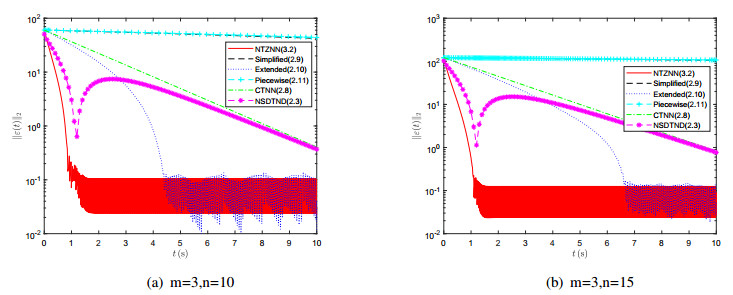
Multi-linear systems play a crucial role in various practical applications such as high-dimensional partial differential equations (PDEs), signal processing, and high-order statistics. In this paper, we propose a noise-tolerant zeroing neural network (NTZNN) model with fixed-time convergence activated by a new nonlinear activation function for solving multi-linear systems with nonsingular $ \mathcal{M} $-tensors. The detailed theoretical analysis demonstrates that the NTZNN model is stable in the sense of Lyapunov stability theory and achieves fixed-time convergence with or without the presence of noises. Furthermore, compared with existing neural network models, the proposed NTZNN model significantly improves the convergence rate while maintaining noise tolerance. Numerical experiments further show the effectiveness and superiority of the proposed NTZNN model.
Citation: Ruijuan Zhao, Mengyao Li, Tingjia Liu, Shu-Xin Miao. A noise-tolerant zeroing neural network with fixed-time convergence for solving multi-linear systems with nonsingular $ \mathcal{M} $-tensors[J]. AIMS Mathematics, 2025, 10(6): 13974-13995. doi: 10.3934/math.2025628
Multi-linear systems play a crucial role in various practical applications such as high-dimensional partial differential equations (PDEs), signal processing, and high-order statistics. In this paper, we propose a noise-tolerant zeroing neural network (NTZNN) model with fixed-time convergence activated by a new nonlinear activation function for solving multi-linear systems with nonsingular $ \mathcal{M} $-tensors. The detailed theoretical analysis demonstrates that the NTZNN model is stable in the sense of Lyapunov stability theory and achieves fixed-time convergence with or without the presence of noises. Furthermore, compared with existing neural network models, the proposed NTZNN model significantly improves the convergence rate while maintaining noise tolerance. Numerical experiments further show the effectiveness and superiority of the proposed NTZNN model.

| [1] |
W. Ding, Y. Wei, Solving multi-linear systems with $\mathcal{M}$-tensors, J. Sci. Comput., 68 (2016), 689–715. https://doi.org/10.1007/s10915-015-0156-7 doi: 10.1007/s10915-015-0156-7

|
| [2] |
X. Li, M. Ng, Solving sparse non-negative tensor equations: Algorithms and applications, Front. Math. China, 10 (2015), 649–680. https://doi.org/10.1007/s11464-014-0377-3 doi: 10.1007/s11464-014-0377-3
|
| [3] |
Z. Luo, L. Qi, N. Xiu, The sparsest solutions to $\mathcal{Z}$-tensor complementarity problems, Optim. Lett., 11 (2017), 471–482. https://doi.org/10.1007/s11590-016-1013-9 doi: 10.1007/s11590-016-1013-9
|
| [4] |
P. Azimzadeh, E. Bayraktar, High order Bellman equations and weakly chained diagonally dominant tensors, SIAM J. Matrix Anal. A., 40 (2019), 276–298. https://doi.org/10.1137/18M1196923 doi: 10.1137/18M1196923
|
| [5] |
H. He, C. Ling, L. Qi, G.Yhou, A globally and quadratically convergent algorithm for solving multilinear systems with $\mathcal{M}$-tensors, J. Sci. Comput., 76 (2018), 1718–1741. https://doi.org/10.1007/s10915-018-0689-7 doi: 10.1007/s10915-018-0689-7
|
| [6] |
M. Liang, L. Dai, G. Zhou, Iterative methods for solving tensor equations based on exponential acceleration, Numer. Algorithms, 97 (2023), 29–49. https://doi.org/10.1007/s11075-023-01692-w doi: 10.1007/s11075-023-01692-w
|
| [7] |
L. Han, A homotopy method for solving multilinear systems with $\mathcal{M}$-tensors, Appl. Math. Lett., 69 (2017), 49–54. https://doi.org/10.1016/j.aml.2017.01.019 doi: 10.1016/j.aml.2017.01.019
|
| [8] |
D. Li, S. Xie, H. Xu, Splitting methods for tensor equations, Numer. Linear Algebr., 24 (2017), e2102. https://doi.org/10.1002/nla.2102 doi: 10.1002/nla.2102
|
| [9] |
D. Liu, W. Li, S. Vong, The tensor splitting with application to solve multi-linear systems, J. Comput. Appl. Math., 330 (2018), 75–94. https://doi.org/10.1016/j.cam.2017.08.009 doi: 10.1016/j.cam.2017.08.009
|
| [10] |
W. Li, D. Liu, S. Vong, Comparison results for splitting iterations for solving multi-linear systems, Appl. Numer. Math., 134 (2018), 105–121. https://doi.org/10.1016/j.apnum.2018.07.009 doi: 10.1016/j.apnum.2018.07.009
|
| [11] |
L. Cui, M. Li, Y. Song, Preconditioned tensor splitting iterations method for solving multi-linear systems, Appl. Math. Lett., 96 (2019), 89–94. https://doi.org/10.1016/j.aml.2019.04.019 doi: 10.1016/j.aml.2019.04.019
|
| [12] |
D. Liu, W. Li, S. Vong, A new preconditioned SOR method for solving multi-linear systems with an $\mathcal{M}$-tensor, Calcolo, 57 (2020), 15. https://doi.org/10.1007/s10092-020-00364-8 doi: 10.1007/s10092-020-00364-8
|
| [13] |
C. Lv, C. Ma, A Levenberg-Marquardt method for solving semi-symmetric tensor equations, J. Comput. Appl. Math., 332 (2018), 13–25. https://doi.org/10.1016/j.cam.2017.10.005 doi: 10.1016/j.cam.2017.10.005
|
| [14] |
M. Liang, B. Zheng, Y. Zheng, R. Zhao, A two-step accelerated Levenberg-Marquardt method for solving multilinear systems in tensor-train format, J. Comput. Appl. Math., 382 (2021), 113069. https://doi.org/10.1016/j.cam.2020.113069 doi: 10.1016/j.cam.2020.113069
|
| [15] |
M. Liang, B. Zheng, R. Zhao, Alternating iterative methods for solving tensor equations with applications, Numer. Algorithms, 80 (2019), 1437–1465. https://doi.org/10.1007/s11075-018-0601-4 doi: 10.1007/s11075-018-0601-4
|
| [16] |
Y. Zhang, Y. Yang, N. Tan, B. Cai, Zhang neural network solving for time-varying full-rank matrix Moore-Penrose inverse, Computing, 92 (2011), 97–121. https://doi.org/10.1007/s00607-010-0133-9 doi: 10.1007/s00607-010-0133-9
|
| [17] |
Y. Xia, J. Wang, A recurrent neural network for nonlinear convex optimization subject to nonlinear inequality constraints, IEEE T. Circuits-I, 51 (2004), 1385–1394. https://doi.org/10.1109/TCSI.2004.830694 doi: 10.1109/TCSI.2004.830694
|
| [18] |
B. Qiu, J. Guo, M. Mao, N. Tan, A fuzzy-enhanced robust DZNN model for future multiconstrained nonlinear optimization with robotic manipulator control, IEEE T. Fuzzy Syst., 32 (2023), 160–173. https://doi.org/10.1109/TFUZZ.2023.3293834 doi: 10.1109/TFUZZ.2023.3293834
|
| [19] |
Y. Han, G. Cheng, B. Qiu, A triple-integral noise-resistant RNN for time-dependent constrained nonlinear optimization applied to manipulator control, IEEE T. Ind. Electron., 72 (2024), 6214–6133. https://doi.org/10.1109/TIE.2024.3482112 doi: 10.1109/TIE.2024.3482112
|
| [20] |
B. Qiu, J. Guo, X. Li, Z. Zhang, Y. Zhang, Discrete-time advanced zeroing neurodynamic algorithm applied to future equality-constrained nonlinear optimization with various noises, IEEE T. Cybernetics, 52 (2020), 3539–3552. https://doi.org/10.1109/TCYB.2020.3009110 doi: 10.1109/TCYB.2020.3009110
|
| [21] |
Q. Liu, J. Wang, A projection neural network for constrained quadratic minimax optimization, IEEE T. Neur. Net. Lear., 26 (2015), 2891–2900. https://doi.org/10.1109/TNNLS.2015.2425301 doi: 10.1109/TNNLS.2015.2425301
|
| [22] |
Y. Xia, J. Wang, D. Hung, Recurrent neural networks for solving linear inequalities and equations, IEEE T. Circ. Syst. Fundam., 46 (1999), 452–462. https://doi.org/10.1109/81.754846 doi: 10.1109/81.754846
|
| [23] |
B. Zhou, Finite-time stabilization of linear systems by bounded linear time-varying feedback, Automatica, 113 (2020), 108760. https://doi.org/10.1016/j.automatica.2019.108760 doi: 10.1016/j.automatica.2019.108760
|
| [24] |
Y. Zhang, B. Liao, G. Geng, GNN model with robust finite-time convergence for time-varying systems of linear equations, IEEE T. Syst. Man Cy.-S., 54 (2024), 4786–4797. https://doi.org/10.1109/TSMC.2024.3387023 doi: 10.1109/TSMC.2024.3387023
|
| [25] |
L. Xiao, Z. Zhang, S. Li, Solving time-varying system of nonlinear equations by finite-time recurrent neural networks with application to motion tracking of robot manipulators, IEEE T. Syst., Man, Cy.-S., 49 (2018), 2210–2220. https://doi.org/10.1109/TSMC.2018.2836968 doi: 10.1109/TSMC.2018.2836968
|
| [26] |
X. Xiao, D. Fu, G. Wang, S. Liao, Y. Qi, H. Huang, et al., Two neural dynamics approaches for computing system of time-varying nonlinear equations, Neurocomputing, 394 (2020), 84–94. https://doi.org/10.1016/j.neucom.2020.02.011 doi: 10.1016/j.neucom.2020.02.011
|
| [27] |
M. Kharrat, Neural networks-based adaptive fault-tolerant control for stochastic nonlinear systems with unknown backlash-like hysteresis and actuator faults, J. Appl. Math. Comput., 70 (2024), 1995–2018. https://doi.org/10.1007/s12190-024-02042-2 doi: 10.1007/s12190-024-02042-2
|
| [28] |
S. Qiao, X. Wang, Y. Wei, Two finite-time convergent Zhang neural network models for time-varying complex matrix Drazin inverse, Linear Algebra Appl., 542 (2018), 101–117. https://doi.org/10.1016/j.laa.2017.03.014 doi: 10.1016/j.laa.2017.03.014
|
| [29] |
X. Wang, Y. Wei, P. S. Stanimirović, Complex neural network models for time-varying Drazin inverse, Neural Comput., 28 (2016), 2790–2824. https://doi.org/10.1162/NECO-a-00866 doi: 10.1162/NECO-a-00866
|
| [30] |
Y. Zhang, J. Zhang, J. Weng, Dynamic Moore-Penrose inversion with unknown derivatives: Gradient neural network approach, IEEE T. Neur. Net. Lear., 34 (2022), 10919–10929. https://doi.org/10.1109/TNNLS.2022.3171715 doi: 10.1109/TNNLS.2022.3171715
|
| [31] |
S. Qiao, Y. Wei, X. Zhang, Computing time-varying ML-weighted pseudoinverse by the Zhang neural networks, Numer. Func. Anal. Opt., 41 (2020), 1672–1693. https://doi.org/10.1080/01630563.2020.1740887 doi: 10.1080/01630563.2020.1740887
|
| [32] |
Y. Zhang, S. Ge, Design and analysis of a general recurrent neural network model for time-varying matrix inversion, IEEE T. Neural Networ., 16 (2005), 1477–1490. https://doi.org/10.1109/TNN.2005.857946 doi: 10.1109/TNN.2005.857946
|
| [33] |
Y. Zhang, S. Li, J. Weng, B. Liao, GNN model for time-varying matrix inversion with robust finite-time convergence, IEEE T. Neur. Net. Lear., 35 (2022), 559–569. https://doi.org/10.1109/TNNLS.2022.3175899 doi: 10.1109/TNNLS.2022.3175899
|
| [34] |
Y. Shen, P. Miao, Y. Huang, Y. Shen, Finite-time stability and its application for solving time-varying Sylvester equation by recurrent neural network, Neural Process. Lett., 42 (2015), 763–784. https://doi.org/10.1007/s11063-014-9397-y doi: 10.1007/s11063-014-9397-y
|
| [35] |
M. Zhang, B. Zheng, Accelerating noise-tolerant zeroing neural network with fixed-time convergence to solve the time-varying Sylvester equation, Automatica, 135 (2022), 109998. https://doi.org/10.1016/j.automatica.2021.109998 doi: 10.1016/j.automatica.2021.109998
|
| [36] |
Q. Hu, B. Zheng, An efficient takagi-sugeno fuzzy zeroing neural network for solving time-varying Sylvester equation, IEEE T. Fuzzy Syst., 31 (2022), 2401–2411. https://doi.org/10.1109/TFUZZ.2022.3225630 doi: 10.1109/TFUZZ.2022.3225630
|
| [37] |
Q. Hu, B. Zheng, An efficient and robust varying-parameter projection neural network for sparse signal reconstruction, Neurocomputing, 579 (2024), 127939. https://doi.org/10.1016/j.neucom.2024.127939 doi: 10.1016/j.neucom.2024.127939
|
| [38] |
C. Han, J. Xu, B. Zheng, A second-order projection neurodynamic approach with exponential convergence for sparse signal reconstruction, Appl. Soft Comput., 165 (2024), 112044. https://doi.org/10.1016/j.asoc.2024.112044 doi: 10.1016/j.asoc.2024.112044
|
| [39] |
Y. N. Zhang, D. C. Jiang, J. Wang, A recurrent neural network for solving Sylvester equation with time-varying coefficients, IEEE T. Neural Networ., 13 (2002), 1053–1063. https://doi.org/10.1109/TNN.2002.1031938 doi: 10.1109/TNN.2002.1031938
|
| [40] |
X. Wang, M. Che, Y. Wei, Neural networks based approach solving multi-linear systems with $\mathcal{M}$-tensors, Neurocomputing, 351 (2019), 33–42. https://doi.org/10.1016/j.neucom.2019.03.025 doi: 10.1016/j.neucom.2019.03.025
|
| [41] |
S. Wang, L. Jin, X. Du, P. S. Stanimirovi, Accelerated convergent zeroing neurodynamics models for solving multi-linear systems with $\mathcal{M}$-tensors, Neurocomputing, 458 (2021), 271–283. https://doi.org/10.1016/j.neucom.2021.06.005 doi: 10.1016/j.neucom.2021.06.005
|
| [42] |
M. Liu, H. Wu, M. Shang, A noise-suppressing discrete-time neural dynamics model for solving time-dependent multi-linear $\mathcal{M}$-tensor equation, Neurocomputing, 520 (2023), 240–249. https://doi.org/10.1016/j.neucom.2022.11.071 doi: 10.1016/j.neucom.2022.11.071
|
| [43] | X. Wang, M. Che, Y. Wei, Neural network approach for solving nonsingular multi-linear tensor systems, J. Comput. Appl. Math., 368 (2020) 112569. https://doi.org/10.1016/j.cam.2019.112569 |
| [44] |
X. Wang, C. Mo, M. Che, Y. Wei, Accelerated dynamical approaches for finding the unique positive solution of $\mathcal{KS}$-tensor equations, Numer. Algorithms, 88 (2021), 1787–1810. https://doi.org/10.1007/s11075-021-01095-9 doi: 10.1007/s11075-021-01095-9
|
| [45] |
Y. Zhang, C. Yi, D. Guo, J. Zheng, Comparison on Zhang neural dynamics and gradient-based neural dynamics for online solution of nonlinear time-varying equation, Neural Comput. Appl., 20 (2011), 1–7. https://doi.org/10.1007/s00521-010-0452-y doi: 10.1007/s00521-010-0452-y
|
| [46] |
L. Qi, Eigenvalues of a real supersymmetric tensor, J. Symb. comput., 40 (2005), 1302–1324. https://doi.org/10.1016/j.jsc.2005.05.007 doi: 10.1016/j.jsc.2005.05.007
|
| [47] | L. Lim, Singular values and eigenvalues of tensors: A variational approach, In: CAMSAP'05: Proceedings of IEEE International Workshop on Computational Advances in Multi-Sensor Adaptive Processing, Puerto Vallarta, Mexico, 2005,129–132. https://doi.org/10.1109/CAMAP.2005.1574201 |
| [48] |
Y. N. Yang, Q. Z. Yang, Further results for Perron-Frobenius theorem for nonnegative tensors, SIAM J. Matrix Anal. A., 31 (2010), 2517–2530. https://doi.org/10.1137/090778766 doi: 10.1137/090778766
|
| [49] |
A. Polyakov, Nonlinear feedback design for fixed-time stabilization of linear control systems, IEEE T. Automat. Contr., 57 (2012), 2106–2110. https://doi.org/10.1109/TAC.2011.2179869 doi: 10.1109/TAC.2011.2179869
|


Figures(7)

Ruijuan Zhao, Mengyao Li, Tingjia Liu, Shu-Xin Miao. A noise-tolerant zeroing neural network with fixed-time convergence for solving multi-linear systems with nonsingular $ \mathcal{M} $-tensors[J]. AIMS Mathematics, 2025, 10(6): 13974-13995. doi: 10.3934/math.2025628





 DownLoad: