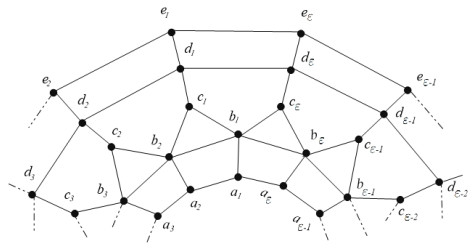
A path in a graph encompassing its whole vertex set is called Hamiltonian. Such a path with sharing the same initial and terminal vertices is called a Hamiltonian cycle. A graph comprising a Hamiltonian path (resp. cycle) is said to be traceable (resp. Hamiltonian). Graphs possessing Hamiltonian paths between every pair of their vertices are said to be Hamilton-connected. The computational complexity of evaluating a graph to be Hamilton-connected is NP-complete. A detour is the longest path in a graph. The detour index is the sum of the length of detours between every unordered pair of vertices. Computing the detour index of a graph is an NP-complete problem as well. A finite subset $ P\subset \mathbb{R}^ \varepsilon $ is called a convex polytope if $ P $ is a convex hull. In this paper, we devised two distinct methods to prove a graph to be Hamilton-connected and employed these methods to construct some infinite families of Hamilton-connected convex polytopes. The convex polytope $ B_ \varepsilon $ has been shown to be non-Hamilton-connected in the literature. We showed that the existing proof for $ B_ \varepsilon $ is false and showed that this family is, in fact, Hamilton-connected. The paper is concluded with study implications followed by some future directions.
Citation: Sakander Hayat, Bagus Imanda, Asad Khan, Mohammed J. F. Alenazi. Three infinite families of Hamilton-connected convex polytopes and their detour index[J]. AIMS Mathematics, 2025, 10(5): 12343-12387. doi: 10.3934/math.2025559
A path in a graph encompassing its whole vertex set is called Hamiltonian. Such a path with sharing the same initial and terminal vertices is called a Hamiltonian cycle. A graph comprising a Hamiltonian path (resp. cycle) is said to be traceable (resp. Hamiltonian). Graphs possessing Hamiltonian paths between every pair of their vertices are said to be Hamilton-connected. The computational complexity of evaluating a graph to be Hamilton-connected is NP-complete. A detour is the longest path in a graph. The detour index is the sum of the length of detours between every unordered pair of vertices. Computing the detour index of a graph is an NP-complete problem as well. A finite subset $ P\subset \mathbb{R}^ \varepsilon $ is called a convex polytope if $ P $ is a convex hull. In this paper, we devised two distinct methods to prove a graph to be Hamilton-connected and employed these methods to construct some infinite families of Hamilton-connected convex polytopes. The convex polytope $ B_ \varepsilon $ has been shown to be non-Hamilton-connected in the literature. We showed that the existing proof for $ B_ \varepsilon $ is false and showed that this family is, in fact, Hamilton-connected. The paper is concluded with study implications followed by some future directions.

| [1] |
B. Alspach, J. P. Liu, On the Hamilton connectivity of generalized Petersen graphs, Discrete Math., 309 (2009), 5461–5473. https://doi.org/10.1016/j.disc.2008.12.016 doi: 10.1016/j.disc.2008.12.016

|
| [2] | M. Bača, Face anti-magic labelings of convex polytopes, Util. Math., 55 (1999), 221–226. |
| [3] | M. Bača, Labelings of two classes of convex polytopes, Util. Math., 34 (1988), 24–31. |
| [4] |
M. Bača, On magic labellings of convex polytopes, Ann. Discrete Math., 51 (1992), 13–16. https://doi.org/10.1016/S0167-5060(08)70599-5 doi: 10.1016/S0167-5060(08)70599-5
|
| [5] |
L. W. Beineke, Characterizations of derived graphs, J. Combin. Theory, 9 (1970), 129–135. https://doi.org/10.1016/s0021-9800(70)80019-9 doi: 10.1016/s0021-9800(70)80019-9
|
| [6] |
D. H. Cai, P. Z. Fan, Q. Y. Zou, Y. Q. Xu, Z. G. Ding, Z. Q. Liu, Active device detection and performance analysis of massive non-orthogonal transmissions in cellular Internet of Things, Sci. China Inform. Sci., 65 (2022), 182301. https://doi.org/10.1007/s11432-021-3328-y doi: 10.1007/s11432-021-3328-y
|
| [7] |
G. Chartrand, A. M. Hobbs, H. A. Jung, S. F. Kapoor, C. S. J. A. Nash-Williams, The square of a block is Hamiltonian connected, J. Combin. Theory Ser. B, 16 (1974), 290–292. https://doi.org/10.1016/0095-8956(74)90075-6 doi: 10.1016/0095-8956(74)90075-6
|
| [8] |
A. A. Dobrynin, R. Entringer, I. Gutman, Wiener index of trees: theory and applications, Acta Appl. Math., 66 (2001), 211–249. https://doi.org/10.1023/A:1010767517079 doi: 10.1023/A:1010767517079
|
| [9] |
R. Frucht, A canonical representation of trivalent Hamiltonian graphs, J. Graph Theory, 1 (1977), 45–60. https://doi.org/10.1002/jgt.3190010111 doi: 10.1002/jgt.3190010111
|
| [10] | F. V. Fomin, P. A. Golovach, W. Lochet, D. Sagunov, S. Saurabh, K. Simonov, Detours in directed graphs, J. Comput. Syst. Sci., 137 (2023), 66–86. https://doi.org/10.1016/j.jcss.2023.05.001 |
| [11] | M. R. Garey, D. S. Johnson, Computers and intractability: a guide to the theory of NP-completeness, San Francisco: W. H. Freeman and Company, 1983. |
| [12] |
V. S. Gordon, Y. L. Orlovich, F. Werner, Hamiltonian properties of triangular grid graphs, Discrete Math., 308 (2008), 6166–6188. https://doi.org/10.1016/j.disc.2007.11.040 doi: 10.1016/j.disc.2007.11.040
|
| [13] |
Y. G. Guo, R. Zhao, S. W. Lai, L. S. Fan, X. F. Lei, G. K. Karagiannidis, Distributed machine learning for multiuser mobile edge computing systems, IEEE J. Sel. Top. Signal Process., 16 (2022), 460–473. https://doi.org/10.1109/jstsp.2022.3140660 doi: 10.1109/jstsp.2022.3140660
|
| [14] | F. Harary, Graph theory, Addison-Wesley, 1969. |
| [15] |
S. Hayat, A. Khan, S. Khan, J. B. Liu, Hamilton connectivity of convex polytopes with applications to their detour index, Complexity, 2021 (2021), 6684784. https://doi.org/10.1155/2021/6684784 doi: 10.1155/2021/6684784
|
| [16] | R. W. Hung, F. Keshavarz-Kohjerdi, C. B. Lin, J. S. Chen, The Hamiltonian connectivity of alphabet supergrid graphs, IAENG Int. J. Appl. Math., 49 (2019), 1–17. |
| [17] |
M. Imran, H. M. A. Siddiqui, Computing the metric dimension of convex polytopes generated by wheel related graphs, Acta Math. Hungar., 149 (2016), 10–30. https://doi.org/10.1007/s10474-016-0606-1 doi: 10.1007/s10474-016-0606-1
|
| [18] | Z. Kewen, H. J. Lai, J. Zhou, Hamiltonian-connected graphs, Comput. Math. Appl., 55 (2008), 2707–2714. https://doi.org/10.1016/j.camwa.2007.10.018 |
| [19] | R. Kužel, L. Xiong, Every 4-connected line graph is Hamiltonian if and only if it is Hamiltonian connected, In: Hamiltonian properties of graphs, Ph.D. thesis, U.W.B. Pilsen, 2004. |
| [20] |
I. Lukovits, Indicators for atoms included in cycles, J. Chem. Inf. Comput. Sci., 36 (1996), 65–68. https://doi.org/10.1021/ci950082o doi: 10.1021/ci950082o
|
| [21] | I. Lukovits, The detour index, Croat. Chem. Acta, 69 (1996), 873–882. |
| [22] |
I. Lukovits, M. Razinger, On calculation of the detour index, J. Chem. Inf. Comput. Sci., 37 (1997), 283–286. https://doi.org/10.1021/ci960034j doi: 10.1021/ci960034j
|
| [23] |
J. B. Liu, X. Wang, J. D. Cao, The coherence and properties analysis of balanced $2^p$-ary tree networks, IEEE Trans. Netw. Sci. Eng., 11 (2024), 4719–4728. https://doi.org/10.1109/TNSE.2024.3395710 doi: 10.1109/TNSE.2024.3395710
|
| [24] | O. Ore, Hamilton-connected graphs, J. Math. Pure Appl., 42 (1963), 21–27. |
| [25] |
G. Rücker, C. Rücker, Symmetry-aided computation of the detour matrix and the detour index, J. Chem. Inf. Comput. Sci., 38 (1998), 710–714. https://doi.org/10.1021/ci980024d doi: 10.1021/ci980024d
|
| [26] |
H. Raza, S. Hayat, X. F. Pan, Binary locating-dominating sets in rotationally-symmetric convex polytopes, Symmetry, 10 (2018), 1–18. https://doi.org/10.3390/sym10120727 doi: 10.3390/sym10120727
|
| [27] |
H. Raza, S. Hayat, X. F. Pan, On the fault-tolerant metric dimension of convex polytopes, Appl. Math. Comput., 339 (2018), 172–185. https://doi.org/10.1016/j.amc.2018.07.010 doi: 10.1016/j.amc.2018.07.010
|
| [28] |
H. Raza, J. B. Liu, S. J. Qu, On mixed metric dimension of rotationally symmetric graphs, IEEE Access, 8 (2020), 11560–11569. https://doi.org/10.1109/ACCESS.2019.2961191 doi: 10.1109/ACCESS.2019.2961191
|
| [29] | A. Simić, M. Bogdanović, J. Milošević, The binary locating-dominating number of some convex polytopes, Ars Math. Contemp., 13 (2017), 367–377. |
| [30] |
C. Thomassen, Hamiltonian-connected tournaments, J. Combin. Theory Ser. B, 28 (1980), 142–163. https://doi.org/10.1016/0095-8956(80)90061-1 doi: 10.1016/0095-8956(80)90061-1
|
| [31] |
C. Y. Tan, D. H. Cai, F. Fang, Z. G. Ding, P. Z. Fan, Federated unfolding learning for CSI feedback in distributed edge networks, IEEE Trans. Commun., 73 (2025), 410–424. https://doi.org/10.1109/tcomm.2024.3429170 doi: 10.1109/tcomm.2024.3429170
|
| [32] |
N. Trinajstić, S. Nikolić, Z. Mihalić, On computing the molecular detour matrix, Int. J. Quantum Chem., 65 (1997), 415–419. https://doi.org/10.1002/(SICI)1097-461X(1997)65:5<415::AID-QUA6>3.0.CO;2-Z doi: 10.1002/(SICI)1097-461X(1997)65:5<415::AID-QUA6>3.0.CO;2-Z
|
| [33] |
N. Trinajstić, S. Nikolić, B. Lučić, D. Amić, Z. Mihalić, The detour matrix in chemistry, J. Chem. Inf. Comput. Sci., 37 (1997), 631–638. https://doi.org/10.1021/ci960149n doi: 10.1021/ci960149n
|
| [34] |
B. Wei, Hamiltonian paths and Hamiltonian connectivity in graphs, Discrete Math., 121 (1993), 223–228. https://doi.org/10.1016/0012-365x(93)90555-8 doi: 10.1016/0012-365x(93)90555-8
|
| [35] | H. Whitney, Congruent graphs and the connectivity of graphs, In: Hassler Whitney collected papers, 1992, 61–79. |
| [36] |
J. Wei, Z. F. You, H. J. Lai, Spectral analogues of Erdös' theorem on Hamilton-connected graphs, Appl. Math. Comput., 340 (2019), 242–250. https://doi.org/10.1016/j.amc.2018.08.005 doi: 10.1016/j.amc.2018.08.005
|
| [37] |
X. J. Yang, J. F. Du, L. M. Xiong, Forbidden subgraphs for supereulerian and Hamiltonian graphs, Discrete Appl. Math., 288 (2021), 192–200. https://doi.org/10.1016/j.dam.2020.08.034 doi: 10.1016/j.dam.2020.08.034
|
| [38] |
X. F. Yang, D. J. Evans, H. J. Lai, G. M. Megson, Generalized honeycomb torus is Hamiltonian, Inform. Process. Lett., 92 (2004), 31–37. https://doi.org/10.1016/j.ipl.2004.05.017 doi: 10.1016/j.ipl.2004.05.017
|
| [39] |
S. H. Zheng, C. Shen, X. Chen, Design and analysis of uplink and downlink communications for federated learning, IEEE J. Sel. Areas Commun., 39 (2021), 2150–2167. https://doi.org/10.1109/jsac.2020.3041388 doi: 10.1109/jsac.2020.3041388
|
| [40] |
Q. N. Zhou, L. G. Wang, Some sufficient spectral conditions on Hamilton-connected and traceable graphs, Linear Multilinear Algebra, 65 (2017), 224–234. https://doi.org/10.1080/03081087.2016.1182463 doi: 10.1080/03081087.2016.1182463
|
| [41] |
Q. N. Zhou, L. G. Wang, Y. Lu, Signless Laplacian spectral conditions for Hamilton-connected graphs with large minimum degree, Linear Algebra Appl., 592 (2020), 48–64. https://doi.org/10.1016/j.laa.2020.01.021 doi: 10.1016/j.laa.2020.01.021
|
| [42] |
Q. N. Zhou, L. G. Wang, Y. Lu, Wiener index and Harary index on Hamilton-connected graphs with large minimum degree, Discrete Appl. Math., 247 (2018), 180–185. https://doi.org/10.1016/j.dam.2018.03.063 doi: 10.1016/j.dam.2018.03.063
|
Figures(5)

Sakander Hayat, Bagus Imanda, Asad Khan, Mohammed J. F. Alenazi. Three infinite families of Hamilton-connected convex polytopes and their detour index[J]. AIMS Mathematics, 2025, 10(5): 12343-12387. doi: 10.3934/math.2025559





 DownLoad: