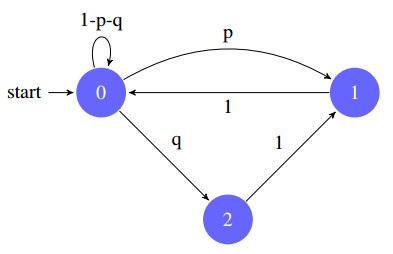
This paper presents a detailed procedure for deriving a Binet's type formula for the Tribonacci sequence $ \{ {\mathsf T}_n\} $. We examine the limiting distribution of a Markov chain that encapsulates the entire sequence $ \{ {\mathsf T}_n\} $, offering insights into its asymptotic behavior. An approximation of $ {\mathsf T}_n $ is provided using two distinct probabilistic approaches. Furthermore, we study random sequences of the form $ \{ {\mathsf Z}_0, {\mathsf Z}_1, {\mathsf Z}_2, {\mathsf Z}_n = {\mathsf Z}_{n-3} + {\mathsf Z}_{n-2} + {\mathsf Z}_{n-1}, n = 3, \ldots\} $, referred to as the Tribonacci sequence of Random Variables. These sequences, fully defined by their initial random variables, are analyzed in terms of their distributional and limiting properties.
Citation: Skander Hachicha, Najmeddine Attia. Probabilistic approaches to exploring Binet's type formula for the Tribonacci sequence[J]. AIMS Mathematics, 2025, 10(5): 11957-11975. doi: 10.3934/math.2025540
This paper presents a detailed procedure for deriving a Binet's type formula for the Tribonacci sequence $ \{ {\mathsf T}_n\} $. We examine the limiting distribution of a Markov chain that encapsulates the entire sequence $ \{ {\mathsf T}_n\} $, offering insights into its asymptotic behavior. An approximation of $ {\mathsf T}_n $ is provided using two distinct probabilistic approaches. Furthermore, we study random sequences of the form $ \{ {\mathsf Z}_0, {\mathsf Z}_1, {\mathsf Z}_2, {\mathsf Z}_n = {\mathsf Z}_{n-3} + {\mathsf Z}_{n-2} + {\mathsf Z}_{n-1}, n = 3, \ldots\} $, referred to as the Tribonacci sequence of Random Variables. These sequences, fully defined by their initial random variables, are analyzed in terms of their distributional and limiting properties.

| [1] | B. Singh, S. Bhatnagar, O. Sikhwal, Fibonacci-like sequence, Int. J. Adv. Math. Sci., 1 (2013), 145–151. https://doi.org/10.14419/ijams.v1i3.898 |
| [2] | B. Singh, O. Sikhwal, S. Bhatnagar, Fibonacci-like sequence and its properties, Int. J. Contemp. Math. Sci., 5 (2010), 859–868. |
| [3] |
S. Falcón, Á. Plaza, On the $k$-Fibonacci numbers, Chaos Soliton. Fract., 32 (2007), 1615–1624. https://doi.org/10.1016/j.chaos.2006.09.022 doi: 10.1016/j.chaos.2006.09.022

|
| [4] |
S. Falcón, Á. Plaza, The $k$-Fibonacci sequence and the Pascal 2-triangle, Chaos Soliton. Fract., 33 (2007), 38–49. https://doi.org/10.1016/j.chaos.2006.10.022 doi: 10.1016/j.chaos.2006.10.022
|
| [5] |
Y. K. Panwar, G. P. S. Rathore, R. Chawla, On the $k$-Fibonacci-like numbers, Turk. J. Anal. Number Theory, 2 (2014), 9–12. https://doi.org/10.12691/tjant-2-1-3 doi: 10.12691/tjant-2-1-3
|
| [6] | S. S. Rao, M. Srinivas, Some remarks concerning $k$-Fibonacci-like numbers, Int. J. Math. Sci. Comput., 51 (2015), 8–10. |
| [7] |
Y. K. Panwar, A note on the generalized $k$-Fibonacci sequence, NATURENGS, 2 (2021), 29–39. https://doi.org/10.46572/naturengs.937010 doi: 10.46572/naturengs.937010
|
| [8] | Ş. Uygun, H. Eldogan, Properties of $k$-Jacobsthal and $k$-Jacobsthal Lucas sequences, Gen. Math. Notes, 36 (2016), 34–47. |
| [9] | Ş. Uygun, Bi-periodic Jacobsthal Lucas matrix sequence, Acta Univ. Apulensis, 66 (2021), 53–69. |
| [10] | Ş. Uygun, The $(s, t)$-Jacobsthal and $(s, t)$-Jacobsthal Lucas Sequences, Appl. Math. Sci., 9 (2015), 3467–3476. |
| [11] | J. H. McCabe, G. M. Phillips, Aitken sequences and generalized Fibonacci numbers, Math. Comp., 45(172) (1985), 553–558. https://doi.org/10.1090/S0025-5718-1985-0804944-8 |
| [12] |
N. Attia, C. Souissi, N. Saidi, R. Ali, A note on $k$-Bonacci random walks, Fractal Fract., 7 (2023), 280. https://doi.org/10.3390/fractalfract7040280 doi: 10.3390/fractalfract7040280
|
| [13] |
H. Belbachir, I. E. Djellas, Determinantal and permanental representations of companion sequences associated to the $r$-Fibonacci sequence, Notes Number Theory Discrete Math., 28 (2022), 64–74, https://doi.org/10.7546/nntdm.2022.28.1.64-74 doi: 10.7546/nntdm.2022.28.1.64-74
|
| [14] | T. Abdelhak, I. E. Djellas, M. Mekkaoui, On some nested sums involving $q$-Fibonacci numbers, Palest. J. Math., 12 (2023), 183–193. |
| [15] |
E. Makover, J. McGowan, An elementary proof that random Fibonacci sequences grow exponentially, J. Number Theory, 121 (2006), 40–44. https://doi.org/10.1016/j.jnt.2006.01.002 doi: 10.1016/j.jnt.2006.01.002
|
| [16] |
K. Alladi, V. E. Hoggatt, On Tribonacci numbers and related functions, Fibonacci Q., 15 (1977), 42–45. https://doi.org/10.1080/00150517.1977.12430503 doi: 10.1080/00150517.1977.12430503
|
| [17] | M. Feinberg, Fibonacci-Tribonacci, Fibonacci Q., 1 (1963), 71–74. https://doi.org/10.1080/00150517.1963.12431573 |
| [18] |
K. K. Sharma, Generalized Tribonacci function and Tribonacci numbers, Int. J. Recent Technol. Eng., 9 (2020), 1313–1316. https://doi.org/10.35940/ijrte.F7640.059120 doi: 10.35940/ijrte.F7640.059120
|
| [19] |
Y. Soykan, Summing formulas for generalized Tribonacci numbers, Univ. J. Math. Appl., 3 (2020), 1–11. https://doi.org/10.32323/ujma.637876 doi: 10.32323/ujma.637876
|
| [20] |
Y. Taşyurdu, On the sums of Tribonacci and Tribonacci-Lucas numbers, Appl. Math. Sci., 13 (2019), 1201–1208. https://doi.org/10.12988/ams.2019.910144 doi: 10.12988/ams.2019.910144
|
| [21] |
S. Arolkar, Y. S. Valaulikar, Hyers-Ulam stability of generalized Tribonacci functional equation, Turk. J. Anal. Number Theory, 5 (2017), 80–85. https://doi.org/10.12691/tjant-5-3-1 doi: 10.12691/tjant-5-3-1
|
| [22] |
K. E. Magnani, On third-order linear recurrent functions, Discrete Dyn. Nat. Soc., 2019 (2019), 9489437. https://doi.org/10.1155/2019/9489437 doi: 10.1155/2019/9489437
|
| [23] | M. N. Parizi, M. E. Gordji, On Tribonacci functions and Tribonacci numbers, Int. J. Math. Comput. Sci., 11 (2016), 23–32. |
| [24] |
S. Crvenković, I. Tanackov, N. M. Ralević, I. Pavkov, Initial number of Lucas' type series for the generalized Fibonacci sequence, Filomat, 35 (2021), 3891–3900. https://doi.org/10.2298/FIL2111891C doi: 10.2298/FIL2111891C
|
| [25] |
I. Tanackov, Binet type formula for Tribonacci sequence with arbitrary initial numbers, Chaos Soliton. Fract., 114 (2018), 63–68. https://doi.org/10.1016/j.chaos.2018.06.023 doi: 10.1016/j.chaos.2018.06.023
|
| [26] |
N. Attia, Some remarks on recursive sequence of Fibonacci type, AIMS Math., 9 (2024), 25834–25848. https://doi.org/10.3934/math.20241262 doi: 10.3934/math.20241262
|
| [27] |
M. Huber, A probabilistic approach to the Fibonacci sequence, Math. Intell., 42 (2020), 29–33. https://doi.org/10.1007/s00283-019-09950-33 doi: 10.1007/s00283-019-09950-33
|
| [28] | E. Kiliç, Tribonacci sequences with certain indices and their sums, Ars Comb., 86 (2008), 13–22. |
| [29] | B. V. Gnedenko, Theory of probability, Mocow: Mir Publishers, 1978. |
| [30] | A. V. Skorokhod, Basic principles and applications of probability theory, Springer, 2005. https://doi.org/10.1007/b137401 |
| [31] | W. Feller, An introduction to probability theory and its applications, Vol. 2, 2 Eds., John Wiley & Sons Inc., 1971. |
Figures(2) / Tables(1)

Skander Hachicha, Najmeddine Attia. Probabilistic approaches to exploring Binet's type formula for the Tribonacci sequence[J]. AIMS Mathematics, 2025, 10(5): 11957-11975. doi: 10.3934/math.2025540





 DownLoad: