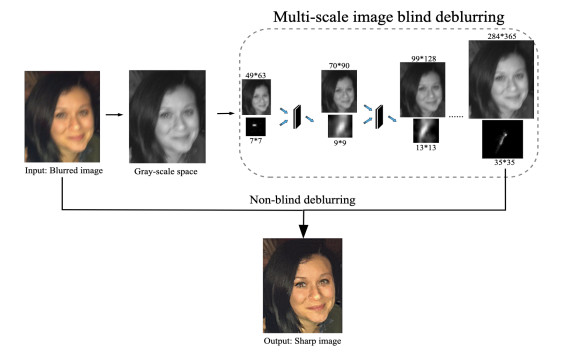
Image deblurring is of great importance for wide applications in reality. An existing method based on the dark channel prior (DCP) has achieved notable success across natural, facial, and text images. However, this method encounters challenges when applied to images with large kernels or more saturated pixels. The main reason of this limitation may come from the linear degradation assumption, while the blur process is often more complex and against the linear assumption. This work introduced an intermediate image correction strategy to enhance the DCP-based deblurring method. By estimating the probability of intermediate image pixels deviating from the linear degradation model, we selectively corrected the disadvantageous pixels. In this way, we can effectively reduce the unfavorable structures and thus improve the accuracy of blur kernel estimation. Extensive experiments show that the intermediate correction strategy enables the proposed model to restore sharp image details more effectively, resulting in significant improvement for blind deblurring performance.
Citation: Min Xiao, Jinkang Zhang, Zijin Zhu, Meina Zhang. Blind deblurring with intermediate correction using the dark channel prior[J]. AIMS Mathematics, 2025, 10(3): 7086-7098. doi: 10.3934/math.2025323
Image deblurring is of great importance for wide applications in reality. An existing method based on the dark channel prior (DCP) has achieved notable success across natural, facial, and text images. However, this method encounters challenges when applied to images with large kernels or more saturated pixels. The main reason of this limitation may come from the linear degradation assumption, while the blur process is often more complex and against the linear assumption. This work introduced an intermediate image correction strategy to enhance the DCP-based deblurring method. By estimating the probability of intermediate image pixels deviating from the linear degradation model, we selectively corrected the disadvantageous pixels. In this way, we can effectively reduce the unfavorable structures and thus improve the accuracy of blur kernel estimation. Extensive experiments show that the intermediate correction strategy enables the proposed model to restore sharp image details more effectively, resulting in significant improvement for blind deblurring performance.

| [1] |
R. Fergus, B. Singh, A. Hertzmann, T. Roweis, W. T. Freeman, Removing camera shake from a single photograph, ACM Trans. Graph., 25 (2006), 787–794. https://doi.org/10.1145/1179352.1141956 doi: 10.1145/1179352.1141956

|
| [2] | H. Cho, J. Wang, S. Lee, Text image debluring using text-specific properties, In: A. Fitzgibbon, S. Lazebnik, P. Perona, Y. Sato, C. Schmid, Computer vision – ECCV 2012, Springer, 2012,524–537. https://doi.org/10.1007/978-3-642-33715-4_38 |
| [3] |
F. Wen, R. Ying, Y. Liu, P. Liu, T. Truong, A simple local minimal intensity prior and an improved algorithm for blind image deblurring, IEEE Trans. Circuits Syst. Video Technol., 31 (2021), 2923–2937. https://doi.org/10.1109/TCSVT.2020.3034137 doi: 10.1109/TCSVT.2020.3034137
|
| [4] |
L. Li, J. Pan, W. Lai, C. Gao, N. Sang, M. Yang, Blind image deblurring via deep discriminative priors, Int. J. Comput. Vision, 127 (2019), 1025–1043. https://doi.org/10.1007/s11263-018-01146-0 doi: 10.1007/s11263-018-01146-0
|
| [5] |
A. Levin, Y. Weiss, F. Durand, W. T. Freeman, Understanding blind deconvolution algorithms, IEEE Trans. Pattern Anal. Mach. Intell., 33 (2011), 2354–2367. https://doi.org/10.1109/TPAMI.2011.148 doi: 10.1109/TPAMI.2011.148
|
| [6] |
L. Chen, Q. Sun, F. Wang, Adaptive blind deconvolution using generalized cross-validation with generalized $l_p$/$l_q$ norm regularization, Neurocomputing, 399 (2020), 75–85. https://doi.org/10.1016/j.neucom.2020.02.091 doi: 10.1016/j.neucom.2020.02.091
|
| [7] |
Y. Yan, W. Ren, Y. Guo, R. Wang, X. Cao, Image deblurring via extreme channels prior, 2017 IEEE Conference on Computer Vision and Pattern Recognition (CVPR), 2017, 6978–6986. https://doi.org/10.1109/CVPR.2017.738 doi: 10.1109/CVPR.2017.738
|
| [8] |
J. Pan, Z. Hu, Z. Su, M. H. Yang, $L_0$-regularized intensity and gradient prior for deblurring text images and beyond, IEEE Trans. Pattern Anal. Mach. Intell., 39 (2017), 342–355. https://doi.org/10.1109/TPAMI.2016.2551244 doi: 10.1109/TPAMI.2016.2551244
|
| [9] |
D. Krishnan, T. Tay, R. Fergus, Blind deconvolution using a normalized sparsity measure, CVPR 2011, 2011,233–240. https://doi.org/10.1109/CVPR.2011.5995521 doi: 10.1109/CVPR.2011.5995521
|
| [10] |
L. Xu, S. Zheng, J. Jia, Unnatural L0 sparse representation for natural image deblurring, 2013 IEEE Conference on Computer Vision and Pattern Recognition, 2013, 1107–1114. https://doi.org/10.1109/CVPR.2013.147 doi: 10.1109/CVPR.2013.147
|
| [11] |
J. Liu, M. Yan, T. Zeng, Surface-aware blind image deblurring, IEEE Trans. Pattern Anal. Mach. Intell., 43 (2019), 1041–1055. https://doi.org/10.1109/TPAMI.2019.2941472 doi: 10.1109/TPAMI.2019.2941472
|
| [12] |
S. Cho, J. Wang, S. Lee, Handling outliers in non-blind image deconvolution, 2011 International Conference on Computer Vision, 2011,495–502. https://doi.org/10.1109/ICCV.2011.6126280 doi: 10.1109/ICCV.2011.6126280
|
| [13] |
J. Pan, Z. Lin, Z. Su, M. Yang, Robust kernel estimation with outliers handling for image deblurring, 2016 IEEE Conference on Computer Vision and Pattern Recognition (CVPR), 2016, 2800–2808. https://doi.org/10.1109/CVPR.2016.306 doi: 10.1109/CVPR.2016.306
|
| [14] |
J. Dong, J. Pan, Z. Su, M. Yang, Blind image deblurring with outlier handling, 2017 IEEE International Conference on Computer Vision (ICCV), 2017, 2497–2505. https://doi.org/10.1109/ICCV.2017.271 doi: 10.1109/ICCV.2017.271
|
| [15] |
Z. Hu, S. Cho, J. Wang, M. Yang, Deblurring low-light images with light streaks, IEEE Trans. Pattern Anal. Mach. Intell., 40 (2018), 3382–3389. https://doi.org/10.1109/TPAMI.2017.2768365 doi: 10.1109/TPAMI.2017.2768365
|
| [16] | L. Chen, F. Fang, J. Zhang, J. Liu, G. Zhang, OID: outlier identifying and discarding in blind image deblurring, In: A. Vedaldi, H. Bischof, T. Brox, J. M. Frahm, Computer vision – ECCV 2020, Springer, 2020,598–613. https://doi.org/10.1007/978-3-030-58595-2_36 |
| [17] |
L. Chen, J. Zhang, S. Lin, F. Fang, J. Ren, Blind deblurring for saturated images, Proceedings of the IEEE/CVF Conference on Computer Vision and Pattern Recognition (CVPR), 2021, 6308–6316. https://doi.org/10.1109/CVPR46437.2021.00624 doi: 10.1109/CVPR46437.2021.00624
|
| [18] |
M. Zhang, Y. Fang, G. Ni, T. Zeng, Pixel screening based intermediate correction for blind deblurring, 2022 IEEE/CVF Conference on Computer Vision and Pattern Recognition (CVPR), 2022, 5892–5900. https://doi.org/10.1109/CVPR52688.2022.00580 doi: 10.1109/CVPR52688.2022.00580
|
| [19] |
J. Pan, Z. Hu, Z. Su, M. Yang, Deblurring text images via l0-regularized intensity and gradient prior, 2014 IEEE Conference on Computer Vision and Pattern Recognition, 2014, 2901–2908. https://doi.org/10.1109/CVPR.2014.371 doi: 10.1109/CVPR.2014.371
|
| [20] |
M. Zhang, Y. Yang, G. Ni, T. Wu, T. Zeng, Self-supervised multi-scale neural network for blind deblurring, Inverse Probl. Imag., 18 (2024), 623–641. https://doi.org/10.3934/ipi.2023046 doi: 10.3934/ipi.2023046
|
| [21] |
L. Chen, F. Fang, T. Wang, G. Zhang, Blind image deblurring with local maximum gradient prior, Proceedings of the IEEE/CVF Conference on Computer Vision and Pattern Recognition (CVPR), 2019, 1742–1750. https://doi.org/10.1109/CVPR.2019.00184 doi: 10.1109/CVPR.2019.00184
|
| [22] | D. P. Kingma, M. Welling, Auto-encoding variational bayes, arXiv, 2013. https://doi.org/10.48550/arXiv.1312.6114 |
| [23] |
D. Ren, K. Zhang, Q. Wang, Q. Hu, W. Zuo, Neural blind deconvolution using deep priors, 2020 IEEE/CVF Conference on Computer Vision and Pattern Recognition (CVPR), 2020, 3338–3347. https://doi.org/10.1109/CVPR42600.2020.00340 doi: 10.1109/CVPR42600.2020.00340
|
| [24] |
S. Umirzakova, S. Ahmad, L. U. Khan, T. Whangbo, Medical image super-resolution for smart healthcare applications: a comprehensive survey, Inf. Fusion, 103 (2024), 102075. https://doi.org/10.1016/j.inffus.2023.102075 doi: 10.1016/j.inffus.2023.102075
|
| [25] |
J. Pan, D. Sun, H. Pfister, M. Yang, Deblurring images via dark channel prior, IEEE Trans. Pattern Anal. Mach. Intell., 40 (2017), 2315–2328. https://doi.org/10.1109/TPAMI.2017.2753804 doi: 10.1109/TPAMI.2017.2753804
|
| [26] |
K. He, J. Sun, X. Tang, Single image haze removal using dark channel prior, 2009 IEEE Conference on Computer Vision and Pattern Recognition, 2010, 2341–2353. https://doi.org/10.1109/CVPR.2009.5206515 doi: 10.1109/CVPR.2009.5206515
|
| [27] | R. Köhler, M. Hirsch, B. Mohler, B. Scholkopf, S. Harmeling, Recording and playback of camera shake: benchmarking blind deconvolution with a real-world database, In: A. Fitzgibbon, S. Lazebnik, P. Perona, Y. Sato, C. Schmid, Computer vision – ECCV 2012, Springer, 2012, 27–40. https://doi.org/10.1007/978-3-642-33786-4_3 |
| [28] |
F. Wen, R. Ying, Y. Liu, P. Liu, T. Truong, A simple local minimal intensity prior and an improved algorithm for blind image deblurring, IEEE Trans. Circuits Syst. Video Technol., 31 (2021), 2923–2937. https://doi.org/10.1109/TCSVT.2020.3034137 doi: 10.1109/TCSVT.2020.3034137
|


Figures(8) / Tables(2)

Min Xiao, Jinkang Zhang, Zijin Zhu, Meina Zhang. Blind deblurring with intermediate correction using the dark channel prior[J]. AIMS Mathematics, 2025, 10(3): 7086-7098. doi: 10.3934/math.2025323





 DownLoad: