Online rumors spread rapidly and severely threaten public opinion, and timely official refutation is an effective way to suppress rumor diffusion. This work established a fractional-order delayed Susceptible–Waverer–Fearful–Propagator–Recovered (SWFPR) compartmental rumor propagation model incorporating a fear effect and dual debunking mechanisms under the Caputo fractional derivative framework. The fractional order describes the memory effect of historical rumor information on individual behavior. We first proved the positivity, existence, uniqueness, and ultimate boundedness of model solutions. Then we analyzed the existence of equilibrium points and derived the stability conditions of rumor-free and rumor-endemic equilibria. By selecting the time delay as the bifurcation parameter, we investigated the Hopf bifurcation of the system and discussed the dynamical influence of the fear effect and refutation delay on rumor prevalence. Numerical simulations were carried out to verify the theoretical results and illustrate the impacts of fractional order, fear intensity, and refutation delay on rumor evolution. The results revealed that an excessively long refutation delay facilitates rumor outbreaks, while the fear effect can inhibit the persistent prevalence of rumors. This work provides theoretical support for understanding rumor dynamics and designing targeted rumor intervention strategies on social media.
Citation: Jiaqi Wang, Ahmadjan Muhammadhaji. Dynamics of a fractional-order SWFPR rumor propagation model with a fear effect and delayed official refutation[J]. Networks and Heterogeneous Media, 2026, 21(7): 2526-2555. doi: 10.3934/nhm.2026094
Online rumors spread rapidly and severely threaten public opinion, and timely official refutation is an effective way to suppress rumor diffusion. This work established a fractional-order delayed Susceptible–Waverer–Fearful–Propagator–Recovered (SWFPR) compartmental rumor propagation model incorporating a fear effect and dual debunking mechanisms under the Caputo fractional derivative framework. The fractional order describes the memory effect of historical rumor information on individual behavior. We first proved the positivity, existence, uniqueness, and ultimate boundedness of model solutions. Then we analyzed the existence of equilibrium points and derived the stability conditions of rumor-free and rumor-endemic equilibria. By selecting the time delay as the bifurcation parameter, we investigated the Hopf bifurcation of the system and discussed the dynamical influence of the fear effect and refutation delay on rumor prevalence. Numerical simulations were carried out to verify the theoretical results and illustrate the impacts of fractional order, fear intensity, and refutation delay on rumor evolution. The results revealed that an excessively long refutation delay facilitates rumor outbreaks, while the fear effect can inhibit the persistent prevalence of rumors. This work provides theoretical support for understanding rumor dynamics and designing targeted rumor intervention strategies on social media.

| [1] |
D. Daley, D. Kendall, Epidemics and rumours, Nature, 204 (1964), 1118. https://doi.org/10.1038/2041118a0 doi: 10.1038/2041118a0
|
| [2] |
D. Daley, D. Kendall, Stochastic rumours, IMA J. Appl. Math., 1 (1965), 42–55. https://doi.org/10.1093/imamat/1.1.42 doi: 10.1093/imamat/1.1.42
|
| [3] |
D. Maki, M. Thomson, Mathematical Models and Applications, Englewood Cliffs: Prentice-Hall, 1973. |
| [4] |
H. Wang, L. Deng, F. Xie, H. Xu, J. Han, A new rumor propagation model on SNS structure, in 2012 IEEE International Conference on Granular Computing, 2012,499–503. https://doi.org/10.1109/GrC.2012.6468621 |
| [5] |
L. Zhu, X. Zhou, Y. Li, Global dynamics analysis and control of a rumor spreading model in online social networks, Physica A, 526 (2019), 120903. https://doi.org/10.1016/j.physa.2019.04.139 doi: 10.1016/j.physa.2019.04.139
|
| [6] |
G. Chen, ILSCR rumor spreading model to discuss the control of rumor spreading in emergency, Physica A, 522 (2019), 88–97. https://doi.org/10.1016/j.physa.2018.11.068 doi: 10.1016/j.physa.2018.11.068
|
| [7] |
X. L. Sun, Y. G. Wang, Y. Chai, Y. Liu, Dynamic analysis and control strategies of the SEIHR rumor diffusion model in online social networks, Appl. Math. Modell., 134 (2024), 611–634. https://doi.org/10.1016/j.apm.2024.06.005 doi: 10.1016/j.apm.2024.06.005
|
| [8] |
R. R. Yin, A. Muhammadhaji, Dynamic analysis of rumor propagation model with distributed delay and saturation cure rate in multilingual environment, Chaos, Solitons Fractals, 200 (2025), 117055. https://doi.org/10.1016/j.chaos.2025.117055 doi: 10.1016/j.chaos.2025.117055
|
| [9] |
P. Li, R. Gao, C. Xu, Y. Li, A. Akgul, D. Baleanu, Dynamics exploration for a fractional-order delayed zooplankton-phytoplankton system, Chaos, Solitons Fractals, 166 (2023), 112975. https://doi.org/10.1016/j.chaos.2022.112975 doi: 10.1016/j.chaos.2022.112975
|
| [10] |
A. De Santis, E. Farsimadan, L. Moradi, F. Palmieri, Generalized defensive modeling of fake news propagation in social networks using fractional differential equations, IEEE Trans. Comput. Social Syst., 12 (2025), 622–634. https://doi.org/10.1109/TCSS.2024.3492097 doi: 10.1109/TCSS.2024.3492097
|
| [11] |
Y. H. Niu, A. Muhammadhaji, Dynamics of a fractional-order IDSR rumor propagation model with time delays, Fractal Fract., 9 (2025), 242. https://doi.org/10.3390/fractalfract9040242 doi: 10.3390/fractalfract9040242
|
| [12] |
M. Cinelli, W. Quattrociocchi, A. Galeazzi, C. M. Valensise, E. Brugnoli, A. L. Schmidt, et al., The COVID-19 social media infodemic, Sci. Rep., 10 (2020), 16598. https://doi.org/10.1038/s41598-020-73510-5 doi: 10.1038/s41598-020-73510-5
|
| [13] |
R. H. Knapp, A psychology of rumor, Public Opin. Q., 8 (1944), 22–37. https://doi.org/10.1086/265665 doi: 10.1086/265665
|
| [14] |
N. Stieglitz, L. D. Xuan, Emotions and information diffusion in social media: Empirical analysis of the 2011 Japanese earthquake, J. Manage. Inf. Syst., 30 (2013), 251–278. |
| [15] |
S. Pfattheicher, Anxiety and the acceptance of vaccine side-effect rumors during the COVID-19 pandemic, J. Appl. Social Psychol., 51 (2021), 389–402. |
| [16] |
Y. Zhao, Z. Li, W. Wang, Rumor spreading model with time delay and heterogeneous refutation in complex networks, Physica A, 556 (2020), 124834. |
| [17] |
Y. Y. Cheng, L. A. Huo, L. J. Zhao, Dynamical behaviors and control measures of rumor-spreading model in consideration of the infected media and time delay, Inf. Sci., 564 (2021), 237–253. https://doi.org/10.1016/j.ins.2021.02.047 doi: 10.1016/j.ins.2021.02.047
|
| [18] |
L. H. Zhu, G. Guan, Dynamical analysis of a rumor spreading model with self-discrimination and time delay in complex networks, Physica A, 533 (2019), 121953. https://doi.org/10.1016/j.physa.2019.121953 doi: 10.1016/j.physa.2019.121953
|
| [19] |
P. A. Naik, M. Yavuz, S. Qureshi, M. Naik, K. M. Owolabi, A. Soomro, A. H. Ganie, Memory impacts in hepatitis C: A global analysis of a fractional-order model with an effective treatment, Comput. Methods Programs Biomed., 254 (2024), 108306. https://doi.org/10.1016/j.cmpb.2024.108306 doi: 10.1016/j.cmpb.2024.108306
|
| [20] |
V. Madhusudanan, P. A. Naik, B. S. N. Murthy, L. Guerrini, M. N. Srinivas, L. Chada, Modeling tuberculosis transmission with kernel functions: Effects of vaccination and time delay, Eur. Phys. J. Plus, 141 (2026), 76. https://doi.org/10.1140/epjp/s13360-026-07309-0 doi: 10.1140/epjp/s13360-026-07309-0
|
| [21] |
A. Muhammadhaji, Y. H. Niu, Stability and hopf bifurcation of a delayed fractional-order ISR rumor propagation model with saturation incidence, Fractal Fract., 10 (2026), 708. https://doi.org/10.3390/fractalfract10100708 doi: 10.3390/fractalfract10100708
|
| [22] |
T. Zhou, A. Muhammadhaji, Dynamics in a fractional-order competitive-competitive-cooperative system with Beddington-Deangelis functional responses and delay, Fractal Fract., 10 (2026), 176. https://doi.org/10.3390/fractalfract10030176 doi: 10.3390/fractalfract10030176
|
| [23] |
M. Mandal, S. Jana, S. K. Nandi, T. K. Kar, Modelling and control of a fractional-order epidemic model with fear effect, Energy Ecol. Environ., 5 (2020), 421–432. https://doi.org/10.1007/s40974-020-00192-0 doi: 10.1007/s40974-020-00192-0
|
| [24] |
J. Y. Zhang, Y. K. Xue, G. Q. Hu, Analysis of fractional order SVEIR infectious disease model with fear effect and secondary vaccination, Nonlinear Dyn., 113 (2025), 34047–34065. https://doi.org/10.1007/s11071-025-11752-6 doi: 10.1007/s11071-025-11752-6
|
| [25] |
X. Zhang, J. C. Li, Y. L. Ma, M. H. Wang, Dynamic modelling and analysis of online rumour propagation considering dual debunking mechanisms and time delay effects, Humanit. Social Sci. Commun., 13 (2026), 905. https://doi.org/10.1057/s41599-026-07243-7 doi: 10.1057/s41599-026-07243-7
|
| [26] |
Y. Liu, G. Liang, X. Wang, P. Zhu, Z. Wang, Diffusion containment in complex networks through collective influence of connections, IEEE Trans. Inf. Forensics Secur., 19 (2024), 1510–1524. https://doi.org/10.1109/TIFS.2023.3338423 doi: 10.1109/TIFS.2023.3338423
|
| [27] |
G. Liu, J. Zhu, Q. Li, C. Zhang, W. Jiang, X. Zhong, et al., Networked spatiotemporal optimal control and DC-PPO reinforcement learning for combating malware spread in IoUT, IEEE Trans. Network Sci. Eng., 13 (2026), 10252–10269. https://doi.org/10.1109/TNSE.2026.3692250 doi: 10.1109/TNSE.2026.3692250
|
| [28] |
G. Liu, C. Wang, T. Tan, D. Shen, G. Fortino, G. Franze, et al., A fractional-order game-theoretic model with sparse attention multi-agent reinforcement learning for malware defense in IoV, IEEE Trans. Autom. Sci. Eng., 2025, 3950–3966. https://doi.org/10.1109/TASE.2025.3641288 doi: 10.1109/TASE.2025.3641288
|
Figures(8) / Tables(2)
Jiaqi Wang, Ahmadjan Muhammadhaji. Dynamics of a fractional-order SWFPR rumor propagation model with a fear effect and delayed official refutation[J]. Networks and Heterogeneous Media, 2026, 21(7): 2526-2555. doi: 10.3934/nhm.2026094

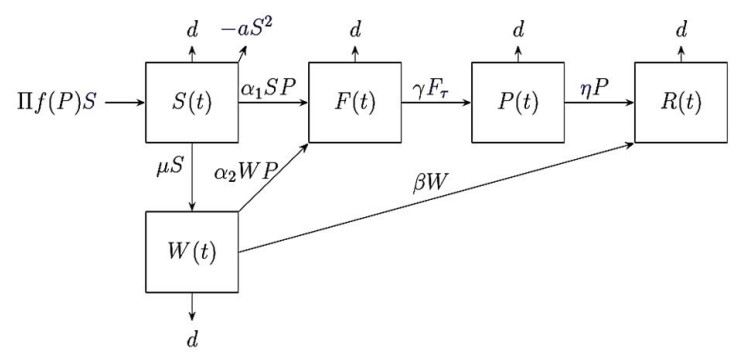
Flow diagram of the SWFPR fractional-order delayed rumor propagation model. Arrows between compartments represent inter-compartment transition fluxes. The outward flux $ aS^2 $ from the susceptible compartment $ S $ denotes density-dependent attention competition and spontaneous exit of susceptible users. The delayed flux $ \gamma F_\tau $ describes the transformation from $ F $ to $ P $ with time delay $ \tau $. The transition from $ P $ to $ R $ follows the flux $ \eta P $
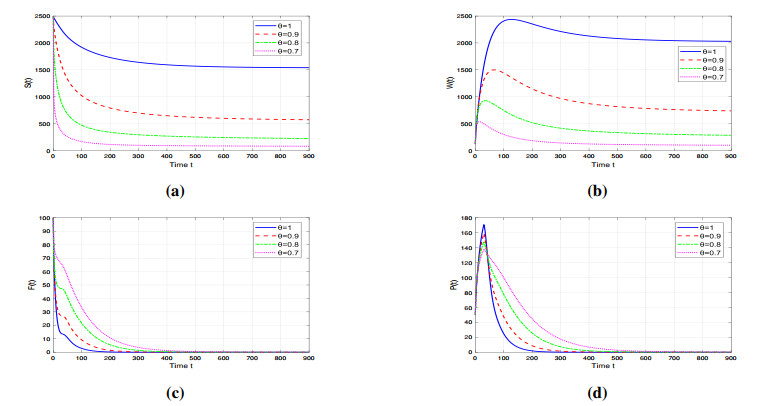
Local asymptotic stability of $ E^0 $ in system (3.2) with $\theta = 1$, $\theta = 0.9$, $\theta = 0.8$, and $\theta = 0.7$. Panels (a)–(d) show the convergence of $ S(t), W(t), F(t) $, and $ P(t) $ to the equilibrium $ E^0 $, illustrating the local asymptotic stability of $ E^0 $ for $ \theta = 1 $, 0.9, 0.8, and 0.7, respectively
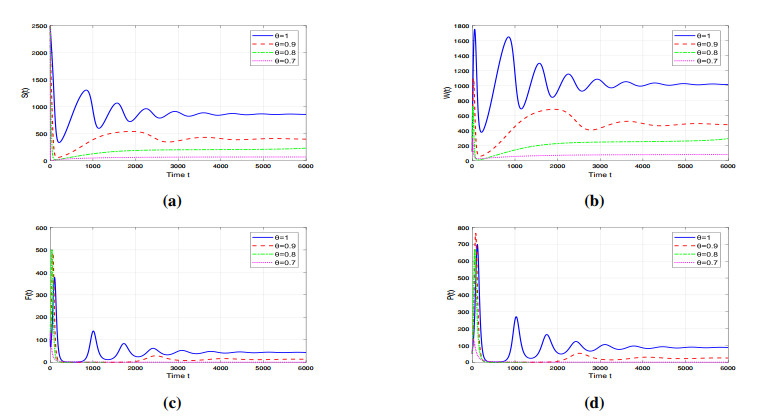
Local asymptotic stability of $ E^* $ in system (3.2) with $\theta = 1$, $\theta = 0.9$, $\theta = 0.8$, and $\theta = 0.7$. Panels (a)–(d) show the convergence of $ S(t), W(t), F(t) $, and $ P(t) $ to the equilibrium $ E^* $, illustrating the local asymptotic stability of $ E^* $ for $ \theta = 1 $, 0.9, 0.8, and 0.7, respectively
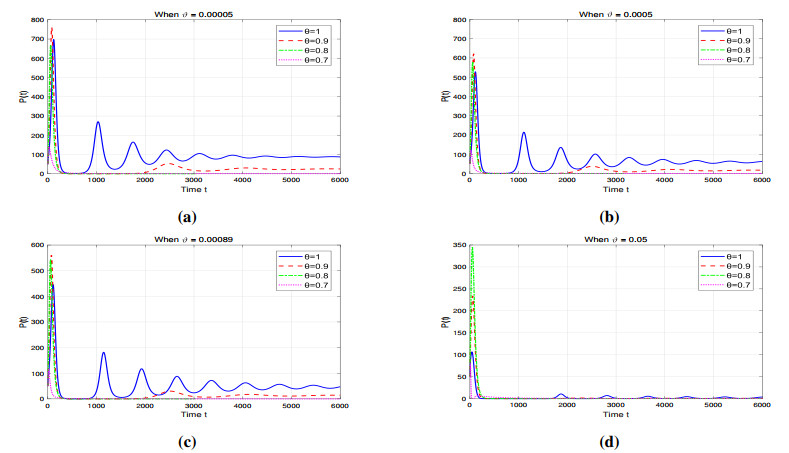
Dynamical evolution profiles of $ P(t) $ under various combinations of fear factors $ \vartheta = 0.00005, 0.0005, 0.00089, 0.05 $ and fractional orders $ \theta = 1, 0.9, 0.8, 0.7 $, where panels (a)–(d) show the convergence of $ P(t) $ for these parameter sets, respectively
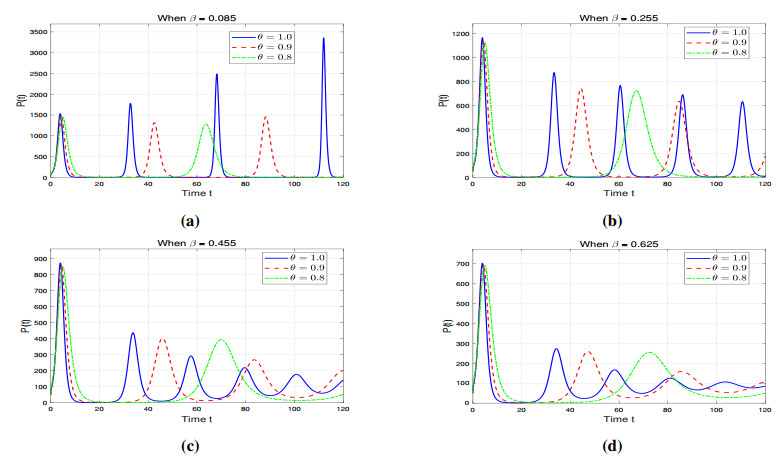
System dynamics under different official rumor-refuting rates, with $ \beta $ set to $ 0.085 $, $ 0.255 $, $ 0.455 $, $ 0.625 $ and fractional orders $ \theta = 1, 0.9, 0.8 $, where panels (a)–(d) show the convergence of $ P(t) $ for these parameter sets, respectively
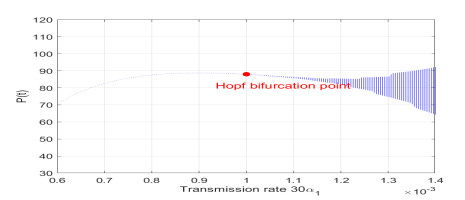
Hopf bifurcation arising from variations in the transmission rate
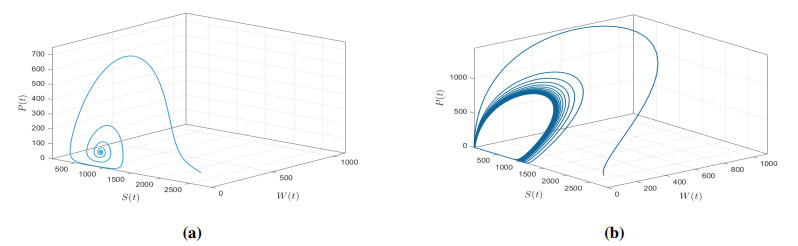
Effects of parameter $ \alpha $ on the steady state of rumor propagators, where panels (a) and (b) show that (a) $ \alpha < 3.3\times10^{-5} $, the rumor-prevailing equilibrium is locally asymptotically stable; (b) $ \alpha > 3.3\times10^{-5} $, Hopf bifurcation occurs and periodic oscillations emerge
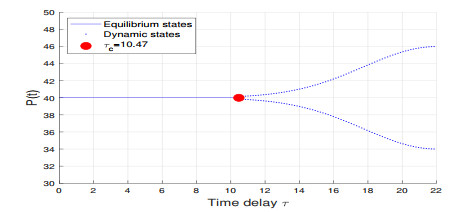
Time delay-induced Hopf bifurcation diagram



 DownLoad: