Smart-city digital twins rely on visual observations collected by distributed sensing devices in heterogeneous urban environments. For camera-based sensing, wireless image transmission is an important communication-layer function because visual data must be delivered from edge devices to edge servers or digital-twin platforms for reconstruction and machine analysis. Deep joint source-channel coding (D-JSCC) improves wireless image transmission by jointly learning source and channel coding, but conventional methods mainly optimize pixel-level distortion and may not preserve task-relevant semantic information. This paper proposes a semantic-fidelity enhanced D-JSCC framework, termed S-JSCC, for wireless visual sensing. S-JSCC introduces teacher-guided semantic supervision that combines supervised contrastive representation with attribution consistency guided by gradient-weighted class activation mapping (Grad-CAM), encouraging reconstructions to preserve both global semantic structure and local task-sensitive responses. Experiments on CIFAR-10 and KITTI under additive white Gaussian noise (AWGN) and simplified Rayleigh fading channels show that S-JSCC improves peak signal-to-noise ratio (PSNR) and recognition accuracy compared with D-JSCC and contrastive JSCC baselines.
Citation: Yang Wang, Shantong Sun, Hanjun Duan, Ziwei Tang. Semantic-fidelity enhanced deep joint source-channel coding for wireless visual sensing in smart-city digital twins[J]. Networks and Heterogeneous Media, 2026, 21(7): 2504-2525. doi: 10.3934/nhm.2026093
Smart-city digital twins rely on visual observations collected by distributed sensing devices in heterogeneous urban environments. For camera-based sensing, wireless image transmission is an important communication-layer function because visual data must be delivered from edge devices to edge servers or digital-twin platforms for reconstruction and machine analysis. Deep joint source-channel coding (D-JSCC) improves wireless image transmission by jointly learning source and channel coding, but conventional methods mainly optimize pixel-level distortion and may not preserve task-relevant semantic information. This paper proposes a semantic-fidelity enhanced D-JSCC framework, termed S-JSCC, for wireless visual sensing. S-JSCC introduces teacher-guided semantic supervision that combines supervised contrastive representation with attribution consistency guided by gradient-weighted class activation mapping (Grad-CAM), encouraging reconstructions to preserve both global semantic structure and local task-sensitive responses. Experiments on CIFAR-10 and KITTI under additive white Gaussian noise (AWGN) and simplified Rayleigh fading channels show that S-JSCC improves peak signal-to-noise ratio (PSNR) and recognition accuracy compared with D-JSCC and contrastive JSCC baselines.

| [1] |
M. Yessef, Y. Hakam, M. Tabaa, M. M. Alammar, Z. M. S. Elbarbary, Digital twin technology in smart cities: A step toward intelligent urban management, Energy Rep., 14 (2025), 5539–5557. https://doi.org/10.1016/j.egyr.2025.11.097 doi: 10.1016/j.egyr.2025.11.097
|
| [2] |
M. Alvi, H. Dutta, R. Minerva, N. Crespi, S. M. Raza, M. Herath, Global perspectives on digital twin smart cities: Innovations, challenges, and pathways to a sustainable urban future, Sustain. Cities Soc., 126 (2025), 106356. https://doi.org/10.1016/j.scs.2025.106356 doi: 10.1016/j.scs.2025.106356
|
| [3] |
T. A. Jauhar, S. Han, T. H. Khan, C. Noh, A. Lavrinec, An implementation of sensor network to assess near real-time digital twin fidelity, Cyber-Phys. Syst., 12 (2026), 366–389. https://doi.org/10.1080/23335777.2026.2613415 doi: 10.1080/23335777.2026.2613415
|
| [4] |
R. Prenger, R. Valle, B. Catanzaro, Waveglow: A flow-based generative network for speech synthesis, in ICASSP 2019 - 2019 IEEE International Conference on Acoustics, Speech and Signal Processing (ICASSP), Brighton, UK, 2019, 3617–3621. https://doi.org/10.1109/ICASSP.2019.8683143 |
| [5] |
E. Bourtsoulatze, D. B. Kurka, D. Gündüz, Deep joint source-channel coding for wireless image transmission, IEEE Trans. Cogn. Commun. Netw., 5 (2019), 567–579. https://doi.org/10.1109/TCCN.2019.2919300 doi: 10.1109/TCCN.2019.2919300
|
| [6] |
D. B. Kurka, D. Gündüz, DeepJSCC-F: Deep joint source-channel coding of images with feedback, IEEE J. Sel. Areas Inf. Theory, 1 (2020), 178–193. https://doi.org/10.1109/JSAIT.2020.2987203 doi: 10.1109/JSAIT.2020.2987203
|
| [7] |
M. Yang, H. S. Kim, Deep joint source-channel coding for wireless image transmission with adaptive rate control, in ICASSP 2022 - 2022 IEEE International Conference on Acoustics, Speech and Signal Processing (ICASSP), Singapore, Singapore, 2022, 5193–5197. https://doi.org/10.1109/ICASSP43922.2022.9746335 |
| [8] |
D. B. Kurka, D. Gündüz, Bandwidth-agile image transmission with deep joint source-channel coding, IEEE Trans. Wireless Commun., 20 (2021), 8081–8095. https://doi.org/10.1109/TWC.2021.3090048 doi: 10.1109/TWC.2021.3090048
|
| [9] |
M. Yang, C. Bian, H. S. Kim, OFDM-guided deep joint source channel coding for wireless multipath fading channels, IEEE Trans. Cogn. Commun. Netw., 8 (2022), 584–599. https://doi.org/10.1109/TCCN.2022.3151935 doi: 10.1109/TCCN.2022.3151935
|
| [10] |
N. Huang, W. Hua, L. Chen, MI-based joint source channel coding for wireless image transmission, in 2023 IEEE/CIC International Conference on Communications in China (ICCC), Dalian, China, 2023, 1–6. https://doi.org/10.1109/ICCC57788.2023.10233378 |
| [11] |
W. Hua, D. Chen, J. Fang, L. Chen, J. F. C. Mota, X. Hong, Semantics-guided contrastive joint source-channel coding for image transmission, in 2022 14th International Conference on Wireless Communications and Signal Processing (WCSP), Nanjing, China, 2022,505–510. https://doi.org/10.1109/WCSP55476.2022.10039111 |
| [12] |
S. Tang, Q. Yang, L. Fan, X. Lei, Y. Deng, A. Nallanathan, Contrastive learning based semantic communication for wireless image transmission, in 2023 IEEE 98th Vehicular Technology Conference (VTC2023-Fall), Hong Kong, 2023, 1–6. https://doi.org/10.1109/VTC2023-Fall60731.2023.10333392 |
| [13] |
J. Feng, G. Cao, J. Liu, Z. Wang, Z. Liu, Y. Ding, Deep joint source-channel coding for wireless image transmission with auxiliary semantics, Phys. Commun., 73 (2025), 102836. https://doi.org/10.1016/j.phycom.2025.102836 doi: 10.1016/j.phycom.2025.102836
|
| [14] |
A. D. Raha, A. Adhikary, M. Gain, Y. Park, W. Saad, C. S. Hong, DD-JSCC: Dynamic deep joint source-channel coding for semantic communications, in ICC 2025 - IEEE International Conference on Communications, Montreal, QC, Canada, 2025, 3754–3759. https://doi.org/10.1109/ICC52391.2025.11162089 |
| [15] |
X. Li, D. Ban, Z. Ruan, X. Yue, H. Chen, Y. Sun, A star modulation network for wireless image semantic transmission, Sci. Rep., 15 (2025), 31127. https://doi.org/10.1038/s41598-025-16753-4 doi: 10.1038/s41598-025-16753-4
|
| [16] |
W. Hua, L. Xiong, S. Liu, L. Chen, X. Hong, J. F. C. Mota, Classification-driven discrete neural representation learning for semantic communications, IEEE Internet Things J., 11 (2024), 16061–16073. https://doi.org/10.1109/JIOT.2024.3354312 doi: 10.1109/JIOT.2024.3354312
|
| [17] |
L. Xiong, W. Hua, X. Hong, X. Cheng, Semantic-oriented feature compression for resource-constrained distributed sensor networks, in 2024 IEEE Wireless Communications and Networking Conference (WCNC), Dubai, United Arab Emirates, 2024, 1–6. https://doi.org/10.1109/WCNC57260.2024.10570935 |
| [18] |
D. Chen, W. Hua, Hierarchical VAE based semantic communications for POMDP tasks, in ICASSP 2024 - 2024 IEEE International Conference on Acoustics, Speech and Signal Processing (ICASSP), Seoul, South Korea, 2024, 5540–5544. https://doi.org/10.1109/ICASSP48485.2024.10445833 |
| [19] |
C. Liang, D. Li, Generative AI-enabled semantic communication: State-of-the-art, applications, and the way ahead, IEEE Commun. Surv. Tutor., 28 (2026), 3976–4015. https://doi.org/10.1109/COMST.2025.3649707 doi: 10.1109/COMST.2025.3649707
|
| [20] |
C. Liang, D. Li, Image generation with supervised selection based on multimodal features for semantic communications, IEEE Trans. Commun., 73 (2025), 14469–14485. https://doi.org/10.1109/TCOMM.2025.3615798 doi: 10.1109/TCOMM.2025.3615798
|
| [21] |
C. Liang, D. Li, Joint source-channel noise adding with adaptive denoising for diffusion-based semantic communications, IEEE Internet Things J., 12 (2025), 45909–45912. https://doi.org/10.1109/JIOT.2025.3589398 doi: 10.1109/JIOT.2025.3589398
|
| [22] |
P. Huang, D. Li, Exploring textual semantics diversity for image transmission in semantic communication systems, IEEE Trans. Commun., 74 (2026), 10602–10611. https://doi.org/10.1109/TCOMM.2026.3704182 doi: 10.1109/TCOMM.2026.3704182
|
| [23] |
Q. Wu, F. Liu, H. Xia, T. Zhang, Semantic transfer between different tasks in the semantic communication system, in 2022 IEEE Wireless Communications and Networking Conference (WCNC), Austin, TX, USA, 2022,566–571. https://doi.org/10.1109/WCNC51071.2022.9771768 |
| [24] |
Q. Sun, C. Guo, Y. Yang, J. Chen, R. Tang, C. Liu, Deep joint source-channel coding for wireless image transmission with semantic importance, preprint, arXiv: 2302.02287. https://doi.org/10.48550/arXiv.2302.02287 |
| [25] |
Q. Hu, G. Zhang, Z. Qin, Y. Cai, G. Yu, G. Y. Li, Robust semantic communications with masked VQ-VAE enabled codebook, IEEE Trans. Wireless Commun., 22 (2023), 8707–8722. https://doi.org/10.1109/TWC.2023.3265201 doi: 10.1109/TWC.2023.3265201
|
| [26] |
F. Kalantari, K. Faez, H. Amindavar, S. Nazari, Improved image reconstruction from brain activity through automatic image captioning, Sci. Rep., 15 (2025), 4907. https://doi.org/10.1038/s41598-025-89242-3 doi: 10.1038/s41598-025-89242-3
|
| [27] |
T. Chen, S. Kornblith, M. Norouzi, G. Hinton, A simple framework for contrastive learning of visual representations, in Proceedings of the 37th International Conference on Machine Learning, 119 (2020), 1597–1607. Available from: https://proceedings.mlr.press/v119/chen20j.html. |
| [28] |
D. Gao, W. Hua, W. Su, Z. Xu, K. Chen, Supervised contrastive learning-based modulation classification of underwater acoustic communication, Wirel. Commun. Mob. Comput., 2022 (2022), 3995331. https://doi.org/10.1155/2022/3995331 doi: 10.1155/2022/3995331
|
| [29] |
P. Khosla, P. Teterwak, C. Wang, A. Sarna, Y. Tian, P. Isola, et al., Supervised contrastive learning, in Proceedings of the 34th International Conference on Neural Information Processing Systems (NIPS'20), 2020, 18661–18673. Available from: https://dl.acm.org/doi/abs/10.5555/3495724.3497291. |
| [30] |
R. R. Selvaraju, M. Cogswell, A. Das, R. Vedantam, D. Parikh, Dhruv Batra, Grad-CAM: Visual explanations from deep networks via gradient-based localization, in 2017 IEEE International Conference on Computer Vision (ICCV), Venice, Italy, 2017,618–626. https://doi.org/10.1109/ICCV.2017.74 |
| [31] |
Z. Wang, H. Li, A multi-task training semantic communication system for image reconstruction and classification tasks, J. Imaging, 12 (2026), 367. https://doi.org/10.3390/jimaging12080367 doi: 10.3390/jimaging12080367
|
| [32] |
A. Krizhevsky, Learning Multiple Layers of Features from Tiny Images, University of Toronto, Technical Report, 2009. Available from: https://www.cs.toronto.edu/kriz/learning-features-2009-TR.pdf. |
| [33] |
A. Geiger, P. Lenz, C. Stiller, R. Urtasun, Vision meets robotics: The KITTI dataset, Int. J. Robot. Res., 32 (2013), 1231–1237. https://doi.org/10.1177/0278364913491297 doi: 10.1177/0278364913491297
|
| [34] |
K. He, X. Zhang, S. Ren, J. Sun, Deep residual learning for image recognition, in 2016 IEEE Conference on Computer Vision and Pattern Recognition (CVPR), Las Vegas, NV, USA, 2016,770–778. https://doi.org/10.1109/CVPR.2016.90 |
| [35] |
K. Simonyan, A. Zisserman, Very deep convolutional networks for large-scale image recognition, in International Conference on Learning Representations, 2015. Available from: https://mlanthology.org/iclr/2015/simonyan2015iclr-very/. |
| [36] |
R. Girshick, J. Donahue, T. Darrell, J. Malik, Rich feature hierarchies for accurate object detection and semantic segmentation, in 2014 IEEE Conference on Computer Vision and Pattern Recognition, Columbus, OH, USA, 2014,580–587. https://doi.org/10.1109/CVPR.2014.81 |
| [37] |
J. Long, E. Shelhamer, T. Darrell, Fully convolutional networks for semantic segmentation, in 2015 IEEE Conference on Computer Vision and Pattern Recognition (CVPR), Boston, MA, USA, 2015, 3431–3440. https://doi.org/10.1109/CVPR.2015.7298965 |
Figures(9) / Tables(4)
Yang Wang, Shantong Sun, Hanjun Duan, Ziwei Tang. Semantic-fidelity enhanced deep joint source-channel coding for wireless visual sensing in smart-city digital twins[J]. Networks and Heterogeneous Media, 2026, 21(7): 2504-2525. doi: 10.3934/nhm.2026093

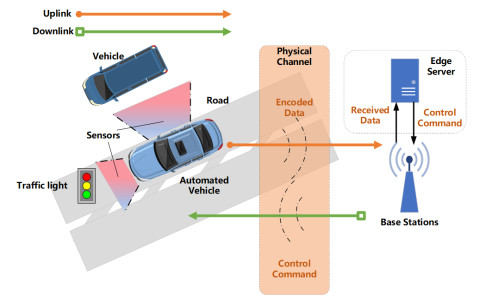
An edge-assisted visual sensing scenario for wireless image transmission toward smart-city digital twins
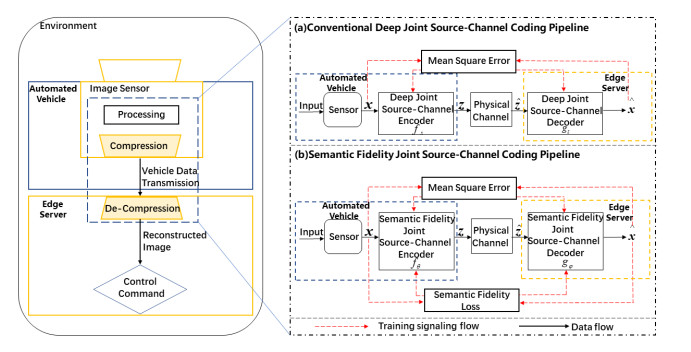
Overview of the considered wireless image transmission framework. (a) Conventional D-JSCC framework [4,5]. (b) The proposed S-JSCC framework
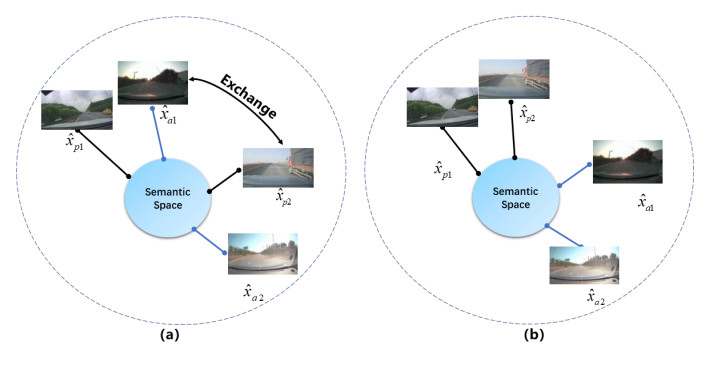
Conceptual illustration of semantic-space regularization. The image thumbnails represent reconstructed samples from two illustrative groups, distinguished by black and blue links to the semantic space. (a) Channel distortion may disturb their semantic relationships; the "Exchange" arrow depicts this possible displacement, not a sample-swapping operation. (b) Contrastive supervision encourages preservation of the intended group relationships. The layout is schematic and does not report measured embedding distances or a high-resolution KITTI evaluation
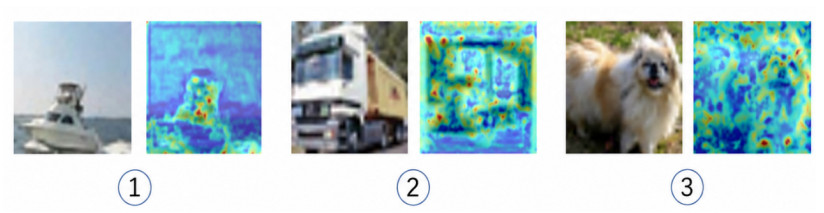
Examples of reconstructed images and their corresponding Grad-CAM responses for local semantic-fidelity supervision
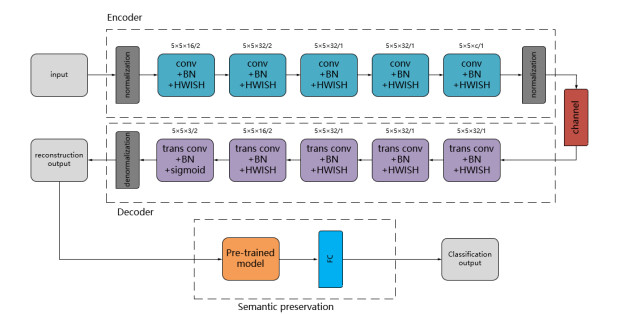
DNN architecture and implementation configuration
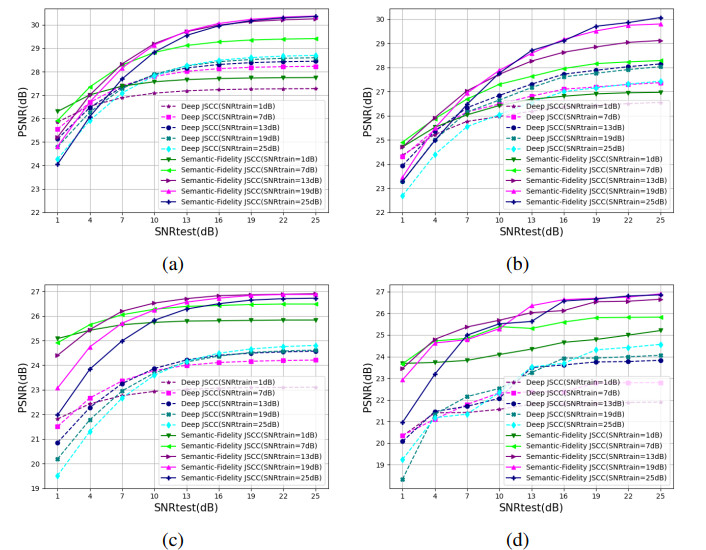
Reconstruction quality of D-JSCC and S-JSCC under different training SNRs ($ K = 500 $). (a) CIFAR-10 under AWGN; (b) CIFAR-10 under Rayleigh fading; (c) KITTI under AWGN; (d) KITTI under Rayleigh fading
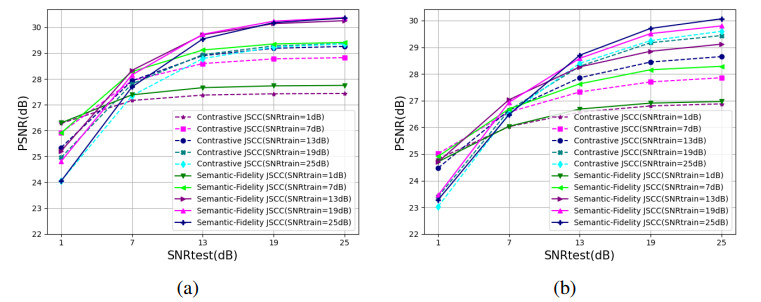
PSNR comparison between C-JSCC [11] and S-JSCC on CIFAR-10 with $ K = 500 $. (a) AWGN channel; (b) Rayleigh fading channel
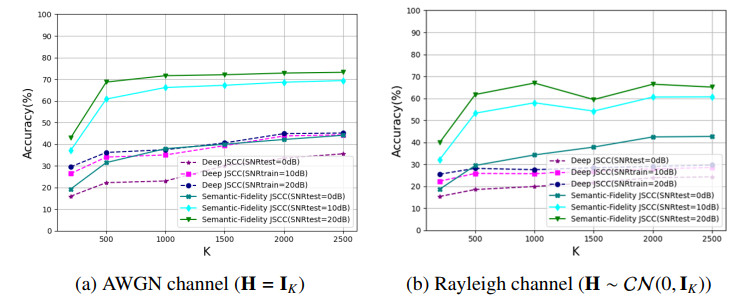
Recognition accuracy of reconstructed images using S-JSCC trained at SNR$ _\text{train} = 20 $ dB under different compression ratios and test SNRs. (a) AWGN channel; (b) Rayleigh fading channel
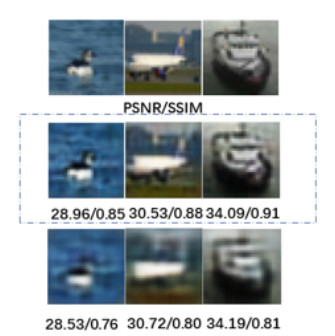
Visual comparison of S-JSCC and D-JSCC under similar PSNR/SSIM values. The text below each image reports PSNR/SSIM; blue boxes denote S-JSCC results, and the last row denotes D-JSCC results



 DownLoad: