With the advent of the data-intelligence era, the risk of rumor propagation on online social networks is increasingly threatening the security of online ideology. By deploying the truth to capture the high ground of public opinion and create a favorable ecological environment for online public opinion, the breeding ground of rumors can be thoroughly eradicated, and the discourse power of online public opinion can be firmly grasped. Therefore, this paper focuses on the problem of time-sensitive dominant competitive influence maximization. Without knowing the opponent's strategy, a truth source selection algorithm for directed signed social networks is proposed to gain greater competitive advantages, seize the strategic dominant position, and proactively shape an overall favorable trend for future public opinion development. First, the structural balance theory and the echo chamber effect are utilized to optimize the dissemination rules, and a continuous opinion competition propagation model suitable for directed signed social networks is proposed. Second, by using directed signed graph embedding and mixed-strategy Nash equilibrium, the state space and action space are reconstructed, and a truth source selection algorithm integrating game theory and double deep Q-network is proposed. Finally, experiments are conducted on four real social network datasets. The results show that the algorithm proposed in this paper further improves the quality of the positive seed set compared with state-of-the-art algorithms and has good robustness and interpretability. Meanwhile, in addition to the placement of truth sources, this paper also discusses the effects of the number and duration of their deployment on intervention outcomes, thereby forming a comprehensive deployment plan for truth sources and providing actionable practical guidance for strategic decision-making in rumor governance.
Citation: Ying Guo, Yong-nan Li. Integrating game theory and reinforcement learning for optimizing truth source selection strategies: A time-sensitive influence maximization method in signed social networks[J]. Networks and Heterogeneous Media, 2026, 21(7): 2468-2503. doi: 10.3934/nhm.2026092
With the advent of the data-intelligence era, the risk of rumor propagation on online social networks is increasingly threatening the security of online ideology. By deploying the truth to capture the high ground of public opinion and create a favorable ecological environment for online public opinion, the breeding ground of rumors can be thoroughly eradicated, and the discourse power of online public opinion can be firmly grasped. Therefore, this paper focuses on the problem of time-sensitive dominant competitive influence maximization. Without knowing the opponent's strategy, a truth source selection algorithm for directed signed social networks is proposed to gain greater competitive advantages, seize the strategic dominant position, and proactively shape an overall favorable trend for future public opinion development. First, the structural balance theory and the echo chamber effect are utilized to optimize the dissemination rules, and a continuous opinion competition propagation model suitable for directed signed social networks is proposed. Second, by using directed signed graph embedding and mixed-strategy Nash equilibrium, the state space and action space are reconstructed, and a truth source selection algorithm integrating game theory and double deep Q-network is proposed. Finally, experiments are conducted on four real social network datasets. The results show that the algorithm proposed in this paper further improves the quality of the positive seed set compared with state-of-the-art algorithms and has good robustness and interpretability. Meanwhile, in addition to the placement of truth sources, this paper also discusses the effects of the number and duration of their deployment on intervention outcomes, thereby forming a comprehensive deployment plan for truth sources and providing actionable practical guidance for strategic decision-making in rumor governance.

| [1] |
Y. Guo, Y. N. Li, Multiple rumor source localization in signed social networks driven by data intelligence, AIMS Math., 11 (2026), 1927–1953. https://doi.org/10.3934/math.2026080 doi: 10.3934/math.2026080
|
| [2] |
W. Zhu, Y. Huang, S. Yang, Y. Miao, C. Peng, A positive influence maximization algorithm in signed social networks, Comput. Mater. Contin., 76 (2023), 1977–1994. https://doi.org/10.32604/cmc.2023.040998 doi: 10.32604/cmc.2023.040998
|
| [3] |
C. Dong, G. Q. Xu, L. Meng, CRB: A new rumor blocking algorithm in online social networks based on competitive spreading model and influence maximization, Chin. Phys. B, 33 (2024), 088901. https://doi.org/10.1088/1674-1056/ad531f doi: 10.1088/1674-1056/ad531f
|
| [4] |
D. Li, Y. Wang, M. Li, X. Sun, J. Pan, J. Ma, Net positive influence maximization in signed social networks, J. Intell. Fuzzy Syst., 41 (2021), 3821–3832. https://doi.org/10.3233/JIFS-191908 doi: 10.3233/JIFS-191908
|
| [5] |
S. Kumar, A. Mallik, B. S. Panda, Influence maximization in social networks using transfer learning via graph-based LSTM, Expert Syst. Appl., 212 (2023), 118770. https://doi.org/10.1016/j.eswa.2022.118770 doi: 10.1016/j.eswa.2022.118770
|
| [6] |
L. Ma, Z. Shao, X. Li, Q. Lin, J. Li, V. C. M. Leung, et al., Influence maximization in complex networks by using evolutionary deep reinforcement learning, IEEE Trans. Emerg. Top. Comput. Intell., 7 (2023), 995–1009. https://doi.org/10.1109/TETCI.2021.3136643 doi: 10.1109/TETCI.2021.3136643
|
| [7] |
C. Guo, W. Li, F. Liu, K. Zhong, X. Wu, Y. Zhao, et al., Influence maximization algorithm based on group trust and local topology structure, Neurocomputing, 564 (2024), 126936. https://doi.org/10.1016/j.neucom.2023.126936 doi: 10.1016/j.neucom.2023.126936
|
| [8] |
W. Zhu, K. Zhang, J. Zhong, C. Hou, J. Ji, BiGDN: An end-to-end influence maximization framework based on deep reinforcement learning and graph neural networks, Expert Syst. Appl., 270 (2025), 126384. https://doi.org/10.1016/j.eswa.2025.126384 doi: 10.1016/j.eswa.2025.126384
|
| [9] |
H. Li, L. Pan, P. Wu, Dominated competitive influence maximization with time-critical and time-delayed diffusion in social networks, J. Comput. Sci., 28 (2018), 318–327. https://doi.org/10.1016/j.jocs.2017.10.015 doi: 10.1016/j.jocs.2017.10.015
|
| [10] |
A. I. E. Hosni, K. Li, C. Ding, S. Ahmed, Least cost rumor influence minimization in multiplex social networks, in Proceedings of the 25th International Conference on Neural Information Processing, (2018), 93–105. https://doi.org/10.1007/978-3-030-04224-0_9 |
| [11] |
D. T. Nguyen, H. Zhang, S. Das, M. T. Thai, T. N. Dinh, Least cost influence in multiplex social networks: Model representation and analysis, in Proceedings of the 13th International Conference on Data Mining, (2013), 567–576. https://doi.org/10.1109/ICDM.2013.24 |
| [12] |
Q. He, X. Wang, Y. Zhao, B. Yi, X. Lu, M. Yang, M. Huang, Reinforcement-learning-based competitive opinion maximization approach in signed social networks, IEEE Trans. Comput. Soc. Syst., 9 (2022), 1505–1514. https://doi.org/10.1109/TCSS.2021.3120421 doi: 10.1109/TCSS.2021.3120421
|
| [13] |
L. Yu, T. Yang, C. Yao, D. Fu, Y. Wang, Opinion maximization on social trust networks based on game theory and DQN method, Inf. Sci., 729 (2026), 122879. https://doi.org/10.1016/j.ins.2025.122879 doi: 10.1016/j.ins.2025.122879
|
| [14] |
Q. He, L. Zhang, H. Fang, X. Wang, L. Ma, K. Yu, et al., Multistage competitive opinion maximization with Q-learning-based method in social networks, IEEE Trans. Neural Netw. Learn. Syst., 36 (2025), 7158–7168. https://doi.org/10.1109/TNNLS.2024.3387293 doi: 10.1109/TNNLS.2024.3387293
|
| [15] |
A. Hevapathige, Q. Wang, A. N. Zehmakan, DeepSN: A sheaf neural framework for influence maximization, in Proceedings of the 39th Annual AAAI Conference on Artificial Intelligence, (2025), 17177–17185. https://doi.org/10.1609/aaai.v39i16.33888 |
| [16] |
W. Zhu, K. Zhang, Y. Bai, A. Yu, Deep reinforcement learning-based algorithm for maximizing the influence of location-based social networks, Neurocomputing, 671 (2026), 132747. https://doi.org/10.1016/j.neucom.2026.132747 doi: 10.1016/j.neucom.2026.132747
|
| [17] |
Y. Zou, G. Li, Y. Wang, B. Ning, S. Wang, Topic-aware influence maximization based on deep reinforcement learning and group relative optimization, Appl. Soft Comput., 192 (2026), 114786. https://doi.org/10.1016/j.asoc.2026.114786 doi: 10.1016/j.asoc.2026.114786
|
| [18] |
Y. Wang, Y. Zhang, F. Yang, D. Li, X. Sun, J. Ma, Time-sensitive positive influence maximization in signed social networks, Phys. A, 584 (2021), 126353. https://doi.org/10.1016/j.physa.2021.126353 doi: 10.1016/j.physa.2021.126353
|
| [19] |
Q. He, H. Du, Z. Liang, Positive influence maximization in signed networks within a limited time, IEEE Trans. Comput. Soc. Syst., 10 (2023), 2624–2635. https://doi.org/10.1109/TCSS.2022.3192410 doi: 10.1109/TCSS.2022.3192410
|
| [20] |
C. E. Sung, H. S. Ma, J. W. Huang, Positive influence maximization and negative influence minimization in signed networks under competitive independent cascade model, in Proceedings of the 7th International Conference on Data Science and Advanced Analytics, (2020), 236–244. https://doi.org/10.1109/DSAA49011.2020.00036 |
| [21] |
Y. Li, H. Gao, Y. Gao, J. Guo, W. Wu, A survey on influence maximization: From an ML-based combinatorial optimization, ACM Trans. Knowl. Discov. Data, 17 (2023), 133. https://doi.org/10.1145/3604559 doi: 10.1145/3604559
|
| [22] |
H. Li, M. Xu, S. S. Bhowmick, J. S. Rayhan, C. Sun, J. Cui, PIANO: Influence maximization meets deep reinforcement learning, IEEE Trans. Comput. Soc. Syst., 10 (2023), 1288–1300. https://doi.org/10.1109/TCSS.2022.3164667 doi: 10.1109/TCSS.2022.3164667
|
| [23] |
T. Chen, S. Yan, J. Guo, W. Wu, ToupleGDD: A fine-designed solution of influence maximization by deep reinforcement learning, IEEE Trans. Comput. Soc. Syst., 11 (2024), 2210–2221. https://doi.org/10.1109/TCSS.2023.3272331 doi: 10.1109/TCSS.2023.3272331
|
| [24] |
J. Wang, Z. Cao, C. Xie, Y. Li, J. Liu, Z. S. Gao, DGN: Influence maximization based on deep reinforcement learning, J. Supercomput., 81 (2025), 130. https://doi.org/10.1007/s11227-024-06621-9 doi: 10.1007/s11227-024-06621-9
|
| [25] |
D. Kempe, J. Kleinberg, É. Tardos, Maximizing the spread of influence through a social network, in Proceedings of the ninth ACM SIGKDD International Conference on Knowledge Discovery and Data Mining, (2003), 137–146. https://doi.org/10.1145/956750.956769 |
| [26] |
E. Yildiz, A. Ozdaglar, D. Acemoglu, A. Saberi, A. Scaglione, Binary opinion dynamics with stubborn agents, ACM Trans. Econ. Comput., 1 (2013), 19. https://doi.org/10.1145/2538508 doi: 10.1145/2538508
|
| [27] |
L. Vassio, F. Fagnani, P. Frasca, A. Ozdaglar, Message passing optimization of harmonic influence centrality, IEEE Trans. Control Netw. Syst., 1 (2014), 109–120. https://doi.org/10.1109/TCNS.2014.2304870 doi: 10.1109/TCNS.2014.2304870
|
| [28] |
M. Bini, P. Frasca, C. Ravazzi, F. Dabbene, Graph structure-based heuristics for optimal targeting in social networks, IEEE Trans. Control Netw. Syst., 9 (2022), 1189–1201. https://doi.org/10.1109/TCNS.2022.3163665 doi: 10.1109/TCNS.2022.3163665
|
| [29] |
Q. Zhang, D. Chen, L. M. Kaplan, A. Jøsang, D. H. Jeong, F. Chen, et al., Beyond binary opinions: A deep reinforcement learning-based approach to uncertainty-aware competitive influence maximization, IEEE Trans. Netw. Sci. Eng., 13 (2026), 2219–2235. https://doi.org/10.1109/TNSE.2025.3611330 doi: 10.1109/TNSE.2025.3611330
|
| [30] |
F. K. Chang, S. C. Li, J. W. Huang, Efficient influence maximization in signed networks with positive influence increasing and negative influence decreasing simultaneously via edge-view influence estimation, in Social Networks Analysis and Mining, ASONAM 2025, Lecture Notes in Computer Science, Springer, Cham, 16322 (2026), 142–150. https://doi.org/10.1007/978-3-032-13513-1_12 |
| [31] |
Y. Liu, Y. Zhong, X. Li, P. Zhu, Z. Wang, Vital nodes identification via evolutionary algorithm with percolation optimization in complex networks, IEEE Trans. Netw. Sci. Eng., 11 (2024), 3838–3850. https://doi.org/10.1109/TNSE.2024.3388994 doi: 10.1109/TNSE.2024.3388994
|
| [32] |
N. Wang, W. Xie, V. Tiberius, Y. Qiu, Accelerating new product diffusion: How lead users serve as opinion leaders in social networks, J. Retail. Consum. Serv., 72 (2023), 103297. https://doi.org/10.1016/j.jretconser.2023.103297 doi: 10.1016/j.jretconser.2023.103297
|
| [33] |
S. Bharathi, D. Kempe, M. Salek, Competitive influence maximization in social networks, in Internet and Network Economics, WINE 2007, Lecture Notes in Computer Science, Springer, Berlin, Heidelberg, 4858 (2007), 306–311. https://doi.org/10.1007/978-3-540-77105-0_31 |
| [34] |
X. He, G. Song, W. Chen, Q. Jiang, Influence blocking maximization in social networks under the competitive linear threshold model, in Proceedings of the 2012 SIAM International Conference on Data Mining, (2012), 463–474. https://doi.org/10.1137/1.9781611972825.40 |
| [35] |
N. E. Friedkin, E. C. Johnsen, Social influence and opinions, J. Math. Sociol., 15 (1990), 193–206. https://doi.org/10.1080/0022250X.1990.9990069 doi: 10.1080/0022250X.1990.9990069
|
| [36] |
H. Zhang, Y. Li, Y. Chen, H. V. Zhao, Smart evolution for information diffusion over social networks, IEEE Trans. Inf. Forensics Secur., 16 (2021), 1203–1217. https://doi.org/10.1109/tifs.2020.3032039 doi: 10.1109/tifs.2020.3032039
|
| [37] |
F. Heider, Attitudes and cognitive organization, J. Psychol., 21 (1946), 107–112. https://doi.org/10.1080/00223980.1946.9917275 doi: 10.1080/00223980.1946.9917275
|
| [38] |
D. Cartwright, F. Harary, Structural balance: A generalization of Heider's theory, Psychol. Rev., 63 (1956), 277–293. https://doi.org/10.1037/h0046049 doi: 10.1037/h0046049
|
| [39] |
D. Choi, S. Chun, H. Oh, J. Han, T. Kwon, Rumor propagation is amplified by echo chambers in social media, Sci. Rep., 10 (2020), 310. https://doi.org/10.1038/s41598-019-57272-3 doi: 10.1038/s41598-019-57272-3
|
| [40] |
M. Cinelli, G. D. F. Morales, A. Galeazzi, W. Quattrociocchi, M. Starnini, The echo chamber effect on social media, Proc. Natl. Acad. Sci. U. S. A., 118 (2021), e2023301118. https://doi.org/10.1073/pnas.2023301118 doi: 10.1073/pnas.2023301118
|
| [41] |
P. Cisneros-Velarde, K. S. Chan, F. Bullo, Polarization and fluctuations in signed social networks, IEEE Trans. Automat. Contr., 66 (2021), 3789–3793. https://doi.org/10.1109/TAC.2020.3024967 doi: 10.1109/TAC.2020.3024967
|
| [42] |
G. Shi, C. Altafini, J. S. Baras, Dynamics over signed networks, SIAM Rev., 61 (2019), 229–257. https://doi.org/10.1137/17M1134172 doi: 10.1137/17M1134172
|
| [43] |
Q. He, L. Sun, X. Wang, Z. Wang, M. Huang, B. Yi, et al., Positive opinion maximization in signed social networks, Inf. Sci., 558 (2021), 34–49. https://doi.org/10.1016/j.ins.2020.12.091 doi: 10.1016/j.ins.2020.12.091
|
| [44] |
Y. Liu, Y. Hu, S. Yu, X. Zhou, K. Li, Conformity-aware adoption maximization in competitive social networks, Neurocomputing, 573 (2024), 127224. https://doi.org/10.1016/j.neucom.2023.127224 doi: 10.1016/j.neucom.2023.127224
|
| [45] |
H. van Hasselt, A. Guez, D. Silver, Deep reinforcement learning with double Q-learning, in Proceedings of the AAAI Conference on Artificial Intelligence, 30 (2016), 2094–2100. https://doi.org/10.1609/aaai.v30i1.10295 doi: 10.1609/aaai.v30i1.10295
|
| [46] |
S. C. Lin, S. D. Lin, M. S. Chen, A learning-based framework to handle multi-round multi-party influence maximization on social networks, in Proceedings of the 21th ACM SIGKDD International Conference on Knowledge Discovery and Data Mining, (2015), 695–704. https://doi.org/10.1145/2783258.2783392 |
| [47] |
Y. Xiao, G. Kang, J. Liu, B. Cao, L. Ding, WSGCN4SLP: Weighted signed graph convolutional network for service link prediction, in Proceedings of the 2021 IEEE International Conference on Web Services, (2021), 135–144. https://doi.org/10.1109/ICWS53863.2021.00029 |
| [48] |
Y. Wu, L. Hu, Y. Wang, Signed attention based graph neural network for graphs with heterophily, Neurocomputing, 557 (2023), 126731. https://doi.org/10.1016/j.neucom.2023.126731 doi: 10.1016/j.neucom.2023.126731
|
| [49] |
F. Morone, H. A. Makse, Influence maximization in complex networks through optimal percolation, Nature, 524 (2015), 65–68. https://doi.org/10.1038/nature14604 doi: 10.1038/nature14604
|
| [50] |
Z. Zhao, X. Wang, W. Zhang, Z. Zhu, A community-based approach to identifying influential spreaders, Entropy, 17 (2015), 2228–2252. https://doi.org/10.3390/e17042228 doi: 10.3390/e17042228
|
| [51] |
J. Nash, Non-cooperative games, Ann. Math., 54 (1951), 286–295. https://doi.org/10.2307/1969529 doi: 10.2307/1969529
|
| [52] |
T. Schaul, J. Quan, I. Antonoglou, D. Silver, Prioritized experience replay, in Proceedings of the 2016 International Conference on Learning Representations, (2016). Available from: https://mlanthology.org/iclr/2016/schaul2016iclr-prioritized/. |
| [53] |
S. Kumar, B. Hooi, D. Makhija, M. Kumar, C. Faloutsos, V. S. Subrahmanian, REV2: Fraudulent user prediction in rating platforms, in Proceedings of the 11th ACM International Conference on Web Search and Data Mining, (2018), 333–341. https://doi.org/10.1145/3159652.3159729 |
| [54] |
R. West, H. S. Paskov, J. Leskovec, C. Potts, Exploiting social network structure for person-to-person sentiment analysis, Trans. Assoc. Comput. Linguist., 2 (2014), 297–310. https://doi.org/10.1162/tacl_a_00184 doi: 10.1162/tacl_a_00184
|
| [55] |
J. Leskovec, D. Huttenlocher, J. Kleinberg, Signed networks in social media, in Proceedings of the SIGCHI Conference on Human Factors in Computing Systems, (2010), 1361–1370. https://doi.org/10.1145/1753326.1753532 |
| [56] |
W. Chen, C. Wang, Y. Wang, Scalable influence maximization for prevalent viral marketing in large-scale social networks, in Proceedings of the 16th ACM SIGKDD International Conference on Knowledge Discovery and Data Mining, (2010), 1029–1038. https://doi.org/10.1145/1835804.1835934 |
Figures(9) / Tables(5)
Ying Guo, Yong-nan Li. Integrating game theory and reinforcement learning for optimizing truth source selection strategies: A time-sensitive influence maximization method in signed social networks[J]. Networks and Heterogeneous Media, 2026, 21(7): 2468-2503. doi: 10.3934/nhm.2026092

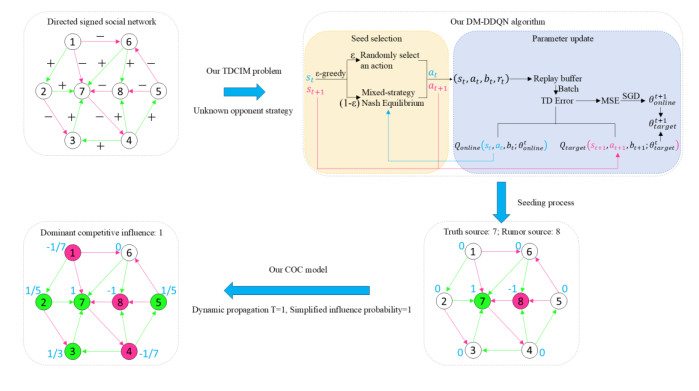
The overall process of truth source selection
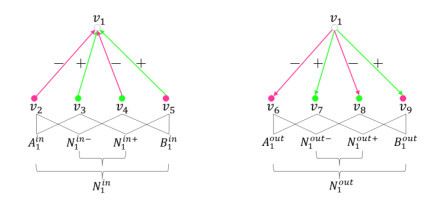
The set of in-degree/out-degree neighbors of node $ i $
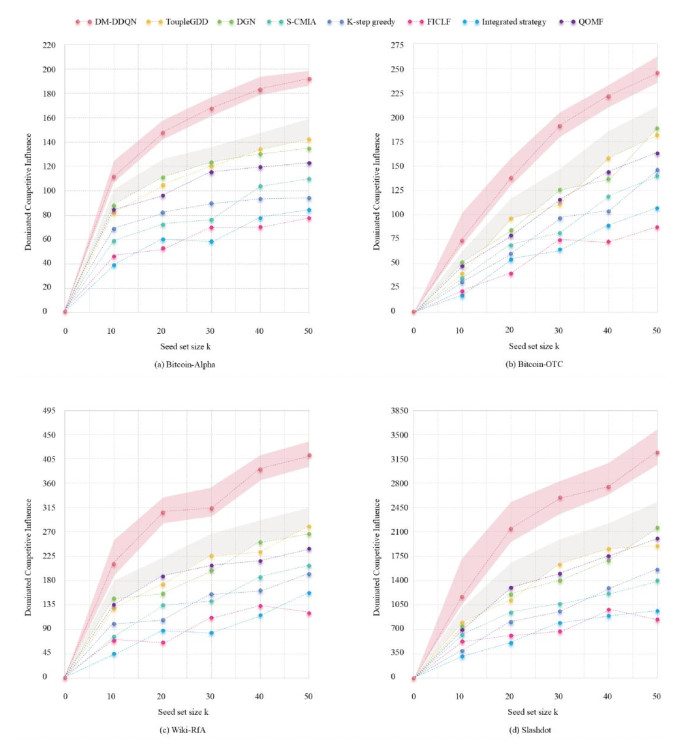
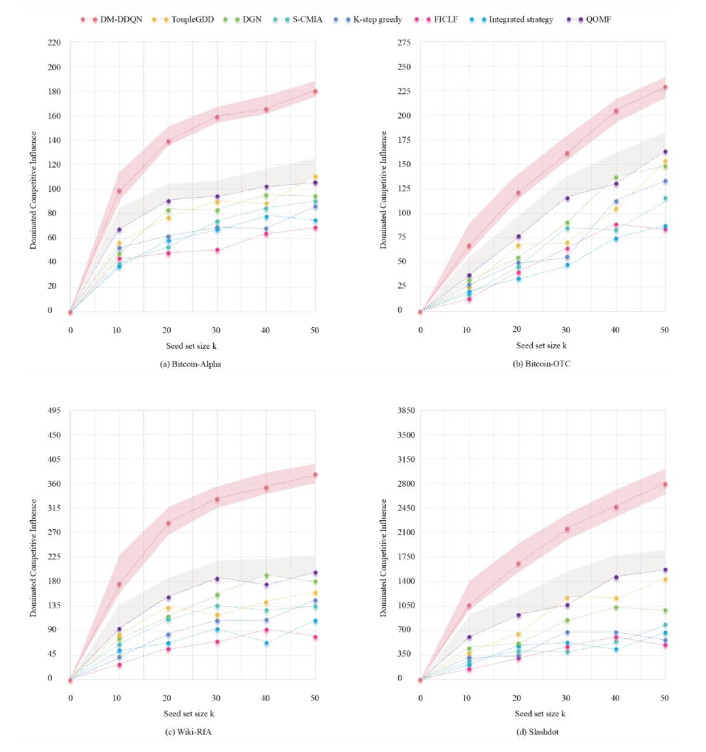
Performance comparison of seeding algorithms across different seed counts. (T = 50 and the opponent uses a random strategy.)
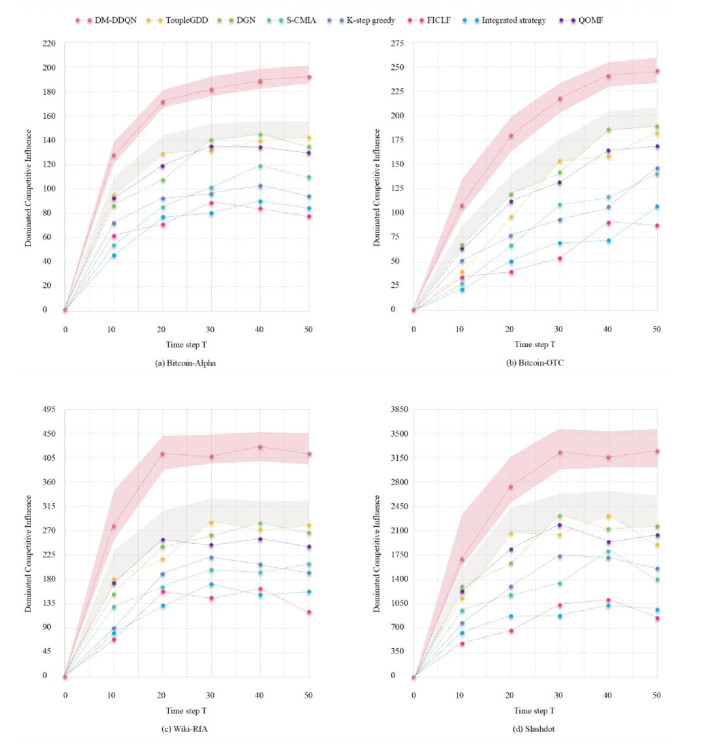
Performance comparison of seeding algorithms across different time steps. (k = 50 and the opponent adopts a random strategy.)
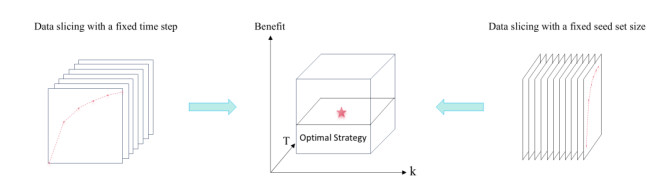
Schematic diagram of maximum dominant competitive influence under varying positive seed deployment strategies
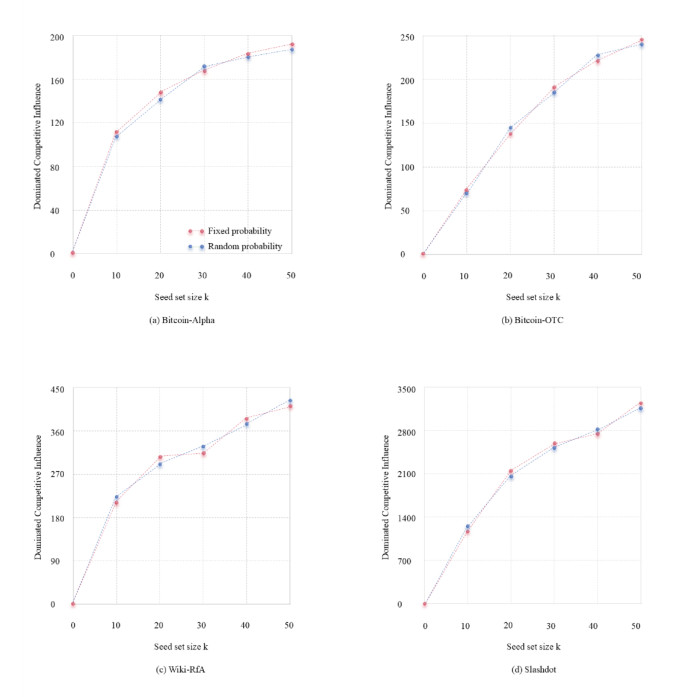
Performance comparison of seeding algorithms across different seed counts. (T = 50 and the opponent adopts an equilibrium strategy.)
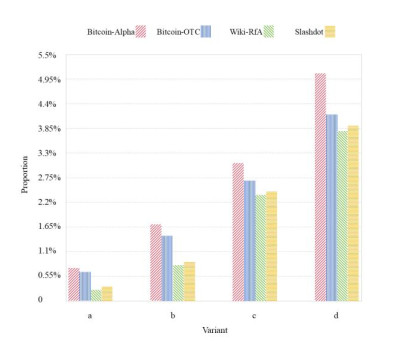
Comparison of propagation performance across different variants. Among them, a) serves as the baseline, b) improves the propagation rules, c) redesigns the state space of DDQN, and d) redesigns the action space of DDQN
Performance comparison under different values of $ \sigma $
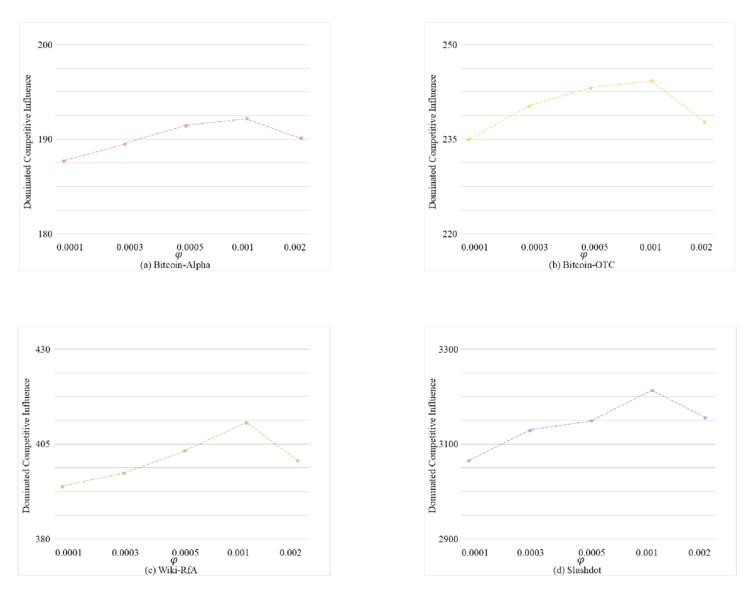
Performance comparison under different values of $ \varphi $



 DownLoad: