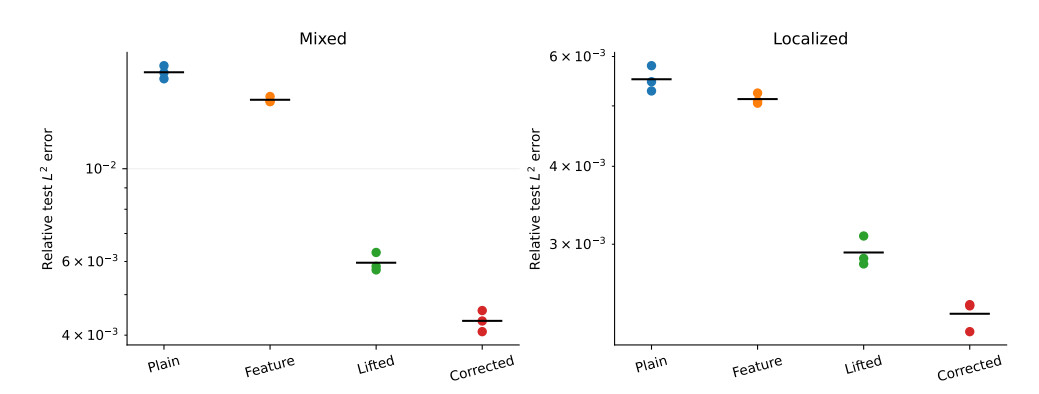
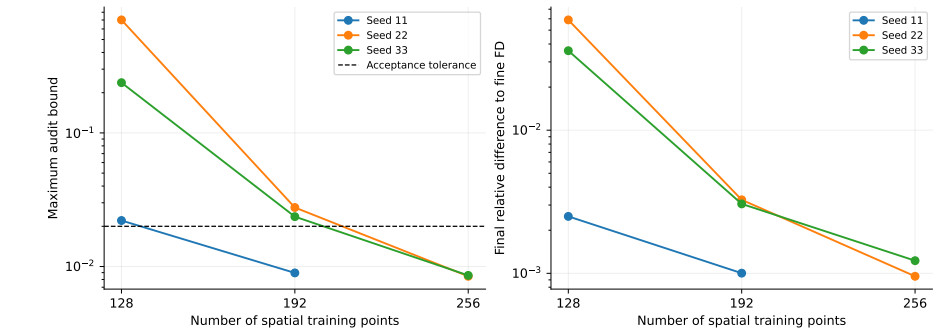
We developed a singularity-corrected fractional physics-informed neural network (fPINN) for the two-dimensional time-fractional Allen–Cahn equation. The trial function enforces the initial and homogeneous Dirichlet data and includes two fractional powers whose coefficients are determined by the initial data and forcing. The method evaluates the Caputo derivative of these terms analytically and applies the nonuniform L1 formula to the neural remainder. For the corrected L1 scheme with a five-point spatial stencil, the discrete residual gives a computable maximum-norm bound on the error relative to the discrete solution. The comparison uses the signs of the L1 coefficients and the one-sided Lipschitz property of the cubic reaction under an explicit time-step restriction. With additional regularity, temporal and spatial consistency estimates give an error bound at the nodes relative to the exact partial differential equation (PDE) solution. Over three random initializations, the correction reduced the mean relative $ L^2 $ test error by $ 74.6\% $ for the Mixed method and $ 57.9\% $ for the Localized method compared with the plain fPINN. In the unforced test, the maximum discrete error bound fell below $ 0.02 $ after one or two spatial enrichment stages in each of the three runs.
Citation: Lijie Liu, Leilei Wei. Residual bounds for singularity-corrected fractional physics-informed neural networks for the two-dimensional Allen–Cahn equation[J]. Networks and Heterogeneous Media, 2026, 21(7): 2556-2574. doi: 10.3934/nhm.2026095
We developed a singularity-corrected fractional physics-informed neural network (fPINN) for the two-dimensional time-fractional Allen–Cahn equation. The trial function enforces the initial and homogeneous Dirichlet data and includes two fractional powers whose coefficients are determined by the initial data and forcing. The method evaluates the Caputo derivative of these terms analytically and applies the nonuniform L1 formula to the neural remainder. For the corrected L1 scheme with a five-point spatial stencil, the discrete residual gives a computable maximum-norm bound on the error relative to the discrete solution. The comparison uses the signs of the L1 coefficients and the one-sided Lipschitz property of the cubic reaction under an explicit time-step restriction. With additional regularity, temporal and spatial consistency estimates give an error bound at the nodes relative to the exact partial differential equation (PDE) solution. Over three random initializations, the correction reduced the mean relative $ L^2 $ test error by $ 74.6\% $ for the Mixed method and $ 57.9\% $ for the Localized method compared with the plain fPINN. In the unforced test, the maximum discrete error bound fell below $ 0.02 $ after one or two spatial enrichment stages in each of the three runs.

| [1] |
S. M. Allen, J. W. Cahn, A microscopic theory for antiphase boundary motion and its application to antiphase domain coarsening, Acta Metall., 27 (1979), 1085–1095. https://doi.org/10.1016/0001-6160(79)90196-2 doi: 10.1016/0001-6160(79)90196-2
|
| [2] |
H. Liu, A. Cheng, H. Wang, J. Zhao, Time-fractional Allen–Cahn and Cahn–Hilliard phase-field models and their numerical investigation, Comput. Math. Appl., 76 (2018), 1876–1892. https://doi.org/10.1016/j.camwa.2018.07.036 doi: 10.1016/j.camwa.2018.07.036
|
| [3] |
K. Sakamoto, M. Yamamoto, Initial value/boundary value problems for fractional diffusion-wave equations and applications to some inverse problems, J. Math. Anal. Appl., 382 (2011), 426–447. https://doi.org/10.1016/j.jmaa.2011.04.058 doi: 10.1016/j.jmaa.2011.04.058
|
| [4] |
Q. Du, J. Yang, Z. Zhou, Time-fractional Allen–Cahn equations: Analysis and numerical methods, J. Sci. Comput., 85 (2020), 42. https://doi.org/10.1007/s10915-020-01351-5 doi: 10.1007/s10915-020-01351-5
|
| [5] |
B. Ji, H. L. Liao, L. Zhang, Simple maximum principle preserving time-stepping methods for time-fractional Allen–Cahn equation, Adv. Comput. Math., 46 (2020), 37. https://doi.org/10.1007/s10444-020-09782-2 doi: 10.1007/s10444-020-09782-2
|
| [6] |
H. L. Liao, T. Tang, T. Zhou, A second-order and nonuniform time-stepping maximum-principle preserving scheme for time-fractional Allen–Cahn equations, J. Comput. Phys., 414 (2020), 109473. https://doi.org/10.1016/j.jcp.2020.109473 doi: 10.1016/j.jcp.2020.109473
|
| [7] |
T. Tang, H. Yu, T. Zhou, On energy dissipation theory and numerical stability for time-fractional phase-field equations, SIAM J. Sci. Comput., 41 (2019), A3757–A3778. https://doi.org/10.1137/18M1203560 doi: 10.1137/18M1203560
|
| [8] |
H. L. Liao, X. Zhu, J. Wang, The variable-step L1 scheme preserving a compatible energy law for time-fractional Allen–Cahn equation, Numer. Math. Theory Methods Appl., 15 (2022), 1128–1146. https://doi.org/10.4208/nmtma.OA-2022-0011s doi: 10.4208/nmtma.OA-2022-0011s
|
| [9] |
Z. Mao, Y. Huang, Y. Yu, A. Xiao, H. Yuan, A lattice Boltzmann method for time-fractional Allen–Cahn equation, Comput. Math. Appl., 215 (2026), 122–134. https://doi.org/10.1016/j.camwa.2026.04.030 doi: 10.1016/j.camwa.2026.04.030
|
| [10] |
X. Zhang, H. Wang, Z. Luo, L. Wei, A high-accuracy compact finite difference scheme for time-fractional diffusion equations, Rev. Union Mat. Argent., 68 (2025), 589–609. https://doi.org/10.33044/revuma.4665 doi: 10.33044/revuma.4665
|
| [11] |
X. Zhang, Y. Feng, L. Wei, High-precision numerical simulation for fractional convection–diffusion–reaction equations, Math. Methods Appl. Sci., 49 (2026), 13928–13945. https://doi.org/10.1002/mma.70756 doi: 10.1002/mma.70756
|
| [12] |
L. Wei, Y. Chen, F. Qin, J. Huang, P. Li, The discontinuous Galerkin method for solving the two-dimensional transport equation with distributed-order memory kernel on triangular meshes, Appl. Numer. Math., 228 (2026), 57–70. https://doi.org/10.1016/j.apnum.2026.05.009 doi: 10.1016/j.apnum.2026.05.009
|
| [13] |
Y. Lin, C. Xu, Finite difference/spectral approximations for the time-fractional diffusion equation, J. Comput. Phys., 225 (2007), 1533–1552. https://doi.org/10.1016/j.jcp.2007.02.001 doi: 10.1016/j.jcp.2007.02.001
|
| [14] |
B. Jin, R. Lazarov, Z. Zhou, An analysis of the L1 scheme for the subdiffusion equation with nonsmooth data, IMA J. Numer. Anal., 36 (2016), 197–221. https://doi.org/10.1093/imanum/dru063 doi: 10.1093/imanum/dru063
|
| [15] |
M. Stynes, E. O'Riordan, J. L. Gracia, Error analysis of a finite difference method on graded meshes for a time-fractional diffusion equation, SIAM J. Numer. Anal., 55 (2017), 1057–1079. https://doi.org/10.1137/16M1082329 doi: 10.1137/16M1082329
|
| [16] |
N. Kopteva, Error analysis of the L1 method on graded and uniform meshes for a fractional-derivative problem in two and three dimensions, Math. Comput., 88 (2019), 2135–2155. https://doi.org/10.1090/mcom/3410 doi: 10.1090/mcom/3410
|
| [17] |
L. Wei, L. Feng, I. Turner, Z. Mao, F. Liu, Numerical investigation of the 2D unsteady natural convection heat transfer equation with tempered fractional constitutive relationship, Commun. Nonlinear Sci. Numer. Simul., 161 (2026), 110071. https://doi.org/10.1016/j.cnsns.2026.110071 doi: 10.1016/j.cnsns.2026.110071
|
| [18] |
H. L. Liao, D. Li, J. Zhang, Sharp error estimate of the nonuniform L1 formula for linear reaction-subdiffusion equations, SIAM J. Numer. Anal., 56 (2018), 1112–1133. https://doi.org/10.1137/17M1131829 doi: 10.1137/17M1131829
|
| [19] |
H. L. Liao, W. McLean, J. Zhang, A discrete Grönwall inequality with applications to numerical schemes for subdiffusion problems, SIAM J. Numer. Anal., 57 (2019), 218–237. https://doi.org/10.1137/16M1175742 doi: 10.1137/16M1175742
|
| [20] |
C. Lubich, Discretized fractional calculus, SIAM J. Math. Anal., 17 (1986), 704–719. https://doi.org/10.1137/0517050 doi: 10.1137/0517050
|
| [21] |
M. Raissi, P. Perdikaris, G. E. Karniadakis, Physics-informed neural networks: A deep learning framework for solving forward and inverse problems involving nonlinear partial differential equations, J. Comput. Phys., 378 (2019), 686–707. https://doi.org/10.1016/j.jcp.2018.10.045 doi: 10.1016/j.jcp.2018.10.045
|
| [22] |
G. E. Karniadakis, I. G. Kevrekidis, L. Lu, P. Perdikaris, S. Wang, L. Yang, Physics-informed machine learning, Nat. Rev. Phys., 3 (2021), 422–440. https://doi.org/10.1038/s42254-021-00314-5 doi: 10.1038/s42254-021-00314-5
|
| [23] |
A. T. Deresse, T. T. Dufera, A deep learning approach: Physics-informed neural networks for solving the 2D nonlinear Sine–Gordon equation, Results Appl. Math., 25 (2025), 100532. https://doi.org/10.1016/j.rinam.2024.100532 doi: 10.1016/j.rinam.2024.100532
|
| [24] |
G. Pang, L. Lu, G. E. Karniadakis, fPINNs: Fractional physics-informed neural networks, SIAM J. Sci. Comput., 41 (2019), A2603–A2626. https://doi.org/10.1137/18M1229845 doi: 10.1137/18M1229845
|
| [25] |
L. Guo, H. Wu, X. Yu, T. Zhou, Monte Carlo fPINNs: Deep learning method for forward and inverse problems involving high dimensional fractional partial differential equations, Comput. Methods Appl. Mech. Eng., 400 (2022), 115523. https://doi.org/10.1016/j.cma.2022.115523 doi: 10.1016/j.cma.2022.115523
|
| [26] |
X. Kang, Y. Li, Y. Li, J. Hu, K. Zheng, Solving the fractional Allen–Cahn equation and the fractional Cahn–Hilliard equation with the fractional physics-informed neural networks, Fractal Fract., 9 (2025), 773. https://doi.org/10.3390/fractalfract9120773 doi: 10.3390/fractalfract9120773
|
| [27] |
S. Wang, Y. Teng, P. Perdikaris, Understanding and mitigating gradient flow pathologies in physics-informed neural networks, SIAM J. Sci. Comput., 43 (2021), A3055–A3081. https://doi.org/10.1137/20M1318043 doi: 10.1137/20M1318043
|
| [28] |
S. Wang, X. Yu, P. Perdikaris, When and why PINNs fail to train: A neural tangent kernel perspective, J. Comput. Phys., 449 (2022), 110768. https://doi.org/10.1016/j.jcp.2021.110768 doi: 10.1016/j.jcp.2021.110768
|
| [29] |
B. Gao, R. Yao, Y. Li, Physics-informed neural networks with adaptive loss weighting algorithm for solving partial differential equations, Comput. Math. Appl., 181 (2025), 216–227. https://doi.org/10.1016/j.camwa.2025.01.007 doi: 10.1016/j.camwa.2025.01.007
|
| [30] |
J. Yu, L. Lu, X. Meng, G. E. Karniadakis, Gradient-enhanced physics-informed neural networks for forward and inverse PDE problems, Comput. Methods Appl. Mech. Eng., 393 (2022), 114823. https://doi.org/10.1016/j.cma.2022.114823 doi: 10.1016/j.cma.2022.114823
|
| [31] |
S. Wang, S. Sankaran, P. Perdikaris, Respecting causality for training physics-informed neural networks, Comput. Methods Appl. Mech. Eng., 421 (2024), 116813. https://doi.org/10.1016/j.cma.2024.116813 doi: 10.1016/j.cma.2024.116813
|
| [32] |
L. Lu, X. Meng, Z. Mao, G. E. Karniadakis, DeepXDE: A deep learning library for solving differential equations, SIAM Rev., 63 (2021), 208–228. https://doi.org/10.1137/19M1274067 doi: 10.1137/19M1274067
|
| [33] |
C. Wu, M. Zhu, Q. Tan, Y. Kartha, L. Lu, A comprehensive study of non-adaptive and residual-based adaptive sampling for physics-informed neural networks, Comput. Methods Appl. Mech. Eng., 403 (2023), 115671. https://doi.org/10.1016/j.cma.2022.115671 doi: 10.1016/j.cma.2022.115671
|
| [34] |
N. Sukumar, A. Srivastava, Exact imposition of boundary conditions with distance functions in physics-informed deep neural networks, Comput. Methods Appl. Mech. Eng., 389 (2022), 114333. https://doi.org/10.1016/j.cma.2021.114333 doi: 10.1016/j.cma.2021.114333
|
| [35] |
H. Li, Z. Tan, Q. Zou, SC-PIELM: A singularity-capturing physics-informed extreme learning machine for time-fractional PDEs with initial singularities, Commun. Nonlinear Sci. Numer. Simul., 163 (2026), 110789. https://doi.org/10.1016/j.cnsns.2026.110789 doi: 10.1016/j.cnsns.2026.110789
|
| [36] |
H. Li, Z. Tan, DSC-PINN: A decomposed singularity-capturing PINN for time-fractional PDEs involving initial singularities, J. Comput. Phys., 561 (2026), 114965. https://doi.org/10.1016/j.jcp.2026.114965 doi: 10.1016/j.jcp.2026.114965
|
| [37] |
S. Kumar, H. K. Dwivedi, Rajeev, Accelerated singularity-aware fractional PINNs for time-fractional phase-field equations: Forward and inverse problems, J. Comput. Sci., 100 (2026), 102969. https://doi.org/10.1016/j.jocs.2026.102969 doi: 10.1016/j.jocs.2026.102969
|
| [38] |
Y. Shin, J. Darbon, G. E. Karniadakis, On the convergence of physics informed neural networks for linear second-order elliptic and parabolic type PDEs, Commun. Comput. Phys., 28 (2020), 2042–2074. https://doi.org/10.4208/cicp.OA-2020-0193 doi: 10.4208/cicp.OA-2020-0193
|
| [39] |
S. Mishra, R. Molinaro, Estimates on the generalization error of physics-informed neural networks for approximating PDEs, IMA J. Numer. Anal., 43 (2023), 1–43. https://doi.org/10.1093/imanum/drab093 doi: 10.1093/imanum/drab093
|
| [40] |
T. De Ryck, S. Mishra, Numerical analysis of physics-informed neural networks and related models in physics-informed machine learning, Acta Numer., 33 (2024), 633–713. https://doi.org/10.1017/S0962492923000089 doi: 10.1017/S0962492923000089
|
| [41] |
N. Kopteva, Pointwise-in-time a posteriori error control for time-fractional parabolic equations, Appl. Math. Lett., 123 (2022), 107515. https://doi.org/10.1016/j.aml.2021.107515 doi: 10.1016/j.aml.2021.107515
|
| [42] |
S. Franz, N. Kopteva, Pointwise-in-time a posteriori error control for higher-order discretizations of time-fractional parabolic equations, J. Comput. Appl. Math., 427 (2023), 115122. https://doi.org/10.1016/j.cam.2023.115122 doi: 10.1016/j.cam.2023.115122
|
| [43] |
S. Jiang, J. Zhang, Q. Zhang, Z. Zhang, Fast evaluation of the Caputo fractional derivative and its applications to fractional diffusion equations, Commun. Comput. Phys., 21 (2017), 650–678. https://doi.org/10.4208/cicp.OA-2016-0136 doi: 10.4208/cicp.OA-2016-0136
|
Figures(5) / Tables(9)
Lijie Liu, Leilei Wei. Residual bounds for singularity-corrected fractional physics-informed neural networks for the two-dimensional Allen–Cahn equation[J]. Networks and Heterogeneous Media, 2026, 21(7): 2556-2574. doi: 10.3934/nhm.2026095

Test errors for three initialization seeds. Points denote individual initializations and black bars mark arithmetic means. The vertical axis is logarithmic
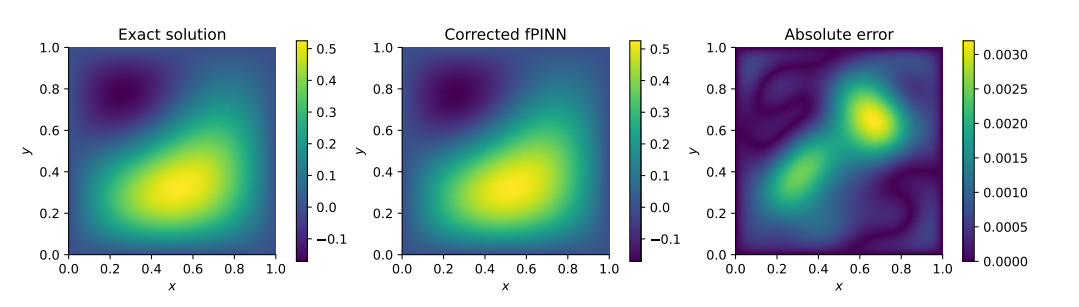
Exact solution, corrected fPINN, and absolute error for Mixed at $ t = 1 $ with seed 11
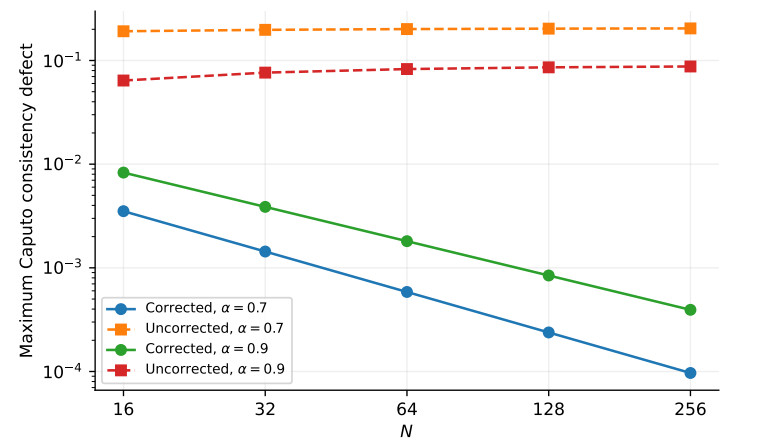
Maximum nodal Caputo-derivative errors for the prescribed history $ w(t) $. The corrected formula differentiates both fractional powers analytically
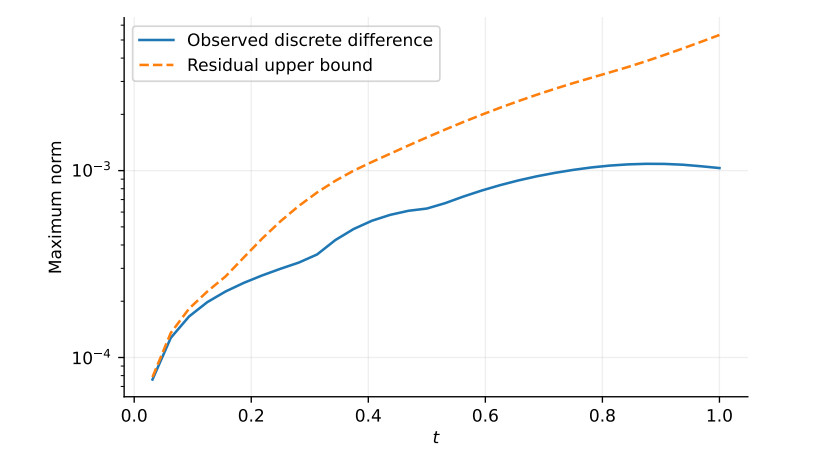
Network--Newton difference $ \left\lVert{W^n-V^n}\right\rVert_{\infty, h} $ and paired bound from Eq (4.9) for Corrected in the Mixed test with seed 11
Final reference differences and discrete bounds during spatial enrichment in the unforced test



 DownLoad: