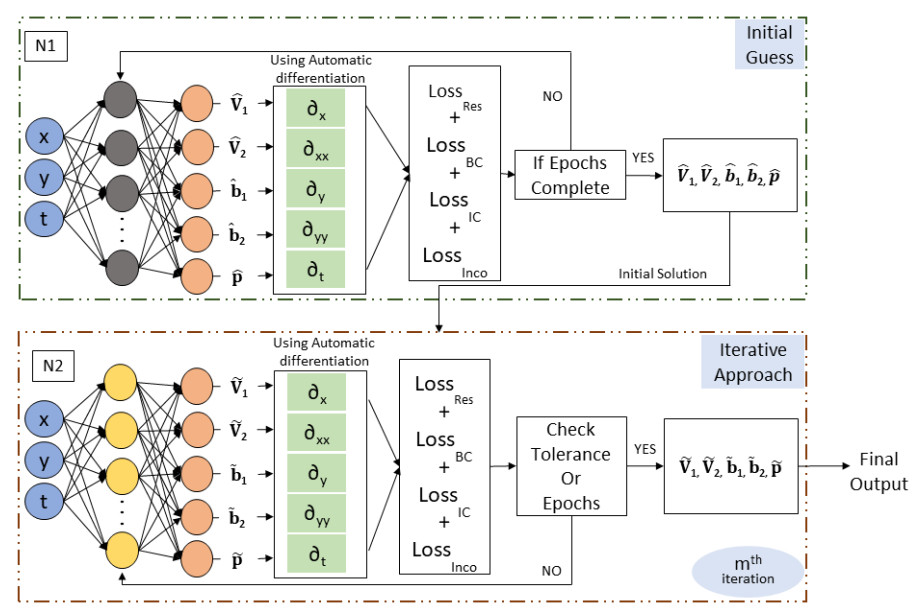
In this work, we design an iteration-based unsupervised neural network algorithm and the theoretical bound of the loss function through Barron space to solve reaction–convection–diffusion-based magnetohydrodynamic (MHD) coupled systems for 1D and 2D problems. Our algorithm is also be able to capture the presence of boundary layers. In general, these systems are characterized by strong coupling in the reaction and convection processes and involve non-diagonally dominant matrices in the context of convection coupling. Traditional numerical techniques face challenges in approximating these problems due to the failure of the required maximum principle, which is used for the well-posedness and further convergence analysis of numerical solutions. We specifically provide a new modified iterative physics-informed neural network (MI-PINN)-based unsupervised deep learning algorithm to capture the layer behavior of singularly perturbed strongly coupled steady-state problems, appearing in MHD flows where theoretical analysis and numerical methods are limited. A different analysis based on the sigmoid activation function is provided for the steady-state case, which shows that the empirical loss under the $ L^2 $ norm is bounded and converges for the two layer-based networks- whenever the solution lies in the Barron space. Additionally, the proposed algorithm improves the neural network's output without using the boundary layer functions a priori and does not use hard constraints or interpolation with the neural network's solution. The experimental results show that the proposed algorithm performs very well for MHD flows appearing in the form of strongly coupled systems.
Citation: Arihant Patawari, Shridhar Kumar, Pratibhamoy Das. A modified iterative PINN algorithm for strongly coupled system of boundary layer originated convection diffusion reaction problems in MHD flows with analysis[J]. Networks and Heterogeneous Media, 2025, 20(3): 1026-1060. doi: 10.3934/nhm.2025045
In this work, we design an iteration-based unsupervised neural network algorithm and the theoretical bound of the loss function through Barron space to solve reaction–convection–diffusion-based magnetohydrodynamic (MHD) coupled systems for 1D and 2D problems. Our algorithm is also be able to capture the presence of boundary layers. In general, these systems are characterized by strong coupling in the reaction and convection processes and involve non-diagonally dominant matrices in the context of convection coupling. Traditional numerical techniques face challenges in approximating these problems due to the failure of the required maximum principle, which is used for the well-posedness and further convergence analysis of numerical solutions. We specifically provide a new modified iterative physics-informed neural network (MI-PINN)-based unsupervised deep learning algorithm to capture the layer behavior of singularly perturbed strongly coupled steady-state problems, appearing in MHD flows where theoretical analysis and numerical methods are limited. A different analysis based on the sigmoid activation function is provided for the steady-state case, which shows that the empirical loss under the $ L^2 $ norm is bounded and converges for the two layer-based networks- whenever the solution lies in the Barron space. Additionally, the proposed algorithm improves the neural network's output without using the boundary layer functions a priori and does not use hard constraints or interpolation with the neural network's solution. The experimental results show that the proposed algorithm performs very well for MHD flows appearing in the form of strongly coupled systems.

| [1] |
T. Chen, Z. Ren, G. Lin, Z. Wu, B. L. Ye, Real-time computational optimal control of an MHD flow system with parameter uncertainty quantification, J. Frankl. Inst., 357 (2020), 2830–2850. https://doi.org/10.1016/j.jfranklin.2019.12.013 doi: 10.1016/j.jfranklin.2019.12.013

|
| [2] |
S. Wu, B. Peng, Z. Tian, Exponential compact ADI method for a coupled system of convection-diffusion equations arising from the 2D unsteady magnetohydrodynamic MHD flows, Appl. Numer. Math., 146 (2019), 89–122. https://doi.org/10.1016/j.apnum.2019.07.003 doi: 10.1016/j.apnum.2019.07.003
|
| [3] |
T. Chen, Z. Ren, G. Lin, C. Xu, Learning-PDE-Based approximate optimal control for an MHD system with uncertainty quantification, IEEE Trans. Syst. Man Cybern. Syst., 52 (2022), 7185–7192. https://doi.org/10.1109/TSMC.2022.3152505 doi: 10.1109/TSMC.2022.3152505
|
| [4] | C. G. Campbell, Magnetohydrodynamics in binary stars, in Astrophysics and Space Science Library Springer Cham, (2018), ⅩⅦ, 474. https://doi.org/10.1007/978-3-319-97646-4. |
| [5] | E. N. Parker, Cosmical Magnetic Fields: Their Origin and Their Activity, Oxford University Press, Oxford, UK, 1979. Available from: https://books.google.co.in/books?id=rgCvDwAAQBAJ. |
| [6] | P. A. Davidson, An introduction to magnetohydrodynamics, in Cambridge Texts in Applied Mathematics, Cambridge University Press, Cambridge, UK, (2001). https://doi.org/10.1017/CBO9780511626333 |
| [7] | R. Moreau, Magnetohydrodynamics, in Fluid Mechanics and Its Applications, Springer Dordrecht, The Netherlands, (1990), ⅩⅣ, 320. https://doi.org/10.1007/978-94-015-7883-7 |
| [8] |
P. W. Hsieh, S. Y. Yang, Two new upwind difference schemes for a coupled system of convection–diffusion equations arising from the steady MHD duct flow problems, J. Comput. Phys., 229 (2010), 9216–9234. https://doi.org/10.1016/j.jcp.2010.08.034 doi: 10.1016/j.jcp.2010.08.034
|
| [9] |
P. Das, S. Rana, J. Vigo-Aguiar, Higher order accurate approximations on equidistributed meshes for boundary layer originated mixed type reaction diffusion systems with multiple scale nature, Appl. Numer. Math., 148 (2020), 79–97. https://doi.org/10.1016/j.apnum.2019.08.028 doi: 10.1016/j.apnum.2019.08.028
|
| [10] | T. Linß, Layer-Adapted meshes for reaction-convection-diffusion problems, in Lecture Notes in Mathematics, Springer Berlin, Heidelberg, Germany, (2010), Ⅻ, 326. https://doi.org/10.1007/978-3-642-05134-0 |
| [11] |
M. K. Kadalbajoo, K. C. Patidar, Singularly perturbed problems in partial differential equations: A survey, Appl. Math. Comput., 134 (2003), 371–429. https://doi.org/10.1016/S0096-3003(01)00291-0 doi: 10.1016/S0096-3003(01)00291-0
|
| [12] |
S. Saini, P. Das, S. Kumar, Parameter uniform higher order numerical treatment for singularly perturbed robin type parabolic reaction-diffusion multiple scale problems with large delay in time, Appl. Numer. Math., 196 (2024), 1–21. https://doi.org/10.1016/j.apnum.2023.10.003 doi: 10.1016/j.apnum.2023.10.003
|
| [13] |
S. Arslan, M. Tezer-Sezgin, Exact and FDM solutions of 1D MHD flow between parallel electrically conducting and slipping plates, Adv. Comput. Math., 45 (2019), 1923–1938. https://doi.org/10.1007/s10444-019-09669-x doi: 10.1007/s10444-019-09669-x
|
| [14] |
A. Ayet, B. Chapron, The dynamical coupling of wind-waves and atmospheric turbulence: A review of theoretical and phenomenological models, Bound. Layer Meteorol., 183 (2022), 1–33. https://doi.org/10.1007/s10546-021-00666-6 doi: 10.1007/s10546-021-00666-6
|
| [15] | N. Madden, M. Stynes, G. Thomas, On the application of robust numerical methods to a complete flow wave current model. Boundary and Interior Layers ONERA, in Proceedings of BAIL, 2004. https://doi.org/10.13025/15121 |
| [16] | M. S. Gockenbach, Understanding and implementing the finite element method, in Other Titles in Applied Mathematics, SIAM, 2006. https://doi.org/10.1137/1.9780898717846 |
| [17] |
V. Saw, P. Das, H. M. Srivastava, Investigations of a class of liouville-caputo fractional order pennes bioheat flow partial differential equations through orthogonal polynomials on collocation points, Bull. Sci. Math., 201 (2025), 103637. https://doi.org/10.1016/j.bulsci.2025.103637 doi: 10.1016/j.bulsci.2025.103637
|
| [18] |
K. Zhuang, Z. Du, X. Lin, Solitary waves solutions of singularly perturbed higher-order kdV equation via geometric singular perturbation method, Nonlinear Dyn., 80 (2015), 629–635. https://doi.org/10.1007/s11071-015-1894-7 doi: 10.1007/s11071-015-1894-7
|
| [19] |
Aakansha, S. Kumar, P. Das, Analysis of an efficient parameter uniform domain decomposition approach for singularly perturbed gierer-meinhardt type nonlinear coupled systems of parabolic problems, Int. J. Numer. Anal. Model., 22 (2025), 459–482. https://doi.org/10.4208/ijnam2025-1020 doi: 10.4208/ijnam2025-1020
|
| [20] |
T. Apel, G. Lube, Anisotropic mesh refinement for a singularly perturbed reaction diffusion model problem, Appl. Numer. Math., 26 (1998), 415–433. https://doi.org/10.1016/S0168-9274(97)00106-2 doi: 10.1016/S0168-9274(97)00106-2
|
| [21] | C. Kuehn, Multiple time scale dynamics, in Applied Mathematical Sciences, Springer Cham, (2015), ⅩⅢ, 814. https://doi.org/10.1007/978-3-319-12316-5 |
| [22] |
S. Kumar, P. Das, K. Kumar, Adaptive mesh based efficient approximations for darcy scale precipitation–dissolution models in porous media, Int. J. Numer. Methods Fluids, 96 (2024), 1415–1444. https://doi.org/10.1002/fld.5294 doi: 10.1002/fld.5294
|
| [23] |
S. Kumar, I. Rosey, P. Das, Impact of mixed boundary conditions and non-smooth data on layer originated non-premixed combustion problems: Higher order convergence analysis, Stud. Appl. Math., 96 (2024), e12763. https://doi.org/10.1111/sapm.12763 doi: 10.1111/sapm.12763
|
| [24] |
M. Raissi, P. Perdikaris, G. Em Karniadakis, Physics-informed neural networks: A deep learning framework for solving forward and inverse problems involving nonlinear partial differential equations, J. Comput. Phys., 378 (2019), 686–707. https://doi.org/10.1016/j.jcp.2018.10.045 doi: 10.1016/j.jcp.2018.10.045
|
| [25] |
A. Arzani, K. W. Cassel, R. M. D'Souza, Theory-guided physics-informed neural networks for boundary layer problems with singular perturbation, J. Comput. Phys., 473 (2023), 111768. https://doi.org/10.1016/j.jcp.2022.111768 doi: 10.1016/j.jcp.2022.111768
|
| [26] |
S. Rezaei, A. Harandi, A. Moeineddin, B. X. Xu, S. Reese, A mixed formulation for physics-informed neural networks as a potential solver for engineering problems in heterogeneous domains: Comparison with finite element method, Comput. Methods Appl. Mech. Engrg., 401 (2022), 115616. https://doi.org/10.1016/j.cma.2022.115616 doi: 10.1016/j.cma.2022.115616
|
| [27] |
S. Yadav, S. Ganesan, Artificial neural network-augmented stabilized finite element method, J. Comput. Phys., 499 (2024), 112702. https://doi.org/10.1016/j.jcp.2023.112702 doi: 10.1016/j.jcp.2023.112702
|
| [28] | A. Patawari, P. Das, From traditional to computationally efficient scientific computing algorithms in option pricing: Current progresses with future directions, Arch. Comput. Methods Eng., (2025). |
| [29] |
S. Kumar, P. Das, A uniformly convergent analysis for multiple scale parabolic singularly perturbed convection-diffusion coupled systems: Optimal accuracy with less computational time, Appl. Numer. Math., 207 (2025), 534–557. https://doi.org/10.1016/j.apnum.2024.09.020 doi: 10.1016/j.apnum.2024.09.020
|
| [30] | M. Raissi, P. Perdikaris, G. Em Karniadakis, Physics informed deep learning (part ⅰ): Data-driven solutions of nonlinear partial differential equations, preprint, 2017. https://doi.org/10.48550/arXiv.1711.10561 |
| [31] | M. Raissi, Deep hidden physics models: Deep learning of nonlinear partial differential equations, J. Mach. Learn. Res., 19 (2018), 1–24. Available from: http://jmlr.org/papers/v19/18-046.html. |
| [32] |
S. Cuomo, V. S. Di Cola, F. Giampaolo, G. Rozza, M. Raissi, F. Piccialli, Scientific machine learning through physics–informed neural networks: Where we are and what's next, J. Sci. Comput., 92 (2022), 88. https://doi.org/10.1007/s10915-022-01939-z doi: 10.1007/s10915-022-01939-z
|
| [33] |
A. Beguinet, V. Ehrlacher, R. Flenghi, M. Fuente, O. Mula, A. Somacal, Deep learning-based schemes for singularly perturbed convection-diffusion problems, ESAIM: Proc. Surv., 73 (2023), 48–67. https://doi.org/10.1051/proc/202373048 doi: 10.1051/proc/202373048
|
| [34] |
C. Banerjee, K. Nguyen, C. Fookes, K. George, Physics-informed computer vision: A review and perspectives, ACM Comput. Surv., 57 (2024), 1–38. https://doi.org/10.1145/3689037 doi: 10.1145/3689037
|
| [35] |
G. Cybenko, Approximation by superpositions of a sigmoidal function, Math. Control Signals Syst., 2 (1989), 303–314. https://doi.org/10.1007/BF02551274 doi: 10.1007/BF02551274
|
| [36] |
Y. Shin, J. Darbon, G. Em Karniadakis, On the convergence of physics informed neural networks for linear second-order elliptic and parabolic type PDEs, Commun. Comput. Phys., 28 (2020), 2042–2074. https://doi.org/10.4208/cicp.OA-2020-0193 doi: 10.4208/cicp.OA-2020-0193
|
| [37] |
S. Mishra, R. Molinaro, Estimates on the generalization error of physics-informed neural networks for approximating PDEs, IMA J. Numer. Anal., 43 (2023), 1–43. https://doi.org/10.1093/imanum/drab093 doi: 10.1093/imanum/drab093
|
| [38] |
T. De Ryck, A. D. Jagtap, S. Mishra, Error estimates for physics-informed neural networks approximating the Navier–Stokes equations, IMA J. Numer. Anal., 44 (2024), 83–119. https://doi.org/10.1093/imanum/drac085 doi: 10.1093/imanum/drac085
|
| [39] |
A. D. Jagtap, K. Kawaguchi, G. Em Karniadakis, Adaptive activation functions accelerate convergence in deep and physics-informed neural networks, J. Comput. Phys., 404 (2020), 109136. https://doi.org/10.1016/j.jcp.2019.109136 doi: 10.1016/j.jcp.2019.109136
|
| [40] |
J. Linghu, W. Gao, H. Dong, Y. Nie, Higher-order multi-scale physics-informed neural network (HOMS-PINN) method and its convergence analysis for solving elastic problems of authentic composite materials, J. Comput. Appl. Math., 456 (2025), 116223. https://doi.org/10.1016/j.cam.2024.116223 doi: 10.1016/j.cam.2024.116223
|
| [41] | Y. L. Cun, A theoretical framework for back-propagation, Phy. Eng., 1, (1988), 21–28. Avaiable from: https://api.semanticscholar.org/CorpusID: 16775098. |
| [42] | A. Krishnapriyan, A. Gholami, S. Zhe, R. Kirby, M. W. Mahoney, Characterizing possible failure modes in physics-informed neural networks, preprint, 2021. https://doi.org/10.48550/arXiv.2109.01050 |
| [43] |
G. M. Gie, Y. Hong, C. Y. Jung, Semi-analytic PINN methods for singularly perturbed boundary value problems, Appl. Anal., 103 (2024), 2554–2571. https://doi.org/10.1080/00036811.2024.2302405 doi: 10.1080/00036811.2024.2302405
|
| [44] |
E. Kharazmi, Z. Zhang, G. Em Karniadakis, hp-VPINNs: Variational physics-informed neural networks with domain decomposition, Comput. Methods Appl. Mech. Engrg., 374 (2021), 113547. https://doi.org/10.1016/j.cma.2020.113547 doi: 10.1016/j.cma.2020.113547
|
| [45] |
L. Wang, L. Zhang, G. He, Chien-physics-informed neural networks for solving singularly perturbed boundary-layer problems, Appl. Math. Mech., 45 (2024), 1467–1480. https://doi.org/10.1007/s10483-024-3149-8 doi: 10.1007/s10483-024-3149-8
|
| [46] | P. D. Miller, Applied asymptotic analysis, Amer. Math. Soc., 75 (2006). http://doi.org/10.1090/gsm/075 |
| [47] | E. Kharazmi, Z. Zhang, G. Em Karniadakis, Variational physics-informed neural networks for solving partial differential equations, preprint, 2019. https://doi.org/10.48550/arXiv.1912.00873 |
| [48] | R. Khodayi-Mehr, M. Zavlanos, VarNet: Variational neural networks for the solution of partial differential equations, Proc. Machine Learning Res., 120 (2020), 1–10. Available from: http://proceedings.mlr.press/v120/khodayi-mehr20a/khodayi-mehr20a.pdf. |
| [49] |
W. N. E, C. Ma, L. Wu, The Barron space and the flow-induced function spaces for neural network models, Constr. Approximation, 55 (2022), 369–406. https://doi.org/10.1007/s00365-021-09549-y doi: 10.1007/s00365-021-09549-y
|
| [50] | G. M. Gie, Y. Hong, C. Y. Jung, D. Lee, Singular Layer physics-informed neural network for convection-dominated boundary layer problems in 2D, preprint, 2023. https://doi.org/10.48550/arXiv.2312.03295 |
| [51] |
X. Chu, X. Shi, D. Shi, Unconditional superconvergence analysis of low-order conforming mixed finite element method for time-dependent incompressible MHD equations, Commun. Nonlinear Sci. Numer. Simul., 143 (2025), 108627. https://doi.org/10.1016/j.cnsns.2025.108627 doi: 10.1016/j.cnsns.2025.108627
|
| [52] |
C. Clavero, J. Jorge, A splitting uniformly convergent method for one-dimensional parabolic singularly perturbed convection-diffusion systems, Appl. Numer. Math., 183 (2023), 317–332. https://doi.org/10.1016/j.apnum.2022.09.012 doi: 10.1016/j.apnum.2022.09.012
|
| [53] |
M. Brdar, S. Franz, L. Ludwig, H. G. Roos, Numerical analysis of a singularly perturbed convection-diffusion problem with shift in space, Appl. Numer. Math., 186 (2023), 129–142. https://doi.org/10.1016/j.apnum.2023.01.003 doi: 10.1016/j.apnum.2023.01.003
|
| [54] |
E. O'Riordan, M. Stynes, Numerical analysis of a strongly coupled system of two singularly perturbed convection-diffusion problems, Adv. Comput. Math., 30 (2009), 101–121. https://doi.org/10.1007/s10444-007-9058-z doi: 10.1007/s10444-007-9058-z
|
| [55] | H. G. Roos, M. Stynes, L. Tobiska, Robust Numerical Methods for Singularly Perturbed Differential Equations: Convection-Diffusion-Reaction and Flow Problems, Springer Berlin, Heidelberg, 2008. https://doi.org/10.1007/978-3-540-34467-4 |
| [56] |
T. Linß, Analysis of an upwind finite-difference scheme for a system of coupled singularly perturbed convection-diffusion equations, Computing, 79 (2007), 23–32.https://doi.org/10.1007/s00607-006-0215-x doi: 10.1007/s00607-006-0215-x
|
| [57] |
T. Linß, M. Stynes, Numerical solution of systems of singularly perturbed differential equations, Comput. Methods Appl. Math., 9 (2009), 165–191. https://doi.org/10.2478/cmam-2009-0010 doi: 10.2478/cmam-2009-0010
|
| [58] |
G. Beckett, J. Mackenzie, On a uniformly accurate finite difference approximation of a singularly perturbed reaction-diffusion problem using grid equidistribution, Appl. Numer. Math., 35 (2001), 87–109. https://doi.org/10.1016/S0377-0427(00)00260-0 doi: 10.1016/S0377-0427(00)00260-0
|
| [59] | G. I. Shishkin, Mesh approximation of singularly perturbed boundary-value problems for systems of elliptic and parabolic equations, Comp. Math. Math. Phys., 35 (1995), 429–446. https://dl.acm.org/doi/abs/10.5555/214478.214484 |
| [60] |
P. Das, J. Vigo-Aguiar, Parameter uniform optimal order numerical approximation of a class of singularly perturbed system of reaction-diffusion problems involving a small perturbation parameter, J. Comput. Appl. Math., 354 (2019), 533–544. https://doi.org/10.1016/j.cam.2017.11.026 doi: 10.1016/j.cam.2017.11.026
|
| [61] | K. Anukiruthika, P. Muthukumar, P. Das, Semigroup-based theoretical prospects on optimal control of stochastic second-order gurtin–pipkin integro-differential equations, Optimization, (2025), 1–18. https://doi.org/10.1080/02331934.2025.2534119 |
| [62] |
H. G. Roos, Special features of strongly coupled systems of convection-diffusion equations with two small parameters, Appl. Math. Lett., 25 (2012), 1127–1130. https://doi.org/10.1016/j.aml.2012.02.018 doi: 10.1016/j.aml.2012.02.018
|
| [63] | T. Linß, N. Madden, Analysis of an alternating direction method applied to singularly perturbed reaction-diffusion problems, Int. J. Numer. Anal. Model, 7 (2010). |
| [64] |
H. G. Roos, C. Reibiger, Analysis of a strongly coupled system of two convection-diffusion equations with full layer interaction, J. Appl. Math. Mech., 91 (2011), 537–543. https://doi.org/10.1002/zamm.201000153 doi: 10.1002/zamm.201000153
|
| [65] | N. Rahaman, A. Baratin, D. Arpit, F. Draxler, M. Lin, F. Hamprecht, et al., On the spectral bias of neural networks, preprint, 2019. https://doi.org/10.48550/arXiv.1806.08734 |
| [66] |
A. R. Barron, Universal approximation bounds for superpositions of a sigmoidal function, IEEE Trans. Inform. Theory, 39 (2002), 930–945. https://doi.org/10.1109/18.256500 doi: 10.1109/18.256500
|
| [67] |
D. Sarkar, S. Kumar, P. Das, H. Ramos, Higher order convergence analysis for interior and boundary layers in a semi-linear reaction-diffusion system networked by a $ k $-star graph with non-smooth source terms, Networks Heterog. Media, 19 (2024), 1085–1115. https://doi.org/10.3934/nhm.2024048 doi: 10.3934/nhm.2024048
|

Figures(19) / Tables(16)
Arihant Patawari, Shridhar Kumar, Pratibhamoy Das. A modified iterative PINN algorithm for strongly coupled system of boundary layer originated convection diffusion reaction problems in MHD flows with analysis[J]. Networks and Heterogeneous Media, 2025, 20(3): 1026-1060. doi: 10.3934/nhm.2025045




 DownLoad: