A new ensemble Monte Carlo (EMC) method is proposed and applied to numerically simulate a parabolic optimal control problem with random coefficients. The state equation is discretized by the EMC method, which shares a common coefficient matrix with multiple right-hand vectors. It saves the computational cost compared with the Monte Carlo (MC) method. For this new EMC method, it is unconditionally stable and does not need to subgroup the samples in the simulation. Under natural regularity condition, some error estimates are obtained for the EMC approximation of the optimal control problem. Two numerical examples are presented to test the theoretical results.
Citation: Yan Guo, Xianbing Luo, Changlun Ye. A new ensemble Monte Carlo method for a parabolic optimal control problem with random coefficient[J]. Networks and Heterogeneous Media, 2025, 20(3): 732-758. doi: 10.3934/nhm.2025031
A new ensemble Monte Carlo (EMC) method is proposed and applied to numerically simulate a parabolic optimal control problem with random coefficients. The state equation is discretized by the EMC method, which shares a common coefficient matrix with multiple right-hand vectors. It saves the computational cost compared with the Monte Carlo (MC) method. For this new EMC method, it is unconditionally stable and does not need to subgroup the samples in the simulation. Under natural regularity condition, some error estimates are obtained for the EMC approximation of the optimal control problem. Two numerical examples are presented to test the theoretical results.

| [1] | M. Hinze, R. Pinnau, M. Ulbrich, S. Ulbrich, Optimization with PDE Constraints, Springer, New York, 2009. |
| [2] |
W. Liu, H. Ma, T. Tang, N. Yan, A posteriori error estimates for discontinuous Galerkin time-stepping method for optimal control problems governed by parabolic equations, SIAM J. Numer. Anal., 42 (2004), 1032–1061. https://doi.org/10.1137/S0036142902397090 doi: 10.1137/S0036142902397090

|
| [3] |
D. Meidner, B. Vexler, A priori error estimates for space-time finite element discretization of parabolic optimal control problems. Part Ⅰ: Problems without control constraints, SIAM J. Control Optim., 47 (2008), 1150–1177. https://doi.org/10.1137/070694016 doi: 10.1137/070694016
|
| [4] | F. Tröltzsch, Optimal Control of Partial Differential Equations: Theory, Methods and Applications, American Mathematical Society, Providence, Rhode Island, 2010. |
| [5] |
A. A. Ali, E. Ullmann, M. Hinze, Multilevel Monte Carlo analysis for optimal control of elliptic PDEs with random coefficients, SIAM/ASA J. Uncertainty Quantif., 5(2017), 466–492. https://doi.org/10.1137/16M109870X doi: 10.1137/16M109870X
|
| [6] |
P. Chen, U. Villa, O. Ghattas, Taylor approximation and variance reduction for PDE-constrained optimal control under uncertainty, J. Comput. Phys., 385 (2019), 163–186. https://doi.org/10.1016/j.jcp.2019.01.047 doi: 10.1016/j.jcp.2019.01.047
|
| [7] |
P. A. Guth, V. Kaarnioja, F. Kuo, C. Schillings, I. H. Sloan, A quasi-Monte Carlo method for an optimal control problem under uncertainty, SIAM/ASA J. Uncertainty Quantif., 9 (2021), 354–383. https://doi.org/10.1137/19M1294952 doi: 10.1137/19M1294952
|
| [8] |
H. Li, M. Li, X. Luo, S. Xiang, Convergence analysis of finite element approximations for a nonlinear second order hyperbolic optimal control problems, Networks Heterog. Media, 19 (2024), 842–866. https://doi.org/10.3934/nhm.2024038 doi: 10.3934/nhm.2024038
|
| [9] |
J. Yong, X. Luo, S. Sun, C. Ye, Deep mixed residual method for solving PDE-constrained optimization problems, Comput. Math. Appl., 176 (2024), 510–524. https://doi.org/10.1016/j.camwa.2024.11.009 doi: 10.1016/j.camwa.2024.11.009
|
| [10] |
A. Kunoth, C. Schwab, Analytic regularity and GPC approximation for control problems constrained by linear parametric elliptic and parabolic PDEs, SIAM J. Control Optim., 51 (2013), 2442–2471. https://doi.org/10.1137/110847597 doi: 10.1137/110847597
|
| [11] |
A. Borzi, G. Winckel, Multigrid methods and sparse-grid collocation techniques for parabolic optimal control problems with random coefficients, SIAM J. Sci. Comput., 31 (2009), 2172–2192. https://doi.org/10.1137/070711311 doi: 10.1137/070711311
|
| [12] |
B. Gong, T. Sun, W. Shen, W. Liu, A priori error estimate of stochastic Galerkin method for optimal control problem governed by random parabolic PDE with constrained control, Int. J. Comput. Methods, 13 (2016), 1650028. https://doi.org/10.1142/S0219876216500286 doi: 10.1142/S0219876216500286
|
| [13] |
W. Shen, L. Ge, W. Liu, Stochastic Galerkin method for optimal control problem governed by random elliptic PDE with state constraints, J. Sci. Comput., 78 (2019), 1571–1600. https://doi.org/10.1007/s10915-018-0823-6 doi: 10.1007/s10915-018-0823-6
|
| [14] |
N. Jiang, A second-order ensemble method based on a blended backward differentiation formula timestepping scheme for time-dependent Navier-Stokes equations, Numer. Methods PDEs, 33 (2017), 34–61. https://doi.org/10.1002/num.22070 doi: 10.1002/num.22070
|
| [15] |
M. Gunzburger, N. Jiang, M. Schneier, An ensemble-proper orthogonal decomposition method for the nonstationary Navier-Stokes equations, SIAM J. Numer. Anal., 55 (2017), 286–304. https://doi.org/10.1137/16M1056444 doi: 10.1137/16M1056444
|
| [16] |
N. Jiang, W. Layton, An algorithm for fast calculation of flow ensembles, Int. J. Uncertainty Quantif., 4 (2014), 273–301. https://doi.org/10.1615/Int.J.UncertaintyQuantification.2014007691 doi: 10.1615/Int.J.UncertaintyQuantification.2014007691
|
| [17] |
M. Li, X. Luo, An MLMCE-HDG method for the convection diffusion equation with random diffusivity, Comput. Math. Appl., 127 (2022), 127–143. https://doi.org/10.1016/j.camwa.2022.10.002 doi: 10.1016/j.camwa.2022.10.002
|
| [18] |
T. Yao, C. Ye, X. Luo, S. Xiang, An ensemble scheme for the numerical solution of a random transient heat equation with uncertain inputs, Numer. Algorithms, 94 (2023), 643–668. https://doi.org/10.1007/s11075-023-01514-z doi: 10.1007/s11075-023-01514-z
|
| [19] |
J. Yong, C. Ye, X. Luo, S. Sun, Improved error estimates of ensemble Monte Carlo methods for random transient heat equations with uncertain inputs, Comp. Appl. Math., 44 (2025), 58. https://doi.org/10.1007/s40314-024-03022-9 doi: 10.1007/s40314-024-03022-9
|
| [20] |
Y. Luo, Z. Wang, An ensemble algorithm for numerical solutions to deterministic and random parabolic PDEs, SIAM J. Numer. Anal., 56 (2018), 859–876. https://doi.org/10.1137/17M1131489 doi: 10.1137/17M1131489
|
| [21] | L. C. Evans, Partial Differential Equations (2nd edition), American Mathematical Society, Beijing, 2010. |
| [22] | V. Thomée, Galerkin Finite Element Methods for Parabolic Problems, Springer-Verlag, Berlin, 2006. |
| [23] |
M. Hinze, A variational discretization concept in control constrained optimization: The linear quadratic case, Comput. Optim. Appl., 30 (2005), 45–63. https://doi.org/10.1007/s10589-005-4559-5 doi: 10.1007/s10589-005-4559-5
|
| [24] |
D. A. French, J. T. King, Analysis of a robust finite element approximation for a parabolic equation with rough boundary data, Math. Comput., 60 (1993), 79–104. https://doi.org/10.1090/S0025-5718-1993-1153163-1 doi: 10.1090/S0025-5718-1993-1153163-1
|
| [25] |
W. Gong, M. Hinze, Z. Zhou, A priori error analysis for finite element approximation of parabolic optimal control problems with pointwise control, SIAM J. Control Optim., 52 (2014), 97–119. https://doi.org/10.1137/110840133 doi: 10.1137/110840133
|
| [26] |
W. Gong, M. Hinze, Z. Zhou, Finite element method and a priori error estimates for dirichlet boundary control problems governed by parabolic PDEs, J. Sci. Comput., 66 (2016), 941–967. https://doi.org/10.1007/s10915-015-0051-2 doi: 10.1007/s10915-015-0051-2
|
| [27] |
A. Günther, M. Hinze, Elliptic control problems with gradient constraints—variational discrete versus piecewise constant controls, Comput. Optim. Appl., 49 (2011), 549–566. https://doi.org/10.1007/s10589-009-9308-8 doi: 10.1007/s10589-009-9308-8
|
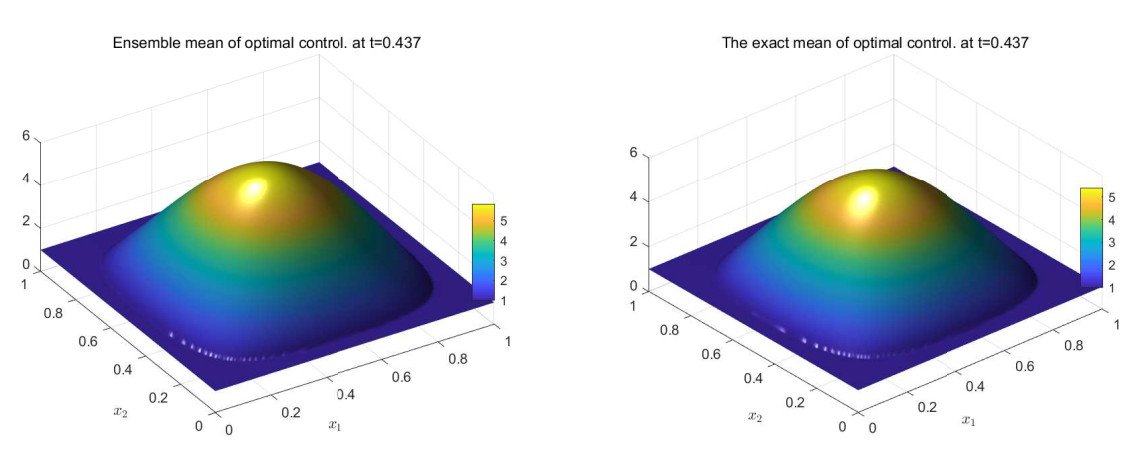
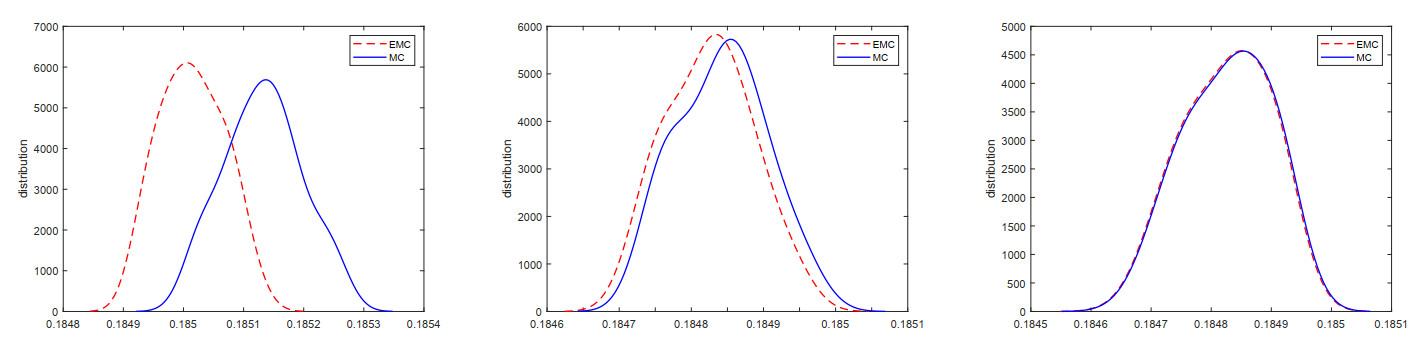
Figures(2) / Tables(7)
Yan Guo, Xianbing Luo, Changlun Ye. A new ensemble Monte Carlo method for a parabolic optimal control problem with random coefficient[J]. Networks and Heterogeneous Media, 2025, 20(3): 732-758. doi: 10.3934/nhm.2025031




 DownLoad: