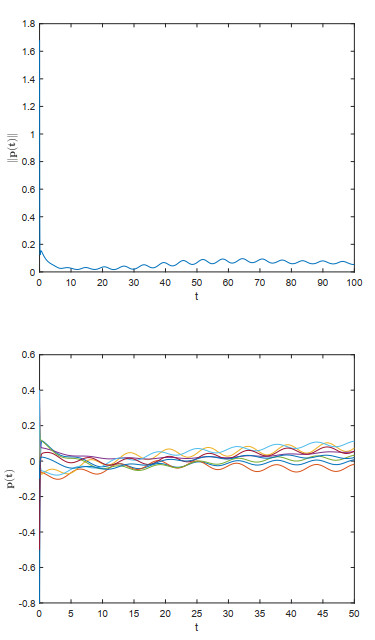
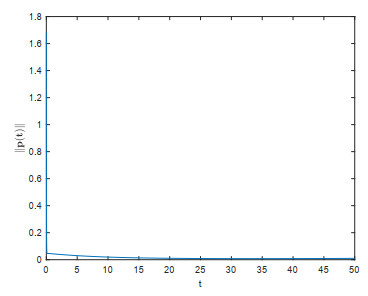
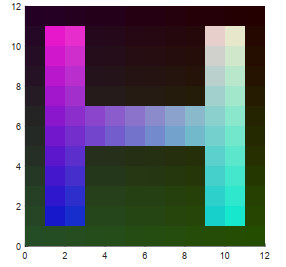
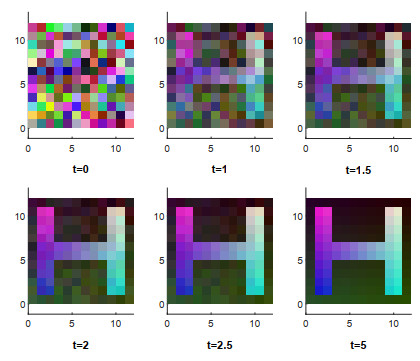
The article addressed the Lagrange exponential stability of Cohen-Grossberg inertial neural networks (CGINNs) with quaternion-valued state variables and unbounded time-varying delays. The study extended stability analysis to a more complex and realistic model that included the inertial term, representing the system's acceleration-like memory effect, and quaternion-valued variables, representing multidimensional signals such as 3D rotations or color images. Unbounded time-varying delays added complexity while properly replicating real-world neural network (NN) dynamics. Unlike traditional studies that relied on order-reduction transformations, this work introduced a non-reduction order approach. To achieve stability, Lyapunov functional approaches were used with advanced inequality techniques to generate adequate criteria that ensured Lagrange stability under these complex conditions. Finally, Example 1 was presented to validate the efficiency of the proposed method, while Example 2, related to Quaternion-valued NNs (QVNNs), exhibited the efficiency of storing true color image patterns.
Citation: Sapna Baluni, Qianyi Li. Stability analysis of Cohen-Grossberg quaternion-valued inertial neural networks with unbounded time-varying delays in Lagrange sense[J]. Mathematical Modelling and Control, 2026, 6(2): 194-204. doi: 10.3934/mmc.2026015
The article addressed the Lagrange exponential stability of Cohen-Grossberg inertial neural networks (CGINNs) with quaternion-valued state variables and unbounded time-varying delays. The study extended stability analysis to a more complex and realistic model that included the inertial term, representing the system's acceleration-like memory effect, and quaternion-valued variables, representing multidimensional signals such as 3D rotations or color images. Unbounded time-varying delays added complexity while properly replicating real-world neural network (NN) dynamics. Unlike traditional studies that relied on order-reduction transformations, this work introduced a non-reduction order approach. To achieve stability, Lyapunov functional approaches were used with advanced inequality techniques to generate adequate criteria that ensured Lagrange stability under these complex conditions. Finally, Example 1 was presented to validate the efficiency of the proposed method, while Example 2, related to Quaternion-valued NNs (QVNNs), exhibited the efficiency of storing true color image patterns.

| [1] |
M. E. Petersen, D. D. Ridder, H. Handels, Image processing with neural networks review, Pattern Recognit., 35 (2002), 2279–2301. https://doi.org/10.1016/S0031-3203(01)00178-9 doi: 10.1016/S0031-3203(01)00178-9

|
| [2] |
M. Pfeiffer, A. Hohmann, Applications of neural networks in training science, Hum. Mov. Sci., 31 (2012), 344–359. https://doi.org/10.1016/j.humov.2010.11.004 doi: 10.1016/j.humov.2010.11.004
|
| [3] |
C. Chen, L. Li, H. Peng, Y. Yang, L. Mi, H. Zhao, A new fixed-time stability theorem and its application to the fixed-time synchronization of neural networks, Neural Networks, 123 (2020), 412–419. https://doi.org/10.1016/j.neunet.2019.12.028 doi: 10.1016/j.neunet.2019.12.028
|
| [4] |
O. Abdel-Hamid, A. R. Mohamed, H. Jiang, L. Deng, G. Penn, D. Yu, Convolutional neural networks for speech recognition, IEEE-ACM T. Audio Spe., 22 (2014), 1533–1545. https://doi.org/10.1109/TASLP.2014.2339736 doi: 10.1109/TASLP.2014.2339736
|
| [5] |
B. B. Traore, B. Kamsu-Foguem, F. Tangara, Deep convolution neural network for image recognition, Ecol. Inf., 48 (2018), 257–268. https://doi.org/10.1016/j.ecoinf.2018.10.002 doi: 10.1016/j.ecoinf.2018.10.002
|
| [6] |
M. A. Cohen, S. Grossberg, Absolute stability of global pattern formation and parallel memory storage by competitive neural networks, IEEE Trans. Syst., Man, Cybern., 5 (1983), 815–826. https://doi.org/10.1109/TSMC.1983.6313075 doi: 10.1109/TSMC.1983.6313075
|
| [7] |
J. Cao, X. Li, Stability in delayed cohen-grossberg neural networks: LMI optimization approach, Phys. D, 212 (2005), 54–65. https://doi.org/10.1016/j.physd.2005.09.005 doi: 10.1016/j.physd.2005.09.005
|
| [8] |
E. Gospodinova, I. Torlakov, Information processing with stability point modeling in cohen–grossberg neural networks, Axioms, 12 (2023), 612. https://doi.org/10.3390/axioms12070612 doi: 10.3390/axioms12070612
|
| [9] |
Y. Liu, D. Zhang, J. Lou, J. Lu, J. Cao, Stability analysis of quaternion-valued neural networks: decomposition and direct approaches, IEEE Trans. Neural Networks Learn. Syst., 29 (2018), 4201–4211. https://doi.org/10.1109/TNNLS.2017.2755697 doi: 10.1109/TNNLS.2017.2755697
|
| [10] |
Y. Liu, Y. Zheng, J. Lu, J. Cao, L. Rutkowski, Constrained quaternion-variable convex optimization: a quaternion-valued recurrent neural network approach, IEEE Trans. Neural Networks Learn. Syst., 31 (2020), 1022–1035. https://doi.org/10.1109/TNNLS.2019.2916597 doi: 10.1109/TNNLS.2019.2916597
|
| [11] |
Z. Xia, Y. Liu, J. Lu, J. Cao, L. Rutkowski, Penalty method for constrained distributed quaternion-variable optimization, IEEE Trans. Cybern., 51 (2021), 5631–5636. http://doi.org/10.1109/TCYB.2020.3031687 doi: 10.1109/TCYB.2020.3031687
|
| [12] |
E. Bayro-Corrochano, S. Solis-Gamboa, G. Altamirano-Escobedo, L. Lechuga-Gutierres, J. Lisarraga-Rodriguez, Quaternion spiking and quaternion quantum neural networks: theory and applications, Int. J. Neural Syst., 31 (2021), 2050059. https://doi.org/10.1142/S0129065720500598 doi: 10.1142/S0129065720500598
|
| [13] |
L. Yang, Y. Liu, K. I. Kou, Quaternion optimized model with sparseness for color image recovery, Digital Signal Process., 156 (2025), 104781. https://doi.org/10.1016/j.dsp.2024.104781 doi: 10.1016/j.dsp.2024.104781
|
| [14] |
B. Huang, Y. Liu, K. I. Kou, H. Jiang, A predefined-time matrix-value neural network for quaternion optimization with applications to color images, Inf. Sci., 702 (2025), 121899. https://doi.org/10.1016/j.ins.2025.121899 doi: 10.1016/j.ins.2025.121899
|
| [15] |
K. L. Babcock, R. M. Westervelt, Stability and dynamics of simple electronic neural networks with added inertia, Phys. D, 23 (1986) 464–469. https://doi.org/10.1016/0167-2789(86)90152-1 doi: 10.1016/0167-2789(86)90152-1
|
| [16] |
B. B. He, H. C. Zhou, Asymptotic stability and synchronization of fractional order hopfield neural networks with unbounded delay, Math. Methods Appl. Sci., 46 (2023), 3157–3175. https://doi.org/10.1002/mma.8000 doi: 10.1002/mma.8000
|
| [17] |
P. Wan, Y. Zhou, Z. Zeng, Adaptive drive-response synchronization of timescale-type neural networks with unbounded time-varying delays, IEEE Trans. Neural Networks Learn. Syst., 36 (2025), 1056–1068. https://doi.org/10.1109/TNNLS.2023.3329138 doi: 10.1109/TNNLS.2023.3329138
|
| [18] |
S. Arunagirinathan, T. H. Lee, Generalized delay-dependent reciprocally convex inequality on stability for neural networks with time-varying delay, Math. Comput. Simul., 217 (2024), 109–120. https://doi.org/10.1016/j.matcom.2023.10.013 doi: 10.1016/j.matcom.2023.10.013
|
| [19] |
M. Solak, O. Faydasicok, S. Arik, A general framework for robust stability analysis of neural networks with discrete time delays, Neural Networks, 162 (2023), 186–198. https://doi.org/10.1016/j.neunet.2023.02.040 doi: 10.1016/j.neunet.2023.02.040
|
| [20] |
C. Li, K. I. Kou, Y. Zhang, Y. Liu, Advancements in exponential synchronization and encryption techniques: quaternion-valued artificial neural networks with two-sided coefficients, Neural Networks, 183 (2025), 106982. https://doi.org/10.1016/j.neunet.2024.106982 doi: 10.1016/j.neunet.2024.106982
|
| [21] |
Y. Liu, Z. Wang, X. Liu, Global exponential stability of generalized recurrent neural networks with discrete and distributed delays, Neural Networks, 19 (2006), 667–675. https://doi.org/10.1016/j.neunet.2005.03.015 doi: 10.1016/j.neunet.2005.03.015
|
| [22] |
J. Wang, L. Huang, Z. Guo, Global asymptotic stability of neural networks with discontinuous activations, Neural Networks, 22 (2009), 931–937. https://doi.org/10.1016/j.neunet.2009.04.004 doi: 10.1016/j.neunet.2009.04.004
|
| [23] |
A. Wu, Z. Zeng, Lagrange stability of memristive neural networks with discrete and distributed delays, IEEE Trans. Neural Networks Learn. Syst., 25 (2014), 690–703. https://doi.org/10.1109/TNNLS.2013.2280458 doi: 10.1109/TNNLS.2013.2280458
|
| [24] |
L. Wang, T. Huang, Q. Xiao, Lagrange stability of delayed switched inertial neural networks, Neurocomputing, 381 (2020), 52–60. https://doi.org/10.1016/j.neucom.2019.10.052 doi: 10.1016/j.neucom.2019.10.052
|
| [25] |
S. Baluni, V. K. Yadav, S. Das, Lagrange stability criteria for hypercomplex neural networks with time varying delays, Commun. Nonlinear Sci. Numer. Simul., 131 (2024), 107765. https://doi.org/10.1016/j.cnsns.2023.107765 doi: 10.1016/j.cnsns.2023.107765
|
| [26] |
R. Wei, J. Cao, C. Huang, Lagrange exponential stability of quaternion-valued memristive neural networks with time delays, Math. Methods Appl. Sci., 43 (2020), 7269–7291. https://doi.org/10.1002/mma.6463 doi: 10.1002/mma.6463
|
| [27] |
S. Lakshmanan, C. P. Lim, M. Prakash, S. Nahavandi, P. Balasubramaniam, Neutral-type of delayed inertial neural networks and their stability analysis using the LMI approach, Neurocomputing, 230 (2017), 243–250. https://doi.org/10.1016/j.neucom.2016.12.020 doi: 10.1016/j.neucom.2016.12.020
|
| [28] |
W. Li, X. Gao, R. Li, Stability and synchronization control of inertial neural networks with mixed delays, Appl. Math. Comput., 367 (2020), 124779. https://doi.org/10.1016/j.amc.2019.124779 doi: 10.1016/j.amc.2019.124779
|
| [29] |
J. Wang, L. Tian, Stability of inertial neural network with time-varying delays via sampled-data control, Neural Process. Lett., 50 (2019), 1123–1138. https://doi.org/10.1007/s11063-018-9905-6 doi: 10.1007/s11063-018-9905-6
|
| [30] |
C. Huang, H. Zhang, Periodicity of non-autonomous inertial neural networks involving proportional delays and non-reduced order method, Int. J. Biomath., 12 (2019), 1950016. https://doi.org/10.1142/S1793524519500165 doi: 10.1142/S1793524519500165
|
| [31] |
Q. Huang, J. Cao, Stability analysis of inertial cohen–grossberg neural networks with markovian jumping parameters, Neurocomputing, 282 (2018), 89–97. https://doi.org/10.1016/j.neucom.2017.12.028 doi: 10.1016/j.neucom.2017.12.028
|
| [32] |
Y. Gu, H. Wang, Y. Yu, Stability and synchronization for riemann-liouville fractional-order time-delayed inertial neural networks, Neurocomputing, 340 (2019), 270–280. https://doi.org/10.1016/j.neucom.2019.03.005 doi: 10.1016/j.neucom.2019.03.005
|
| [33] |
C. Aouiti, E. A. Assali, Y. E. Foutayeni, Finite-time and fixed-time synchronization of inertial cohen–grossberg-type neural networks with time varying delays, Neural Process. Lett., 50 (2019), 2407–2436. https://doi.org/10.1007/s11063-019-10018-8 doi: 10.1007/s11063-019-10018-8
|
| [34] |
S. Yu, Z. Zhang, Z. Quan, New global exponential stability conditions for inertial cohen–grossberg neural networks with time delays, Neurocomputing, 151 (2015), 1446–1454. https://doi.org/10.1016/j.neucom.2014.10.043 doi: 10.1016/j.neucom.2014.10.043
|
| [35] |
C. Aouiti, F. Touati, Global dissipativity of quaternion-valued fuzzy cellular fractional-order neural networks with time delays, Neural Process. Lett., 55 (2023), 481–503. https://doi.org/10.1007/s11063-022-10893-8 doi: 10.1007/s11063-022-10893-8
|
Figures(4)
Sapna Baluni, Qianyi Li. Stability analysis of Cohen-Grossberg quaternion-valued inertial neural networks with unbounded time-varying delays in Lagrange sense[J]. Mathematical Modelling and Control, 2026, 6(2): 194-204. doi: 10.3934/mmc.2026015




 DownLoad: