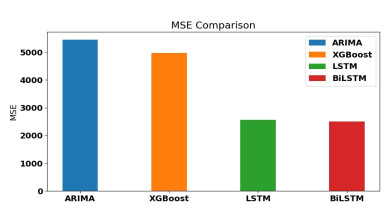
This paper investigated an innovative prediction approach using the bidirectional long short-term memory (BiLSTM) model for the forecasting of solar radiation in the smart farm in Naju, South Jeolla Province. Accurate solar radiation prediction holds substantial significance in facilitating efficient solar power generation, significantly impacting agricultural sustainability and resource utilization. This study rigorously assessed the effectiveness of various predictive models for forecasting solar radiation, a crucial factor in optimizing solar energy utilization in greenhouse settings. The variety of statistical and machine learning models aims to improve the accuracy of solar radiation prediction, which is crucial for precise energy management and cultivation practices. An hour-ahead mean absolute error (MAE) of 13.53 demonstrated the proposed BiLSTM model's impressive forecasting capabilities. The comparative analysis among individual models then revealed that the LSTM model achieves an MAE of 15.23, extreme gradient boosting (XGBoost) at 24.64, and autoregressive integrated moving average (ARIMA) at 28.52. This exploration underscored the important role of accurate solar radiation forecasting, specifically highlighting the effectiveness of the BiLSTM model in optimizing solar power generation within greenhouse environments. Its importance extended to the promotion of sustainable agricultural practices and the improvement of resource-efficient energy control strategies.
Citation: Divyadharshini Venkateswaran, Yongyun Cho, Jinyoung Kim, Myeongbae Lee, Wonjun Hwang, Sooho Jung. BiLSTM networks for solar radiation forecasting in greenhouse environments[J]. Mathematical Modelling and Control, 2026, 6(2): 205-215. doi: 10.3934/mmc.2026016
This paper investigated an innovative prediction approach using the bidirectional long short-term memory (BiLSTM) model for the forecasting of solar radiation in the smart farm in Naju, South Jeolla Province. Accurate solar radiation prediction holds substantial significance in facilitating efficient solar power generation, significantly impacting agricultural sustainability and resource utilization. This study rigorously assessed the effectiveness of various predictive models for forecasting solar radiation, a crucial factor in optimizing solar energy utilization in greenhouse settings. The variety of statistical and machine learning models aims to improve the accuracy of solar radiation prediction, which is crucial for precise energy management and cultivation practices. An hour-ahead mean absolute error (MAE) of 13.53 demonstrated the proposed BiLSTM model's impressive forecasting capabilities. The comparative analysis among individual models then revealed that the LSTM model achieves an MAE of 15.23, extreme gradient boosting (XGBoost) at 24.64, and autoregressive integrated moving average (ARIMA) at 28.52. This exploration underscored the important role of accurate solar radiation forecasting, specifically highlighting the effectiveness of the BiLSTM model in optimizing solar power generation within greenhouse environments. Its importance extended to the promotion of sustainable agricultural practices and the improvement of resource-efficient energy control strategies.

| [1] | R. G. Newell, D. Raimi, S. Villanueva, B. Prest, Global energy outlook 2020: energy transition or energy addition, Resources for the Future, 2020. Available from: https://media.rff.org/documents/GEO_2020_Report.pdf. |
| [2] | B. Espinar, J. L. Aznarte, R. Girard, A. M. Moussa, G. Kariniotakis, Photovoltaic forecasting: a state of the art, 5th European PV-hybrid and mini-grid conference, Tarragona, Spain, 2010. Available from: https://minesparis-psl.hal.science/hal-00771465. |
| [3] |
A. Ghosh, Nexus between agriculture and photovoltaics (agrivoltaics, agriphotovoltaics) for sustainable development goal: a review, Sol. Energy, 266 (2023), 112146. https://doi.org/10.1016/j.solener.2023.112146 doi: 10.1016/j.solener.2023.112146

|
| [4] |
K. Rabea, S. Michailos, G. T. Udeh, J. Park, Y. W. Lee, S. Kim, et al., A comprehensive technoeconomic and environmental evaluation of a hybrid renewable energy system for a smart farm in South Korea, Int. J. Energy Res., 2023 (2023), 1–18. https://doi.org/10.1155/2023/4951589 doi: 10.1155/2023/4951589
|
| [5] |
D. Venkateswaran, Y. Cho, Efficient solar power generation forecasting for greenhouses: a hybrid deep learning approach, Alex. Eng. J., 91 (2024), 222–236. https://doi.org/10.1016/j.aej.2024.02.004 doi: 10.1016/j.aej.2024.02.004
|
| [6] |
D. Venkateswaran, Y. Cho, C. Shin, Hybrid LSTM-Markovian model for greenhouse power consumption prediction: a dynamical approach, Eur. Phys. J.-Spec. Top., 234 (2025), 2673–2683. https://doi.org/10.1140/epjs/s11734-024-01244-w doi: 10.1140/epjs/s11734-024-01244-w
|
| [7] | G. E. P. Box, G. M. Jenkins, G. C. Reinsel, G. M. Ljung, Time series analysis: forecasting and control, John Wiley & Sons, 2015. Available from: https://books.google.co.kr/books?id = rNt5CgAAQBAJ. |
| [8] |
M. Khashei, M. Bijari, A novel hybridization of artificial neural networks and arima models for time series forecasting, Appl. Soft Comput., 11 (2011), 2664–2675. https://doi.org/10.1016/j.asoc.2010.10.015 doi: 10.1016/j.asoc.2010.10.015
|
| [9] | A. A. Adebiyi, A. O. Adewumi, C. K. Ayo, Stock price prediction using the arima model, UKSim-AMSS 16th International Conference on Computer Modelling and Simulation, IEEE, 2014,106–112. https://doi.org/10.1109/UKSim.2014.67 |
| [10] | A. M. Alonso, C. G. Martos, Time series analysis-forecasting with arima models, Universidad Carlos III de Madrid, Universidad Politecnica de Madrid, 2012. |
| [11] |
C. Krauss, X. A. Do, N. Huck, Deep neural networks, gradient-boosted trees, random forests: statistical arbitrage on the S&P 500, Eur. J. Oper. Res., 259 (2017), 689–702. https://doi.org/10.1016/j.ejor.2016.10.031 doi: 10.1016/j.ejor.2016.10.031
|
| [12] |
V. E. Sathishkumar, J. Park, Y. Cho, Using data mining techniques for bike sharing demand prediction in metropolitan city, Comput. Commun., 153 (2020), 353–366. https://doi.org/10.1016/j.comcom.2020.02.007 doi: 10.1016/j.comcom.2020.02.007
|
| [13] |
V. E. Sathishkumar, Y. Cho, Season wise bike sharing demand analysis using random forest algorithm, Comput. Intell., 40 (2024), e12287. https://doi.org/10.1111/coin.12287 doi: 10.1111/coin.12287
|
| [14] | V. E. Sathishkumar, S. Venkatesan, J. Park, C. Shin, Y. Kim, Y. Cho, Nutrient water supply prediction for fruit production in greenhouse environment using artificial neural networks, Basic Clin. Physiol. Pharmacol., 126 (2020), 257–258. |
| [15] | S. I. Lee, S. J. Yoo, A deep efficient frontier method for optimal investments, arXiv preprint, 2017. https://doi.org/10.48550/arXiv.1709.09822 |
| [16] |
J. Kim, N. Moon, Bilstm model based on multivariate time series data in multiple field for forecasting trading area, J. Ambient Intell. Human Comput., 2019. https://doi.org/10.1007/s12652-019-01398-9 doi: 10.1007/s12652-019-01398-9
|
| [17] | Z. Cui, R. Ke, Z. Pu, Y. Wang, Deep bidirectional and unidirectional lstm recurrent neural network for network-wide traffic speed prediction, arXiv Preprint, 2018. https://doi.org/10.48550/arXiv.1801.02143 |
| [18] |
S. S. Namini, N. Tavakoli, A. S. Namin, A comparison of arima and lstm in forecasting time series, 17th IEEE International Conference on Machine Learning and Applications (ICMLA), 2018, 1394–1401. https://doi.org/10.1109/ICMLA.2018.00227 doi: 10.1109/ICMLA.2018.00227
|
| [19] | N. Tavakoli, Modeling genome data using bidirectional lstm, IEEE 43rd Annual Computer Software and Applications Conference (COMPSAC), IEEE, 2019,183–188. https://doi.org/10.1109/COMPSAC.2019.10204 |
| [20] |
N. Tavakoli, D. Dai, Y. Chen, Client-side straggler-aware I/O scheduler for object-based parallel file systems, Parallel Comput., 82 (2019), 3–18. https://doi.org/10.1016/j.parco.2018.07.001 doi: 10.1016/j.parco.2018.07.001
|
| [21] | Y. Pang, X. Xue, A. S. Namin, Predicting vulnerable software components through n-gram analysis and statistical feature selection, 14th International Conference on Machine Learning and Applications (ICMLA), IEEE, 2015,543–548. https://doi.org/10.1109/ICMLA.2015.99 |
| [22] |
M. K. Anser, M. Mohsin, Q. Abbas, I. S. Chaudhry, Assessing the integration of solar power projects: SWOT-based AHP–F-TOPSIS case study of Turkey, Environ. Sci. Pollut. Res., 27 (2020), 31737–31749. https://doi.org/10.1007/s11356-020-09092-6 doi: 10.1007/s11356-020-09092-6
|
| [23] | D. C. Montgomery, C. L. Jennings, M. Kulahci, Introduction to time series analysis and forecasting, John Wiley & Sons, 2015. Available from: https://books.google.com/books?id = JCFiBwAAQBAJ. |
| [24] | R. J. Hyndman, G. Athanasopoulos, Forecasting: principles and practice, OTexts, 2018. Available from: https://otexts.com/fpp2. |
| [25] | T. Chen, C. Guestrin, Xgboost: A scalable tree boosting system. Proceedings of the 22nd ACM SIGKDD International Conference on Knowledge Discovery and Data Mining, ACM, 2016,785–794. https://doi.org/10.1145/2939672.2939785 |
| [26] |
H. Abbasimehr, R. Paki, A. Bahrini, A novel XGBoost-based featurization approach to forecast renewable energy consumption with deep learning models, Sustain. Comput.-Inf. Syst., 38 (2023), 100863. https://doi.org/10.1016/j.suscom.2023.100863 doi: 10.1016/j.suscom.2023.100863
|
| [27] | S. Yan, Understanding LSTM and its diagrams, ML Review, 2017. |
| [28] |
Z. Cui, R. Ke, Z. Pu, Y. Wang, Stacked bidirectional and unidirectional lstm recurrent neural network for forecasting network-wide traffic state with missing values. Transport Res. C-Emer., 118 (2020), 102674. https://doi.org/10.1016/j.trc.2020.102674 doi: 10.1016/j.trc.2020.102674
|
Figures(8) / Tables(2)
Divyadharshini Venkateswaran, Yongyun Cho, Jinyoung Kim, Myeongbae Lee, Wonjun Hwang, Sooho Jung. BiLSTM networks for solar radiation forecasting in greenhouse environments[J]. Mathematical Modelling and Control, 2026, 6(2): 205-215. doi: 10.3934/mmc.2026016




 DownLoad: