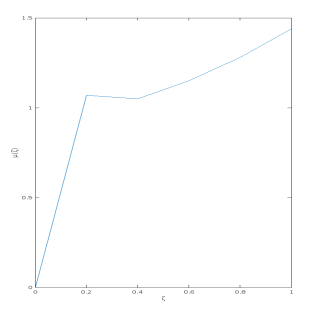
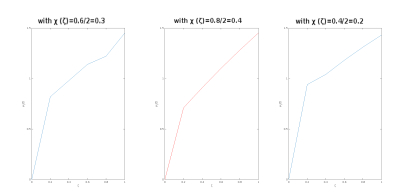
This study presented a novel approach to investigating the existence, uniqueness, and stability of solutions for an initial value problem involving fractional differential equations of variable order. In contrast to conventional methods in the literature, which often utilized generalized intervals and piecewise constant functions, we introduced a new fractional operator that is more appropriate for this problem. The existence and uniqueness of the solutions ware demonstrated through Leray-Schauder fixed point theorem and Banach's theorem, with an analysis of the uniform stability of the problem. The strength of our approach lies in its straightforwardness and reliance on fewer restrictive assumptions. The study concluded with an application that features a practical example, accompanied by visual illustrations.
Citation: Souad Guedim, Amar Benkerrouche, Mohammed Said Souid, Abdelkader Amara, Rashid Jan, Imtiaz Ahmad. Initial value problem for fractional differential equations of variable order[J]. Mathematical Modelling and Control, 2025, 5(4): 379-389. doi: 10.3934/mmc.2025026
This study presented a novel approach to investigating the existence, uniqueness, and stability of solutions for an initial value problem involving fractional differential equations of variable order. In contrast to conventional methods in the literature, which often utilized generalized intervals and piecewise constant functions, we introduced a new fractional operator that is more appropriate for this problem. The existence and uniqueness of the solutions ware demonstrated through Leray-Schauder fixed point theorem and Banach's theorem, with an analysis of the uniform stability of the problem. The strength of our approach lies in its straightforwardness and reliance on fewer restrictive assumptions. The study concluded with an application that features a practical example, accompanied by visual illustrations.

| [1] |
H. Mohammadi, S. Kumar, S. Rezapour, S. Etemad, A theoretical study of the Caputo-Fabrizio fractional modeling for hearing loss due to Mumps virus with optimal control, Chaos Soliton. Fract., 144 (2021), 110668. https://doi.org/10.1016/j.chaos.2021.110668 doi: 10.1016/j.chaos.2021.110668

|
| [2] |
S. Chávez-Vázquez, J. E. Vín-Delgado, J. F. Mez-Aguilar, J. R. Razo-Hernández, S. Etemad, S. Rezapour, Trajectory tracking of Stanford robot manipulator by fractional-order sliding mode control, Appl. Math. Model., 120 (2023), 436–462. https://doi.org/10.1016/j.apm.2023.04.001 doi: 10.1016/j.apm.2023.04.001
|
| [3] |
H. Khan, J. Alzabut, A. Shah, Z. Y. He, S. Etemad, S. Rezapour, et al., On fractal-fractional waterborne disease model: a study on theoretical and numerical aspects of solutions via simulations, Fractals, 31 (2023), 2340055. https://doi.org/10.1142/S0218348X23400558 doi: 10.1142/S0218348X23400558
|
| [4] |
K. Dehingia, K. A. A. Mohsen, S. A. Alharbi, R. D. Alsemiry, S. Rezapour, Dynamical behavior of a fractional order model for within-host SARS-CoV-2, Mathematics, 10 (2022), 2344. https://doi.org/10.3390/math10132344 doi: 10.3390/math10132344
|
| [5] |
S. Hussain, E. N. Madi, H. Khan, S. Etemad, S. Rezapour, T. Sitthiwirattham, et al., Investigation of the stochastic modeling of COVID-19 with environmental noise from the analytical and numerical point of view, Mathematics, 9 (2021), 3122. https://doi.org/10.3390/math9233122 doi: 10.3390/math9233122
|
| [6] |
S. M. Aydogan, D. Baleanu, H. Mohammadi, S. Rezapour, On the mathematical model of Rabies by using the fractional Caputo–Fabrizio derivative, Adv. Differ. Equ., 2020 (2020), 382. https://doi.org/10.1186/s13662-020-02798-4 doi: 10.1186/s13662-020-02798-4
|
| [7] |
M. Ahmad, A. Zada, M. Ghaderi, R. George, S. Rezapour, On the existence and stability of a neutral stochastic fractional differential system, Fractal Fract., 6 (2022), 203. https://doi.org/10.3390/fractalfract6040203 doi: 10.3390/fractalfract6040203
|
| [8] |
S. Hussain, E. N. Madi, H. Khan, H. Gulzar, S. Etemad, S. Rezapour, et al., On the stochastic modeling of COVID-19 under the environmental white noise, J. Funct. Space, 2022 (2022), 4320865. https://doi.org/10.1155/2022/4320865 doi: 10.1155/2022/4320865
|
| [9] |
N. Tuan, H. Mohammadi, S. Rezapour, A mathematical model for COVID-19 transmission by using the Caputo fractional derivative, Chaos Soliton. Fract., 140 (2020), 110107. https://doi.org/10.1016/j.chaos.2020.110107 doi: 10.1016/j.chaos.2020.110107
|
| [10] |
H. Khan, K. Alam, H. Gulzar, S. Etemad, S. Rezapour, A case study of fractal-fractional tuberculosis model in China: existence and stability theories along with numerical simulations, Math. Comput. Simul., 198 (2022), 455–473. https://doi.org/10.1016/j.matcom.2022.03.009 doi: 10.1016/j.matcom.2022.03.009
|
| [11] |
D. Baleanu, S. M. Aydogn, H. Mohammadi, S. Rezapour, On modelling of epidemic childhood diseases with the Caputo-Fabrizio derivative by using the Laplace adomian decomposition method, Alex. Eng. J., 59 (2020), 3029–3039. https://doi.org/10.1016/j.aej.2020.05.007 doi: 10.1016/j.aej.2020.05.007
|
| [12] |
D. Baleanu, A. Jajarmi, H. Mohammadi, S. Rezapour, A new study on the mathematical modelling of human liver with Caputo-Fabrizio fractional derivative, Chaos Soliton. Fract., 134 (2020), 109705. https://doi.org/10.1016/j.chaos.2020.109705 doi: 10.1016/j.chaos.2020.109705
|
| [13] |
D. Baleanu, S. Etemad, H. Mohammadi, S. Rezapour, A novel modeling of boundary value problems on the glucose graph, Commun. Nonlinear Sci. Numer. Simul., 100 (2021), 105844. https://doi.org/10.1016/j.cnsns.2021.105844 doi: 10.1016/j.cnsns.2021.105844
|
| [14] |
M. A. Hammad, L. Diabi, A. Dababneh, A. Zraiqat, S. Momani, A. Ouannas, et al., On new symmetric fractional discrete-time systems: chaos, complexity, and control, Symmetry, 16 (2024), 840. https://doi.org/10.3390/sym16070840 doi: 10.3390/sym16070840
|
| [15] |
X. Xu, J. Lu, J. Chen, Convergence analysis of iterative learning control for initialized fractional order systems, Fractal Fract., 8 (2024), 168. https://doi.org/10.3390/fractalfract8030168 doi: 10.3390/fractalfract8030168
|
| [16] | R. P. Agarwal, M. Benchohra, S. Hamani, S. Pinelas, Boundary value problems for differential equations involving Riemann-Liouville fractional derivative on the half-line, Dyn. Contin. Discrete Impulsive Syst. Ser. A, 18 (2011), 235–244. |
| [17] |
C. F. M. Coimbra, Mechanics with variable-order differential operators, Ann. Phys., 515 (2023), 692–703. https://doi.org/10.1002/andp.200351511-1203 doi: 10.1002/andp.200351511-1203
|
| [18] |
G. Diaz, C. F. M. Coimbra, Nonlinear dynamics and control of a variable order oscillator with application to the van der Pol equation, Nonlinear Dyn., 56 (2009), 145–157. https://doi.org/10.1007/s11071-008-9385-8 doi: 10.1007/s11071-008-9385-8
|
| [19] |
P. Zhuang, F. Liu, V. Anh, I. Turner, Numerical methods for the variable-order fractional adsection-diffusion equation with a nonlinear source term, SIAM J. Numer. Anal., 47 (2009), 1760–1781. https://doi.org/10.1137/080730597 doi: 10.1137/080730597
|
| [20] |
H. Sun, W. Chen, Y. Chen, Variable-order fractional differential operators in anomalous diffusion modeling, Phys. A, 388 (2009), 4586–4592. https://doi.org/10.1016/j.physa.2009.07.024 doi: 10.1016/j.physa.2009.07.024
|
| [21] |
D. Valério, J. S. Costa, Variable-order fractional derivatives and their numerical approximations, Signal Process., 91 (2011), 470–483. https://doi.org/10.1016/j.sigpro.2010.04.006 doi: 10.1016/j.sigpro.2010.04.006
|
| [22] |
C. Y. Gu, F. X. Zheng, B. Shiri, Mittag–Leffler stability analysis of tempered fractaional neural networks with short memory and variable-order, Fractals, 29 (2021), 2140029. https://doi.org/10.1142/S0218348X21400296 doi: 10.1142/S0218348X21400296
|
| [23] |
A. Benkerrouche, D. Baleanu, M. S. Souid, A. Hakem, M. Inc, Boundary value problem for nonlinear fractional differential equations of variable order via Kuratowski MNC technique, Adv. Differ. Equ., 2021 (2021), 1–19. https://doi.org/10.1186/s13662-021-03520-8 doi: 10.1186/s13662-021-03520-8
|
| [24] |
A. Benkerrouche, M. S. Souid, S. Chandok, A. Hakem, Existence and stability of a Caputo variable-order boundary value problem, J. Math., 2021 (2021), 1–16. https://doi.org/10.1155/2021/7967880 doi: 10.1155/2021/7967880
|
| [25] |
A. Benkerrouche, M. S. Souid, S. Etemad, A. Hakem, P. Agarwal, S. Rezapour, et al., Qualitative study on solutions of a Hadamard variable order boundary problem via the Ulam-Hyers-Rassias stability, Fractal Fract., 5 (2021), 1–20. https://doi.org/10.3390/fractalfract5030108 doi: 10.3390/fractalfract5030108
|
| [26] |
S. G. Samko, Fractional integration and differentiation of variable order, Anal. Math., 21 (1995), 213–236. https://doi.org/10.1007/bf01911126 doi: 10.1007/bf01911126
|
| [27] |
S. G. Samko, B. Boss, Integration and differentiation to a variable fractional order, Integr. Transf. Spec. Funct., 1 (1993), 277–300. https://doi.org/10.1080/10652469308819027 doi: 10.1080/10652469308819027
|
| [28] |
D. Valerio, J. S. Costa, Variable-order fractional derivatives and their numerical approximations, Signal Process., 91 (2011), 470–483. https://doi.org/10.1016/j.sigpro.2010.04.006 doi: 10.1016/j.sigpro.2010.04.006
|
| [29] |
S. Zhang, L. Hu, Unique existence result of approximate solution to initial value problem for fractional differential equation of variable order involving the derivative arguments on the half-axis, Mathematics, 7 (2019), 1–23. https://doi.org/10.3390/math7030286 doi: 10.3390/math7030286
|
| [30] |
S. Zhang, S. Li, L. Hu, The existenes and uniqueness result of solutions to initial value problems of nonlinear diffusion equations involving with the conformable variable, RACSAM, 113 (2019), 1601–1623. https://doi.org/10.1007/s13398-018-0572-2 doi: 10.1007/s13398-018-0572-2
|
| [31] | S. Kesavan, Functional analysis, Hindustan Book Agency, 1 Ed., New Delhi, India, 2009. |
| [32] | A. Granas, J. Dugundji, Fixed point theory, Springer-Verlag, New York, 2003. |
Figures(2)
Souad Guedim, Amar Benkerrouche, Mohammed Said Souid, Abdelkader Amara, Rashid Jan, Imtiaz Ahmad. Initial value problem for fractional differential equations of variable order[J]. Mathematical Modelling and Control, 2025, 5(4): 379-389. doi: 10.3934/mmc.2025026




 DownLoad: