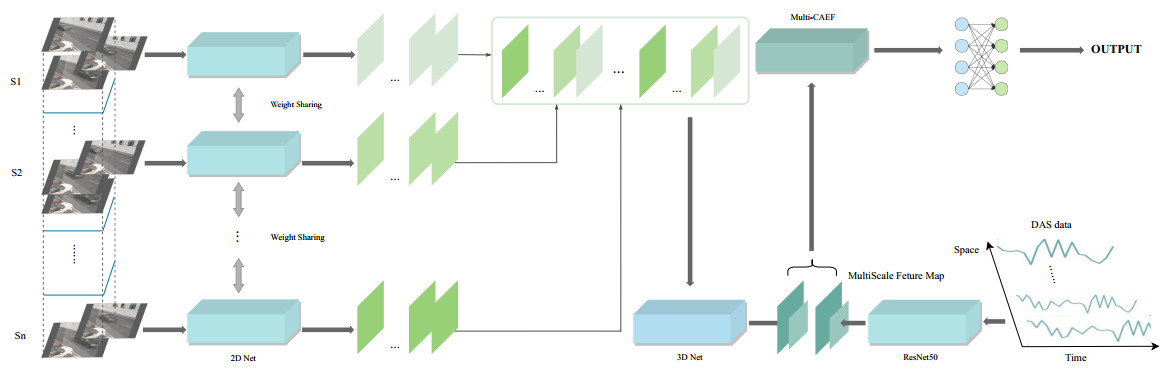
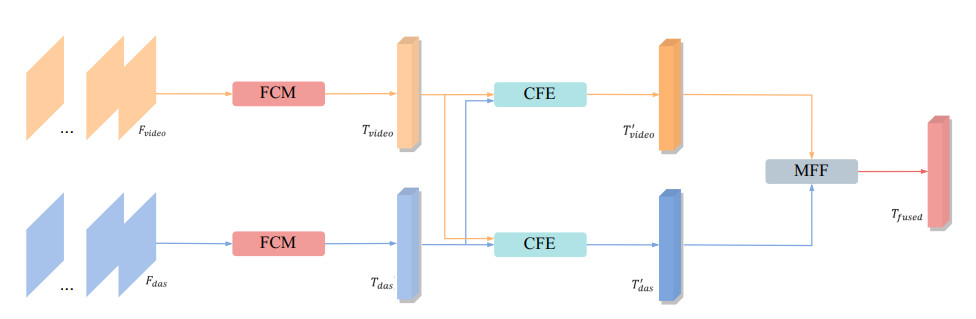
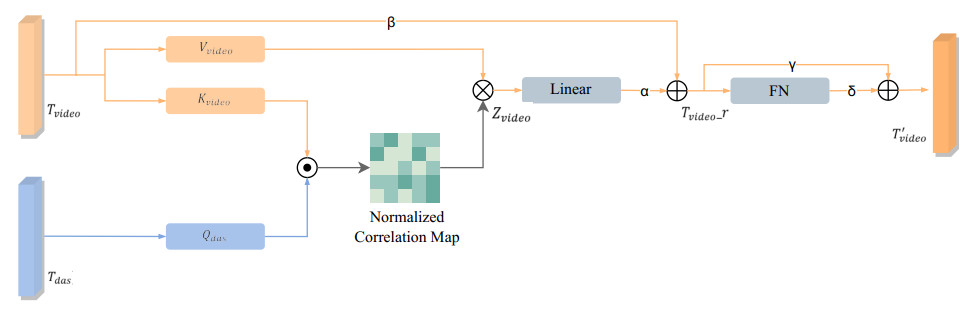
The realization of intelligent transportation is inseparable from the perception and processing of traffic information. In the field of intelligent transportation, video surveillance, infrared, magnetic induction sensors, other methods have been applied, to a certain extent to meet the needs. However, the above method has some limitations, such as complex installation, high cost, blind spot detection, weather influence. Therefore, this paper proposes a traffic information classification algorithm based on distributed optical fiber sensing, which uses the distributed perception ability of optical fiber to obtain traffic vibration data, combined with video data, and realizes high-precision classification of vibration signals through neural network. This method uses multi-modal fusion technology to extract key features of fiber distributed sensing data and video data respectively through ResNet and video understanding network, and then extracts multi-scale features corresponding to the two modes from different levels of the feature extraction network. Finally, multi-modal cross-attention feature enhancement fusion module is used to achieve multi-modal feature fusion. The information complementation between different modes is realized effectively, and the classification of traffic information is completed. In this study, we conducted tests on the traffic data set we collected, and the framework showed excellent performance in various types of identification, which can provide a reference for the construction of intelligent transportation.
Citation: Chun Shan, Dongping Liu, Yewen Huang, Xiaoyan Huang, Tongyi Zou, Jiayi Li, Shaoming Liu. Multi-modal fusion traffic information classification algorithm based on distributed optical fiber sensing[J]. Mathematical Modelling and Control, 2025, 5(4): 355-367. doi: 10.3934/mmc.2025024
The realization of intelligent transportation is inseparable from the perception and processing of traffic information. In the field of intelligent transportation, video surveillance, infrared, magnetic induction sensors, other methods have been applied, to a certain extent to meet the needs. However, the above method has some limitations, such as complex installation, high cost, blind spot detection, weather influence. Therefore, this paper proposes a traffic information classification algorithm based on distributed optical fiber sensing, which uses the distributed perception ability of optical fiber to obtain traffic vibration data, combined with video data, and realizes high-precision classification of vibration signals through neural network. This method uses multi-modal fusion technology to extract key features of fiber distributed sensing data and video data respectively through ResNet and video understanding network, and then extracts multi-scale features corresponding to the two modes from different levels of the feature extraction network. Finally, multi-modal cross-attention feature enhancement fusion module is used to achieve multi-modal feature fusion. The information complementation between different modes is realized effectively, and the classification of traffic information is completed. In this study, we conducted tests on the traffic data set we collected, and the framework showed excellent performance in various types of identification, which can provide a reference for the construction of intelligent transportation.

| [1] |
S. Taghvaeeyan, R. Rajamani, Portable roadside sensors for vehicle counting, classification, and speed measurement, IEEE Trans. Intell. Transp. Syst., 15 (2014), 73–83. http://doi.org/10.1109/TITS.2013.2273876 doi: 10.1109/TITS.2013.2273876

|
| [2] |
M. Li, Y. Liu, Z. Tian, C. Shan, Privacy protection method based on multidimensional feature fusion under 6G networks, IEEE Trans. Network Sci. Eng., 10 (2023), 1462–1471. http://doi.org/10.1109/tnse.2022.3186393 doi: 10.1109/tnse.2022.3186393
|
| [3] |
M. Li, C. Shan, Z. Tian, X. Du, M. Guizani, Adaptive information hiding method based on feature extraction for visible light communication, IEEE Commun. Mag., 61 (2023), 102–106. http://doi.org/10.1109/mcom.001.2200035 doi: 10.1109/mcom.001.2200035
|
| [4] |
S. Chun, X. Chen, G. Deng, H. Liu, A trusted NUMFabric algorithm for congestion price calculation at the internet-of-things datacenter, Comp. Model. Eng., 126 (2021), 1203–1216. http://doi.org/10.32604/cmes.2021.012230 doi: 10.32604/cmes.2021.012230
|
| [5] |
M. Li, C. Liu, C. Shan, H. Song, Z. Lv, A dual-embedded tamper detection framework based on block truncation coding for intelligent multimedia systems, Inform. Sciences, 649 (2023), 119362. http://doi.org/10.1016/j.ins.2023.119362 doi: 10.1016/j.ins.2023.119362
|
| [6] | R. I. Crickmore, D. J. Hill, Traffic sensing and monitoring apparatus, Patent application number: 20080277568, United States Patent, 2007. |
| [7] |
T. Parker, S. Shatalin, M. Farhadiroushan, Distributed Acoustic Sensing - a new tool for seismic applications, Eur. Assoc. Geosci. Eng., 32 (2014), 61–69. http://doi.org/10.3997/1365-2397.2013034 doi: 10.3997/1365-2397.2013034
|
| [8] | J. Mestayer, B. Cox, P. Wills, D. Kiyashchenko, J. Lopez, M. Costello, et al., Field trials of distributed acoustic sensing for geophysical monitoring, Soc. Explor. Geophys., 2011, 4253–4257. http://doi.org/10.1190/1.3628095 |
| [9] |
C. Shan, J. Cai, Y. Liu, J. Luo, Node importance to community based caching strategy forinformation centric networking, Concurr. Comp. Pract. E., 31 (2019), e4797. http://doi.org/10.1002/cpe.4797 doi: 10.1002/cpe.4797
|
| [10] | R. O. Duda, P. E. Hart, D. G. Stork, Pattern classification, Wiley Interscience, 2001. |
| [11] |
M. K. Barnoski, S. M. Jensen, Fiber waveguides: a novel technique for investigating attenuation characteristics, Appl. Optics, 15 (1976), 2112–2115. http://doi.org/10.1364/AO.15.002112 doi: 10.1364/AO.15.002112
|
| [12] |
M. Imahama, Y. Koyamada, Hogari, Restorability of Rayleigh backscatter traces measured by coherent OTDR with precisely frequency-controlled light source, IEICE Trans. Commun., E91.B (2008), 1243–1246. http://doi.org/10.1093/ietcom/e91-b.4.1243 doi: 10.1093/ietcom/e91-b.4.1243
|
| [13] | P. Healey, Fading in heterodyne OTDR, Electron. Lett., 20 (1984), 30–32. http://doi.org/10.1049/el: 19840022 |
| [14] |
P. Healey, Fading rates in coherent OTDR, Electron. Lett., 20 (1984), 443–444. http://doi.org/10.1049/el:19840308 doi: 10.1049/el:19840308
|
| [15] |
J. King, D. Smith, K. Richards, P. Timson, R. Epworth, S. Wright, Development of a coherent OTDR instrument, J. Lightwave Technol., 5 (1987), 616–624. http://doi.org/10.1109/JLT.1987.1075523 doi: 10.1109/JLT.1987.1075523
|
| [16] |
L. C. Blank, D. M. Spirit, OTDR performance enhancement through erbium fibre amplification, Electron. Lett., 25 (1989), 1693–1694. http://doi.org/10.1049/el:19891132 doi: 10.1049/el:19891132
|
| [17] |
Y. Koyamada, H. Nakamoto, High performance single mode OTDR using coherent detection and fibre amplifiers, Electron. Lett., 26 (1990), 573–575. http://doi.org/10.1049/el:19900375 doi: 10.1049/el:19900375
|
| [18] |
H. Izumita, Y. Koyamada, S. Furukawa, I. Sankawa, The performance limit of coherent OTDR enhanced with optical fiber amplifiers due to optical nonlinear phenomena, J. Lightwave Technol., 12 (1994), 1230–1238. http://doi.org/10.1109/50.301816 doi: 10.1109/50.301816
|
| [19] |
M. Sumida, OTDR performance enhancement using a quaternary FSK modulated probe and coherent detection, IEEE Photonics Technol. Lett., 7 (1995), 336–338. http://doi.org/10.1109/68.372764 doi: 10.1109/68.372764
|
| [20] |
C. Shan, X. Wu, Y. Liu, J. Cai, J. Luo, IBP based caching strategy in D2D, Appl. Sci., 9 (2019), 2416. http://doi.org/10.3390/app9122416 doi: 10.3390/app9122416
|
| [21] |
M. Sumida, Optical time domain reflectometry using an M-ary FSK probe and coherent detection, J. Lightwave Technol., 14 (1996), 2483–2491. http://doi.org/10.1109/50.548145 doi: 10.1109/50.548145
|
| [22] |
H. Iida, Y. Koshikiya, F. Ito, K. Tanaka, High-sensitivity coherent optical time domain reflectometry employing frequency-division multiplexing, J. Lightwave Technol., 30 (2012), 1121–1126. http://doi.org/10.1109/JLT.2011.2170960 doi: 10.1109/JLT.2011.2170960
|
| [23] |
K. Shimizu, T. Horiguchi, Y. Koyamada, Characteristics and reduction of coherent fading noise in Rayleigh backscattering measurement for optical fibers and components, J. Lightwave Technol., 10 (1992), 982–987. http://doi.org/10.1109/50.144923 doi: 10.1109/50.144923
|
| [24] |
H. Izumita, Y. Koyamada, S. Furukawa, I. Sankawa, Stochastic amplitude fluctuation in coherent OTDR and a new technique for its reduction by stimulating synchronous optical frequency hopping, J. Lightwave Technol., 15 (1997), 267–278. http://doi.org/10.1109/50.554377 doi: 10.1109/50.554377
|
| [25] |
L. Lu, Y. Song, X. Zhang, F. Zhu, Frequency division multiplexing OTDR with fast signal processing, Opt. Laser Technol., 44 (2012), 2206–2209. https://doi.org/10.1016/j.optlastec.2012.02.037 doi: 10.1016/j.optlastec.2012.02.037
|
| [26] |
X. Zhang, Y. Song, L. Lu, Time division multiplexing optical time domain reflectometry based on dual frequency probe, IEEE Photonics Technol. Lett., 24 (2012), 2005–2008. http://doi.org/10.1109/LPT.2012.2217737 doi: 10.1109/LPT.2012.2217737
|
| [27] |
M. Chen, Y. Song, X. Zhang, Transient effect to small duty-cycle pulse in cascaded erbium-doped fiber amplifier system, Opt. Eng., 52 (2013), 0325006. http://doi.org/10.1117/1.OE.52.2.025006 doi: 10.1117/1.OE.52.2.025006
|
| [28] |
X. Zhang, X. Chen, L. Liang, S. Zhao, R. He, S. Tong, et al., Enhanced C-OTDRbased online monitoring scheme for long-distance submarine cables, Acta Opt. Sin., 41 (2021), 1306001. http://doi.org/10.3788/AOS202141.1306001 doi: 10.3788/AOS202141.1306001
|
| [29] | H. F. Taylor, C. E. Lee, Apparatus and method for fiber optic intrusion sensing, Patent Number: US5194847, United States Patent, 1993. Available from: http://patents.google.com/patent/US5194847A. |
| [30] | Y. Rao, Z. Ran, K. Xie, A method for improving the performance of distributed sensing systems using subcarrier technology, Patent Number: CN101034035A, 2007. Available from: http://patents.google.com/patent/CN101034035A/zh. |
| [31] |
L. Huang, X. Fan, Z. He, Hybrid distributed fiber-optic sensing system by using Rayleigh backscattering lightwave as probe of stimulated Brillouin scattering, J. Lightwave Technol., 41 (2023), 4374–4380. http://doi.org/10.1109/JLT.2022.3213729 doi: 10.1109/JLT.2022.3213729
|
| [32] |
M. Atluri, M. Chowdhury, N. Kanhere, R. Fries, W. Sarasua, J. Ogle, Development of a sensor system for traffic data collection, J. Adv. Transport., 43 (2009), 1–20. http://doi.org/10.1002/atr.5670430102 doi: 10.1002/atr.5670430102
|
| [33] |
H. Liu, J. Ma, T. Xu, W. Yan, L. Ma, X. Zhang, Vehicle detection and classification using distributed fiber optic acoustic sensing, IEEE Trans. Veh. Technol., 69 (2020), 1363–1374. http://doi.org/10.1109/TVT.2019.2962334 doi: 10.1109/TVT.2019.2962334
|
| [34] |
C. Shan, J. Zhou, D. Guo, H. Wang, L. Liu, Q. Wang, et al., Hartley-Domain DD-FTN Algorithm for ACO-SCFDM in Optical-Wireless Communications, IEEE Photonics J., 11 (2019), 1–9. http://doi.org/10.1109/JPHOT.2019.2925007 doi: 10.1109/JPHOT.2019.2925007
|
| [35] | K. He, X. Zhang, S. Ren, J. Sun, Deep residual learning for image recognition, 2016 IEEE Conference on Computer Vision and Pattern Recognition (CVPR), 2016. http://doi.org/10.1109/CVPR.2016.90 |
| [36] | J. Deng, W. Dong, R. Socher, L. J. Li, K. Li, F. F. Li, ImageNet: a large-scale hierarchical image database, 2009 IEEE Conference on Computer Vision and Pattern Recognition, 2009,248–255. http://doi.org/10.1109/CVPR.2009.5206848 |
| [37] | M. Zolfaghari, K. Singh, T. Brox, ECO: efficient convolutional network for online video understanding, arXiv, 2018. http://doi.org/10.48550/arXiv.1804.09066 |
| [38] | A. Vaswani, N. Shazeer, N. Parmar, J. Uszkoreit, L. Jones, A. N. Gomez, et al., Attention is all you need, arXiv, 2017. http://doi.org/10.48550/arXiv.1706.03762 |
| [39] | D. M. W. Powers, Evaluation: from precision, recall and F-measure to ROC, informedness, markedness and correlation, Int. J. Mach. Learn. Technol., 2 (2011), 37–63. |
Figures(7) / Tables(4)
Chun Shan, Dongping Liu, Yewen Huang, Xiaoyan Huang, Tongyi Zou, Jiayi Li, Shaoming Liu. Multi-modal fusion traffic information classification algorithm based on distributed optical fiber sensing[J]. Mathematical Modelling and Control, 2025, 5(4): 355-367. doi: 10.3934/mmc.2025024




 DownLoad: