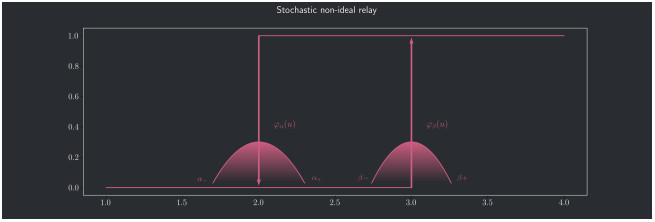
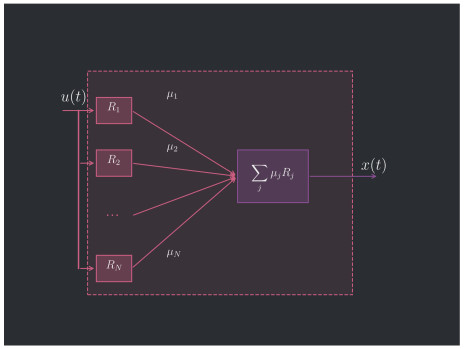
In this paper, we propose a method for identifying the measure of the stochastic Preisach operator using machine learning techniques. The classical Preisach operator model is widely used to describe hysteresis phenomena in various fields such as physics, chemistry, economics, and biology. However, it does not account for uncontrolled fluctuations in the parameters of elementary hysteresis carriers — hysterons, which limits its applicability in real systems where these parameters can be stochastic variables. The proposed method is based on sequential reconstruction of the operator's measure on the plane of hysteron threshold parameters $ (\alpha, \beta) $. The identification is carried out through specially constructed input signals that trigger switching of only specific hysterons in given local regions of this plane. Multiple repetitions of such input actions and application of the law of large numbers allow for estimating the mathematical expectations of hysteron state changes. These estimates are used in the algorithm to minimize a loss functional, leading to the reconstruction of the operator's measure from experimental data. The results open new possibilities for modeling and analyzing complex systems with hysteretic properties, taking into account the stochastic nature of parameters.
Citation: Aleksandr I. Proshunin, Sergei V. Borzunov, Nikolay I. Sel'vesyuk. Identification of the parameters of the stochastic Preisach operator[J]. Mathematics in Engineering, 2025, 7(5): 586-609. doi: 10.3934/mine.2025024
In this paper, we propose a method for identifying the measure of the stochastic Preisach operator using machine learning techniques. The classical Preisach operator model is widely used to describe hysteresis phenomena in various fields such as physics, chemistry, economics, and biology. However, it does not account for uncontrolled fluctuations in the parameters of elementary hysteresis carriers — hysterons, which limits its applicability in real systems where these parameters can be stochastic variables. The proposed method is based on sequential reconstruction of the operator's measure on the plane of hysteron threshold parameters $ (\alpha, \beta) $. The identification is carried out through specially constructed input signals that trigger switching of only specific hysterons in given local regions of this plane. Multiple repetitions of such input actions and application of the law of large numbers allow for estimating the mathematical expectations of hysteron state changes. These estimates are used in the algorithm to minimize a loss functional, leading to the reconstruction of the operator's measure from experimental data. The results open new possibilities for modeling and analyzing complex systems with hysteretic properties, taking into account the stochastic nature of parameters.

| [1] |
R. Abdolvand, H. M. Lavasani, G. K. Ho, F. Ayazi, Thin-film piezoelectric-on-silicon resonators for high-frequency reference oscillator applications, IEEE Transactions on Ultrasonics, Ferroelectrics, and Frequency Control, 55 (2008), 2596–2606. https://doi.org/10.1109/TUFFC.2008.976 doi: 10.1109/TUFFC.2008.976

|
| [2] |
F. Baronti, N. Femia, R. Saletti, C. Visone, W. Zamboni, Hysteresis modeling in Li-ion batteries, IEEE Trans Magn., 50 (2014), 1–4. https://doi.org/10.1109/TMAG.2014.2323426 doi: 10.1109/TMAG.2014.2323426
|
| [3] |
F. Baronti, N. Femia, R. Saletti, C. Visone, W. Zamboni, Preisach modelling of lithium-iron-phosphate battery hysteresis, J. Energy Storage., 4 (2015), 51–61. https://doi.org/10.1016/j.est.2015.09.004 doi: 10.1016/j.est.2015.09.004
|
| [4] |
I. Bodale, A. Stancu, Reversible and irreversible processes in drying and wetting of soil, Materials, 13 (2019), 135. https://doi.org/10.3390/ma13010135 doi: 10.3390/ma13010135
|
| [5] |
S. V. Borzunov, M. E. Semenov, N. I. Sel'vesyuk, P. A. Meleshenko, A. M. Solovyov, Stochastic model of a hysteresis converter with a domain structure, Math. Model. Comput. Simul., 14 (2022), 305–321. https://doi.org/10.1134/S207004822202003X doi: 10.1134/S207004822202003X
|
| [6] |
S. V. Borzunov, M. E. Semenov, N. I. Sel'vesyuk, P. A. Meleshenko, Hysteretic converters with stochastic parameters, Math. Model. Comput. Simul., 12 (2020), 164–175. https://doi.org/10.1134/S2070048220020040 doi: 10.1134/S2070048220020040
|
| [7] |
M. Belhaq, A. Bichri, J. Der Hogapian, J. Mahfoud, Effect of electromagnetic actuations on the dynamics of a harmonically excited cantilever beam, Int. J. Non-Linear Mech., 46 (2011), 828–833. https://doi.org/10.1016/j.ijnonlinmec.2011.03.001 doi: 10.1016/j.ijnonlinmec.2011.03.001
|
| [8] |
L. Chen, Q. Yi, T. Ben, Z. Zhang, Y. Wang, Parameter identification of Preisach model based on velocity-controlled particle swarm optimization method, AIP Adv., 11 (2021), 015022. https://doi.org/10.1063/9.0000030 doi: 10.1063/9.0000030
|
| [9] | G. Cipriani, M. Corpora, D. Curto, V. Di Dio, V. Franzitta, M. Trapanese, An electromagnetic generator for MAGLEV transportation systems, 2015 International Conference on Renewable Energy Research and Applications (ICRERA), 2015, 1523–1526. https://doi.org/10.1109/ICRERA.2015.7418662 |
| [10] |
P. Cacciola, A. Tombari, Steady state harmonic response of nonlinear soil-structure interaction problems through the Preisach formalism, Soil Dyn. Earthq. Eng., 144 (2021), 106669. https://doi.org/10.1016/j.soildyn.2021.106669 doi: 10.1016/j.soildyn.2021.106669
|
| [11] |
P. Cacciola, I. Caliò, N. Fiorini, G. Occhipinti, D. Spina, A. Tombari, Seismic response of nonlinear soil-structure interaction systems through the Preisach formalism: the Messina Bell Tower case study, Bull Earthquake Eng., 20 (2020), 3485–3514. https://doi.org/10.1007/s10518-021-01268-w doi: 10.1007/s10518-021-01268-w
|
| [12] |
P. Chojecki, G. Walters, Z. Forrester, T. Nishida, Preisach modeling of imprint on hafnium zirconium oxide ferroelectric capacitors, J. Appl. Phys., 130 (2021), 094102. https://doi.org/10.1063/5.0053185 doi: 10.1063/5.0053185
|
| [13] |
D. Davino, P. Krejčí, A. Pimenov, D. Rachinskii, C. Visone, Analysis of an operator-differential model for magnetostrictive energy harvesting, Commun. Nonlinear Sci. Numer. Simul., 39 (2016), 504–519. https://doi.org/10.1016/j.cnsns.2016.04.004 doi: 10.1016/j.cnsns.2016.04.004
|
| [14] |
J. Dho, C. W. Leung, M. G. Blamire, Universal time relaxation behavior of the exchange bias in ferromagnetic/antiferromagnetic bilayers, J. Appl. Phys., 99 (2006), 033910. https://doi.org/10.1063/1.2169876 doi: 10.1063/1.2169876
|
| [15] |
D. Damjanovic, M. Demartin, Contribution of the irreversible displacement of domain walls to the piezoelectric effect in barium titanate and lead zirconate titanate ceramics, J. Phys.: Condens. Matter., 9 (1997), 4943. https://doi.org/10.1088/0953-8984/9/23/018 doi: 10.1088/0953-8984/9/23/018
|
| [16] |
B. Ducharne, B. Gupta, G. Litak, Simulation of synchronized-switching method energy harvester including accurate piezoceramic nonlinear behavior, Energies, 12 (2019), 4466. https://doi.org/10.3390/en12234466 doi: 10.3390/en12234466
|
| [17] |
R. Egli, VARIFORC: an optimized protocol for calculating non-regular first-order reversal curve (FORC) diagrams, Global Planet. Change, 110 (2013), 302–320. https://doi.org/10.1016/j.gloplacha.2013.08.003 doi: 10.1016/j.gloplacha.2013.08.003
|
| [18] |
X. Fan, K. Guo, Y. Wang, Toward a high performance and strong resilience wind energy harvester assembly utilizing flow-induced vibration: role of hysteresis, Energy, 251 (2022), 123921. https://doi.org/10.1016/j.energy.2022.123921 doi: 10.1016/j.energy.2022.123921
|
| [19] |
D. Flynn, A. Zhezherun, A. Pokrovskii, J. P. O'Kane, Modeling discontinuous flow through porous media using ODEs with Preisach operator, Phys. B, 403 (2008), 440–442. https://doi.org/10.1016/j.physb.2007.08.070 doi: 10.1016/j.physb.2007.08.070
|
| [20] | J. Freudenreich, Étude de l'aimantation initiale en fonction de la température, Ph.D. Thesis, ETH Zurich, 1918. https://doi.org/10.3929/ethz-a-000092325 |
| [21] |
C. Gavioli, P. Krejčí, Control and controllability of PDEs with hysteresis, Appl. Math. Optim., 84 (2021), 829–847. https://doi.org/10.1007/s00245-020-09663-6 doi: 10.1007/s00245-020-09663-6
|
| [22] |
C. Gavioli, P. Krejčí, Phase transitions in porous media, Nonlinear Differ. Equ Appl., 29 (2022), 72. https://doi.org/10.1007/s00030-022-00805-z doi: 10.1007/s00030-022-00805-z
|
| [23] | C. Gavioli, P. Krejčí, Degenerate diffusion with Preisach hysteresis, arXiv, 2023. https://doi.org/10.48550/arXiv.2303.17451 |
| [24] | R. B. Gorbet, D. W. L. Wang, K. A. Morris, Preisach model identification of a two-wire SMA actuator, Proceedings. 1998 IEEE International Conference on Robotics and Automation, 1998, 2161-2167. https://doi.org/10.1109/ROBOT.1998.680641 |
| [25] |
V. Hassani, T. Tjahjowidodo, T. N. Do, A survey on hysteresis modeling, identification and control, Mech. Syst. Signal Process, 49 (2014), 209–233. https://doi.org/10.1016/j.ymssp.2014.04.012 doi: 10.1016/j.ymssp.2014.04.012
|
| [26] |
R. J. Harrison, J. M. Feinberg, FORCinel: an improved algorithm for calculating first-order reversal curve distributions using locally weighted regression smoothing, Geochem Geophys Geosyst., 9 (2008), 1–11. https://doi.org/10.1029/2008GC001987 doi: 10.1029/2008GC001987
|
| [27] |
Y. He, B. Bahr, M. Si, P. Ye, D. Weinstein, A tunable ferroelectric based unreleased RF resonator, Microsyst Nanoeng., 6 (2020), 8. https://doi.org/10.1038/s41378-019-0110-1 doi: 10.1038/s41378-019-0110-1
|
| [28] |
K. H. Hoffmann, J. Sprekels, A. Visintin, Identification of hysteresis loops, J. Comput. Phys., 78 (1988), 215–230. https://doi.org/10.1016/0021-9991(88)90045-9 doi: 10.1016/0021-9991(88)90045-9
|
| [29] | D. C. Hughes, J. T. Wen, Preisach modeling and compensation for smart material hysteresis, Act. Mater. Smart Struct., 1995, 50–64. https://doi.org/10.1117/12.200933 |
| [30] |
S. C. Hwang, C. S. Lynch, R. M. McMeeking, Ferroelectric/ferroelastic interactions and a polarization switching model, Acta Metall. Mater., 43 (1995), 2073–2784. https://doi.org/10.1016/0956-7151(94)00379-V doi: 10.1016/0956-7151(94)00379-V
|
| [31] | S. Humad, R. Abdolvand, G. K. Ho, G. Piazza, F. Ayazi, High frequency micromechanical piezo-on-silicon block resonators, IEEE International Electron Devices Meeting 2003, 2003. https://doi.org/10.1109/IEDM.2003.1269437 |
| [32] |
R. V. Iyer, X. Tan, P. S. Krishnaprasad, Approximate inversion of the Preisach hysteresis operator with application to control of smart actuators, IEEE Trans. Automat. Contr., 50 (2005), 798–810. https://doi.org/10.1109/TAC.2005.849205 doi: 10.1109/TAC.2005.849205
|
| [33] |
R. V. Iyer, M. E. Shirley, Hysteresis parameter identification with limited experimental data, IEEE Trans. Magn., 40 (2024), 3227–3239. https://doi.org/10.1109/TMAG.2004.833427 doi: 10.1109/TMAG.2004.833427
|
| [34] |
D. C. Jiles, D. L. Atherton, Theory of ferromagnetic hysteresis (invited), J. Appl. Phys., 55 (1984), 2115–2120. https://doi.org/10.1063/1.333582 doi: 10.1063/1.333582
|
| [35] |
T. Kalmár-Nagy, A. Amann, D. Kim, D. Rachinskii, The devil is in the details: spectrum and eigenvalue distribution of the discrete Preisach memory model, Commun. Nonlinear Sci. Numer. Simul., 77 (2019), 1–17. https://doi.org/10.1016/j.cnsns.2019.04.023 doi: 10.1016/j.cnsns.2019.04.023
|
| [36] |
V. Khikhlovskyi, A. V. Gorbunov, A. J. J. M. van Breemen, R. A. J. Janssen, G. H. Gelinck, M. Kemerink, Multi-bit organic ferroelectric memory, Org. Electron., 14 (2013), 3399–3405. https://doi.org/10.1016/j.orgel.2013.09.006 doi: 10.1016/j.orgel.2013.09.006
|
| [37] |
P. Krejčí, E. Rocca, J. Sprekels, Unsaturated deformable porous media flow with thermal phase transition, Math. Mod. Meth. Appl. Sci., 27 (2017), 2675–2710. https://doi.org/10.1142/S0218202517500555 doi: 10.1142/S0218202517500555
|
| [38] | P. Krejčí, Evolution variational inequalities and multidimensional hysteresis operators, In: Nonlinear differential equations, Boca Raton: Chapman and Hall/CRC, 2024. |
| [39] |
H. J. Khasawneh, Z. S. Abo-Hammour, M. I. Al Saaideh, S. M. Momani, Identification of hysteresis models using real-coded genetic algorithms, Eur. Phys. J. Plus., 134 (2019), 507. https://doi.org/10.1140/epjp/i2019-12883-7 doi: 10.1140/epjp/i2019-12883-7
|
| [40] |
C. E. Korman, I. D. Mayergoy, Review of Preisach type models driven by stochastic inputs as a model for after-effect, Phys. B, 233 (1997), 381–389. https://doi.org/10.1016/S0921-4526(97)00325-6 doi: 10.1016/S0921-4526(97)00325-6
|
| [41] | M. A. A. Krasnosel'skii, A. V. Pokrovskii, Systems with hysteresis, Berlin: Springer, 2012. |
| [42] |
J. Li, H. Huang, T. Morita, Stepping piezoelectric actuators with large working stroke for nano-positioning systems: a review, Sens. Actuators A: Phys., 292 (2019), 39–51. https://doi.org/10.1016/j.sna.2019.04.006 doi: 10.1016/j.sna.2019.04.006
|
| [43] |
G. Litak, J. Margielewicz, D. Gaska, A. Rysak, C. Trigona, On theoretical and numerical aspects of bifurcations and hysteresis effects in kinetic energy harvesters, Sensors, 22 (2022), 381. https://doi.org/10.3390/s22010381 doi: 10.3390/s22010381
|
| [44] |
I. D. Mayergoyz, "Dynamic Preisach models of hysteresis", IEEE Trans. Magn., 24 (1988), 2925–2927. https://doi.org/10.1109/20.92290 doi: 10.1109/20.92290
|
| [45] | I. D. Mayergoyz, Mathematical models of hysteresis and their applications, Academic Press, 2003. https://doi.org/10.1016/B978-0-12-480873-7.X5000-2 |
| [46] |
I. D. Mayergoyz, Mathematical models of hysteresis, IEEE Trans. Magn., 22 (1986), 603–608. https://doi.org/10.1109/TMAG.1986.1064347 doi: 10.1109/TMAG.1986.1064347
|
| [47] |
P. Muralt, Ferroelectric thin films for micro-sensors and actuators: a review, J. Micromech. Microeng., 10 (2000), 1366. https://doi.org/10.1088/0960-1317/10/2/307 doi: 10.1088/0960-1317/10/2/307
|
| [48] | Y. Nesterov, Lectures on convex optimization, Berlin: Springer, 2018. https://doi.org/10.1007/978-3-319-91578-4 |
| [49] |
A. Nemirovski, A. Juditsky, G. Lan, A. Shapiro, Robust stochastic approximation approach to stochastic programming, SIAM J. Optim., 19 (2009), 1574–1609. https://doi.org/10.1137/070704277 doi: 10.1137/070704277
|
| [50] |
S. O'Ceallaigh, A. Pimenov, A. Pokrovskii, D. Rachinskii, A. Zhezherun, Algorithm for linear stability analysis in systems with Preisach hysteresis, Phys. B, 403 (2008), 305–307. https://doi.org/10.1016/j.physb.2007.08.035 doi: 10.1016/j.physb.2007.08.035
|
| [51] |
J. Ortiz-Lopez, F. Luty, Optical studies of thermal cycling and hysteresis effects in elastic order-disorder phase transformations. I. Pure alkali-metal cyanide crystals, Phys. Rev. B, 37 (1988), 5452. https://doi.org/10.1103/physrevb.37.5452 doi: 10.1103/physrevb.37.5452
|
| [52] |
F. Preisach, Über die magnetische Nachwirkung, Z. Phys., 94 (1935), 277–302. https://doi.org/10.1007/BF01349418 doi: 10.1007/BF01349418
|
| [53] |
C. R. Pike, A. P. Roberts, K. L. Verosub, First order reversal curve diagrams and thermal relaxation effects in magnetic particles, Geophys. J. Int., 145 (2001), 721–730. https://doi.org/10.1046/j.0956-540x.2001.01419.x doi: 10.1046/j.0956-540x.2001.01419.x
|
| [54] | A. Poulovassilis, The effect of the entrapped air on the hysteresis curves of a porous body and on its hydraulic conductivity, Soil Sci., 109 (1970), 154–162. |
| [55] |
G. Quaranta, W. Lacarbonara, S. F. Masri, A review on computational intelligence for identification of nonlinear dynamical systems, Nonlinear Dyn., 99 (2020), 1709–1761. https://doi.org/10.1007/s11071-019-05430-7 doi: 10.1007/s11071-019-05430-7
|
| [56] |
M. Ruderman, On stability of linear dynamic systems with hysteresis feedback, Math. Model. Nat. Phenom., 15 (2020), 52. https://doi.org/10.1051/mmnp/2020014 doi: 10.1051/mmnp/2020014
|
| [57] |
S. Ruta, O. Hovorka, P. W. Huang, K. Wang, G. Ju, R. Chantrell, First order reversal curves and intrinsic parameter determination for magnetic materials; limitations of hysteron-based approaches in correlated systems, Sci. Rep., 7 (2017), 45218. https://doi.org/10.1038/srep45218 doi: 10.1038/srep45218
|
| [58] |
R. Roussel, A. Edelen, D. Ratner, K. Dubey, J. P. Gonzalez-Aguilera, Y. K. Kim, et al., Differentiable Preisach modeling for characterization and optimization of particle accelerator systems with hysteresis, Phys. Rev. Lett., 128 (2022), 204801. https://doi.org/10.1103/physrevlett.128.204801 doi: 10.1103/physrevlett.128.204801
|
| [59] |
L. A. Rios, D. Rachinskii, R. Cross, A model of hysteresis arising from social interaction within a firm, J. Phys.: Conf. Ser., 811 (2017), 012011. https://doi.org/10.1088/1742-6596/811/1/012011 doi: 10.1088/1742-6596/811/1/012011
|
| [60] |
J. B. Restorff, H. T. Savage, A. E. Clark, M. Wun-Fogle, Preisach modeling of hysteresis in Terfenol, J. Appl. Phys., 67 (1990), 5016–5018. https://doi.org/10.1063/1.344708 doi: 10.1063/1.344708
|
| [61] |
A. Stancu, C. Pike, L. Stoleriu, P. Postolache, Micromagnetic and Preisach analysis of the first order reversal curves (FORC) diagram, J. Appl. Phys., 93 (2003), 6620–6622. https://doi.org/10.1063/1.1557656 doi: 10.1063/1.1557656
|
| [62] | S. Shalev-Shwartz, O. Shamir, N. Srebro, K. Sridharan, Stochastic convex optimization, Proceedings of the 22nd Annual Conference on Learning Theory (COLT 2009), 2009. |
| [63] |
M. E. Semenov, S. V. Borzunov, P. A. Meleshenko, A. V. Lapin, A model of optimal production planning based on the hysteretic demand curve, Mathematics, 10 (2022), 3262. https://doi.org/10.3390/math10183262 doi: 10.3390/math10183262
|
| [64] |
M. E. Semenov, O. O. Reshetova, S. V. Borzunov, P. A. Meleshenko, Self-oscillations in a system with hysteresis: the small parameter approach, Eur. Phys. J. Spec. Top., 230 (2021), 3565–3571. https://doi.org/10.1140/epjs/s11734-021-00237-3 doi: 10.1140/epjs/s11734-021-00237-3
|
| [65] |
M. E. Semenov, S. V. Borzunov, P. A. Meleshenko, A new way to compute the Lyapunov characteristic exponents for non-smooth and discontinues dynamical systems, Nonlinear Dyn., 109 (2022), 1805–1821. https://doi.org/10.1007/s11071-022-07492-6 doi: 10.1007/s11071-022-07492-6
|
| [66] |
M. E. Semenov, S, V. Borzunov, P. A. Meleshenko, Stochastic Preisach operator: definition within the design approach, Nonlinear Dyn., 101 (2020), 2599–2614. https://doi.org/10.1007/s11071-020-05907-w doi: 10.1007/s11071-020-05907-w
|
| [67] |
M. E. Semenov, S. V. Borzunov, P. A. Meleshenko, N. I. Sel'vesyuk, The Preisach model of hysteresis: fundamentals and applications, Phys Scr., 99 (2024), 062008. https://doi.org/10.1088/1402-4896/ad4aa2 doi: 10.1088/1402-4896/ad4aa2
|
| [68] | M. Sjöström, D. Djukic, B. Dutoit, Parametrised Preisach modelling of hysteresis in high temperature superconductors, 1998. |
| [69] |
E. C. Stoner, E. P. Wohlfarth, A mechanism of magnetic hysteresis in heterogeneous alloys, Philos. Trans. R. Soc. Lond. Ser. A, Math. Phys. Sci., 240 (1948), 599–642. https://doi.org/10.1098/rsta.1948.0007 doi: 10.1098/rsta.1948.0007
|
| [70] |
M. Trapanese, Identification of the parameters of reduced vector Preisach model by neural networks, IEEE Trans. Magn., 44 (2008), 3197–3200. https://doi.org/10.1109/tmag.2008.2001657 doi: 10.1109/tmag.2008.2001657
|
| [71] |
I. Urbanavičiūtė, T. D. Cornelissen, X. Meng, R. P. Sijbesma, M. Kemerink, Physical reality of the Preisach model for organic ferroelectrics, Nat. Commun., 9 (2018), 4409. https://doi.org/10.1038/s41467-018-06717-w doi: 10.1038/s41467-018-06717-w
|
| [72] | P. Venegas, D. Gómez, M. Arrinda, M. Oyarbide, H. Macicior, A. Bermúdez, Kalman filter and classical Preisach hysteresis model applied to the state of charge battery estimation, Comput. Math. Appl., 118 (2022), 74–84. https://doi.org/10.1016/j.camwa.2022.05.009 |
| [73] |
Z. Yang, S. Zhou, J. Zu, High-performance piezoelectric energy harvesters and their applications, Joule, 2 (2018), 642–697. https://doi.org/10.1016/j.joule.2018.03.011 doi: 10.1016/j.joule.2018.03.011
|
| [74] |
L. Yang, B. Ding, W. Liao, Y. Li, Identification of Preisach model parameters based on an improved particle swarm optimization method for piezoelectric actuators in micro-manufacturing stages, Micromachines, 13 (2022), 698. https://doi.org/10.3390/mi13050698 doi: 10.3390/mi13050698
|
| [75] |
Y. Yu, N. Naganathan, R. Dukkipati, Preisach modeling of hysteresis for piezoceramic actuator system, Mech. Mach. Theory, 37 (2002), 49–59. https://doi.org/10.1016/S0094-114X(01)00065-9 doi: 10.1016/S0094-114X(01)00065-9
|
| [76] |
K. Zhang, T. Zhao, H. Fujiwara, Training effect of exchange biased iron-oxide/ferromagnet systems, J. Appl. Phys., 89 (2001), 6910–6912. https://doi.org/10.1063/1.1360682 doi: 10.1063/1.1360682
|
Figures(7)

Aleksandr I. Proshunin, Sergei V. Borzunov, Nikolay I. Sel'vesyuk. Identification of the parameters of the stochastic Preisach operator[J]. Mathematics in Engineering, 2025, 7(5): 586-609. doi: 10.3934/mine.2025024





 DownLoad: