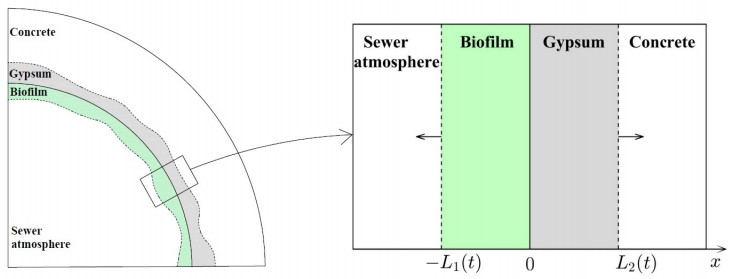
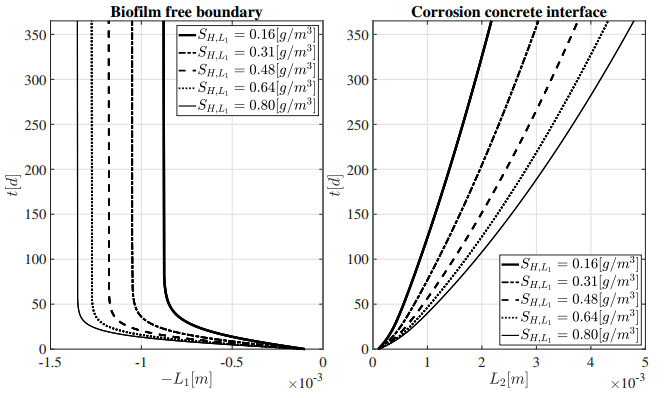
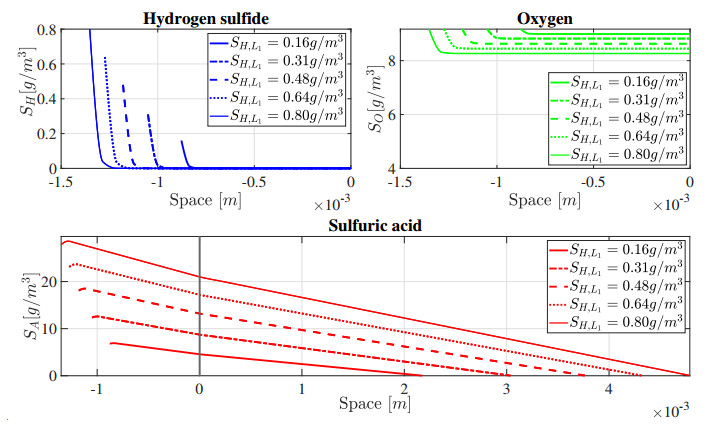
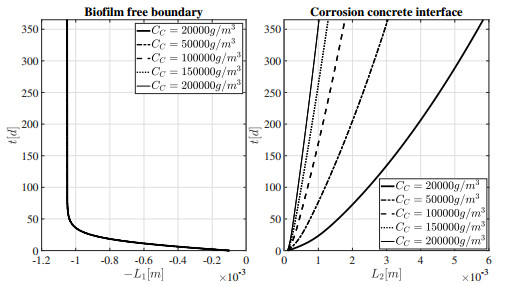
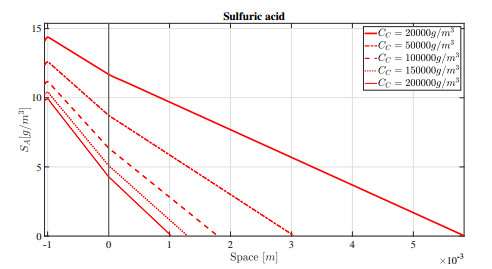
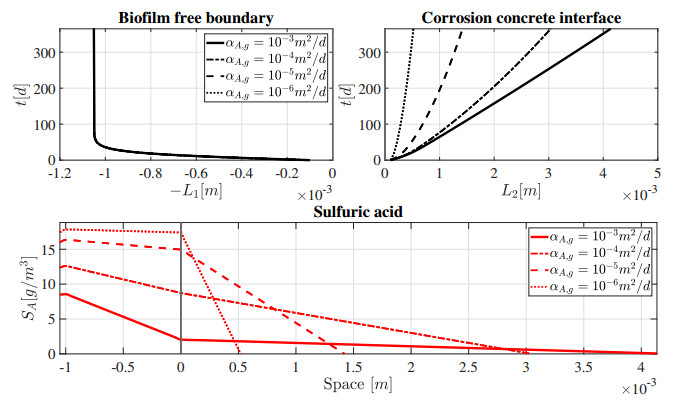
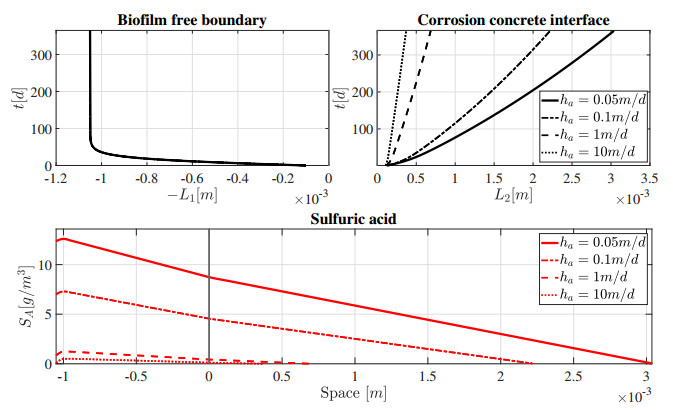
Microbially influenced corrosion (MIC) refers to any corrosion process caused or fostered by microbial activity, and represents a global concern, impacting infrastructure, economies, and the environment worldwide. MIC affects a wide range of materials and is particularly common in wastewater concrete pipes, where it is associated with the proliferation of biofilm colonies of sulfur-oxidizing bacteria (SOBs). SOBs oxidize hydrogen sulfide produced within wastewater effluents and generate corrosive sulfuric acid that triggers the degradation of concrete. We propose here a one-dimensional, two-layer diffusion model with double free boundaries to investigate the proliferation of SOB biofilms and the related corrosion process in wastewater concrete pipes. The domain is composed of two free boundary regions: a monospecies SOB biofilm in contact with the sewer atmosphere, which grows towards the interior cavity of the pipe, sitting on a gypsum layer formed from corrosion, that penetrates the concrete pipe. Diffusion-reaction equations govern the transport and metabolic production or consumption of hydrogen sulfide, oxygen, and sulfuric acid within the biofilm layer. The biofilm free boundary tracks the growth of the microbial community, regulated by metabolic activity of SOBs and detachment phenomena. The corrosion process is incorporated in the model through a Stefan-type condition, which drives the advancement of the gypsum free boundary into the concrete pipe, governed by microbial production of sulfuric acid. Numerical simulations are carried out to investigate the model behavior, encompassing the development and progression of the biofilm as well as the corrosion advancement, with the aim of elucidating the influence of key factors such as hydrogen sulfide level in the sewer, calcium carbonate concentration in concrete, detachment phenomena, and acid diffusivity in the gypsum layer. Interestingly, the model suggests that, under specific conditions, biofilms may impose limitations on sulfuric acid diffusion and act as a partial protective barrier for the underlying concrete.
Citation: Antonella Capuozzo, Alberto Tenore, Fabiana Russo, Luigi Frunzo. A double free boundary problem on microbially induced corrosion in wastewater concrete[J]. Mathematics in Engineering, 2025, 7(4): 481-504. doi: 10.3934/mine.2025020
Microbially influenced corrosion (MIC) refers to any corrosion process caused or fostered by microbial activity, and represents a global concern, impacting infrastructure, economies, and the environment worldwide. MIC affects a wide range of materials and is particularly common in wastewater concrete pipes, where it is associated with the proliferation of biofilm colonies of sulfur-oxidizing bacteria (SOBs). SOBs oxidize hydrogen sulfide produced within wastewater effluents and generate corrosive sulfuric acid that triggers the degradation of concrete. We propose here a one-dimensional, two-layer diffusion model with double free boundaries to investigate the proliferation of SOB biofilms and the related corrosion process in wastewater concrete pipes. The domain is composed of two free boundary regions: a monospecies SOB biofilm in contact with the sewer atmosphere, which grows towards the interior cavity of the pipe, sitting on a gypsum layer formed from corrosion, that penetrates the concrete pipe. Diffusion-reaction equations govern the transport and metabolic production or consumption of hydrogen sulfide, oxygen, and sulfuric acid within the biofilm layer. The biofilm free boundary tracks the growth of the microbial community, regulated by metabolic activity of SOBs and detachment phenomena. The corrosion process is incorporated in the model through a Stefan-type condition, which drives the advancement of the gypsum free boundary into the concrete pipe, governed by microbial production of sulfuric acid. Numerical simulations are carried out to investigate the model behavior, encompassing the development and progression of the biofilm as well as the corrosion advancement, with the aim of elucidating the influence of key factors such as hydrogen sulfide level in the sewer, calcium carbonate concentration in concrete, detachment phenomena, and acid diffusivity in the gypsum layer. Interestingly, the model suggests that, under specific conditions, biofilms may impose limitations on sulfuric acid diffusion and act as a partial protective barrier for the underlying concrete.

| [1] |
F. Abbas, R. Sudarsan, H. J. Eberl, Longtime behavior of one-dimensional biofilm models with shear dependent detachment rates, Math. Biosci. Eng., 9 (2012), 215–239. https://doi.org/10.3934/mbe.2012.9.215 doi: 10.3934/mbe.2012.9.215

|
| [2] |
D. Aregba-Driollet, F. Diele, R. Natalini, A mathematical model for the sulphur dioxide aggression to calcium carbonate stones: numerical approximation and asymptotic analysis, SIAM J. Appl. Math., 64 (2004), 1636–1667. https://doi.org/10.1137/S003613990342829X doi: 10.1137/S003613990342829X
|
| [3] |
A. Augustyniak, P. Sikora, B. Grygorcewicz, D. Despot, B. Braun, R. Rakoczy, et al., Biofilms in the gravity sewer interfaces: making a friend from a foe, Rev. Environ. Sci. Biotechnol., 20 (2021), 795–813. https://doi.org/10.1007/s11157-021-09582-0 doi: 10.1007/s11157-021-09582-0
|
| [4] |
A. Baldanza, V. Loianno, G. Mensitieri, G. Scherillo, Predictive approach for the solubility and permeability of binary gas mixtures in glassy polymers based on an NETGP-NRHB model, Ind. Eng. Chem. Res., 61 (2022), 3439–3456. https://doi.org/10.1021/acs.iecr.1c04864 doi: 10.1021/acs.iecr.1c04864
|
| [5] |
M. Berlanga, R. Guerrero, Living together in biofilms: the microbial cell factory and its biotechnological implications, Microb. Cell Fact., 15 (2016), 165. https://doi.org/10.1186/s12934-016-0569-5 doi: 10.1186/s12934-016-0569-5
|
| [6] |
M. Böhm, J. Devinny, F. Jahani, G. Rosen, On a moving-boundary system modeling corrosion in sewer pipes, Appl. Math. Comput., 92 (1998), 247–269. https://doi.org/10.1016/S0096-3003(97)10039-X doi: 10.1016/S0096-3003(97)10039-X
|
| [7] |
M. Böhm, J. Devinny, F. Jahani, F. B. Mansfeld, I. G. Rosen, C. Wang, A moving boundary diffusion model for the corrosion of concrete wastewater systems: simulation and experimental validation, Proceedings of the 1999 American Control Conference (Cat. No. 99CH36251), 3 (1999), 1739–1743. https://doi.org/10.1109/ACC.1999.786137 doi: 10.1109/ACC.1999.786137
|
| [8] |
G. Bretti, M. Ceseri, R. Natalini, A moving boundary problem for reaction and diffusion processes in concrete: carbonation advancement and carbonation shrinkage, Discret. Contin. Dyn. Syst.-S, 15 (2022), 2033–2052. https://doi.org/10.3934/dcdss.2022092 doi: 10.3934/dcdss.2022092
|
| [9] |
M. F. Carfora, I. Torcicollo, A fractional-in-time prey–predator model with hunting cooperation: qualitative analysis, stability and numerical approximations, Axioms, 10 (2021), 78. https://doi.org/10.3390/axioms10020078 doi: 10.3390/axioms10020078
|
| [10] |
F. Clarelli, A. Fasano, R. Natalini, Mathematics and monument conservation: free boundary models of marble sulfation, SIAM J. Appl. Math., 69 (2008), 149–168. https://doi.org/10.1137/070695125 doi: 10.1137/070695125
|
| [11] | H. Eberl, E. Morgenroth, D. Noguera, C. Picioreanu, B. Rittmann, M. van Loosdrecht, et al., Mathematical modeling of biofilms, Vol. 5, IWA Publishing, 2006. https://doi.org/10.2166/9781780402482 |
| [12] |
S. V. Fedosov, S. A. Loginova, Mathematical model of concrete biological corrosion, Mag. Civ. Eng., 99 (2020), 9906. https://doi.org/10.18720/MCE.99.6 doi: 10.18720/MCE.99.6
|
| [13] |
H. Flemming, T. R. Neu, D. J. Wozniak, The EPS matrix: the "house of biofilm cells", J. Bacteriol., 189 (2007), 7945–7947. https://doi.org/10.1128/jb.00858-07 doi: 10.1128/jb.00858-07
|
| [14] | H. C. Flemming, EPS–Then and now, Microorganisms, 4 (2016), 41. https://doi.org/10.3390/microorganisms4040041 |
| [15] |
L. Frunzo, V. Luongo, M. R. Mattei, A. Tenore, Qualitative analysis and simulations of the biological fouling problem on filtration membranes, Partial Differ. Equ. Appl. Math., 8 (2023), 100557. https://doi.org/10.1016/j.padiff.2023.100557 doi: 10.1016/j.padiff.2023.100557
|
| [16] |
R. M. Furzeland, A comparative study of numerical methods for moving boundary problems, IMA J. Appl. Math., 26 (1980), 411–429. https://doi.org/10.1093/imamat/26.4.411 doi: 10.1093/imamat/26.4.411
|
| [17] |
M. Hong, D. Niu, Q. Fu, Z. Hui, Z. Wan, Insights into bio-deterioration of concrete exposed to sewer environment: a case study, Constr. Build. Mater., 412 (2024), 134835. https://doi.org/10.1016/j.conbuildmat.2023.134835 doi: 10.1016/j.conbuildmat.2023.134835
|
| [18] |
H. S. Jensen, A. H. Nielsen, T. Hvitved-Jacobsen, J. Vollertsen, Modeling of hydrogen sulfide oxidation in concrete corrosion products from sewer pipes, Water Environ. Res., 81 (2009), 365–373. https://doi.org/10.2175/106143008X357110 doi: 10.2175/106143008X357110
|
| [19] |
H. S. Jensen, P. N. Lens, J. L. Nielsen, K. Bester, A. H. Nielsen, T. Hvitved-Jacobsen, et al., Growth kinetics of hydrogen sulfide oxidizing bacteria in corroded concrete from sewers, J. Hazard. Mater., 189 (2011), 685–691. https://doi.org/10.1016/j.jhazmat.2011.03.005 doi: 10.1016/j.jhazmat.2011.03.005
|
| [20] |
I. Klapper, J. Dockery, Mathematical description of microbial biofilms, SIAM Rev., 52 (2010), 221–265. https://doi.org/10.1137/080739720 doi: 10.1137/080739720
|
| [21] |
J. Knisz, R. Eckert, L. M. Gieg, A. Koerdt, J. S. Lee, E. R. Silva, et al., Microbiologically influenced corrosion–more than just microorganisms, FEMS Microbiol. Rev., 47 (2023), 1–33. https://doi.org/10.1093/femsre/fuad041 doi: 10.1093/femsre/fuad041
|
| [22] |
L. Kong, M. Han, X. Yang, Evaluation on relationship between accelerated carbonation and deterioration of concrete subjected to a high-concentrated sewage environment, Constr. Build. Mater., 237 (2020), 117650. https://doi.org/10.1016/j.conbuildmat.2019.117650 doi: 10.1016/j.conbuildmat.2019.117650
|
| [23] |
X. Li, L. O'Moore, Y. Song, P. L. Bond, Z. Yuan, S. Wilkie, et al., The rapid chemically induced corrosion of concrete sewers at high H$_2$S concentration, Water Res., 162 (2019), 95–104. https://doi.org/10.1016/j.watres.2019.06.062 doi: 10.1016/j.watres.2019.06.062
|
| [24] |
W. Li, T. Zheng, Y. Ma, J. Liu, Current status and future prospects of sewer biofilms: their structure, influencing factors, and substance transformations, Sci. Total Environ., 695 (2019), 133815. https://doi.org/10.1016/j.scitotenv.2019.133815 doi: 10.1016/j.scitotenv.2019.133815
|
| [25] |
X. Liu, D. Niu, X. Li, Y. Lv, Effects of Ca(OH)$_2$–CaCO$_3$ concentration distribution on the pH and pore structure in natural carbonated cover concrete: a case study, Constr. Build. Mater., 186 (2018), 1276–1285. https://doi.org/10.1016/j.conbuildmat.2018.08.041 doi: 10.1016/j.conbuildmat.2018.08.041
|
| [26] |
V. Loianno, G. Mensitieri, A novel dynamic method for the storage of calibration gas mixtures based on thermal mass flow controllers, Meas. Sci. Technol., 33 (2022), 065017. https://doi.org/10.1088/1361-6501/ac5a2f doi: 10.1088/1361-6501/ac5a2f
|
| [27] |
R. A. Luimes, F. A. M. Rooyackers, A. S. J. Suiker, F. H. L. R. Clemens, E. Bosco, A novel approach for the lifetime prediction and structural health monitoring of concrete sewer systems exposed to biogenic sulphide corrosion, Cement Concrete Res., 181 (2024), 107517. https://doi.org/10.1016/j.cemconres.2024.107517 doi: 10.1016/j.cemconres.2024.107517
|
| [28] |
M. Mora, L. R. López, J. Lafuente, J. Pérez, R. Kleerebezem, M. C. M. van Loosdrecht, et al., Respirometric characterization of aerobic sulfide, thiosulfate and elemental sulfur oxidation by S-oxidizing biomass, Water Res., 89 (2016), 282–292. https://doi.org/10.1016/j.watres.2015.11.061 doi: 10.1016/j.watres.2015.11.061
|
| [29] |
T. Mori, M. Koga, Y. Hikosaka, T. Nonaka, F. Mishina, Y. Sakai, et al., Microbial corrosion of concrete sewer pipes, H$_2$S production from sediments and determination of corrosion rate, Water Sci. Technol., 23 (1991), 1275–1282. https://doi.org/10.2166/wst.1991.0579 doi: 10.2166/wst.1991.0579
|
| [30] |
T. Mori, T. Nonaka, K. Tazaki, M. Koga, Y. Hikosaka, S. Noda, Interactions of nutrients, moisture and pH on microbial corrosion of concrete sewer pipes, Water Res., 26 (1992), 29–37. https://doi.org/10.1016/0043-1354(92)90107-F doi: 10.1016/0043-1354(92)90107-F
|
| [31] |
C. V. Nikolopoulos, Macroscopic models for a mushy region in concrete corrosion, J. Eng. Math., 91 (2015), 143–163. https://doi.org/10.1007/s10665-014-9743-0 doi: 10.1007/s10665-014-9743-0
|
| [32] |
S. Okabe, M. Odagiri, T. Ito, H. Satoh, Succession of sulfur-oxidizing bacteria in the microbial community on corroding concrete in sewer systems, Appl. Environ. Microbiol., 73 (2007), 971–980. https://doi.org/10.1128/AEM.02054-06 doi: 10.1128/AEM.02054-06
|
| [33] | W. Olmstead, H. Hamlin, Converting portions of the Los Angeles outfall sewer into a septic tank, Eng. News, 44 (1900), 317–318. |
| [34] |
C. D. Parker, The corrosion of concrete, 1. The isolation of a species of bacterium associated with the corrosion of concrete exposed to atmospheres containing hydrogen sulphide, Aust. J. Exp. Biol. Med. Sci., 23 (1945), 81–90. https://doi.org/10.1038/icb.1945.13 doi: 10.1038/icb.1945.13
|
| [35] | C. Picioreanu, M. C. Van Loosdrecht, J. J. Heijnen, Two-dimensional model of biofilm detachment caused by internal stress from liquid flow, Biotech. Bioeng., 72 (2001), 205–218. |
| [36] |
L. Pokorna-Krayzelova, D. Vejmelková, L. Selan, P. Jenicek, E. I. Volcke, J. Bartacek, Final products and kinetics of biochemical and chemical sulfide oxidation under microaerobic conditions, Water Sci. Technol., 78 (2018), 1916–1924. https://doi.org/10.2166/wst.2018.485 doi: 10.2166/wst.2018.485
|
| [37] |
S. K. Pramanik, M. Bhuiyan, D. Robert, R. Roychand, L. Gao, I. Cole, et al., Bio-corrosion in concrete sewer systems: mechanisms and mitigation strategies, Sci. Total Environ., 921 (2024), 171231. https://doi.org/10.1016/j.scitotenv.2024.171231 doi: 10.1016/j.scitotenv.2024.171231
|
| [38] |
D. J. Roberts, D. Nica, G. Zuo, J. L. Davis, Quantifying microbially induced deterioration of concrete: initial studie, Int. Biodeter. Biodegr., 49 (2002), 227–234. https://doi.org/10.1016/S0964-8305(02)00049-5 doi: 10.1016/S0964-8305(02)00049-5
|
| [39] |
F. A. M. Rooyackers, E. Bosco, A. S. J. Suiker, F. H. L. R. Clemens, A chemo-mechanical model for biogenic sulphide corrosion of concrete, Cement Concrete Res., 160 (2022), 106809. https://doi.org/10.1016/j.cemconres.2022.106809 doi: 10.1016/j.cemconres.2022.106809
|
| [40] |
F. Russo, M. R. Mattei, A. Tenore, B. D'Acunto, V. Luongo, L. Frunzo, Analysis and simulations of a free boundary problem modelling phototrophic granular biofilms, Discret. Contin. Dyn. Syst.-B, 29 (2024), 4946–4972. https://doi.org/10.3934/dcdsb.2024073 doi: 10.3934/dcdsb.2024073
|
| [41] |
A. Safari, Z. Tukovic, M. Walter, E. Casey, A. Ivankovic, Mechanical properties of a mature biofilm from a wastewater system: from microscale to macroscale level, Biofouling, 31 (2015), 651–664. https://doi.org/10.1080/08927014.2015.1075981 doi: 10.1080/08927014.2015.1075981
|
| [42] |
E. Samson, J. Marchand, K. A. Snyder, Calculation of ionic diffusion coefficients on the basis of migration test results, Mat. Struct., 36 (2003), 156–165. https://doi.org/10.1007/BF02479554 doi: 10.1007/BF02479554
|
| [43] | A. K. Singh, Microbially induced corrosion and its mitigation, Springer, 2020. https://doi.org/10.1007/978-981-15-8019-2 |
| [44] |
Y. Song, Y. Tian, X. Li, J. Wei, H. Zhang, P. L. Bond, et al., Distinct microbially induced concrete corrosion at the tidal region of reinforced concrete sewers, Water Res., 150 (2019), 392–402. https://doi.org/10.1016/j.watres.2018.11.083 doi: 10.1016/j.watres.2018.11.083
|
| [45] |
P. S. Stewart, A model of biofilm detachment, Biotech. Bioeng., 41 (1993), 111–117. https://doi.org/10.1002/bit.260410115 doi: 10.1002/bit.260410115
|
| [46] | P. S. Stewart, Diffusion in biofilms, J. Bacteriol., 185 (2003), 1485–1491. https://doi.org/10.1128/jb.185.5.1485-1491.2003 |
| [47] |
A. Tenore, F. Russo, J. Jacob, J. D. Grattepanche, B. Buttaro, I. Klapper, A mathematical model of diel activity and long time survival in phototrophic mixed-species subaerial biofilms, Bull. Math. Biol., 86 (2024), 123. https://doi.org/10.1007/s11538-024-01348-3 doi: 10.1007/s11538-024-01348-3
|
| [48] |
J. Vincent, A. Tenore, M. R. Mattei, L. Frunzo, Modelling drinking water biofilms: bacterial adhesion and Legionella pneumophila necrotrophic growth, Commun. Nonlinear Sci. Numer. Simul., 128 (2024), 107639. https://doi.org/10.1016/j.cnsns.2023.107639 doi: 10.1016/j.cnsns.2023.107639
|
| [49] |
J. Vollertsen, A. H. Nielsen, H. S. Jensen, T. Wium-Andersen, T. Hvitved-Jacobsen, Corrosion of concrete sewers–The kinetics of hydrogen sulfide oxidation, Sci. Total Environ., 394 (2008), 162–170. https://doi.org/10.1016/j.scitotenv.2008.01.028 doi: 10.1016/j.scitotenv.2008.01.028
|
| [50] |
S. Wang, H. Zhu, G. Zheng, F. Dong, C. Liu, Dynamic changes in biofilm structures under dynamic flow conditions, Appl. Environ. Microbiol., 88 (2022), e01072-22. https://doi.org/10.1128/aem.01072-22 doi: 10.1128/aem.01072-22
|
| [51] | O. Wanner, W. Gujer, A multispecies biofilm model, Biotech. Bioeng., 28 (1986), 314–328. https://doi.org/10.1002/bit.260280304 |
| [52] |
S. Wei, Z. Jiang, H. Liu, D. Zhou, M. Sanchez-Silva, Microbiologically induced deterioration of concrete: a review, Braz. J. Microbiol., 44 (2013), 1001–1007. https://doi.org/10.1590/S1517-83822014005000006 doi: 10.1590/S1517-83822014005000006
|
| [53] |
M. Wu, T. Wang, K. Wu, L. Kan, Microbiologically induced corrosion of concrete in sewer structures: a review of the mechanisms and phenomena, Constr. Build. Mater., 239 (2020), 117813. https://doi.org/10.1016/j.conbuildmat.2019.117813 doi: 10.1016/j.conbuildmat.2019.117813
|
| [54] | H. Yuan, P. Dangla, H. Chen, P. Chatellier, T. Chaussadent, Modelling of H2S attack of concrete in sewer pipes, The Fourth RILEM International Symposium on Concrete Modelling (CONMOD 2014), 2014,425–431. |
| [55] |
H. Yuan, P. Dangla, H. Chen, P. Chatellier, T. Chaussadent, Degradation modeling of concrete submitted to biogenic acid attack, Cement Concrete Res., 70 (2015), 29–38. https://doi.org/10.1016/j.cemconres.2015.01.002 doi: 10.1016/j.cemconres.2015.01.002
|
| [56] |
L. Zhang, P. De Schryver, B. De Gusseme, W. De Muynck, N. Boon, W. Verstraete, Chemical and biological technologies for hydrogen sulfide emission control in sewer systems: a review, Water Res., 42 (2008), 1–12. https://doi.org/10.1016/j.watres.2007.07.013 doi: 10.1016/j.watres.2007.07.013
|
Figures(14) / Tables(1)

Antonella Capuozzo, Alberto Tenore, Fabiana Russo, Luigi Frunzo. A double free boundary problem on microbially induced corrosion in wastewater concrete[J]. Mathematics in Engineering, 2025, 7(4): 481-504. doi: 10.3934/mine.2025020





 DownLoad: